Logos representative only and should not be seen as an endorsement / preference / recommendation
Updates from the week through to Sunday, April 28th, 2024
This summary is generally published every Monday, and is a list of SL viewer / client releases (official and TPV) made during the previous week. When reading it, please note:
It is based on my Current Viewer Releases Page, a list of all Second Life viewers and clients that are in popular use (and of which I am aware), and which are recognised as adhering to the TPV Policy. This page includes comprehensive links to download pages, blog notes, release notes, etc., as well as links to any / all reviews of specific viewers / clients made within this blog.
By its nature, this summary presented here will always be in arrears, please refer to the Current Viewer Release Page for more up-to-date information.
Note that for purposes of length, TPV test viewers, preview / beta viewers / nightly builds are generally not recorded in these summaries.
Official LL Viewers
Release viewer: 7.1.6.8745209917, formerly the Maintenance Y/Z RC ( My Outfits folder improvements; ability to remove entries from landmark history), dated April 19 and promoted April 23 – NEW
Venus by the Water, April 2024 – click any image for full size
Update, July 2025: Venus by the Water has closed.
Elizabeth (ElizabethNantes) and Cecilia Nansen are two women in Second Life noted for their creativity. Elizabeth is a creator who has produced multiple popular region designs over the years, several of which I’ve previously featured in these pages since around 2016 – the last time being her excellent Hear How Your Landscape Should Sound, produced in collaboration with Electric Monday (see here for more).
Celia Nansen is one of Second Life’s premier photographers noted for producing evocative and narratively rich avatar studies, someone whom I’ve again often featured in these pages since the unveiling of her very first exhibition in-world back in 2017 (see here for more).
Venus by the Water, April 2024
In March, Elizabeth and Cecilia opened a collaboration of their own to Second Life users, one that brings together region design, art and music in a beautifully considered and executed Homestead region they have called Venus by the Water. Fittingly, given the region is the product of two in-world creative talents, Venus by the Water is also offered as a tribute to two exceptional talents from the physical world: Bjork and Polly Jean Harvey (more professionally known as PJ Harvey).
This is an idyllic setting, presented as a low, temperate island which the surrounding waters are in the process of breaking up. Already they have eroded the narrow neck of sand that once linked the two halves into a whole so that a broad wooden deck is now required to maintain the connection between the two segments of land. This deck is set as the region’s landing point, and is home to a tip jar and local Group joiner. From it, visitors can take their pick as to which half of the setting they choose to explore first.
Venus by the Water, April 2024
The larger area of land, forming a W-shape which extends from a narrow tail pointing eastwards along the southern side of the region, through to a rocky headland lying to the north-west, is largely sandy in nature, although the west side is home to lush grass and a small woodland area where horses might be found grazing. A stream cuts right through this land, separating the north-eastern most part of it off from the rest, shingle beaches to the north and west bracketing its grassland, the stream doing the same to the south and east.
Tucked into the south-western corner of this landscape, between the woodlands to the north and the sands to the east, sits the Gallery Bjork. At the time of my visit, the 2D work on display came from artists responding to a call from Cecelia and Elizabeth for submission of art on the theme of Venus on the Water (hence the décor within the Gallery space with a tide gently lapping over coastal reeds and grass).
Venus by the Water, April 2024
Outside, on the rear terrace might be found a sculpture by Mistero Hifeng keeps a quiet eye on things, whilst the front room of the gallery presents an image of PJ Harvey and Bjork from an interview published in (I think) 1993 or 1994, and which also featured American artist Tori Amos. Rendered in monochrome, the photo faces two reflections of its form, each featuring Elizabeth and Cecilia.
The smaller land mass for the setting sits to the north-east, cupped between the arms of the W. It presents a rugged by lushly flowered grassland bordered by trees, an earthen path cutting through it from the landing point to where the Café Polly sits atop an extensive deck reaching out over the waters. Broadly split into two indoor seating areas bracing the central service area, the café additionally offers outdoor seating under parasols for those who prefer, either on the deck itself, or on a smaller deck a very short walk from the café’s door, overlooking the bay that cuts deeply into the land.
Venus by the Water, April 2024
This is a peaceful location, although the aged and bent tree that seems to be trying to stretch its branches toward the café and touch it, together with the corpse of another tree angling itself sharply over the path leading to (or from, depending on your point of view) the café, suggests the island has seen its share of strong winds and harsh weather. Even so, there is nothing now to interrupt the gentle rocking on the rowing boats tied-up at the pier just below the café’s deck.
These rowing boats, rocking gently in the swell as it approaches the shore, are just one of the details that further bring this setting to life. There are many more to be found throughout which both give depth to the region and often offer encouragement for people to stay and enjoy their time here.
Venus by the Water, April 2024
For example, There’s a little camp site out on the sand of the south-east headland and watched over (in a manner of speaking) by the sheep grazing on the stunted grass close by. Then, almost mid-way between the landing point and the Café Polly, the path offers a short branch leading to a raised deck. This is home to a pair of loungers looking out over this bay cutting so deeply into the land. In doing so, they draw attention to another rowing boat, this one anchored out in the sheltered waters to offer another place to sit and past the time, either alone or with someone close to you. Still more such tranquil places await discovery – but I’ll let you find them on your visit 🙂 .
Venus by the Water is finished in an EEP setting which compliments it perfectly, and thus really is best seen under it. The region also fears a very subtle and fitting sound scape, so I recommend having local sounds active when visiting as well. The audio stream for the region has also been carefully curated, and features at times an interesting mash-up or two between Bjork and PJ Harvey, and well as some of their own recordings.
Venus by the Water, April 2024
All told, a perfectly presented and relaxing setting – as one would expect from two creative talents like Cecilia and Elizabeth.
June 29th, 2019: Rocket Lab’s Electron Rocket rises from Launch Complex 1 on the Mahia Peninsula of New Zealand North Island at the start of the mission Make It Rain. Credit: Rocket Lab
Rocket Lab, the New Zealand / US commercial launch provider, is gradually increasing the annual launch cadence of its Electron rocket, as the company continues to garner a solid reputation as a provider of a reliable launch platform whilst also building-out other aspects of its business.
Founded in 2006 in New Zealand by entrepreneur Peter Beck, Rocket Lab initially developed the Ātea (Māori for “space”) sub-orbital sounding rocket, which made its first (and only) flight in 2009 with the Manu Karere or “Bird Messenger” mission. Although a sub-orbital class of rocket, the Ātea -1 nevertheless pushed its upper stage and payload beyond the von Kármán line, the arbitrary “boundary” between the Earth’s atmosphere and space sitting at 100 km altitude (although the Earth’s atmosphere actually extends – albeit tenuously – far further than this), technically making Rocket Lab the first private company in the Southern Hemisphere to reach space.
The company started developing Electron Rocket after being awarded a 2010 US Government contract to study the use of a small-scale launch vehicle specifically geared towards servicing the developing cubesat market – a contract which in part lead to the company relocating to the United States in 2012-13 and taking up residence in California, with its New Zealand operations becoming a wholly owned subsidiary of the US business.
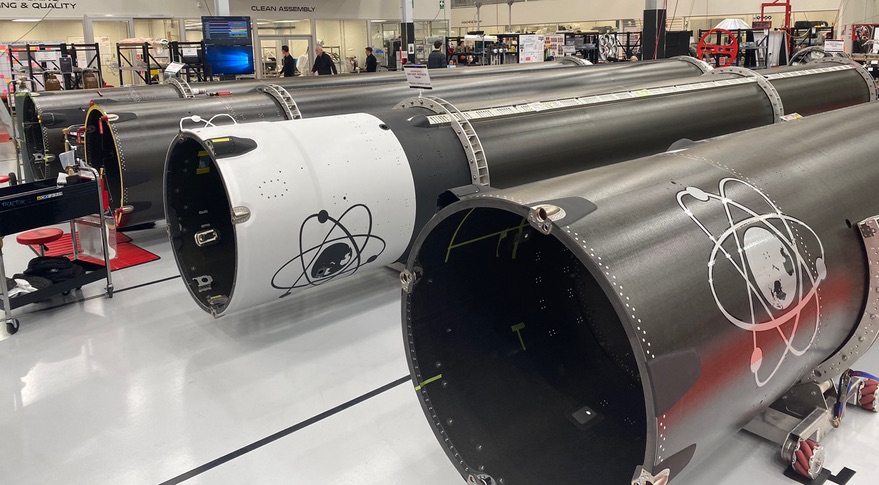
Electron Rocket on the production line in 2020. The one with the Electron logo on a white background was an Electron core stage outfitted to test systems to aid in the recovery of boosters following splashdown. Credit: Peter Beck
A two-stage rocket standing 18 metres tall, Electron made its first flight in May 2017. This did not go as planned and no payload was carried, justifying the mission’s name: It’s A Test. However, the next flight (the first of three in 2018), called Still Testing, successfully delivered a payload of cubesats to orbit, whilst the next flight, called It’s Business Time saw the commencement of commercial launch operations. At the time of writing, Electron has clocked up an impressive 42 successful flights and payload deployments out of 46 launches, with customers paying between US $5 and $10 million per launch.
While this launch rate perhaps doesn’t sound like a lot when compared to SpaceX and its Falcon family, it needs to be remembered that while much is made of the annual volume of Falcon launches, less than 25% of them are actually directly revenue generating commercial sector launches; the vast majority (an average of 60% per year for four years) have been Starlink launches, for which SpaceX absorbs the cost (approx. US $40 million a launch) for no revenue, with a further 15%+ being far more lucrative US-government related launches. By contrast – although the margin of revenue over cost is much smaller, Electron should almost double Falcon’s 4-year average of commercial launches (13.25 per annum) in 2024, if all 21 of its commercial launches are successful (the company also has 4 government contracted launches to complete in 2024 as well).
For a time Rocket Lab toyed with (and tested) the idea of plucking Electron core stages out of the air using a helicopter and a drag line designed to snag the line between the booster’s drogue and main parafoil as it descended towards a splashdown. This idea, whilst promising, was abandoned. in 2021. Credit: Rocket Lab
Currently, Electron is not reusable, making its launch costs higher than they might be. However, the company is looking to change this by recovering spent Electron first stages after splashdown and then refurbishing and reusing their nine Rutherford motors – the rocket motors being the most expensive element of the launch vehicle. The first re-use of a refurbished Rutherford motor took place in 2023, with Electron’s 40th flight, the the company is now building on this.
As well as commercial launch customers, Rocket Lab has garnered US government contracts from NASA, the National Reconnaissance Office and the United States Space Force, with the latter in recent months awarding the company contracts worth some US $547 million to develop and launch satellites as a part of the US military’s Proliferated Warfighter Space Architecture (PWSA), a constellation of satellites from a number of suppliers which provides communications, information gathering, target tracking, etc., to the US military in battlefield and tactical / logistical operations. In addition, Rocket Lab has provided both its US and New Zealand launch services to other governments as well, including France, South Korea and the Australian government.
Nor is the company resting on its laurels with Electron. Despite once saying he would eat his hat if Rocket Lab ever moved towards making a reusable launch system – his belief being that if the engines could be recovered and reused, that was enough – in March 2021 Rocket Lab announced they were to commence work on a medium-lift (8 – 13 tonnes payload range) launch vehicle.
Called Neutron, the reusable vehicle was introduced to the world on March 1st, 2021 in a video which saw Peter Beck keep his promise: he ate his hat (or some of it, at least).
Neutron – unlike SpaceX’s Starship / Super Heavy – has been designed from the ground-up to meet the needs of a number of existing government and commercial markets: the growing smallsat constellation market (which in and of itself is perhaps increasing more issues they it is potentially solving); medium payloads to LEO, SSO and also to geostationary transfer orbit (GTO – e.g. to other planets); and human space flight. It will achieve all of this in a novel approach.
Classified a 2-stage launch vehicle, Neutron will not have a conventional upper stage. Instead, the payload booster and payload will be contained inside the first stage. After passing through the majority of the atmosphere and entering a post-engine shutdown ballistic flight, the upper portion of the Neutron will open to eject the payload. Once the latter is clear, Neutron will use its thrusters to flip itself away from the “upper” stage, allowing the latter to fire its motor and push the payload on to its assigned orbit. Other factors then come into play – such as the shape of the Neutron, the re-use of at least one of its motors, etc – that will allow the rocket to make a propulsive return to launch sight descent and landing.
The advantages of this approach are multiple. Incorporating the upper stage into the rocket means that it can be smaller and lighter, as it does not require the additional structural reinforcement needed for it to be the fist of the rocket as it punches its way up through the atmosphere. Similarly, the integration of the protective payload fairings into the main rocket both increases the overall structural integrity of the vehicle and means they are not simply thrown away during a launch, removing the cost of a brand new set of fairings with each launch.
A rendering of Rocket Lab’s Neutron Rocket. Credit: Rocket Lab
However, there are also potential issues with the approach which Rocket Lab will have to demonstrate they can address. For example, human-rated vehicles generally require means by which a crew can be hauled clear should the rocket malfunction. Clearly, if you are carrying your crew inside the rocket to start with, then getting them out of it will take longer that simply blasting them clear with powerful motors, as can easily be done when they are sitting at the pointy end of the rocket.
Currently, the first Neutron flight is targeting a late 2024 launch – which is an ambitious target for a project only announced in 2021, and which requires not only the development of the launch vehicle, but its propulsion system and fabrication facilities. As such, whether Rocket Lab achieve it or not is still open to debate.
The engine for Neutron is called Archimedes engine, and it is being built by Rocket Lab at their facilities in California. Primarily constructed using 3D printing, nine Archimedes motors will power the Neutron core stage with a further motor powering the “upper” stage.
Meanwhile, ground was broken for the rocket’s production facility in April 2022 at the Mid-Atlantic Regional Spaceport (MARS) within NASA’sWallops Flight Facility on the eastern coast of Virginia, USA – the MARS spaceport being the base of operations for Neutron, with no plans (at present) to launch the vehicle from New Zealand or elsewhere.
In addition to launch vehicles and satellites, Rocket Lab also produces the Photon satellite bus, designed for a variety of uses, including lifting satellites to their assigned orbits and providing power and propulsion for interplanetary payloads. Photon is an attractive vehicle for government space agencies and the private sector, as it can be flown on a variety of launch vehicles and can utilise a wide range of rocket motors, such as Rocket Lab’s other engines, the Curie and HyperCurie and those from third-party suppliers, engine selection being based on mission requirements.
As such, while Rocket Lab might be small (literally and figuratively) when compared to SpaceX’s Goliath, it is (a bit like David was in that particular fight) the one to keep an eye on.
NASA: Voyager 1 and Hubble – Good News / Bad News
After a five month period of anxiety in which the spacecraft has been sending gibberish back to Earth, NASA’s Voyager 1 spacecraft, the most distant human-made object from Earth so far made, has resumed sending understandable engineering data.
As I’ve been covering in these pages, Voyager 1 started sending this gibberish since mid-November 2023, although it has remained fully capable of receiving and acting upon instructions from Earth. This resulted both in a suspension of the spacecraft’s science activities and an inability for engineers to determine the vehicle’s overall operational state.
An artist’s rendering of Voyager 1 in interstellar space. Credit: NASA / JPL
Since then, investigations initially narrowed the potential issue as lying with one of two systems: the spacecraft’s telemetry modulation unit (TMU), responsible for sending data to Earth; or the flight data subsystem (FDS), responsible for the actual packaging of that data ready for transmission to Earth. Further work determined the issue as lying within the FDS, although exactly what has gone wrong remained a puzzle.
Then, and as I reported in March (see: Space Sunday: starships, volcanoes and Voyagers), an engineer from NASA’s Deep Space Tracking Network (DSN), which handles all communications with NASA’s multiple deep-space missions, noticed something odd about some outlier data the communications received from Voyager 1 – it did not appear to be gibberish. Digging deeper, he realised it was actually a complete dump of the FDS’s memory.
This allows engineers to determine a single memory chip within the FDS has failed, corrupting about 3% of the system’s memory; just enough for the data packaging operation to be thrown into disarray and result in gibberish. The cause identified, the problem became how to fix it.
The most obvious means to doe so would be to tell the spacecraft not to use the corrupted memory for data processing. However, that required instructing the FDS to use other memory space – and there wasn’t a single address space in the system large enough to match the corrupted memory and manage its own data processing. As a result, the engineers broke the problem down into a series of steps.
The first step was to updated the FDS software so that the system could take the data normally handled by the corrupted data so that it could be handled through several other parts of the FDS memory, and without messing up any of the other data they had to manage. This recoding was carried out during March and April, and on April 18th, 2024, the updated software was sent to Voyager 1. Then came a nigh-on 48 hours wait for a response: it takes 22.5 hours for a signal from Earth to reach Voyager 1, which then has to execute the code, carry out the instructions related to it, and send a reply – requiring another 22.5 hours to reach Earth.
If the engineers were correct and the update correct, then the response from Voyager 1 should be an engineering update on its overall status. On April 20th, that’s exactly what the mission team at NASA’s Jet Propulsion Laboratory received, and for the first time and for the first time in five months, Voyager 1 weas once again communicating with meaningful data.
Engineers and flight team members responsible for Voyager 1’s operation respond to the confirmation that data received from the spacecraft on April 20th, 2024 confirms their initial attempt to correct a data communications issue has worked. Credit: NASA/JPL
The next steps in the process are to ensure that all science data can be similarly re-routed through the FDS to avoid the corrupted memory sent to Earth without anything becoming confused, and then finally to ensure the faulty memory is completely ignored by all FDS processing and by any of Voyager 1’s systems that interact with the FDS. These steps are expected to take several more weeks. Nevertheless, the fact that Voyager 1 is once again “transmitting in the clear”, so to speak, is welcome news.
Unfortunately, things are not so good with the Hubble Space Telescope (HST), with NASA reporting it is again experience issues with its gyroscopes for the second time in the last six months – and the problem appears to lie with the space gyro that had problems in November 2023.
The gyroscopes are used to precisely point the telescope at targets and hold it steady during imaging. Originally, HST used 3 pairs of gyros, which were periodically swapped-out during servicing missions. However, the last time all six gyros were replaced was during the last servicing mission of 2009 – since the retirement of the space shuttle, NASA has not had the means to safely carry out such a mission, and in the intervening time, three of the gyros have failed completely.
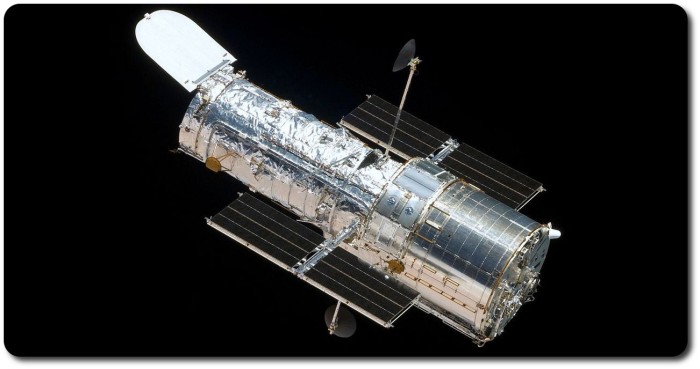
The Hubble Space Telescope (HST) as seen from the departing space shuttle Atlantis, flying STS-125, the final HST Servicing Mission, in 2009. Credit: NASA
Such failures are the result of wear and tear affecting wires less than the width of a human hair and called flex leads which pass through the gyros carrying power and data. As the gyros operate, these flex leads well, flex; but they also slowly corrode as a result of this flexing and can eventually break. One sign of this possibly occurring can be seen when a gyro starts to show power fluctuations. This happened during the past week, causing the gyro to enter a “safe” mode.
As a result, and after allowing the telescope to enter a contingency mode were it can – at reduced capability – function on just two gyros for a few days, on Sunday, April 28th, 2024, NASA completely paused the telescope’s science operations in order to more fully investigate the gyro’s problems in order to try to determine if it is about to suffer a flex lead failure, or whether there is another cause of the gyro’s woes, as was the case in November 2023.
If it turns out the gyro cannot be safely restored to an operational state, NASA has indicated it will switch Hubble over to operating on just a single gyro – permanently degrading its capabilities – in order to hold the second functional gyro as a reserve against any further gyro failure.
Japan’s Moon Sniper Wakes Up – Again
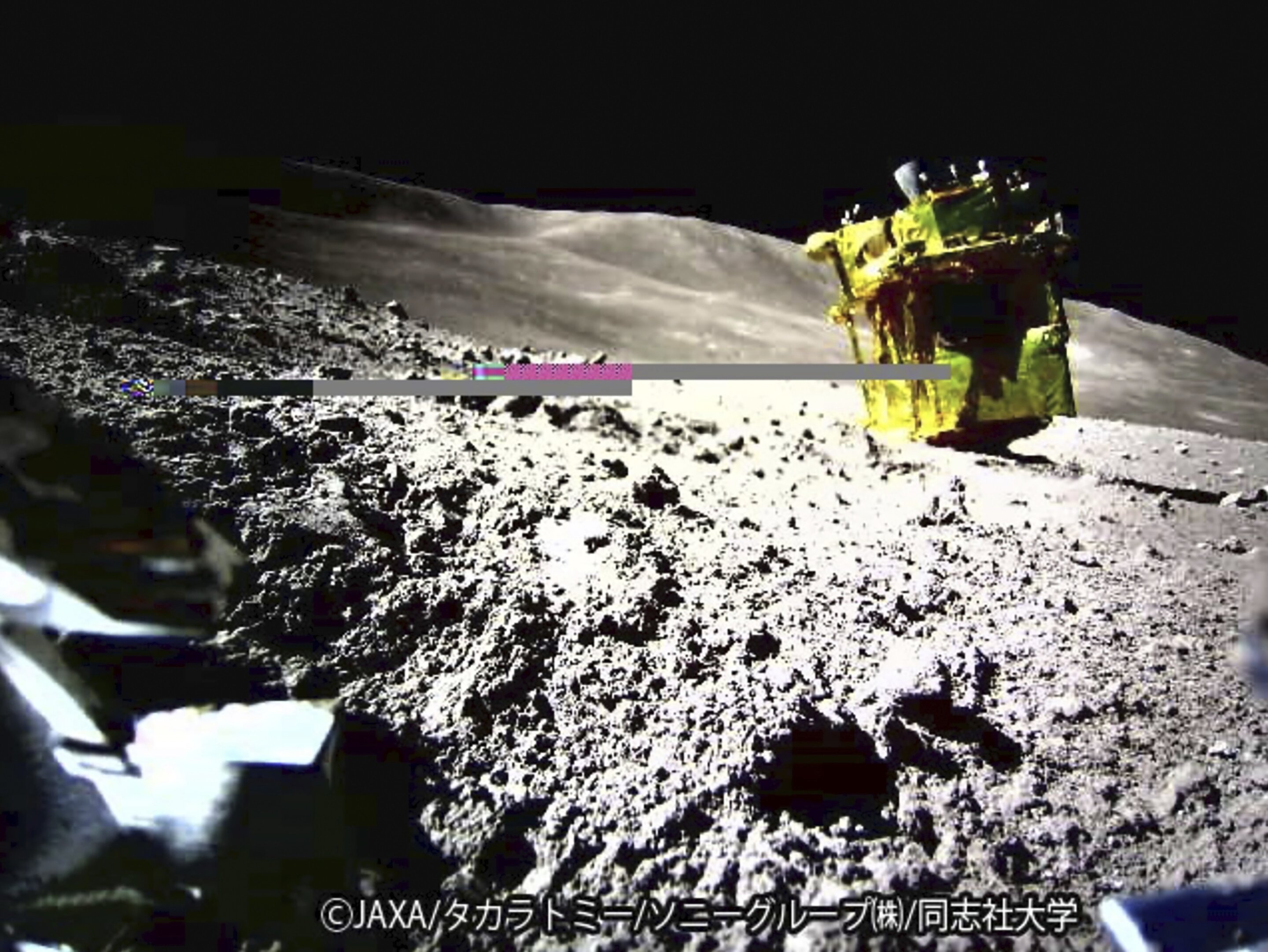
As I’ve previously reported in these pages, Japan became the fifth nation to successful land a spacecraft on the Moon when its Smart Lander for Investigating Moon (SLIM – also called “Moon Sniper”) arrived on the lunar surface on January 19th, 2024. Unfortunately, the craft arrived upside down, as confirmed by images returned by one of the two micro-rovers deposited on the lunar surface as a part of the mission (see: Space Sunday: a helicopter that could; a lander on its head and Space Sunday: More Moon (with people!) and a bit of Mars) – although precisely why it did has not been 100% confirmed.
Despite this, the vehicle was able to complete the majority of its science mission before being put in a dormant state with the onset of the long lunar night. At the time – the start of February – it was not anticipated that the craft would survive the 14 terrestrial day period without sunlight to warm it and provide energy to power its batteries. But it did; as it started to receive sunlight once more in late February, it called home.
Japan Aerospace Exploration Agency (JAXA) released this image, captured by the LEV-2 mini-rover, of their SLIM lander upside down on the Moon. Credit: JAXA
Whilst the team responsible for the spacecraft had hoped this might be the case, they were unable to get the vehicle to resume science operations and, after a further 14 terrestrial days of sunlight, SLIM went back to sleep for a second night. This time, it was not expected to wake up and the mission team disbanded – only to come back together in March 2024, when SLIM did indeed wake up as it received daylight, and started ‘phoning home and sending images, which it continued to do until night came yet again.
This time, the mission team were sure the vehicle would not call home once sunlight had returned to its landing spot and once again, they’ve been proven wrong. SLIM again ‘phoned home on April 24th, 2024, although it is unclear whether or not the mission team have been able to re-establish any of the vehicle’s science gathering activities. Even so, that the craft has thus far survived three long lunar nights again proves Japan’s prowess with their space technology.
The following notes were taken from the Thursday, April 25th, 2024 Combat User Group meeting (also referred to as the Combat Committee User Group or CCUG, an abbreviation also used by the Content Creation User Group, and which I’ll not be using in these summaries to reduce the risk of confusion between the two). They form a summary of the items discussed, and are not intended to be a full transcript.
Meeting Overview
The Combat User Group exists as a forum to discuss improvements to the Linden Lab Combat System or LLCS to better support combat in Second Life.
The core idea is to provide additional events and capabilities which sit on top of LLCS to provide combat creators with better tools with which to create better combat systems for their specific scenarios.
The meetings are the result of a proposal document on improving the native damage system in SL, written by Rider Linden, and which is the focus for both the meeting and any work arising from them.
These meetings are conducted (as a rule):
By Rider Linden, with the support of Kyle Linden.
On alternating Thursdays (rotating with the Content Creation User Group) at 13:00 SLT. Meeting dates are recorded in the Second Life Public Calendar.
Initially in text, although voice might be included in the future depending on feedback from those attending.
Rider is currently fishing up the regions settings for what happens on the “death” of a player in a combat scenario – what happens on death (teleport to spawn point, etc.), hit point regeneration, maximum DPS, options for writing to the combat log, etc.
llGetEnv has been updated to allow all of the options to be read from a script (e.g. ALLOW_DAMAGE_ADJUST, RESTRICT_COMBAT_LOG, DEATH_ACTION (0 = Teleport home 1 = Teleport to parcel landing point. 2 = Teleport to region telehub. 3 = No action), etc.).
At the time of the meeting, his hope was to have ta simulator version supporting all of this running on the Aditi combat test regions (Thermopylae and Gallipoli) by COB on Friday, April 26th.
Rider is also working on a UI mock-up for the new combat options in the viewer, which will have to be vetted / changed / approved by the UI team.
Also on his list of work are: OBJECT_HEALTH, SIT_FLAG_NO_DAMAGE, a UUID for the combat log, and some selective unthrottling for llDamage. Once these items are ready, he hopes the simulator code will be set for passing over to QA to poke at.
Comments and Requests
A request was made for the new viewer region console settings for the above to be written-up, which will be done – although the variable names will be the same as the llGetEnv key names.
It was asked if death_action could be made more flexible – making it possible for more than one respawn point settable either by this mechanism or by some script intervention? for example, move to point A if in some designated group(s) and point B otherwise.
Rather than complicate the options, Rider’s plan has been to let the local combat HUD handle such requirements.
This led to the question: what happens if the region setting is something else (e.g. teleport to landing point) but HUD on_death teleports somewhere else? which one wins?
Rider’s view was that in such cases, the region setting would win, as the simulator has no idea as to what the HUD may try to do. Therefore, in such situation, Teleport to Telehub should be set, or (possibly) an Experience should be set, so as to enforce the HUD’s settings (although this was seen as both a lot of work for limited return, and off-putting to users who are put off by the Accept Experience dialogue box).
There is also the idea of sending people to different locations based on active group. However, Rider is unclear how this can be made to work, so it has been pushed onto a back burner, in case a suitable solution can be identified later.
Clarification was requested for OBJECT_HEALTH, with Rider replying:
Basically it would allow a remote script to look at an object and get an idea about how damaged it is. It would just be an integer and it would be up to the script in the object to keep it updated (and to decide what the number means). Default = 0. The object itself won’t monitor or do anything at all with that number. It will be entirely up to the scripts about how to use it.
The above led to a wider discussion on damage, hit points, object health and agent health + reporting. In particular a request was made for direct sensor-based identification of objects with health (e.g. an OBJECT_WITH_HEALTH flag), and feature Request for this was requested.
There was also further discussion on the idea of vehicle linkset having multiple hit points, allowing for variable damage to be scored (e.g. the front of a tank has 400 HP, but its rear only has 50, allowing a rear-end hit to brew it more easily than a frontal hit (as is generally the case with tanks). This is something Rider would like to achieve, but he noted that there isn’t a clean way to get object details of a specific link of another object.
On Friday, April 26th, 2024, Linden Lab issued a pre-recorded Lab Gab session featuring the company’s Executive Chairman, Brad Oberwager (Oberwolf Linden) discussing the recent news concerning the acquisition of Tilia.io, the all-in-one payments platform established by Linden Lab in 2019 and which manages payment processing and cashing out for Second Life, by Singapore-based business-2-business (B2B) payments infrastructure firm Thunes, and which I reported on here on the acquisition.
At the same time, the blog post promoting the Lab Gab session provided further information on the upcoming Community Round Table event, first informally announced on April 19th, 2024.
The following is a brief summary of the Lab Gab session, offered as a quick reference summary for those interested. In addition, a brief summary of the Round Table event news is at the end of this article.
The news of the acquisition has been the subject of considerable commentary on the official forums and elsewhere, and the concerns voice are seen as “understandable”.
Summary of Tilia (as clarification):
A payments company which (for Second Life) allows users to use credit and debit cards and PayPal to buy Linden dollars; tracks the use of those Linden dollars and support the sale of those Linden Dollars, and allows users to cash-out the USD value of those Linden Dollars [after fees] to their bank accounts.
However, Tilia is not the LindeX itself – that is separate technology specific to Second Life.
Running Tilia costs “millions and millions” of dollars to run, so the decision was taken to spin it out as a business in its own right so that it could support other customers / platforms, and thus alleviate some of the costs faced by LL.
However, this has not worked out as well as had been hoped. While Tilia has a modest client list, it still relied heavily on Linden Lab to meet its costs, thus detracting for finances which could be used within Second Life.
The decision was therefore made to seek an organisation which might – “under guidelines” acquire Tilia and make it profitable.
First criteria: any company acquiring Tilia must to commit to continuing to support Second Life, and the relationship between Second Life and Tilia is continued.
Second criteria: what could any company acquiring Tilia bring to Tilia and thus to Second Life?
Additional criteria included: how much were companies willing to pay; what would happen to Tilia staff, how fast could a buyer commit to completing the deal, etc.
Thunes is an international money movement company “missing one piece of a very interesting jigsaw puzzle” – the United States.
In short, Thunes does not have MTLs to operate in the United States, although they had begun the process of applying for them.
Brad Oberwager was introduced to the CEO of Thunes right at the time thought was being given to selling Tilia, and Thunes were starting on the road of applying for MTLs in the US.
As both parties recognised the value in reaching an agreement, they were able to rapidly enter into an exclusive agreement for the sale of Tilia.
Tilia gives Thunes the ability to operate in the United States in a more cost-effective manner than Thunes could otherwise achieve.
Tilia (rebranded as Thunes) will effectively become Thunes’ centre of operations for expanding its business into the US.
[As noted in my article] Thunes allows for a range of payment methods direct to customers in multiple currencies and to bank accounts, to virtual wallets, etc., with payment made in real-time. These are abilities Linden Lab has not been able to build-in to Tilia, as they are both complex and expensive.
As Thunes integrates Tilia into its business model, Second Life will be able to access Thunes’ global network and services.
[From 11:00] While there were other suitors for the deal, Thunes was the company with which Brad Oberwager felt most comfortable.
Thunes also demonstrated they really want to invest into Tilia and grow it as a business.
They weren’t simply looking at Tilia as a means to gain the MTLs.
They didn’t see Tilia as a one-stop solution; rather it is a merging of capabilities neither Thunes nor Tilia have individually.
The 5-Year Partnership and Payment Options to Second Life Users
The Thunes press release on the acquisition references a 5-year partnership with Linden Lab.
This is in reference to the business agreement between Linden Lab and Thunes, which is “so good” for both, the two companies wanted for formalise it beyond just the acquisition of Tilia, thus meeting the first criteria within the Lab’s requirements for any Tilia acquisition.
Any offer made for Tilia which had not provided the ability to meet the first criteria set by Brad Oberwager would not have been accepted.
There will be “a lot of things offered” to Second Life users, but what cannot be committed to as this point in time is when these things might be offered, simply because Linden Lab will not be involved in the day-to-day management and development of Tilia, post-sale. However:
“First on the roadmap” is better pay-outs and more pay-outs.
There will also [likely] be more options for purchasing L$.
Regulatory Approval and When Will SL Users Notice the Transition
The acquisition is being handled as a reverse triangular merger [in essence, Tilia is both the subsidiary and the post-acquisition entity].
The company will be rebranded, but all the technology and data will “remain Tilia”. As such, Second Life users may never know that the transition has happened; all the things that are important in terms of data are staying the same; all of the things in terms of the technology are “only going to get better”.
What will change in Tilia’s owner, and this is where the regulatory approval comes in.
MTLs cannot simply be handed over to a new owner when a company operating them is sold; the new owner has to be approved by the state (/territorial) regulator(s) responsible for issuing the MTLs.
While regulators work at different speeds [and Tilia is licensed in 48 US states and territories), the process of gaining all the required approvals could take “from 5 to 9 months”.
Confidence in a buyer being able to gain all this regulatory approval was another criterion for any sale of Tilia. Thunes give him that level of confidence, because it has gone through similar processes elsewhere in the world.
Proceeds of the sale will [obviously] go to the owners of Linden Lab. They will then determine how much of those funds are invested back into Second Life.
The better Second Life (or aspects thereof) do, then the greater the amount of money put into Second Life. Cited examples:
If SL Mobile sees high adoption and use, if it becomes successful on the Apple / Google app stores, etc., then more money could well be put towards further development / enhancement of the mobile product.
If SL sees increases in retained new users as a result of initiatives, with the daily average usage of the platform increasing, then more money will go into further improvements in that area.
A key point with the acquisition of Linden Lab [by Oberwager and Waterfield in 2020] is the company spending has increased, which has “proven to be a good thing” for the platform.
User Data Security: An important point to note with the acquisition of Tilia is that Second Life user data is not changing hands.
Tilia will have new owners and will be renamed, but the lock-down of Second Life user data resides in two places: Tilia (for financial information) and Second Life (actual user data).
As a financial services company, Thunes is required to keep financial data as secure as it currently is with Tilia, and the data will not be removed from the current Tilia systems and moved elsewhere.
User fees for payment processing, cashing out, etc.: Brad Oberwager has “no intention” to change fees “any which way” as a result of the deal with Thunes.
Pointed out that LL does revise fees, but tends to do so in a manner intended to reflect the value of the services they provide. So, while fees for payment processing, etc., have increased in the past – they have generally been as a result of lowering fees elsewhere (e.g. in reducing land tier).
Also made clear that while there are no plans to increase payment process / cashing out fees as a result of this deal, the LindeX is expensive to run and maintain – and so he is not saying there will “never” be any fee increases; changes will be made on a business benefit basis.
Views Second Life as a “moral imperative” – it is so good for so many in the world for so many reasons, that there is a moral need that goes beyond a financial reason to have Second Life continue.
The only connection between selling Tilia and Second Life is that, under Linden Lab’s ownership was not “financially good” for Linden Lab, but is a potential financial powerhouse for Thunes.
The Thunes deal has gone ahead purely because it is good for Linden Lab, for Second Life and for Tilia and its employees; therefore there is “nothing negative” about the deal.
He remains fully supportive of Second Life, and – per the earlier examples – willing to put the money raised from the sale back into Second Life.
Round Table Update
As per the original April 19th informal announcement, the Round Table event will take place on Monday, May 20th, 2024, commencing at 09:30 SLT, and will be the first in a series of such events, which are defined as:
An opportunity to connect directly with our top executives, share your input, and discuss ideas on enhancing Second Life. This initiative represents another step in our efforts to improve our community interactions, ensuring that your voice is more directly heard and valued.
The location for the event has not (at the time of writing) been stated, but will be announced “closer to the date”.
This first Round Table will feature Linden Lab Executive Chairman Oberwolf Linden and Senior VP of Product & Engineering Grumpity Linden. Plus:
The session will include further discussion of the above Tilia acquisition, and on upcoming Linden Lab / Second Life Policy updates.
There will be an open Q&A portion of the event (which is not for airing individual support issues or personal grievances and subject to the SL Community Standards.
In addition, questions and / or feedback can be provided to the Leadership in advance of the event using this anonymous form.
Future Round Table events will feature other Lab executives participating on a variety of topics, and the scheduling of these events will likely vary to be more accessible to other time zones.
ArtCare Galleries: The American Scene, curated by Pamela Irelund
As I continue to play catch-up on things, I’m again covering another art exhibition that has been open for a while but will hopefully remain open for a while longer so that people might enjoy it, as the subject matter is both fascinating and engaging.
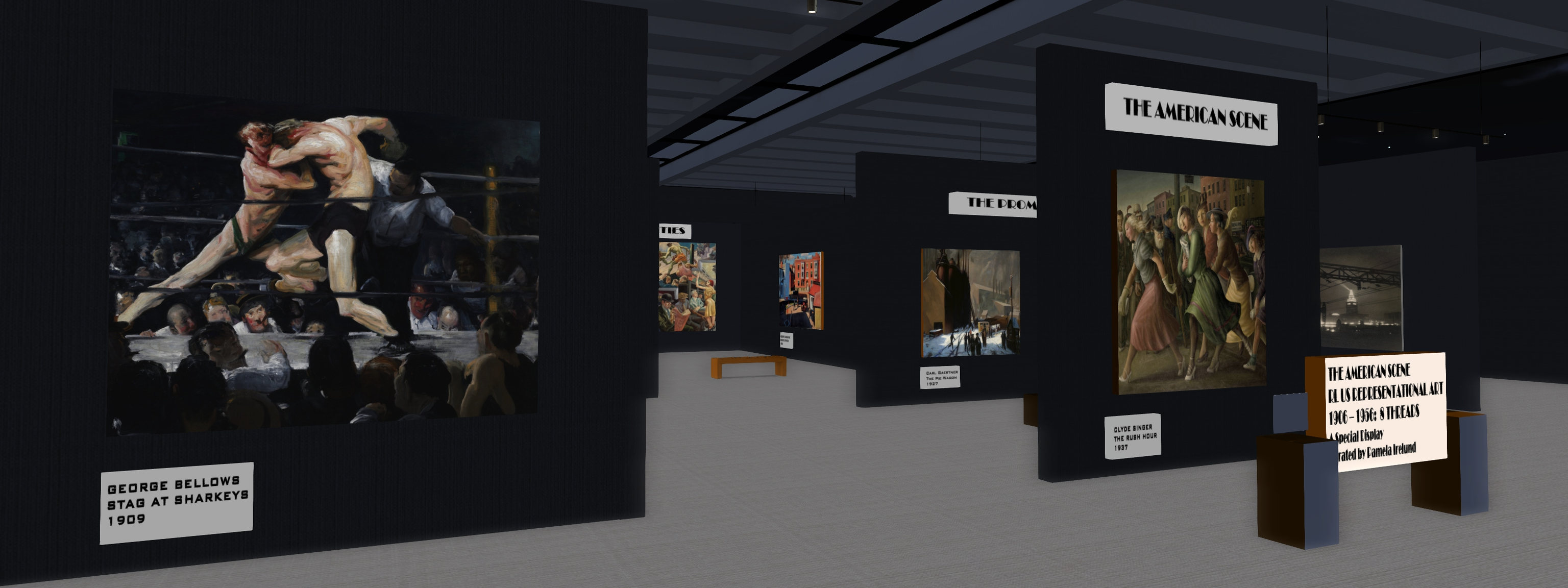
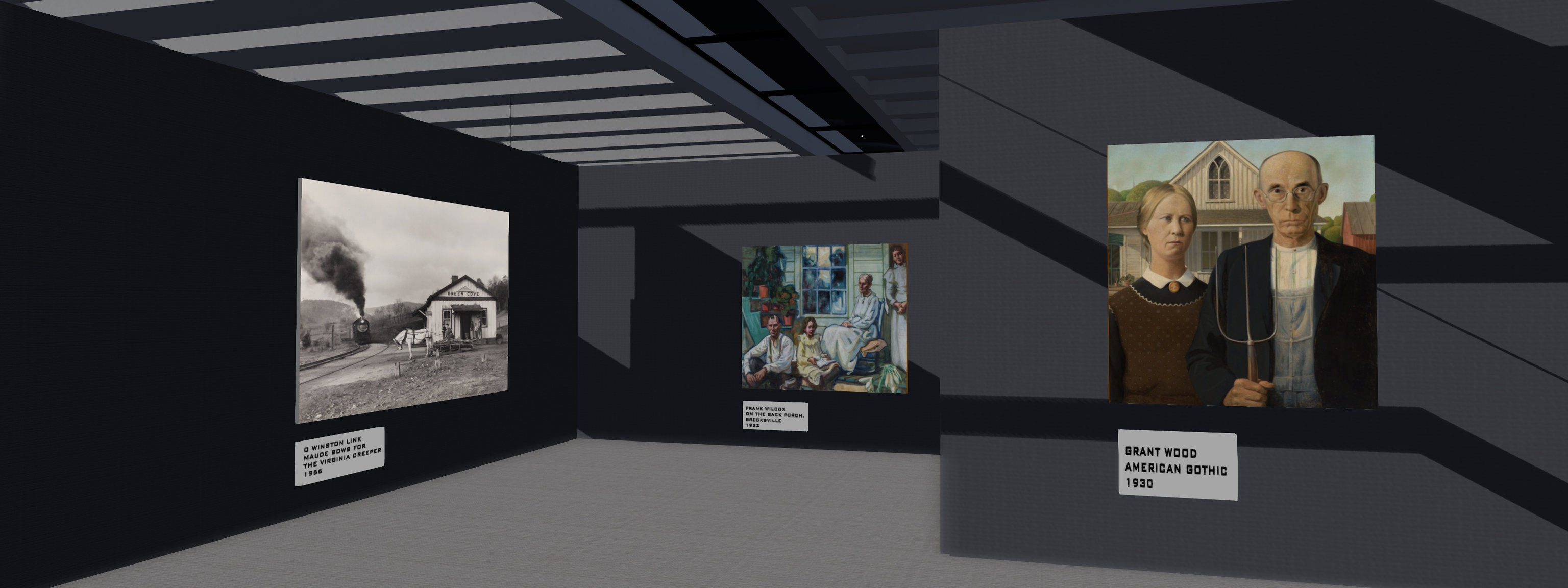
The American Scene, presented at Carelyna’s ArtCare gallery complex, is a collection of art and photography gathered and curated from the physical world by Pamela Irelund as a celebration of the American art movement spanning the majority of the first half of the 20th century (in this case 1906 through 1956, to be precise).
This was a period of American art history with saw a reaction against the European modernist movements in art; a time when American artists – painters, photographers writers, etc., – sought to emphasise realism within their work. Within the art movement, this led to the notable rise of two major styles of art: Regionalism (works emphasising realistic scenes of rural and small-town America, particularly during the period of the Great Depression), and Social Realism (realist portrayals of anonymous workers as well as celebrities as heroic symbols of strength in the face of adversity, notably again during the Depression). In addition, the period also celebrated aspects of American culture and life.
ArtCare Galleries: The American Scene, curated by Pamela Irelund
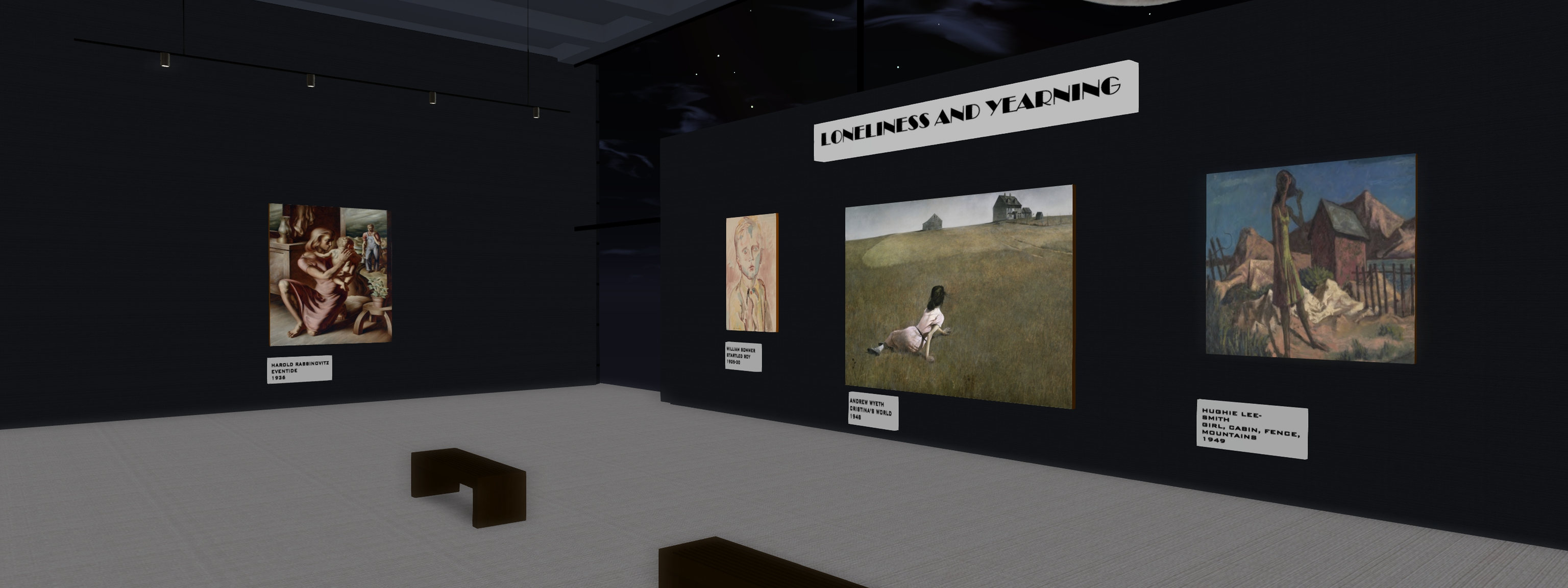
Divided into a series of eight themes: Poverty, Realism and Immigration; The Promise of Industry; Distractions and the Jazz Age; Bustling Cities; The Appeal of Rural Life; Loneliness and Yearning; The Solace of Nature, and The Spirit, the exhibition is a veritable tour de force of American art and artistry throughout the period. The 50+ pieces in the exhibition encompass artists whose names may well be very familiar to some, and others perhaps less well known, but no less deserving of exposure.
For the former, one might select Georgia O’Keeffe, regarded as the Mother of American Modernism (although it is fair to say that throughout most of her career she strove to remain apart from the major art movements). She is particularly well represented both through reproductions of her own work and via a 1918 photograph by her husband, Alfred Steglitz, another name that may be recognised. Steglitz was a major promoter of art in the United States and was a major force behind making photography a recognised art form.
ArtCare Galleries: The American Scene, curated by Pamela Irelund
Also present within the exhibition is realist painter Andrew Wyeth, represented by what may well be his most recognised work, Christina (1948), a piece which actually inspired Second Life photographer shelly70 to create an entire region around Wyeth’s work. Grant Wood is presented by what might be regarded as his most famous piece, American Gothic (1930), whilst artist, photographer and film-maker Charles Steeler (who, if Georgia O’Keeffe is regarded as the Mother of American Modernism, then he might well be regarded as the Father) is also included, as is Archibald Motley (one of the major forces within, and contributors to, the Harlem Renaissance and the Chicago Black Renaissance, and Frank N. Wilcox and Thomas Hart Benson – both particular powerhouses of American Regionalism alongside the likes of Grant Wood.
However, whether or not the names of the artists are recognised, what cannot be denied is that this is an exhibition that genuinely spans the full breadth of the American Scene art movement, as well as encompassing the work of artists who might not be directly associated with the movement, but whose work – such as with Motley – played a major role in cultural recognition and growth.
ArtCare Galleries: The American Scene, curated by Pamela Irelund
In putting this exhibition together, Pamela has shown considerable care in her selections of art and artists – and in her respect for copyright. None of the pieces are offered for sale, regardless of their legal copyright status, and most are intentionally offered as low resolution images, with visitors encouraged to seek individual pieces on-line if they wish to see them at higher resolutions. However, “low resolution” does not mean the reproductions offered lack detail; again, care has been taken to show them at a size and format in which they can be appreciated though gentle camming through the exhibition.
In addition, Pamela also provides a highly informative notecard catalogue to the exhibition, and I highly recommend visitors take a copy: it not only offers information on the exhibition, its purpose and the period it represents, it also offers tidy thumbnail biographies of the artists presented within The American Scene, providing further insight to the period and the art.
ArtCare Galleries: The American Scene, curated by Pamela Irelund
In all, an excellent, and well-presented exhibition which brings an oft-overlooked period of art history.












 Inara Pey: Living in a Modemworld