Logos representative only and should not be seen as an endorsement / preference / recommendation
Updates from the week through to Sunday, May 19th, 2024
This summary is generally published every Monday, and is a list of SL viewer / client releases (official and TPV) made during the previous week. When reading it, please note:
It is based on my Current Viewer Releases Page, a list of all Second Life viewers and clients that are in popular use (and of which I am aware), and which are recognised as adhering to the TPV Policy. This page includes comprehensive links to download pages, blog notes, release notes, etc., as well as links to any / all reviews of specific viewers / clients made within this blog.
By its nature, this summary presented here will always be in arrears, please refer to the Current Viewer Release Page for more up-to-date information.
Note that for purposes of length, TPV test viewers, preview / beta viewers / nightly builds are generally not recorded in these summaries.
Official LL Viewers
Release viewer: 7.1.6.8745209917, formerly the Maintenance Y/Z RC ( My Outfits folder improvements; ability to remove entries from landmark history), dated April 19 and promoted April 23 – No Change
Curiosity, NASA’s Mars Science Laboratory (MSL) rover, arrived on Mars in 2012 – and helped kick-off Space Sunday in this blog. Since then, the mission has been a resounding success; even now the rover continues climbing the flank of “Mount Sharp” (officially designated Aeolis Mons), the 5km high mound of sedimentary and other material towards the centre of Gale Crater where it landed, revealing more and more of the planet’s secrets.
However, there has been one long-running mystery about Curiosity’s findings as it has traversed Gale Crater and climbed “Mount Sharp”. As it has been exploring, the rover has at times been sensing methane in the immediate atmosphere around it. Methane can be produced by both organic (life-related) and inorganic means – so understanding its origins is an important area of study. Unfortunately, Curiosity is ill-equipped to easily detect and investigate potential sources of the gas; that’s more a job for its sibling, Perseverance. As such, the overall cause of the methane Curiosity has detected remains a mystery.
And it is a mystery compounded in several ways. For example: the methane often only seems to “come out” at night; the amount being detected seems to fluctuate with the seasons, suggesting it might be linked to the local environmental changes; but then, and for no apparent reason, Curiosity can sometimes sniff it in concentrations up to 40 times greater than it had a short time before – or after. A further mystery is that whilst Curiosity detects methane in the atmosphere around it, it is the only vehicle on Mars to thus far do so to any significant extent.
Further, the European Space Agency’s (ESA) ExoMars Trace Gas Orbiter (TGO), a vehicle specifically designed to sniff out trace gases like methane throughout the Martian atmosphere has, since 2018 when it started operations, almost totally failed to do so. All of which suggests that whatever Curiosity is encountering is unique to the environment of Gale Crater – and possibly to “Mount Sharp” itself.
Given this, scientists have been trying to determine the source of methane, but so far, they haven’t come up with a specific answer. However, current thinking is that it has something to do with subsurface geological processes involving water – with one avenue of research suggesting that it is curiosity itself that is in part responsible for its release, particularly when it comes to the sudden bursts of methane it detects.
The possible ways methane might get into and be lost from the Martian atmosphere, including via microbes under the surface (l) or via inorganic means (r), which get stored as methane ice (clathrate), which sublimates and outgases in the warm seasons. In addition, it is possible that organics or chemical reactions within the Martian regolith create methane which is then outgassed, whilst even ultraviolet light from the Sun can create it by affecting surface materials – although it more generally causes methane to break down, producing carbon dioxide. Credit: NASA/JPL
A recent study by planetary scientist at NASA’s Goddard Space Flight Centre has demonstrated that any methane within Gale Crater, whether produced by organic or inorganic means, might actually be following the path outlined in the diagram above – but is getting trapped within the regolith by salt deposits before it can ever be outgassed. However, this was not the original intent of the study, which first started in 2017.
At that time, a team of researchers at NASA’s Goddard Research Centre led by Alexander Pavlov, were investigating whether or not bacteria could survive in an analogue of the kind of regolith Curiosity has encountered across Gale Crater and within environmental conditions the rover has recorded. Their results were inclusive in terms of organic survivability, but they did find that the processes thought to be at work within Gale Crater could lead to the formation of solidified salty lumps within their analogue of Martian regolith.
And there the matter might have rested, but for a report Pavlov read in 2019, as he noted in discussing the results of his team’s more recent work.
We didn’t think much of it at the moment. But then MSL Curiosity detected unexplained bursts of methane on Mars in 2019. That’s when it clicked in my mind. We began testing conditions that could form the hardened salt seals and then break them open to see what might happen.
– Alexander Pavlov, Planetary Scientist, NASA Goddard Research Centre
A view across Gale Crater as captured by NASA’s Curiosity rover in September 2015, three years into its surface mission. Credit: NASA/JPL
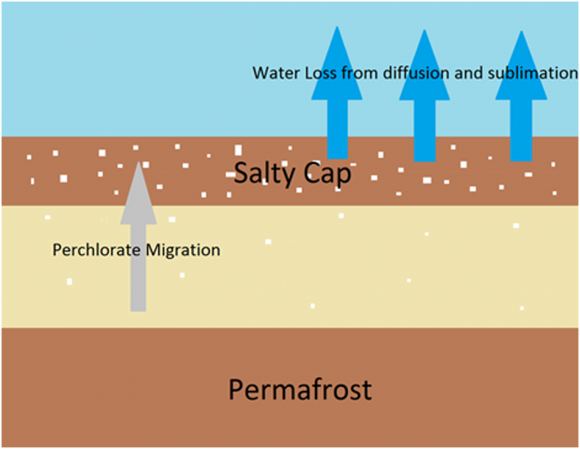
As a result, Pavlov and his team went back to their work, looking at the nature of the sedimentary layers of “Mount Sharp”, the amount of water ice they might contain, etc., and started testing more regolith analogues to see what might happen with different concentrations of perchlorates within the water ice. Starting with around a 10% suspension (much hight than has ever been found on Mars), the team gradually worked down to under 5% (closer to Curiosity’s findings, but still admittedly high). In all cases, they found that not only did the perchlorates leach out of the escaping water vapour as it passed through the reoglith analogue to form frozen lumps, it tended to do so at a fairly uniform depth the lumps combining over time – an average of 10 days – to form what is called a “duricrust” layer.
Duricrusts are extensive (in terms of the area they might cover) layers of frozen minerals trapped within the Martian regolith. They were first noted in detail during the NASA InSight lander mission (operational on the surface of Mars between November 2018 and December 2022), significantly impacting the effectiveness of the lander’s HP3 science instrument, which included a tethered “mole” designed to burrow down into the Martian regolith. However, the “mole” kept encountering duricrust layers which, as it broke through, would surround its pencil-like body with a cushion of very loose, fine material which completely absorbed the spring-loaded action of its burrowing mechanism, preventing it from driving itself forward.
This figure demonstrates how salts deposited in the Martian regolith as the water (originally ice) is lost through diffusion and sublimation, can for a sub-surface seal to trap methane within the regolith. Evidence for this kind of “cementing” of material to form a solid crust within the regolith was found by the NASA InSight lander during its surface mission (November 2018 to December 2022). Credit: Pavlov et al. 2024.
In their tests, Pavlov and his team found that the perchlorate duricrust formed in their tests would not only spread across a sample container, it was very effective in trapping neon gas (their methane analogue). Further, when the samples were exposed to the kind of natural expansion and contraction regolith on Mars would experience during a day / night cycle, they found the gas could indeed escape through cracks in the duricrust into the chamber’s atmosphere and be detected – just as with the methane around Curiosity. They also found that if a sample were subject to a pressure analogous to that of the wheel of a 1-tonne rover passing over it, it could be crushed and allow a sudden concentrated venting of any gas under it – again in the manner Curiosity has sometimes encountered.
Whether or not this is what is happening in Gale Crater, however, is open to question – as Pavlov notes. Firm conclusions cannot be drawn from his team’s work simply because scientist have no idea how much methane might actually be trapped within Gale Crater’s regolith, or whether it is being renewed by some source. As already noted, Curiosity is ill-quipped to study methane concentrations in the regolith and rock samples it gathers, because when the one instrument which could do so – the Sample Analysis at Mars (SAM) instrument – was designed, it was believed any methane trapped within Mars would be so deep as to be beyond the rover’s reach, and it thus wasn’t considered as something that would require analysis. While SAM can be configured for the work, it takes considerable time and effort to do so – and that is time and effort taken away from its primary science work, which is more-or-less constant as it handles both rock and atmospheric samples gathered by the rover.
Although Curiosity is fully capable of recovering rock and regolith samples from Gail Crater – such as the material gathered after drilling into a rock called “Aberlady” in April 2019 – around the time the rover was detecting concentrated bursts of methane in the atmosphere around it -, the rover is unable to easily carry out the kind of analysis required to detect any methane deposits which might reside within the samples. Credit: NASA/JPL
Even so, the Goddard work is compelling for a number of reasons; it points to the fact that howsoever any methane within Gale Crater might be produced (organically or minerally), there is a good chance it is becoming mostly trapped within the regolith, and possibly in concentrated pockets. If this can be shown to be the case, and if these pockets could be localised and reached by a future mission, they might some day give up the secret to their formation – including the potential they are the result of colonies of tiny Martian microbes munching and farting (so so speak!).
Raglan Shire, Second Life’s Tiny community, is once again opening its doors to people from across the grid, as participating artists and visitors are invited to the Raglan Shire Artwalk 2024.
This year, the the event runs from Sunday, May 19th, through until Sunday, June 16th, 2024, inclusive. It offers an opportunity not just to appreciate a huge range of art from both the physical and digital worlds, but to also tour the Shire regions and enjoy the hospitality of the Raglan Shire community – one of the friendliest and fun-seeking groups in Second Life.
A non-juried exhibition, the Artwalk is open to any artist wishing to enter, and has minimal restrictions on the type of art displayed (one of the most important being all art is in keeping with the Shire’s maturity rating). All of this means that it offers one of the richest mixes of art displayed within a single location in Second Life, with 2D art is displayed along the hedgerows of the Shire’s pathways and tree platforms overhead and 3D art among the community’s parks.
Raglan Shire Artwalk 2024
Over 120 artists are participating in 2024, many for the first time. As such, the depth and range of art on display is guaranteed to keep visitors exploring the paths and walks around and through the hedgerows – and if walking proves a little much, there are always the Shire’s tours to ease the load on the feet, together with the teleport boards to help move visitors swiftly around and through the different display areas. But that said, I do recommend exercising your pedal extremities and doing at least some of your exploration on foot – just keep in mind people do have their homes in the regions as well.
Given the number of artists involved, there isn’t a published list of participants, but anyone interested in the world of SL art is bound to recognise many of the names of the artists here. The Artwalk is also a marvellous way to see art from both our physical and digital worlds and for catch artists both familiar and new to your eye. Just don’t try to see it all at once; the Artwalk is open for a month, which gives plenty of time for browsing and appreciating the art without feeling overloaded.
Raglan Shire Artwalk 2024
SLurl Details
All of the Raglan Shire Artwalk regions are rated General)
Bay City, the first major project undertaken by the Moles of the Linden Department of Public Works (LDPW), will be turning sweet sixteen on Sunday, May 19th, 2024. Citizens of Bay City will be joining in celebrations to mark the anniversary, with a parade, music and entertainment, and residents from across of Second Life are invited to visit Bay City and join in the celebrations.
Activities will kick-off at noon SLT, with a parade line-up at the band shell in Bay City – Harwich. At 12:30 SLT, the parade will commence its way along the City’s Route 66, and proceed to the Bay City Fairgrounds in the North Channel region for an afternoon of entertainment and fun.
Bity City Parade Route 2024
DJ GoSpeed Racer will be providing the music throughout the parade, which will be followed by at live concert from 13:30 SLT onwards at the fairgrounds. The line-up for the concert this year comprises (all times SLT):
13:30-14:30: AleyKat (Aleylia Resident).
14:30- 15:30: Mavenn.
15:30-16:30: Sarita Twisted.
As usual, celebratory goods are available at the Bay City Community Centre, in the Daley Bay region for those who wish to be a part of the parade. Ample viewing areas are provided, such as those at Orleans and Falconmoon. The event is also open to anyone who wants to attend, not just Residents of Bay City
About Bay City and the Bay City Alliance
First opened for initial viewing in May of 2008 and with parcels throughout the city being auctioned soon after, Bay City is a Mainland community which has shown itself to be one of the highlights of Second Life: a blending of Linden infrastructure and a strong, friendly community of involved residents who give the area its unique charm. It is home to the resident-run Bay City Alliance, also founded in 2008, to promote the Bay City regions of Second Life and provide a venue for Bay City Residents and other interested parties to socialize and network. It is now the largest Bay city group, and home to most Residents of Bay City.
Each year, in honour of Bay City’s founding, Bay City residents come together with this special celebration.
A Place in the Sun, May 2024 – click any image for full size
As we approach the half-way mark for 2024, spring is inevitably moving towards summer for many of us in the world at large. This is the time when many public regions across Second Life are lovingly given a make-over by their holders and friends, ready to accept visitors old and new with a fresh look to entice and engage.
One such region about – at the time of writing – to go through such a rebirth is that of Bella’s Lullaby, held by BellaSwan Blackheart, a place I’ve always enjoyed visiting and writing about; the last time being in February 2024. Hearing the news that things are about to change reminded me that I had yet to visit Bella’s “new” region design, that of A Place in the Sun – so off I hopped.
A Place in the Sun, May 2024
This is another of Bella’s designs that carries with it a marvellous understatement of natural beauty that immediately captures the eye and offers a richness of detail without in the least feeling forced or overloaded.
Feel welcome and embrace nature at its purest form. Just find a spot to sit and be comfortable, where you can take in the sights, sounds and beauty of nature ❤
– BellaSwan Blackheart
A Place in the Sun, May 2024
In tone, the setting is somewhat similar to the iteration of Bella’s lullaby I visited in February 2024, a low-lying island watched over by the revolving eye of a lighthouse at one end, caught under a sky painted in the feathers of clouds and where the touch of human hands has been minimal enough so as not to spoil the island’s beauty.
Such is the lay of the land that this is a place which might – at first glance, be within the same group of islands as February’s iteration of Bella’s Lullaby. This is largely due to the overall environment settings, which give the feel of both being under the same sky, although the birds and wildfowl present here also add to that sense.
A Place in the Sun, May 2024
However, the most notable difference here lay with the main building, a marvellous Tuscan style villa complete with a stone-slabbed terrace sitting under open-roofed arches, with a stairway leading up to a raise balcony-come-terrace, a perfect spot for relaxing on any enjoy a glass of three of wine on a summer’s evening. From this house a rough path formed more by the passage of feet down the years rather than being deliberately designed, winds to the water’s edge and then on to the lighthouse.
Much of the shoreline is such that boats can be beached in the shallows without undue harm to them – as can be witnessed in places – but here and there decks and boardwalks are provided for rowing boats and small craft to come alongside. Some of these – as with the boats – offer places to sit and pass the time. Further places to sit are scattered across the island in such a way as to suggest a hand has casually tossed them to leave them lie wheresoever they fall, whilst a large trailer caravan makes up the remaining structure to occupy the landscape.
A Place in the Sun, May 2024
What makes many of these little spots so appealing is the manner in which they are surrounded by, or close to, groups of the island’s winged inhabitants, allowing us all to become bird watchers. From white geese and Canada geese to sandpipers, godwits and ducks, to gulls, thrushes, starlings and more, this is a popular stopping-off point for those otherwise on the wing. Closer to the house, peacocks keep an eye on chickens, whilst the local cats watch with disinterest, contenting themselves to sit or lie with canine friends and soak up the Sun.
Although the outside of the house is rich in bric-a-brac, inside it is more austere. There’s a small kitchen, complete with freshly picked apples from the trees outside, whilst one of the two remaining rooms is solely occupied by a sofa and the other is a little painter’s studio. These give the suggestion that, rather than being a home, this is a retreat; a place to escape the rest of the world and create. It’s an engaging juxtaposition: the exterior of the house suggesting it is a cosy home; the interior giving the appearance habitation here is somewhat temporary, giving the villa an air of mystery.
A Place in the Sun, May 2024
Rounded off by a subtle and fitting sound scape (so be sure to have local sounds on), A Place in the Sun is wonderful in its minimalism – which is itself deceptive, given the obvious care and attention Bella has paid to the region’s appearance in order to present such an engaging setting for us to enjoy. So do be sure to visit.
The following notes were taken from my audio recording and chat log transcript of the Content Creation User Group (CCUG) meeting held on Thursday, May 16th, 2024.
Meeting Purpose
The CCUG meeting is for discussion of work related to content creation in Second Life, including current and upcoming LL projects, and encompasses requests or comments from the community, together with related viewer development work. This meeting is held on alternate Thursdays at Hippotropolis.
Mirrors: using reflection probes to generate local static or dynamic (incl. avatar) reflections in real-time.
Both Geenz Linden (mirrors) and Cosmic Linden (PBR terrain) are engaged in follow-up work for both of these projects, which will hopefully appear in a future graphics featurette viewer – not the current version (e.g. allowing PBR materials on terrain to have custom repeats, offsets, rotation).
It terms of PBR terrain, it was noted:
Emissive is supported on terrain.
There is a issue with Mac systems (either emissive or normal may “fall off”).
As running all four PBR materials on terrain can put a load on the viewer, there are some automatic fallbacks for systems unable to handle the full load which mean some of the materials may not be applied
Those opting to use PBR for terrain, as the viewer capability gains adoption (and region owners enable it), there is not requirement to also provide textures for terrain (to allow for those on non-PBR viewers).
General Notes on glTF / PBR
As an extension to the last point above, it was further noted that as PBR gains adoption, there is no enforced requirement for creators to continue to provide fallbacks to handle “non-PBR” viewers.
This lead to a further statement (first made at the May 10th TPV Developer meeting) that creators building for SL21B are not required to provide Blinn-Phong materials fallbacks on their builds when using PBR.
The above can be taken as an informal view that viewers need to support PBR either fully or with a “beta” release by the time of SL21B (commencing Friday, June 21st, 2024).
One of the reasons Linden Water reflections are not as good under PBR is due to attempts to optimise the rendering load so that any potential frame rate hit is minimised for more users.
Geenz Linden is looking at improving them once more as a result of the work done for mirrors. This work, if successful won’t bring water reflections up to the standard of pre-PBR water reflections (updated every frame), but will offer an improvement over what is currently seen with PBR.
Water as a material has been requested and is something LL “is interested in”, but this is not part of the current glTF / PBR work.
LL believe that most users should not see a dramatic fall-off in viewer FPS as a result of PBR, such that their experience is heavily impacted.
There remains no current plan to support displacement maps.
As well as working on mirrors, Geenz Linden is now working on Index of Refraction (IOR) and transmission, both in line with the glTF 2.0 specification (e.g. allowing transparent surfaces that distort what is behind them, as can sometimes be seen in the physical world).
glTF Scene Import
Recap:
Runitai Linden is continuing to work on glTF scene import. This has reached a point where (on test viewers) it is now possible to preview a scene (tied to an in-world object) in-world.
The initial aim is to get to a point where scenes can be imported and seen, and nodes within them updated with both tools in the viewer and / or using LSL, and ensuring they stay in synch with the rest of the scene.
Scenes are liable to use the MSFT glTF extension for Level of Detail (LOD), as this allows LODs to be set per node within a scene, providing more intuitive / consistent LOD switching management (based on screen coverage).
There will be constraints placed on scene imports (e.g. will not be able to have a scene which exceeds the capacity of a region; scenes will not be able to span more than one region (so as to avoid issues with physics, etc.); and so on).
In terms of scene import / export, while it is still earlier days, Runitai noted again that:
The idea is to make the import / export a two-way street for creators so they can modify their scenes with relative ease by taking it back to Blender to fix issues that cannot be fixed in-world.
This will be subject to the permissions system to prevent the wholesale export of content added to a scene.
Scenes uploaded will have attributions appended by the asset service (we owns the asset, when it was uploaded, etc).
In Brief
PBR and Bakes on Mesh:
LL “keenly aware” this needs to be done, and is noting support for it coming via the Feedback Portal.
However – it is not currently a live project.
The discussion also again carried the caveat that updating the Bake Service to support 2K textures is only part of the issue: all SL wearable definitions all also need to be revised to be able to support 2K textures, as these are also currently limited in their resolution.
There was an extended discussion on content ripping from Second Life and copybotting (with the latter covering a number of flavours). In short:
The is the hoary old (but nevertheless true) acknowledgement that Second Life relies on local computer rendering; ergo, regardless of whether it is via a”copybot viewer” or not, content can be ripped from SL and used elsewhere by those determined to do so.
Insofar as content being ripped and re-sold in Second Life (or elsewhere) there is the DMCA process – and in terms of other platforms, it does not matter if they have a DMCA Portal or not – a formal identification of content being misused (with proof of ownership) can still be sent to them in order to initiate a take-down process.
There was discussion on why “obvious” copyright-infringing content in SL was not taken down (with the example of Chanel products being used). As I understand it (and IANAL), this is bound up with the Safe Harbor provisions of the DMCA, design to provide immunity to ISPs and website operators for copyright infringement committed by their users by providing them with a framework for taking action. Pro-actively removing content potentially circumvents this process, leaving the company open to possible legal action if mistakes are made (and / or for simply not pre-actively addressing all infringements, large and small).
There was also a discussion on animations under glTF. However, as this will be a future element of the glTF scene support project, so I’ll leave specifics until such time as the work starts and LL talk more directly as to what they are doing and when.
The latter part of the meeting included (an occasionally heated) discussion on the new Modesty Layers being proposed by Linden Lab (see: 2024 SL Governance meeting week #19: Child Avatar Policy). However, as this was somewhat entangled with matters of policy, and those directly involved in making the changes to said policy / overseeing changes were not available / present at the meeting, ad what was suggested as to possible technical solutions was somewhat speculative, I would prefer to leave further reference out of this summary, and leave matters until those at Linden Lab responsible for the policy have more fully engaged directly with content creators.
† The header images included in these summaries are not intended to represent anything discussed at the meetings; they are simply here to avoid a repeated image of a gathering of people every week. They are taken from my list of region visits, with a link to the post for those interested.

 Curiosity, NASA’s Mars Science Laboratory (MSL) rover, arrived on Mars in 2012 – and helped kick-off Space Sunday in this blog. Since then, the mission has been a resounding success; even now the rover continues climbing the flank of “Mount Sharp” (officially designated Aeolis Mons), the 5km high mound of sedimentary and other material towards the centre of Gale Crater where it landed, revealing more and more of the planet’s secrets.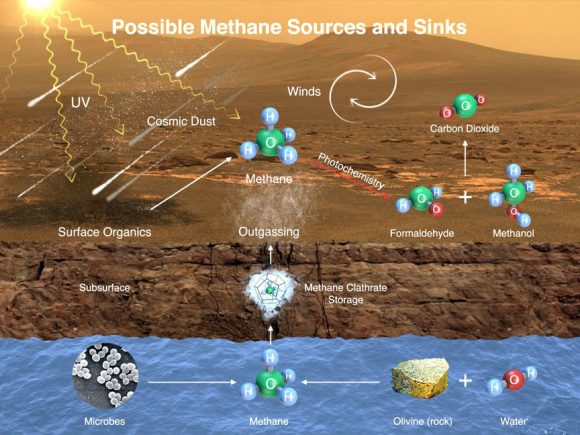



 Inara Pey: Living in a Modemworld