The following notes were taken from:
|
Table of Contents |
Please note that this is not a full transcript of either meeting but a summary of key topics.
Meeting Purpose
- The CCUG meeting is for discussion of work related to content creation in Second Life, including current and upcoming LL projects, and encompasses requests or comments from the community, together with related viewer development work.
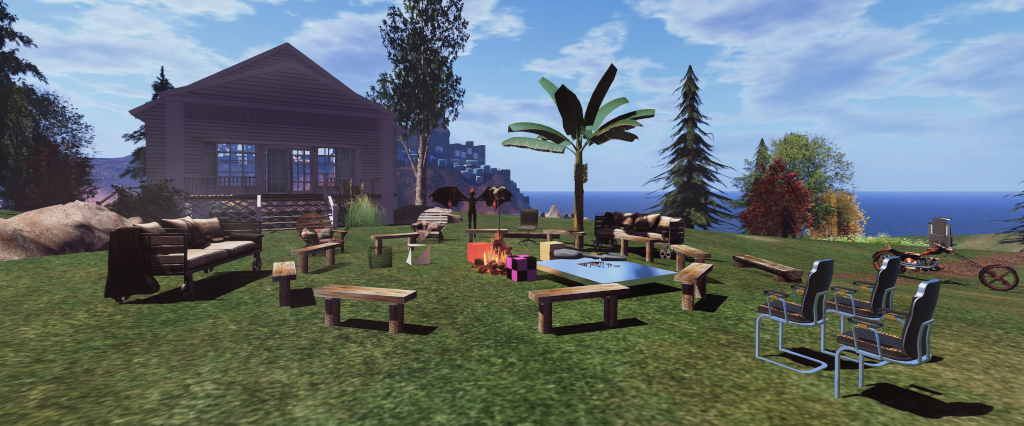
- This meeting is generally held on alternate Thursdays at Hippotropolis and is held in a mix of Voice and text chat.
- The OSUG meeting is a combining of the former Third Party Viewer Developer meeting and the Open Source Development meetings. It is open discussion of Second Life development, including but not limited to open source contributions, third-party viewer development and policy, and current open source programs.
- This meeting is generally held twice a month on a Friday, at 13:00 SLT at the Hippotropolis Theatre and is generally text chat only.
- Dates and times of meetings are recorded in the SL Public Calendar.
Official Viewer Status
- Default viewer 2025.07 7.2.2.18475198968 – Apple Silicon Support – dated October 16 – No Change.
- Release Candidate 2025.08 – 7.2.3.19375695301 – maintenance update with bug fixes and quality of life improvements – November 4 – NEW.
- Second Life Project Lua Editor Alpha (Aditi only), version 7.1.12.14888088240, May 13 – No Change.
General Viewer Updates
- 2025.08 is to be the last viewer release for 2025. This is likely to be promoted to de facto release status after the US Thanksgiving holiday.
- At the time of writing, 2025.08:
- The crash rate is improving.
- This viewer includes the VHACD convex decomposition library.
- Mesh content creators are encouraged to try the current beta of the the viewer to make sure physics hulls are working in-world, etc., given that many settings with the library are different to those used by Havok, the longer-term plan being to eliminate Havok sub-libraries from the viewer.
- The next viewer version will by 2026.01 – details of which will be made available once its likely contents have been initially settled on by the Lab.
- However, it looks like 2026.01 will include the new code for faster log-in loading of inventory for those with very large inventories, and a dedicated Linux build of the viewer.
- During the OSUG meeting, Geenz Linden indicated that another project he hopes to start moving forward with in 2026 is the Current Outfit Folder (COF) updates contributed by Kitty Burnett (Catznip), and the current plan is to get this into 2026.01.
You Tube Embedding Issue
- As a reminder:
- You Tube recently updated elements of their video embedding code such that non i-frame youtube.com/embed/NNNNN style links will not work within Second Life (whilst youtube.com/watch/NNNNN style links will still function correctly – although this latter format does expose all the You Tube on-screen video controls, etc).
- This is an issue liable to impact a variety of in-world television and similar systems utilising You Tube.
- It is very much a You Tube issue, so there is no guarantee they would remain valid / useful for any length of time.
- For further detail please refer to the official blog post: YouTube Embeds in Second Life: What Happened and How to Keep Your Media Working.
- Those finding further information on issues arising from this You Tube change should report them via the SL Feedback Portal.
SLua Update
- Back-end support for SLua is now available in Beta on Agni, the main grid.
- The SLua beta viewer, available from the official Alternate Viewers page, must be used for writing SLua code, but no specialised viewer to view SLua scripts running in-world.
- The latest SLua viewer includes the websocket to Visual Studio.
SLua Resources
- Official scripting portal (this is a work in progress and open to contributions – Github for the latter here).
- Suzanna’s SLua Guide (Suzanna Linn).
- VSCode plugin + documentation (Wolfgang Senizen – likely be discontinued and contributions shifted to support the official documentation).
CCUG Discussion – In Brief
- glTF animation upload support: this is “on the radar” for development, but is not currently an active project, and needs to be added to the current viewer roadmap.
- A request to review animation priorities was also requested, and it was suggested this might be something that could possibly be looked at within the current animation support framework.
- A general discussion on animations and priorities continued through the early part of the meeting, but no-one from the Lab with sufficient up-to-date knowledge of the animation system to provide meaningful input to the discussion.
- This discussion included the following animation feature requests: user-definable animation priorities and allow starting an animation with a specific priority, together with this proposal for animation network reworking from user Coyote Enthusiast.
- A request was made for an independent alpha channel (i.e. not linked to Diffuse/Colour channel) and available to both both Blinn-Phong and PBR that could help reduce the number of unique textures required for things like terrain, and without having to atlas huge sheets of layered details. The short answer was that this is unlikely until there is (at the very least) an opportunity to revisit texture streaming at the very least, with Geenz noting:
We’re already on some razor thin memory margins on some of our potato machines – so if we did that we’d need to find a way to make some stuff more scalable in our texture streaming tech. This isn’t a no – we need that for other things. But it’s not a 30/60/90 days thing I’m sorry to say.
Bakes on Mesh (BoM) Layering
- Better layer ordering has been put to the UI/UX team with not promises as to when it might be worked upon, although there are “other projects” the Lab is planning which would also benefit from this.
- A feature request for allowing sets / containers for/of BOM layers has been submitted, and is defined by Geenz as “interesting” and “TBD”.
- The above led to a discussion on BoM improvements (e.g. PBR materials support; blend modes of different layers; etc).
- In response to this, Geenz noted he would like to get PBR specular support, if only as a migration path from Blinn-Phong (and with the noted, “if you do this expect things to not quite look right if you mix these two”).
- This discussion involved the potential complexities / straightforward aspects of PBR specular support, providing BoM support to alpha channels, before circling back to the benefits of having better texture streaming in general and prioritising the latter to different texture slots, etc.
- This discussion touched upon BoM support for Animesh and a request for a universal alpha.
OSUG Discussion – In Brief
- Signal Linden revealed that Friday, November 21st, 2025 was his last day at Linden Lab after 10 years with the company, rising to the position of Director of Engineering.
- Signal has been the major driver in overhauling and improving the Lab / third-party/open-source relationship, which is to continue along the path Signal has set for it, improving and refining things where appropriate.
- Roxie Linden noted that there has been a WebRTC voice server update. This provides HRTF (better spatialization) as well as server crash fixes. It’s still regarded as “beta”, but the WebRTC team is looking for feedback on its usability.
- Further work on WebRTC is in progress, including spatial moderation.
- Thought is still being given to replacing Echo Canyon (Vivox Voice testing region) with a WebRTC equivalent, with Roxie Linden indicating this is now a matter of scheduling and implementation.
- Roxie’s preferred approach would be to have an ‘echo’ option with Preferences which, when used, does a full round trip to the server and back, allowing both device verification on the WebRTC service and network quality. If adopted, this will require both a server update and some viewer UI work.
- A brief discussion on potentially replacing Chrome Embedded Framework (CEF) in the viewer (e.g. to something like Servo – as this matures). The response was that CEF is unlikely to be replaced in the foreseeable future, which does not mean there will not be fixes, etc., for identified issues.
- Request for LL to provide SGV support, including for text on prims / test rendering in-world, including the following two requests:
- SVG Canvas: A way to generate dynamics graphics on prim faces (without MoaP).
- Add a Text Rendering Method.
- In response, and specifically in terms of in-world text rendering, Geenz Linden suggested that something like MSDF might be more appropriate for SL, as it allows pre-rasterizing a large collection of fonts into some really tiny textures, and get some pretty sharp text rendering that scales “pretty easily”.
- This led to a discussion on potential uses of SVG, and the advantages of SVG over MSDF, and vice-versa, and other options for in-world text rendering (and the use-cased thereof – such as notice boards, etc.).
- Geenz requested tat if there are SVG-specific use-cases before text rendering, these be recorded in a feature request Canny.
- A request was put forward to have TPV stats (usage per OS, crash rates and crash types) on a more frequent basis once more (they were at one time monthly, then switched to weekly before becoming more sporadic once more). This will be looked into.
Next Meetings
- CCUG: 13:00 SLT, Thursday, December 4th, 2025, at the Hippotropolis Campsite.
- OSUG: 13:00 SLT, Friday, December 5th, 2025, at the Hippotropolis Theatre.
 Inara Pey: Living in a Modemworld