
Goddard: Death by a Thousand Cuts?
Earlier in 2025, I wrote about the Trump administration’s apparent drive to decimate NASA’s science budget with it 2026 federal budget proposal (see: Space Sunday: of budgets and proposed cuts and Space Sunday: more NASA budgets threats). Within those pieces, I noted that one of the major targets within NASA when it came to potential cuts was the agency’s largest research centre, the Goddard Space Flight Centre (GSFC), Greenbelt, Maryland.
GSFC’s work in Earth sciences and observations – which obviously encompasses research into anthropomorphic causes of global warming and climate change, monitoring atmospheric and oceanographic pollution, etc., – is potentially the major reason for the nonsensical dislike both of Trump’s administration have shown towards the centre, although it is only in the current administration period that increasingly efforts to drastically reduce Goddard’s science abilities have been shown; efforts which overtly commenced in April 2025 with the effective discontinuing of the Goddard Institute for Space Studies (GISS – see the first of my articles linked to above).
As I noted at the time, GISS – renowned world-wide for its Earth sciences research across a number of disciplines, including agriculture, crop growth and sustainability and climatology (including building some of the largest datasets on current and past climate trends and fluctuations) has been an “off-campus” division of GSFC, operating out of the (Edwin) Armstrong Building operated by Columbia University and leased by the US government at a cost of 3.3 million a year, with said lease budgeted at this amount through until 2031.
At the end of April 2025, the Office of Management and Budget (OMB), under the directorship of Project 2025 co-author Russell Voight (and a long-time, ultra-conservative with a hefty dislike of space and Earth sciences) announced it was terminating the lease effective from the end of May 2025, with no attempt being made to relocate personnel and the majority of the GISS data. Instead, staff were simply told to “work remotely”, with the then-director of GSFC, Dr. Makenzie Lystrup, unable to do anything in the face of the cancellation, other than offer her “confidence” that all GISS staff and activities would be relocated at some point in the future – which has not happened. Instead, staff GISS remain on “temporary remote working status”, within only some of the on-going work carried out by GISS being haphazardly relocated to “temporary” facilities at GSFC and elsewhere.
Not only did the “remote working status” shift for GISS staff stand at odds with another OMB directive requiring all federal agencies end remote working practices and return staff to office-based work, the closure of the Armstrong Building facilities meant that the vast amounts of data curated by GISS had no active home, and thus could not be accessed by GISS personnel, making it impossible for many of them to continue their work.

Since then, the situation for GSFC as a whole has worsened (as it has for some other key NASA activities spread across multiple centres). In particular, the new senior management team as brought-in by the Trump Administration appears to be acting as if the the 2026 budget has been signed into law and that all of the proposals contained in it as they relate to NASA / GSFC are now policy to be enacted without question or consultation.
In fact, when the former GSFC Director, the aforementioned Dr. Makenzie Lystrup, did attempt to consult with GSFC personnel via a series of town hall meetings (as were being held within other NASA centres), she was dismissed from her post in July 2025, to be replaced by her deputy, Cynthia Simmons, who adopted a similar autocratic “follow orders, don’t question” approach as had been adopted by GSFC’s incoming Director of the Engineering & Technology Division (ETD), Segrid Harris, earlier in 2025 year.

In moving to implement the “requirements” of the Trump 2026 NASA budget, both NASA senior management and the upper management of GSFC have sought to accelerate elements of what was to have been a 20-year development roadmap for Goddard, first initiated in 2019. This was to have seen the gradual internal relocation of divisions and departments on the campus, the closure of older facilities (and their potential replacement) and the phased removal of certain activities to other NASA centres. All of this was to have been carried out in full consultation with the affected divisions and departments and their personnel.
Now, however, this 20-year plan is being accelerated without explanation or consultation, with around one-third of the campus in the process of being emptied / abandoned, with some buildings being demolished, others simply being left to an uncertain future. Rather than taking several years to complete, the work is now set to be finished by March 2026. Facilities included in this tranche of work comprise the GSFC Visitor’s Centre (and that of the Wallops Island launch facilities, also operated by GSFC), effectively ending GSFC public-facing operations; and the majority of facilities geared towards personnel welfare – health and welfare facilities, cafeterias, recreational facilities, etc., together with a number of R&D and laboratory facilities.
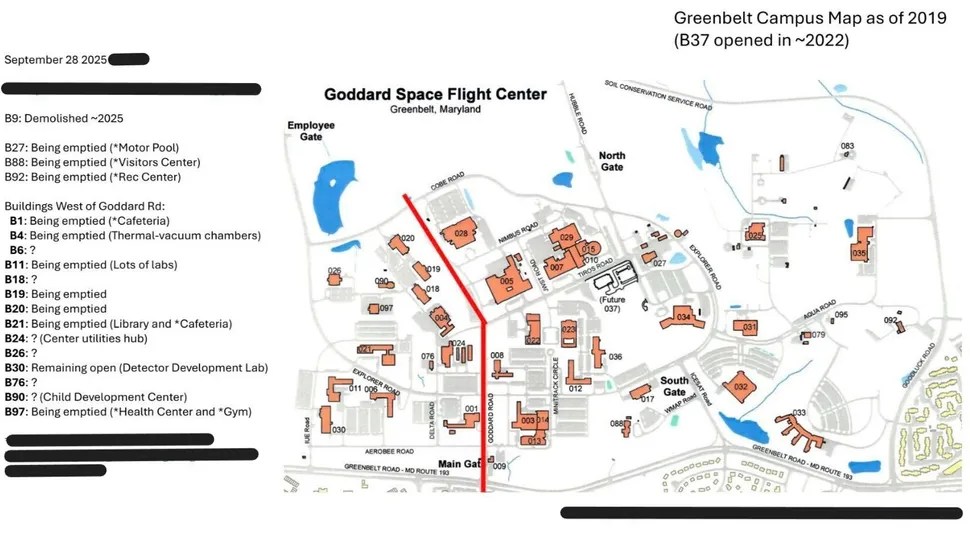
Further, despite the current government shutdown, staff in facilities and buildings earmarked for relocation / closure elsewhere within the campus were, on the day the shutdown commenced, ordered to pack-up their office space / research so they might be relocated during the shutdown. Normally, if such an office move is to be performed when federal employees are furloughed, a federal work exception must be filed by the agency involved. However, reports suggest that of the 100 office relocation notifications issued at GSFC ahead of the shutdown, only two were had the required exceptions filed. Thus, there is a concern among personnel that the shutdown might yet be used as a cover to close additional facilities at the centre.
Of particular concern among GSFC personnel is the fact that some of the proposed relocation work will see divisions which had been specifically relocated to Goddard or formed under its auspices to oversee matters of safety across related aspects of NASA’s operations, thus preventing the kind of inter-centre clashes of management which contributed to tragedies like Challenger from ever happening again, being once more broken-up among various centres, once more diluting their ability to function effectively.
Such is the level of concern both within NASA personnel at GSFC and many of its supporting / affiliated partners such as the Planetary Society – that there have already been three public protests concerning what is happening both at GSFC and to NASA’s science budget in general. The most recent of these was held on Capitol Hill on October 5th, when both the House and Senate were directly called upon to intervene in the manner in which NASA’s non-human spaceflight activities are being impacted, and to force the Executive Branch to continue to properly fund all NASA centres pending the resolution of the current budget crisis.
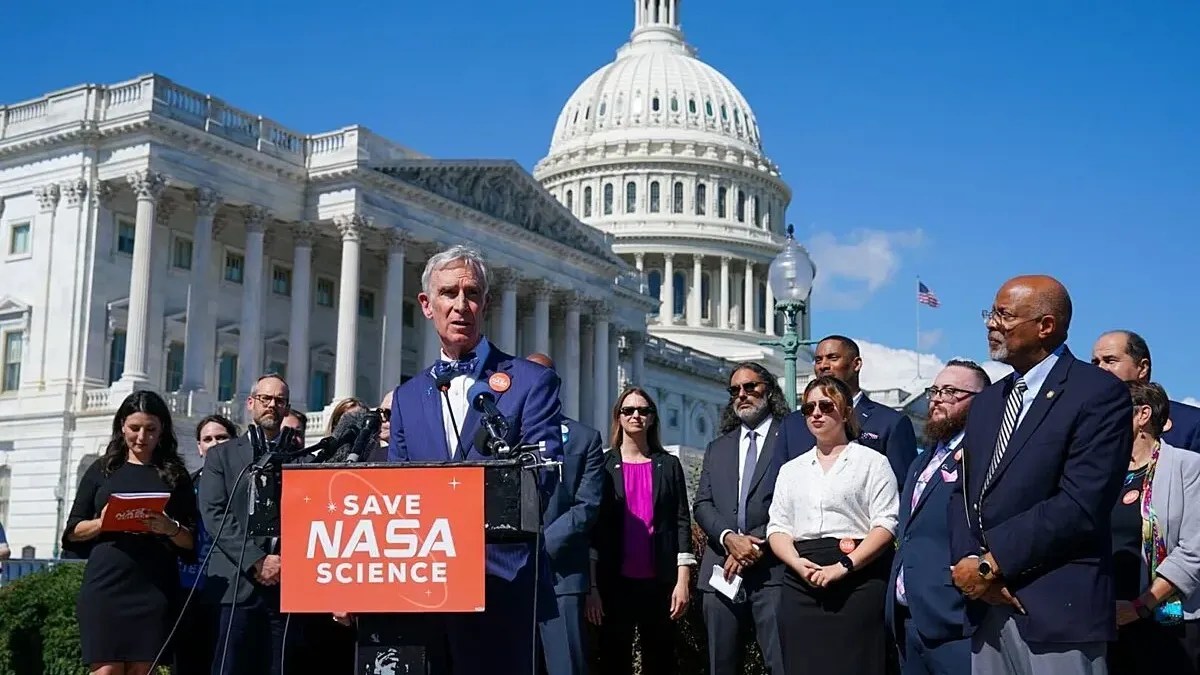
Nor is such concern limited just to NASA personnel and their affiliates. A recent report published by the Senate Committee on Commerce, Science and Transportation goes so far as to state a belief that the current actions on the part of the Executive branch where NASA is concerned could be illegal. For its part, NASA’s headquarters and the administration have responded to all concerns being voiced from all sides as being “false”, “inflammatory”, “wrong”, and – in the case of the Senate report – a “Democratic distraction”. Not only is the latter another demonstration of the Trump administration’s efforts to continually cry wolf and point the finger when their actions are rightfully challenged, it is also patently stupid, given the Senate Committee in question (as with all such Senate committees) is both Republican led and dominated (15 seats to 13), making any report it releases that is critical of the Executive branch to be bipartisan in nature.
A further irony here – which might actually be seen as both causative as well as foreshadowing – is that prior to her departure from the post of Acting NASA Administrator (to be replaced by Sean Duffy), Janet Petro issued two memos to all department heads at GSFC, stating that they should start enacting upcoming Trump’s budget requirements regardless of whether or not the budget would be passed by Congress. Exactly why she would do this is unclear, but it has been suggested that she saw it as inevitable that the Trump Administration would seek to force through their 2026 budget via funding impoundment rather than via working with lawmakers, and as such, GSFC would be better placed in being ready to adhere rather than attempting to oppose.
Currently, exactly what is going to happen at Goddard is unclear – but a lot of people at the centre have spoken out through various channels about their concerns and both the level of uncertainty at the centre and the frequently oppressive style of management now present. It is evident from this that many at the centre are completely demoralised. Earlier this year, NASA, under Sean Duffy, implemented a Deferred Resignation Programme (DRP) aimed at reducing the number of people directly employed by NASA by 20%, in line with the Trump budget proposal. At the time of writing, some 4,000 NASA employees were reported as having signed DRP agreements – 21% of NASA’s total direct workforce. Of these 4,000, 11% came from GSFC, the largest number of DRP agreements signed by staff at any single NASA centre.
On top of this, and following her ousting from Goddard as Director, Dr. Lystrup indicated that as many as 32% of GSFC’s federal staff will be departing NASA both as a result of the DRP programme and due to non-consultative re-organisations and shutdowns (as with GISS) targeting the centre. As such, the long-term future of the centre as a central pillar of NASA’s space and Earth sciences capabilities would appear to be in grave doubt.
3I/ATLAS
Comet 3I/ATLAS is the third confirmed object of extra-solar origin to be identified by astronomers as it passes through our solar system. It is also, and completely unsurprisingly, the third to be subject to all sorts of wild and completely incorrect assertions / suggestions that is is both artificial in nature and alien in construction.

I’ve covered 3I/ALTAS and some of the wild claims around it already in these pages (see here, here, and here), and as the evidence mounted that yes, it is in fact a natural object, albeit one originally formed far beyond our solar system, I’d hoped that the “alien artefact” theories would fade away. And they almost did.
However, in late September, and as it continued to close on the Sun, 3I/ATLAS “abruptly” changed colour when seen in natural light, becoming bright green. Such changes of colour are not uncommon with comets as they become more and more active as they approach the Sun and start outgassing greater volumes of chemicals and minerals trapped within them. In this, green is actually a common colour for comets, signalling as it does the presence of diatomic carbon – a chemical long-range spectrographic analysis had suggested might be present within the make-up of 3I/ATLAS. Unfortunately, this did not prevent the alien artefact theorist proclaiming the colour change as “evidence” of the comet’s artificial nature.
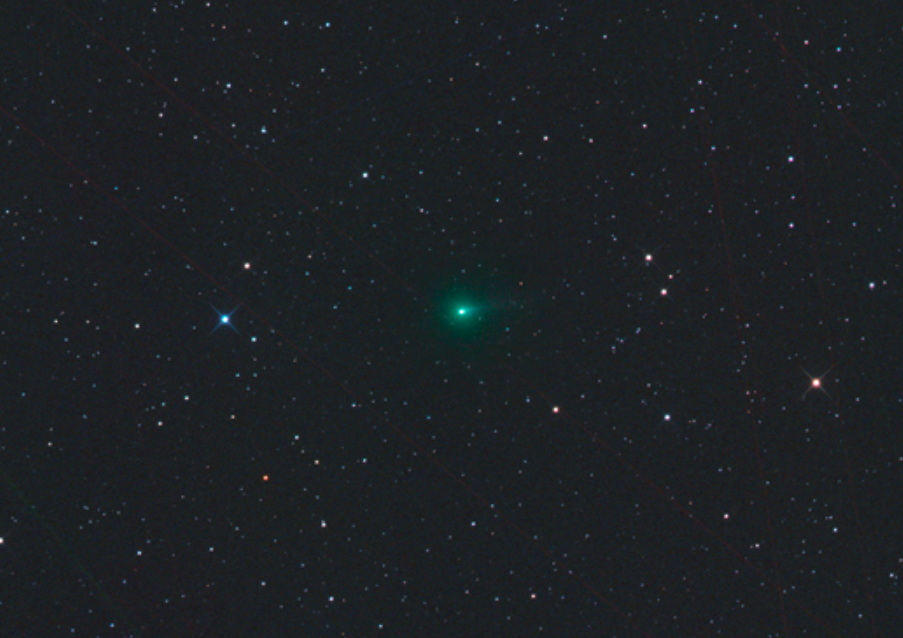
Then, at the start of October 3I/ATLAS passed within 0.19 AU of Mars, allowing it to be imaged by NASA’s orbiters and rovers. However, in order to compensation for 3I/ATLAS’ very low magnitude (+11), these attempts required long exposure times, and because the comet was moving at 58 kilometres per second relative to the Sun throughout the exposure time, the resulting images revealed the comet not as a rounded object, but one that appeared to be somewhat cylindrical in shape, once again causing the alien artefact theorists to again shout, “See! It’s artificial!”
At the same time, as this was happening, the US government shutdown commenced, halting many NASA activities, including proving on-going updates on missions and activities and things like 3I/ATLAS. However, rather than acknowledging the sudden “silence” from NASA was caused by the shutdown, the conspiracists decided it was because NASA had accidentally revealed a “hidden truth” about 3I/ATLAS in the images of it returned via the Mars missions (notably the Perseverance rover).
Oblivious to all of this, 3I/ATLAS reached perihelion on October 29th, passing the Sun at a distance of just 1.36 AU. Unfortunately, it did so on the opposite side of the Sun relative to Earth, so we had to rely on a number of deep space missions – including NASA’s PUNCH (Polarimeter to Unify the Corona and Heliosphere) mission, ESA’s Solar and Heliospheric Observatory (SOHO) and NOAA’s GOES-19 satellite – to try to capture images of the event. Sadly, the combination of comet’s small size and closeness to the Sun did not make for particularly exciting images, the latter’s brightness largely wiping out the light and colour of the comet.
However, this does not mean we are no devoid of any further opportunities to see the comet. During November, 3I/ATLAS will re-emerge from “behind” the sun as it starts to head back out of the solar system. As it does so, it will have a much higher apparent magnitude, making it an ideal target for study not only for the big observatories like Vera C. Rubin, but also potentially by anyone with a larger amateur telescope (e.g. 10-in or larger).
Most excitingly, perhaps is that during November, 3I/ATLAS will be ideally placed for ESA’s Juice mission to take a couple of peeks at it.
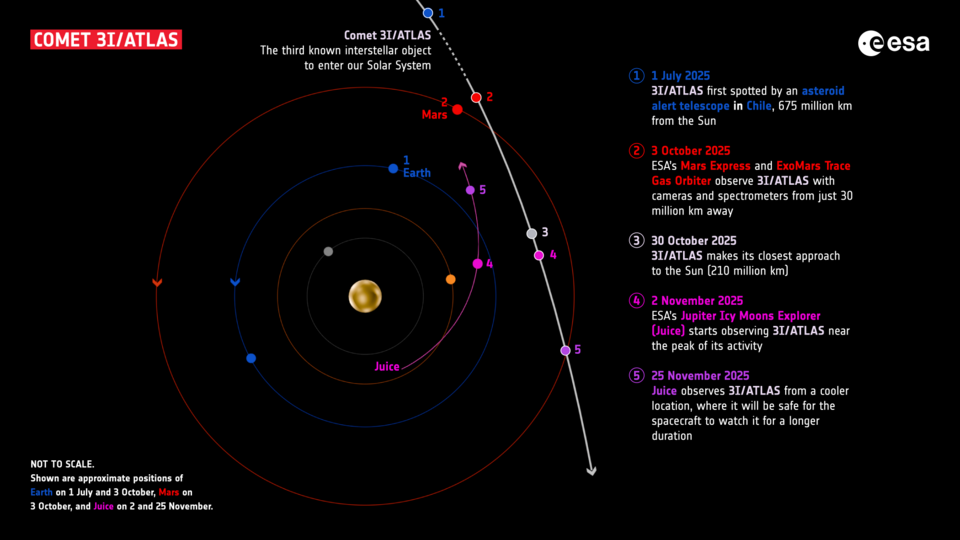
On November 2nd, 2025, Juice will be able to start a “hot” observation of 3I/ATLAS, hopefully catching it while it is still very active as it moves away from the Sun. However, this observation period will be slightly limited, as the instruments will need to be cooled between observations because they are not designed to continuously operate in the temperature environments close to the Sun. A second, “cooler” period of observation will commence on November 25th, when Juice has once more moved beyond the orbit of Earth and will be able to “look back” on the comet as it continues on its way out of the inner solar system.
All of these observations are likely to further confirm 3I/ATLAS as a remarkable interstellar comet, one much older than our own solar system; something which is a marvel in and of itself without any need to attribute its origin or presence in our back yard to some form of alien intelligence bent on mischief towards us.
 Inara Pey: Living in a Modemworld