
After delays and concerns over pressure leaks within the Russian section of the International Space Station (ISS) – see Space Sunday: frustrations and extensions and Space Sunday: Rockets, updates and Planet Nine – the Axiom Ax-4 private mission to the station finally lifted-off from Kennedy Space Centre on June 25th, carrying an international crew of four to the station.
The SpaceX Falcon Nine booster lifted-off from Launch Complex 39A at 06:31:52 UTC, carrying mission commander Peggy Whitson, a highly-experienced former NASA astronaut and now Axiom’s Director of Human Space Flight; India Space Research Organisation’s (ISRO) astronaut Shubhanshu Shukla, filling the role of mission pilot; and mission specialists Sławosz Uznański-Wiśniewski, a European Space Agency project astronaut from Poland, and Tibor Kapu representing the Hungarian Space Office.
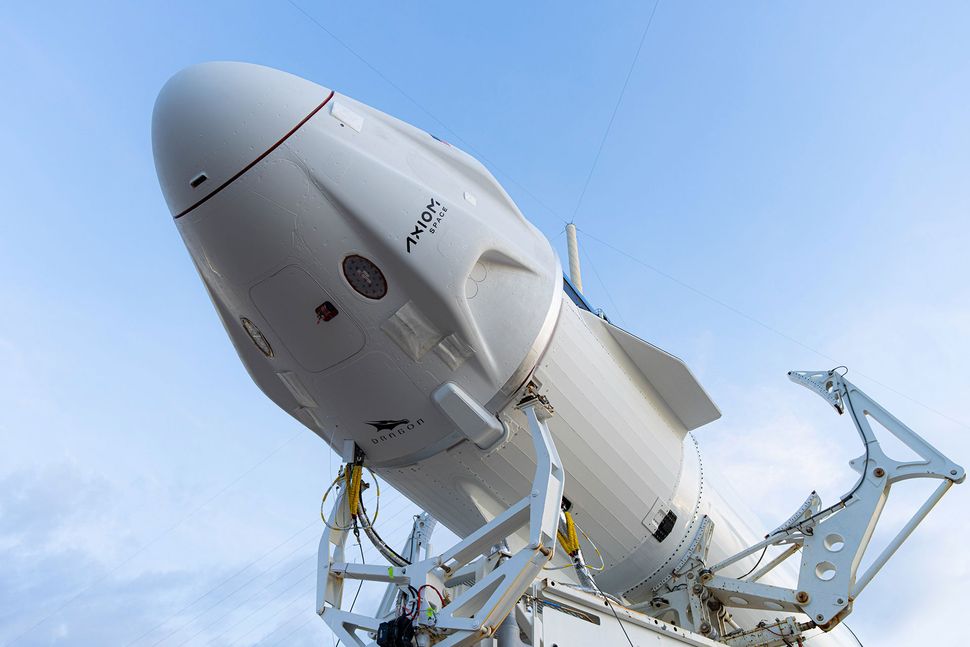
The four were flying aboard the newest Crew Dragon vehicle built by SpaceX, which the crew christened Grace following a flawless launch and ascent to orbit.
We had an incredible ride uphill and now we’d like to set our course for the International Space Station aboard the newest member of the Dragon fleet, our spacecraft named ‘Grace’.
“Grace” is more than a name. It reflects the elegance with which we move through space against the backdrop of Earth. It speaks to the refinement of our mission, the harmony of science and spirit and the unmerited favour we carry with humility. Grace reminds us that spaceflight is not just a seed of engineering, but an act of good work for the benefit of every human everywhere.
– Peggy Whitson, AX-4 Crew commander
Following launch and separation from the Falcon 9 upper stage, Grace preceded on a “slow” orbital trajectory to “chase” the ISS, rendezvousing with the station some 24 hours after launch. This allowed the crew to check-out the vehicle and perform the first of their broadcasts to Earth. Docking with the ISS took place on June 26th, at 10:31 UTC, to mark the start of a say that is designed to last at least 14 days, but could extend to up to 21 days.

Also aboard the flight are a number of science experiments, notably from Poland and India, further emphasising the international focus of the mission. The flight is especially significant for Shukla; he is the first Indian to fly into space as a part of India’s newly-instigated astronaut corps (although not the first Indian national to fly in space), and has already been selected to fly in the first crewed mission aboard India’s home-grown Gaganyaan space capsule. His time aboard Ax-4 is very much seen as preparing him for that mission. For Axiom and NASA, Ax-4, is intended to signify a desire to maintain on-orbit operations aboard space stations as an international endeavour as the ISS researches its end-of-life in 2030, and facilities such as Axiom’s own space station take over from it.
Ax-4 also carries aboard it some special treats for everyone on the ISS: Shukla and Kapu have taken along specifically-developed national dishes and treats such as moong dal halwa, carrot halwa and mango nectar, together with a specially-formulated version of Hungarian chocolate and a range of Hungarian spices to help pep-up the taste of food on the ISS. Uznański-Wiśniewski, meanwhile worked with ESA, NASA and Polish chef and restaurateur Mateusz Gessler to develop an entire menu for the Ax-4 crew which includes pierogi, tomato soup with noodles, Polish ‘leczo’ stew with buckwheat, and apple crumble for dessert.
Nor is carrying such foods simply a matter of catering to personal whims; food can have a positive psychological impact – particularly comfort foods that bring with them memories of home and which offer a departure from the more usual offerings. As such, experiments like this can help nutritionists and psychologists bring more and better varieties of meals and foods to crews on long-duration missions, bolstering their sense of well-being and comfort.
Vera C. Rubin Opens its Eyes
Located on the El Peñón peak of Cerro Pachón, a 2,682-meter-high mountain in northern Chile is the world’s biggest digital camera, a 3.2 gigapixel charge-coupled device. It sits at the heart of the Vera C. Rubin Observatory, a major new astronomy facility capable of imaging the entire southern sky every few nights.
Originally called the Large Synoptic Survey Telescope (LSST), where synoptic describes observations that give a broad view of a subject, the observatory was first proposed in 2001, with work on the 8.4-metre primary mirror starting on 2007 with the aid of private funding.

In 2010, the observatory became the top-rated large ground-based project in the 2010 Astrophysics Decadal Survey, moving to be funded through and overseen by the US National Science Foundation (NSF), with the actual funding provided by the US Department of Energy and the non-profit international LSST Discovery Alliance.
Overall construction of the physical observatory commenced in 2015, with initial testing of the on-sky observational capabilities taking place in late 2024 utilising an engineering test camera, with the First Light images captured with the observatory’s Simonyi Survey Telescope and the 3.2 gigapixel camera taken on June 23rd, 2025.
The primary aim of the observatory is designed to build a continuous survey of the southern sky over 10-years in an attempt to answer a number of questions, including:
- How did the Milky Way galaxy form?
- What is 95% of the Universe made of?
- What will a full inventory of Solar System objects reveal?
- What will we learn from watching millions of changes in the night sky over 10 years?
To answer these questions the observatory will carry out science in four principal areas:
- Understanding the nature of dark matter and dark energy.
- Creating an inventory of the Solar System.
- Mapping the Milky Way.
- Exploring objects that change position or brightness over time.
The telescope’s wide field of view is extraordinary – 3.5 degrees in diameter, or 9.6 square degrees. Combined with the telescope’s large aperture (light-collecting ability), the telescope’s optics have an imaging capability three times that of the largest-view telescopes currently in use. This means the observatory can “see” literally everything – from the smallest sources of reflected light in our own solar system to remote deep-space objects.

To achieve this, the Simonyi Survey Telescope’s 8.4 metre diameter primary mirror is supported by a 3.2-metre diameter secondary mirror, and a tertiary 5-metre mirror, the world’s largest convex mirror. Both the primary and tertiary mirrors were designed to be placed together to make the telescope very compact and easier to re-orient, which it must do quickly and efficiently each night.
Further, it allows the placement of three additional corrective mirrors to reduce image aberrations without over-complicating the optical train. This in turn allows the telescope to avoid the usual adjustable optical mechanisms required to counter atmospheric image dispersion as a telescope is repointed and encounters different atmospheric conditions. This is particularly important as the Vera Rubin must be able to bet re-point and be ready to take an image within 5 seconds after the previous image capture has been confirmed – leaving no time for the usual atmospheric adjustments.
First light with a telescope refers to the first time a telescope and its instruments capture one of more astronomical images after its construction. This moment is significant for astronomers and engineers as it is an important step towards fully calibrating a telescope and correcting potential issues within the optics so that it is ready to start formal operations.
For the Vera C. Rubin observatory, First Light tests produced images revealing over 10 million galaxies and led to the discovery over 2,000 new asteroids. Once operational, the observatory will be capable to capture more information about the universe than all the optical telescopes used throughout history thus far, combined. Its image gathering capability means it will be generate 20 terabytes of image data per night. This data will be collected and transmitted to a series of “data brokers” around the world, ensuring that the data is not only secured across multiple redundant sites, but allows the brokers to serve the information and alerts to astronomers and research centres globally.
To assist in making sure astronomers and institutions can access the data and images they are interested in, the cloud-based data brokers are supported by a dedicated system called Data Butler. This holds all the relevant metadata for every image captured by the observatory, allowing astronomers with access to it to query it using astronomical terms – object type, time scale of observations, object co-ordinates, etc., and receive the images they need.

The alert system allows the system to identify “transients”, unexpected events which could require an immediate response by astronomers: things like supernovas, kilonovas that produce gravitational waves, novas, flare stars, eclipsing binaries, magnetar outbursts, asteroids and comets moving across the sky, quasars, and so on.
Once operational it is expected that the observatory will issue up to 10 million such alerts per night, all of which will be parsed through the Data Brokers, allowing the system to analyse them and determine what should be immediately passed on to astronomers for further / detailed investigation.
In all, the Vera C. Rubin Observatory – named for Vera Florence Cooper Rubin, the American astronomer who pioneered research into galaxy rotation rates which is seen as evidence for the existence of dark matter – is set to revolutionise our visual understanding of the universe, our galaxy and our own solar system. However, there is a cloud on the horizon.
As it moves towards entering service, the observatory’s major source of funding, the National Science Foundation, is facing significant budget cuts and uncertainty about its future operation allocation.
Under the Trump Administration’s budget, NSF is set to have its budget cut by 56%, from US$8.83 billion under the Biden Administration to just US $3.9 billion. Already, the Trump administration has frozen or terminated 1,600 NSF grants. While on the day following Vera C. Rubin’s First Light test, 1,800 NSF staff were informed the administration intends to remove them from their current headquarters building as a part of “government efficiency”. Ironically, NSF only moved into the building under the first Trump administration. Worse, no word has been given as to where NSF staff are to be relocated. As a result, the attempt to displace the NSF is meeting strong resistance from both Capitol Hill and the American Federation of Government Employees (AFGE).
The particular concern for the Vera C. Rubin observatory is that if the Trump budget passes as is, the NSF’s Mathematical and Physical Sciences Directorate, which is responsible for funding astronomical activities under the NSF’s remit, will only have an operation budget of US $500 million. This means that optical and radio centres such as Kitt Peak, and Cerro Tololo Inter-American Observatory some 10 km from Vera C. Rubin, are to be “phased out” of the NSF’s budget, with the hope their operations can be transferred to “other organisations”. Similarly, the Nobel Physics Prize winning Laser Interferometer Gravitational Wave Observatory (LIGO), is to have its budget reduced by 40%, resulting in the closure of one of its two facilities, reducing its effectiveness enormously.
In response to concerns the Trump Administration emphasises “support” for the observatory, noting its 2025/26 budget allocation is increased from US $17.7 million to US $32 million over 2024/25. However, the former budget amount was for the final development phase of the project, not operations, and the US$32 million promised to the observatory is some 20% less than had been requested in order for it to start observational operations.
These concerns aside, the First Light images from Vera C. Rubin are astonishing – and one hopes the observatory will be funded to a point where it can complete its initial 10-year mission.

 Inara Pey: Living in a Modemworld