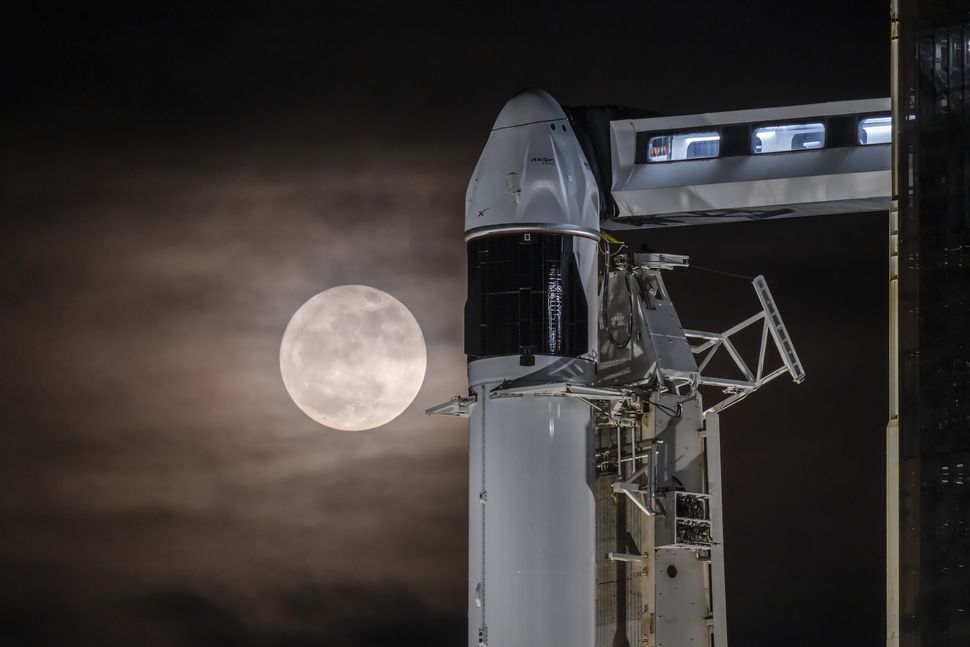
Axiom Space, one of the leading contenders to take over low-Earth orbit space station operations for the United States once the International Space Station (ISS) ends its career, has been encountering frustrations as it tries to get its fourth crew to the ISS.
Axiom Mission 4 (Ax‑4), comprising a four-person crew, had originally been scheduled to lift-off on a 2-3 week mission to the ISS in early spring, using the Crew Dragon Endurance. That launch target was pushed back when SpaceX admitted they would not have their newest Crew Dragon ready for the planned launch of the Crew 10/Expedition 72 mission to the ISS – the so-called “rescue” mission (which it wasn’t) for astronauts Barry Wilmore and Sunita Williams.
Because of this, result Endurance had to be swapped into the Crew 10 mission to avoid the latter slipping (ironic, given the SpaceX CEO was at the time screaming that President Biden was responsible for no “rescue” having been launched). With the two Crew Dragon vehicles swapped, May was targeted for Ax-4, utilising the new Crew Dragon vehicle. That date was pushed back to June 8th, when it was realised final check-outs of the new vehicle weren’t going to be completed on time – only for the weather to intervene, it being too poor over the recovery area on the 8th to enable a safe recovery of the capsule in the event of an ascent abort.
June 11th was finally targeted as the launch date, only for NASA to cancel it after it came to light that SpaceX had been playing down a propellant leak identified during a June 8th static fire test of the booster’s Merlin engines (such pre-launch tests are standard feature of Falcon 9 launches). After revealing the leak after the test, SpaceX insisted it would not impede any launch – only to then state on June 10th that they needed a launch delay in order to correct the issue.
The leak – within the booster’s liquid oxygen feeds – had been noted during the booster’s previous flight in April 2025, but had not been properly resolved during the rocket’s refurbishment following that flight. As a result, Ax-4’s launch was pushed back to June 12th.
Then, if all the above weren’t enough, a long-running issue of pressure leaks within the Russian modules of the space station reared its head once more, initially causing NASA to inform Axiom that it was postponing any launch clearance for the mission “indefinitely”.
As I’ve previously noted numerous times in these pages, all of the major elements of the Russian portion of the ISS are “out of warranty”; that is: they are now exceeding their planned operational life span. Even the Nauka (“Science”) module, which arrived at the ISS in 2021, was originally laid down in the early 1990, and 70% complete by the end of that decade – meaning much of it is now exceeding its 30-year life span.

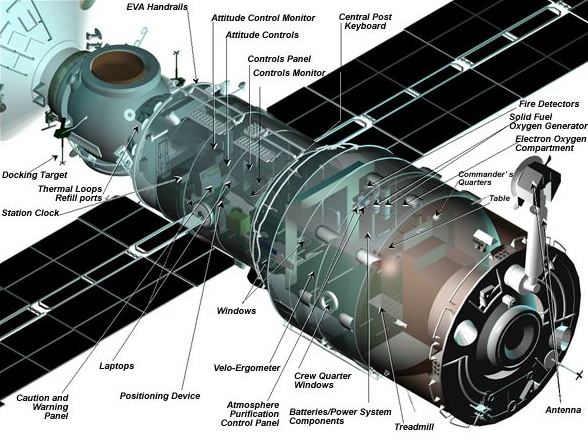
Nauka is mated with the Zvezda module, the core segment of the Russian portion of the ISS, and this has a history going back to the 1980s. At one end of Zvezda is a small transfer tunnel, or “vestibule”, which connects directly to the module’s aft docking port. This port is generally used by Russian Progress resupply vehicles when delivering materiel to the ISS, and so sees a lot of use. Since 2019, the vestibule – referred to as PrK in Russian parlance – has suffered ongoing pressure leaks. By April 2024 the leaks had in NASA’s eyes reached a critical threshold: 1.7 kg per day of atmospheric loss. Whilst Roscosmos disagreed with NASA’s assessment that the leaks pointed to a potential catastrophic failure with PrK, it was agreed to keep the inner (Zvezda-side) hatch on the tunnel shut at all times other than when in active use.
Although this reduced the overall amount of daily pressure loss, the leaks within PrK have remained a concern. This was heightened recently when the pressure loss started to rise again, suggesting the seals on the hatch between Zvezda proper and PrK might be failing, and this is what caused NASA to place the AX-4 mission on “indefinite” hold while Roscosmos acted to fix the issue.
On June 13th, Roscosmos indicated the further micro-cracks within PrK’s inner walls had been sealed, and the cosmonauts on the station would be carrying out regular pressure checks. They made no mention of NASA’s concerns over the state of the seals on the hatch itself. After two days of monitoring, NASA agreed the leaks had once again been stabilised, and on that basis provisionally cleared the AX-4 mission for a potential launch as soon as June 19th, providing the leaks in the PrK did not resume.
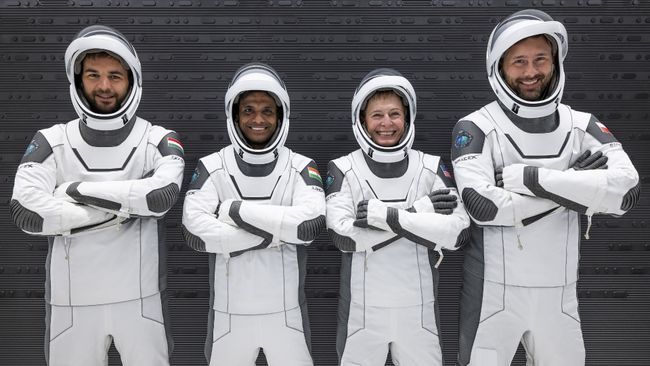
When it does eventually launch, Ax-4 is set to spend up to three weeks at the ISS, with the crew carrying out a range of science experiments and research. The crew is commanded by former NASA astronaut Peggy Whitson, one of the most experienced people to have flown is space, clocking up a total of 675 days in orbit and an impressive 60 hours and 21 minutes of EVA time. She also served as NASA’s Chief of the Astronaut Office for three years between active duty stints as an astronaut. In 2018 she retired from NASA to join Axiom as Director of Human Spaceflight.

Joining Whitson are Shubhanshu Shukla of the Indian Space Research organisation, Sławosz Uznański-Wiśniewski, an ESA astronaut hailing from Poland and Tibor Kapu of the Hungarian Space Organisation, all of whom are making their first trips to orbit. The international mix of the crew is intended to underscore Axiom’s (and NASA’s) desire to maintain the levels of international co-operation in orbital activities beyond the ISS.
In this, Shukla’s presence is seen as particularly important: an Indian Air Force test pilot, he was selected in 2024 as one of the first four astronauts to fly the first crewed mission aboard India’s Gaganyaan crew-capable spacecraft. This flight is currently targeting a 2027 launch (allowing for three uncrewed test flights in 2025/2026). Flying AX-4 as mission Pilot will give Shukla invaluable experience ahead of the Gaganyaan-4 mission.
It is not currently clear if his back-up, Prasanth Nair – who has already been named the Commander of Gaganyaan-4 – will have a similar opportunity to experience spaceflight ahead of that flight; The Ax-5 mission is due to fly to the ISS in May/June 2026, but the crew for that mission has yet to be announced as appears to be subject to some degree of competition between nations.
China Prepares for On-Orbit Satellite Replenishment
If it hasn’t already happened, China could be about to undertake its first automated satellite refuelling test in geostationary Earth orbit (GEO), roughly 35,786 km above the surface of Earth. The mission is part of a broader programme as China develops capabilities to dispose of defunct satellites and refuel / service others to extend their lifespan.
The project was initiated in 2016, with the launch of Shijian-17 (SJ-17). “Shijian” is a name China uses to describe various satellites intended to test capabilities and technologies that may be used in future space activities; as such it can be translated as “practice”. Since the 1970s, Shijian vehicles have been used to test systems and capabilities related to Earth observation, signals intelligence, communications, space environment monitoring, space-based agriculture, optical imaging, ICBM launch monitoring, etc.

At the time of its launch, SJ-17 caused concern in some quarters as it carried a robotic arm, which some in the west suggested could be used to grapple satellites belonging to other nations and drag them off-orbit – or worse, be used as a kinetic force to physically damage them. China’s eventual statement that the vehicle was intended for “space debris remediation” at geostationary orbit altitudes did little to quell the rumours; nor did SJ-17 behaviour following launch. Over multiple months, the vehicle moved between widely varying orbits, often coming to with 55 km of other satellites – not all of them Chinese – and spending multiple days “shadowing” them. Eventually it settled into a parking orbit, where it remains, still operational.
In October 2021, China followed-up SJ-17 with Shijian-21. This again caused concerns in the West as its launch was far more secretive than most, and about a month after it entered orbit, a secondary vehicle appeared to separate from it, and the two proceeded to orbit in very close proximity to one another, with China saying nothing, other than SJ-21 was designed to remove defunct satellites from orbit. They demonstrated this in 2022, when SJ-21 left its unidentified companion to rendezvous and dock with the expended Beidou G2 (Compass G2) navigation satellite, before hauling it to a much higher “graveyard” orbit, leaving room for another satellite to take its place. After depositing Beidou G2, SJ-21 returned a geostationary orbit where it has remained up until earlier this year.
In January 2025, China launched SJ-25, defined as a satellite refuelling and life extension vehicle. After SJ-25 entered its own geosync orbit, it was noticed that SJ-21 had apparently woken up and had commenced manoeuvring. Over several months, SJ-21 altered its trajectory and track to bring it into a more-or-less similar orbit to SJ-25.
At the start of June 2025, SJ-25 commenced refining its position, slowly closing on SJ-21. By June 9th, the vehicles were in absolute lockstep, SJ-25 trailing SJ-21 by some 1,500 km, and closing its orbit by some 1.5° per day. Given SJ-25’s slightly faster velocity, it was anticipated that the two could be in a position to rendezvous and dock any time after June 12th, allowing time for SJ-25 to slow itself sufficiently and gently to achieve such a goal.
As of writing this piece, there have been no reports to confirm any such rendezvous. However, if they do, and the intent is to transfer propellants from SJ-25 to SJ-21, it would be a major achievement for China in developing the ability to extended the lifespan of many of their more expensive and complex satellites.
Just how beneficial this could be has already been demonstrated by the American-built Mission Extension Vehicle-1 (MEV-1), which coincidentally saw the end of its first mission in April 2025.

Initiated as a start-up private venture in 2010, the Mission Extension Vehicle programme is now owned and managed by Northrop Grumman, with MEV-1 the programme’s first demonstrator / operational vehicle, launched in 2019 (MEV-2 was launched in August 2020). Following its arrival in geostationary orbit, MEV-1 gradually adjusted its orbital track and altitude to rendezvous with communications satellite Intelsat 901 (or IS-901).
Originally launched in 2001, with a planned operational life of 13 years, IS-901 was still fully functional in 2019. However, its orbital slot was required by the newer and more capable Intelsat 37e satellite. To this end, and some 5 years over its planned lifespan, IS-901 had been commanded to move itself out of its slot and into a higher “graveyard” orbit. However, rather than being decommissioned, it was placed in hibernation.

This allowed MEV-1 to reach it in February 2020 and make a successful docking. Mev-1 was then used to carry out remote checks on the communications satellite to ensure it was still functional despite its hibernating status. With a confirmation IS-901 could be fully revived, MEV-1 towed it to a new geostationary orbit, where it remained mated to the satellite to provide orbital correctional capabilities and additional power. This allowed Intelsat to bring IS-901 fully back on-line and operate it for an agreed further five years from April 2020 to April 2025.
In April, IS-901 was moved back to its “graveyard” orbit where it was decommissioned. Separating from it MEV-1 commence manoeuvring to rendezvous with its next target, the Australian GEO communications satellite Optus D3, launched in 2009. Once mated, MEV-1 is expected to allow Optus D3 to remain operational for a further 5-7 years.
 Inara Pey: Living in a Modemworld