Meeting Purpose
- The CCUG meeting is for discussion of work related to content creation in Second Life, including current and upcoming LL projects, and encompasses requests or comments from the community, together with related viewer development work.
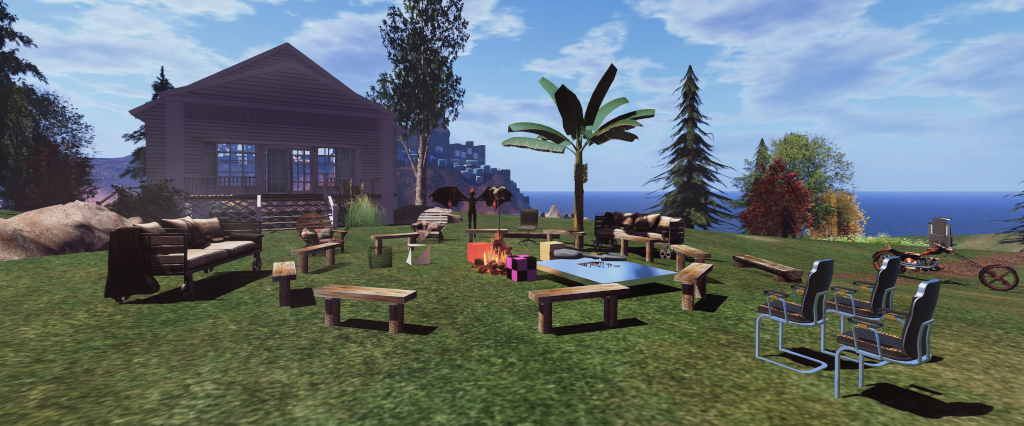
- This meeting is generally held on alternate Thursdays at Hippotropolis.
- Dates and times of meetings are recorded in the SL Public Calendar, and they are conducted in a mix of Voice and text chat.
Official Viewer Status and Updates
Viewer Status
- Default viewer: 2025.03 7.1.13.14343205944, issued April 9th and promoted April 15th.
- New UI element for water exclusion surfaces: Build / Edit floater → Texture Tab → Hide Water checkbox.
- The maximum amount of Reflection Probes can now be adjusted to better accommodate low VRAM scenarios.
- Values will be set automatically depending on your chosen graphics quality. OR
- Use Preferences → Graphics → Advanced Settings → Max. Reflection Probes to manually set.
- An issue with being unable to see Sky Altitude values in the Region/Estate window has now been resolved.
- Preferences → Graphics → Max. # of Non-Imposters has been renamed Max. # of Animated Avatars for clarity.
- Bug and performance fixes and memory optimisations.
- Release Candidate: 2025.04 – 7.1.14.14742193597, Issued May 2nd 2025.
- Includes the following new features:
- Chat Mentions (Early Support): Type @ then pick a name. To follow: audible alerts and highlight colour pickers.
- My Outfits subfolders: now supports the use of subfolders.
- Key updates:
- Build Floater improvements: increase to scale boundaries; Physics Material Type now updates when selecting linked objects; Repeats per Meter value no longer incorrect for non-uniform sized objects.
- Hover height: the minimum/maximum is now +/- 3 meters – requires a simulator-side update, currently in the process of being deployed.
- Snapshot floater: L$ balances can be hidden independently of the rest of the UI.
- Preference Search bar: general usability and readability improvements.
- Refer to the release notes for full updates and fixes.
- Includes the following new features:
- Second Life Project Lua Editor Alpha, version 7.1.12.14175675593, April 2nd.
- Will only work on Aditi. Blog post: Lab officially announces Luau Alpha testing.
Upcoming Viewers
2025.04
- See above.
2025.05
- Internal discussions on what form this should take remain in progress.
- As a result of delays with 2025.03 and 2025.04, coupled with a need to consider how to better offer viewers with features / capabilities user will find valuable, rather than simply lobbing buckets of changes and updates into each release, the viewer team is backing off of the idea of a monthly release cadence for the immediate future.
More on the glTF Mesh Uploader
- Overall, the focus remains on getting the flow of model uploads working smoothly and in providing the same capabilities when uploading glTF models as is currently the case for COLLADA models.
- However, there will be some constraints on capabilities:
- Higher vertex limits on uploads will not be supported for glTF, as it is described as requiring a “whole mesh format upgrade”, which requires further thought before moving in that direction. As such the current 65K vertices per face limit will apply to glTF model uploads.
- Due to the complexity, and until things can be re-thought, glTF materials cannot be imported as a part of a glTF mesh (outside of the Base Colour map); they must be imported separately and then applied. Direct import of glTF materials as a part of a glTF mesh requires an large refactoring of code which is not possible in the immediate future.
- The above point prompted the question from Geenz on whether people would prefer the Base Colour to be uploaded, or simply just have a blank face provided until such time as full glTF materials can be imported with the mesh. Opinion at the meeting leaned towards the blank surface.
In Brief
- [Video: 6:02-7:10] Feature request: Make Appearances Height = Prim Height – responded to as “something that could be looked at”.
- [Video: 15:25-20:21] Are there plans to support Unreal Engine? – No, and defined as “probably never happening”.
- This led to a question about supporting Unreal Engine plug-ins and perhaps getting plug-in support for Marvelous Designer, often used as an adjunct to making and rigging SL clothing (in fact, Linden Lab struck a deal with MD so a plug-in could be provided for the Sansar platform and its avatars).
- While not averse to the idea of plug-in support, it was noted that in respect of rigging to the avatar skeleton, the latter would need additional work to make it offerable to third-parties to support.
- This led to a general acknowledgement and discussion on the need for better pipelining to support popular tools, what those tools might in fact be, beyond Blender, how widespread is their use, availability of SDKs, convergence in trends (e.g. towards OpenUSD) – although how this might all be achieved is a head-scratcher.
- Overall, such work is seen as “worth discussing” but well beyond the current roadmap.
- [Video: 20:24-25:52] In terms of the SL skeleton, it was stated that “everyone” uses Avastar – including the Lab -(although the MayaStar plugin by Cathy Foil also gets good usage), due to the SL skeleton having issues.
- Geenz suggested the way to offer easier compatibility between the SL skeleton and commercial tools like MD would be to get the skeleton files updated and offer them as glTF and / or OpenUSD downloads.
- This grew into a general discussion on the skeleton, its complexity compared to other games / platforms, etc.
- [Video: 25:52-33:30] A general discussion on the Avatar Welcome Pack, specifically some of the shortfalls in how it has been put together.
- Some of the issues are known, and have been raised by the creators who provided the content for LL to bring together, others may not have been identified.
- The request is for any issues identified by experienced users opting to try / test the avatar, etc., to be filed as a bug report.
- It was also noted that clearer instructions were not provided with the Avatar Welcome Pack – such as *copying* a body folder / outfit from the Library to Inventory, rather than adding / wearing an avatar or outfit directly from the Library (and thus spawning multiple copies in Inventory.
- In relation to the above, Kyle Linden suggested the Lab offer the pack’s contents on a Lab-driven Marketplace store to help with discoverability, and this was positively received.
- [Video: 33:35-38:24] A discussion on lighting – “block” (aka volume) lighting, improving the flexibility of lighting in SL, implementing physically based lighting capabilities, etc.
- [Video: 41:20-46:29] A discussion on filling the “voids” between continents and regions with water / air open space to allow free passage to boats and aircraft, and why this currently in not feasible on technical or financial grounds.
The system complexity of doing is so enormous … to do that, we’d have to either run a single server in each one of the void spaces, which would obviously put us out of business overnight [fees to Amazon] or… to build mega regions. But the trick to those mega regions need to sit on top of existing regions, or something. Because otherwise, you have the protocol for cross-region communications at the boundaries, and you no longer have cardinal boundaries. Every programmer here can imagine the horror of going from having one neighbour to your left to having between 1 and 600 neighbours to your left, or something. We just didn’t code Second Life that way, so that we could have regions of different size adjacent to each other. I don’t know how to solve that … I don’t have an easy answer off the top of my head.
- [Video 48:13-54:30] General comments on providing VR support – options, issues, technical hurdles.
Next Meeting
- 13:00 SLT, Thursday, May 15th, 2025, at the Hippotropolis Campsite.
 Inara Pey: Living in a Modemworld