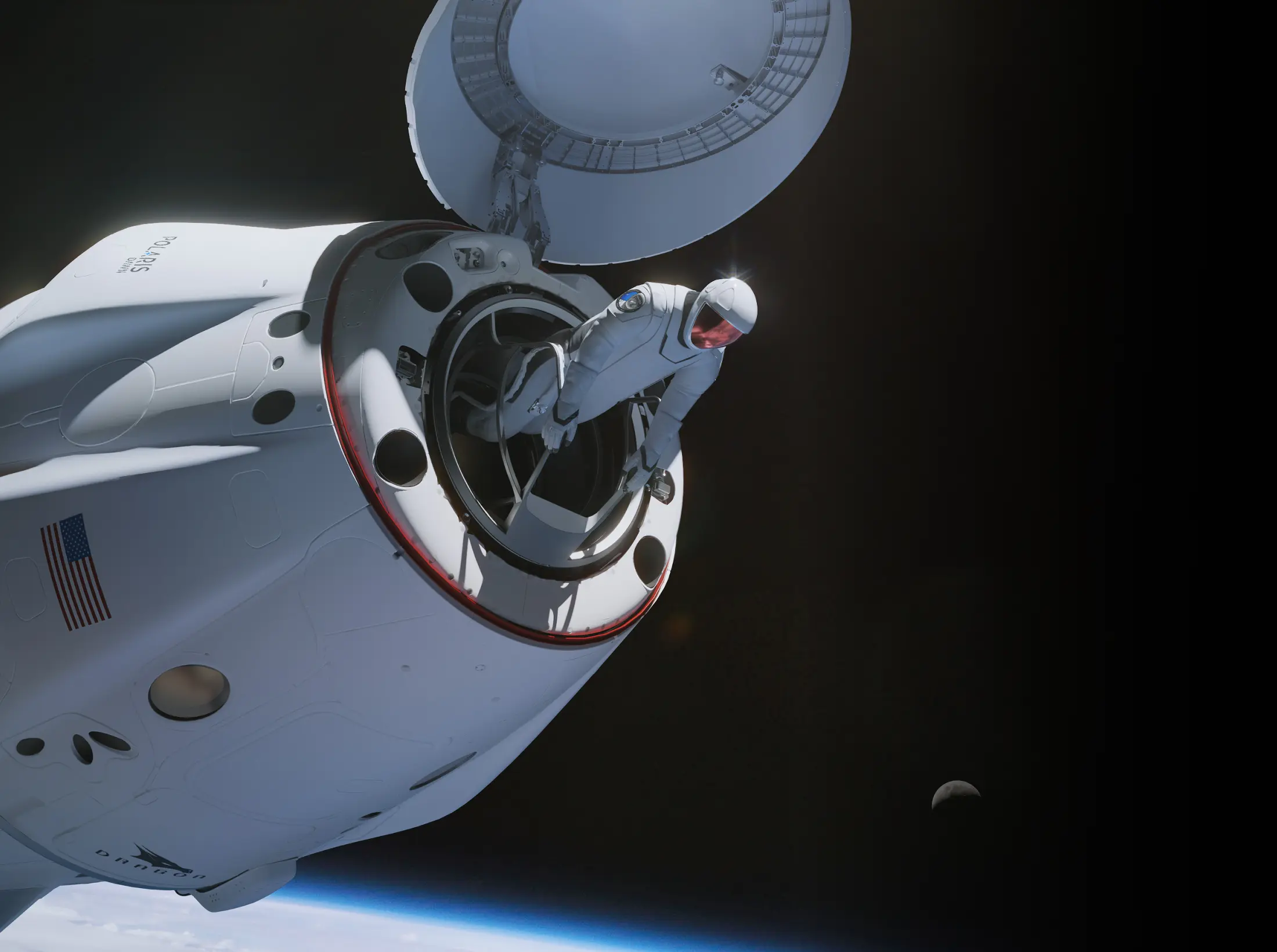
August 27th is due to see the launch of a ground-breaking flight into space which is both daring and possibly questionable. Entitled Polaris Dawn, it is slated to be the first private-venture / commercial spaceflight to feature an EVA – “spacewalk” – and a flight that will carry humans the farthest from Earth since Apollo.
The mission is due to lift-off from Kennedy Space Centre at 07:38 UTC on the morning of August 27th, carrying four “citizen astronauts” into a highly elliptical orbit around the Earth. This will reach a maximum apogee of 1,400 km, putting the crew inside the Van Allen radiation belts, thus providing one of the medical goals for the mission.
Polaris Dawn is one of three such missions that are being led and paid for by billionaire Jared Isaacman. It will mark his second flight into orbit; the first being in 2021, when he paid for and led the Inspiration4 private mission also using SpaceX. This mission flew a crew of paying private citizens around the Earth as part of a multi-million dollar fund-raiser for St. Jude Children’s Research Hospital in Memphis, Tennessee (and for whom Polaris Dawn is continuing to raise money). However, Polaris Dawn is far more ambitious.

Following launch, the Crew Dragon vehicle, comprising the capsule Resilience – also the craft used for the Inspiration4 mission – and a power and propulsion service module (“trunk” in SpaceX parlance) will be placed into an orbit with an apogee of 1,200km, which all then be raised to 1,400 over a number of orbits. These initial orbits will repeatedly pass through South Atlantic Anomaly, exposing the crew to the same amount of radiation in just a few orbits as a crew on the ISS would experience in some 3 months in space. The purpose of this is for researchers to gain, “Valuable research into the health effects of space radiation and spaceflight on the human body.”
On the second day of the flight, the orbit will be lowered and circularised at 750 km as on-board experiments are carried out, including testing the viability of the SpaceX Starlink system for use in crewed missions “to the Moon, Mars and beyond”. Then, on flight day 3, the EVA will be carried out with two of the crew carrying out the spacewalk in a manner harking back to the early days of spaceflight.
In the modern era, EVA – extra vehicular activities – are carried out in self-contained suits complete with life support systems – backpacks, if you will – to supply them with breathable air and vital cooling. The suits the Polaris Dawn crew will be using aren’t self-contained per se; they have no backpacks but instead rely on an umbilical connected to the spacecraft to provide the wearer with air and cooling. This is where some has raised concerns about the flight, together with the manner in which it must be carried out. Resilience does not have an airlock through which EVAs can be made; instead, the entire vehicle will have to be depressurised and the forward hatch (normally fitted with the mating mechanism for docking with the International Space Station) opened., exposing the craft’s entire interior to the vacuum of space.
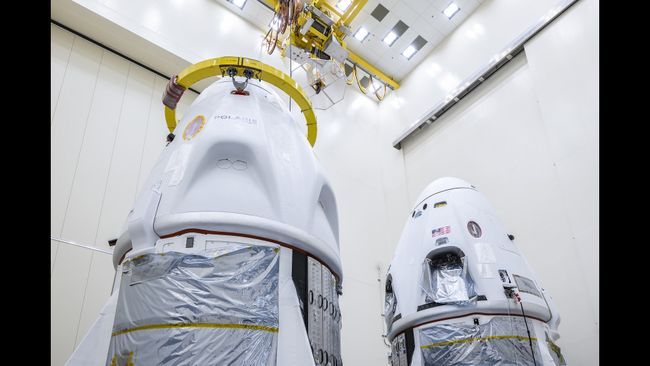
This means the vehicles electrical and power systems have had to be specially updated for the flight. As there is no airlock, it further means that all four crew must be in EVA suits for the spacewalk to take place. As space suits work at a lower atmospheric pressure than the human body is used to, any EVA generally requires the astronauts spend time within an airlock pre-breathing an oxygen mix to remove nitrogen from their blood and organs – which might otherwise cause decompression sickness (also called “the bends”) when returned to a normal atmospheric pressure.
However, as Resilience doesn’t have an airlock, the entire crew will commence pre-breathing roughly an hour into the mission and continue to do so over the first two days of the mission as the pressure within the craft is reduced from 100.0 to 59.6 kPa (14.5 psi to 8.65psi), and enriched with oxygen, meaning all four crew with have to go through decompression after the EVA and prior to their return to Earth – the overall mission elapsed time expected to be around 5 days.
The 15-20 minute spacewalk itself will be carried lout by Isaacman and a Sarah Gillis, the senior space operations engineer at SpaceX, with retired US Air Force pilot Scott Poteet (mission pilot) and SpaceX lead space operations and a mission director Anna Menon remaining in the main capsule ready to provide assistance. The purpose is ostensibly to test the new SpaceX EVA suit – an evolution of the suits used by crews flying to the ISS aboard Crew Dragon, but featuring improved insulation and thermal protection (adapted from elements of the spacecraft’s own thermal insulation), improved mobility and helmets equipped with heads-up displays.

Polaris Dawn is a fascinating venture, although it might be argued that several of its goals might be achieved just as well through other means. It’s also something of a high-risk venture for those directly involved as crew and for private-sector spaceflight as a whole. If successful (as I hope it will be), it could open the doors wide for more private-sector activity in space; however, if it fails, it has been claimed it could have major repercussions on commercial spaceflight, up to and including plans by Axiom and Blue Origin / Sierra Space and others to operate orbital facilities intended to replace the ISS.
Starliner Update: A Tale of Two Returns
On August 24th, NASA provided an update on the overall status of the Boeing Starliner CST-100 Crew Flight Test.
Originally stated to last a little over a week in early June 2024, the flight – with astronauts Barry “Butch” Wilmore and Sunita “Suni” Williams – has experienced a series of issues relating to the propulsion / manoeuvring systems on the Starliner’s service module, forcing it to remain at the ISS.
Boeing had thought they’d found a way to address the core issues as a result of a series of comparative “hot fire” tests on Earth and aboard the vehicle at the space station, however, a detailed review of the data from the last set of tests carried out at the end of July revealed what appears to be wear-and-tear on valves within the system might might also impact the reliability of the vehicle’s thruster systems during critical manoeuvring prior to the service module being jettisoned during a return to Earth.
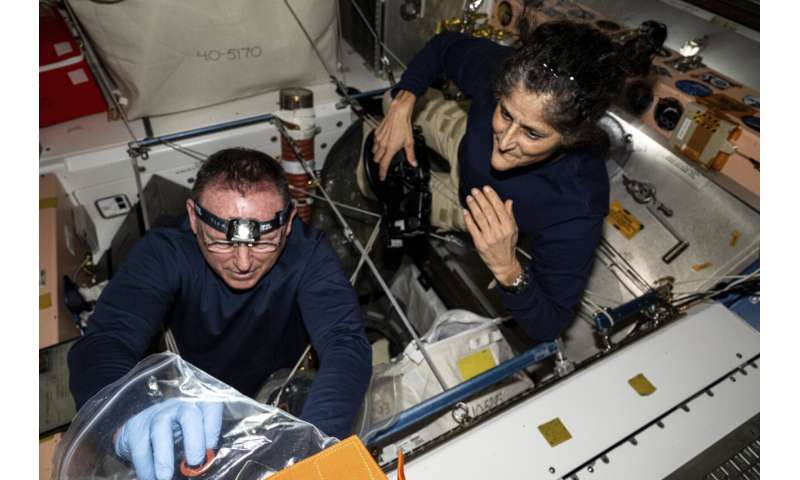
While Boeing has remained adamant the vehicle can make a crewed return to Earth, after seeking input from multiple internal teams, and with the shadows of the Challenger and Columbia disasters ever-present, NASA has made the decision not to use Starliner to return Wilmore and Williams to Earth. Instead, they will now return to Earth aboard the SpaceX Crew 9 / NASA Expedition 72 Crew Dragon, something I’d speculated might be the case when last reporting on this situation back on August 11th:
The most likely scenario for this would launching the Crew 9 mission with only two people on board – most likely Commander Zena Cardman and Pilot Nick Hague, leaving 2 seats free for Williams and Wilmore (although their space suits are different to those used by SpaceX, so this would have to be worked through). Wilmore and Williams would then remain aboard the ISS as a part of the Crew 9 rotation (Expedition 72), returning to Earth with Cardman and Hague in March 2025.
– This column, August 11th, 2024
(side note: One small adjustment to the above statement is that it appears as if cosmonaut Aleksandr Gorbunov will fly the mission in order for NASA to maintain its seating agreement with Roscosmos.)
This means Starliner will now make an automated return to Earth some time ahead of the Crew 9 launch, currently slated for no earlier than September 24th. As I also noted in my August 11th piece, Starliner can in theory do so; unlike Crew Dragon, it is fully capable of fully automated flight, the system being tested during the unscrewed Orbital flight Test-2 in May 2022. The wrinkle here being that OFT-2 used the Starliner SP2 capsule, not Calypso, and so the latter doesn’t have the necessary flight software aboard; instead, Boeing will have to configure, test and upload it, a process which will take a number of weeks.
Whilst NASA management remain convinced Boeing and Rocketdyne will overcome the issues with the thruster systems on Starliner, the entire matter is embarrassing for the US agency, and particularly for Boeing, which has already seen direct losses in share value directly as a result of Starliner’s issues. Boeing have also faced penalties and the need to cover the additional costs involved in having to fly a second Orbital Flight Test mission – and may yet need to meet those of a second Crew Flight Test; NASA has left the need to fly such a mission open, and will decide on it once Boeing are in a position to demonstrate the underpinning problems with the Starliner propulsion systems have been resolved.
RFA Core Stage Explodes at SaxaVord
Britain’s first vertical space launch facility, the SaxaVord Spaceport, located at the northern end of the Isle of Unst in the Shetlands, became the focus of attention on August 19th, albeit for the wrong reasons.
A private venture, SaxaVord was licensed for up to 30 rocket launches a year at the end of 2023, and operations were due to commence this summer via Rocket Factory Augsburg AG (RFA). A German commercial space launch start-up founded in 2018 with the aim of providing a smallsat launch vehicle called RFA One, capable of lifting a maximum payload of 1.6 tonnes to LEO, 450 kg to geostationary transfer orbit (GTO) and a maximum of 150 kg to geostationary Earth orbit (GEO), RFA have the stated goal of producing the RFA-One via a production line process “like a car”, enabling them to provide a rapid launch provisioning service out of SaxaVord and other commercial launch locations.
The core stage of the rocket – which overall will be a 3-stage vehicle some 30 metres tall with a 2 metre diameter and feature two sub-orbital stages and an upper stage called Redshift, which doubles as an orbital transfer vehicle (OTV) – has been undergoing a series of tests at SaxaVord over the past few months in readiness for the first launch.
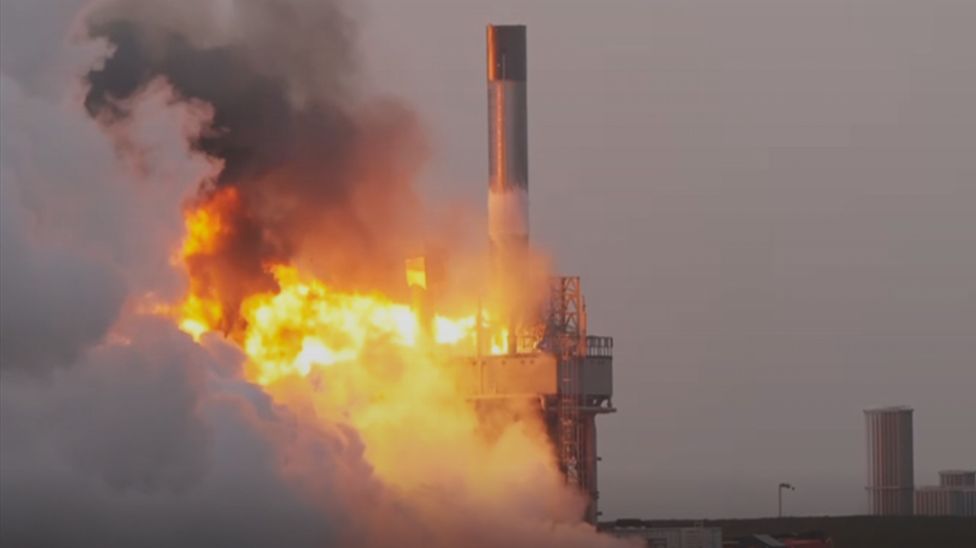
However, on August 19th, during the latest hot fire test with the stage, something went wrong. Intended to be a hot-fire burn of all nine of the stage engines – only four having thus far being fired in any single test, some was seen to go wrong within seconds of motor ignition, While the majority of exhaust gas and flame was being directed down though the elevated launch stand, a powerful jet of ignited exhaust gases could be seen leaving the base of the rocket horizontally.
The motors all rapidly shut down, but the base of the rocket and its launch mount were by that time – around 6 seconds into the test – already on fire, and ignited gases continued to stream from the side of the stage, causing a fire on the launch stand itself. At some 38 seconds after ignition, the lower portion of the rocket was on fire and fames quickly engulfed it and the launch stand prior to the rocket collapsing and exploding.
Following preliminary analysis of data and footage of the event, RFA stated on August 24th that the most likely cause of the incident was the failure of an oxygen pump within one of the motors which started a fire beneath the stage that quickly spread to other propellant lines despite the automatic shut-down of the motors. Fire suppression systems on the stage and the launch mount were then overwhelmed, leading to the loss of the stage.

Also commenting on the incident, SaxaVord management indicated that despite the fire and explosion, the launch stand and its supporting infrastructure had not suffered “major” damage. However, all activities at the launch facility are now suspended pending an investigation with will involve the UK’s Civil Aviation Authority (CAA), which has regulatory oversight of UK launch facilities.
The lost of the stage means that RFA’s plans to launch before the end of summer 2024 are at an end; whilst it is too early for a new date to be provided, the company indicated it is now looking towards the first half of 2025 as the period in which they may attempt their maiden flight.
No-one was injured during the incident, and two other launch developers, HyImpulse (also from Germany) and US-based ABL Space Systems, have indicated the incident does not affect their own plans to operate launches out of SaxaVord.
Juice-y Images of the Moon and Earth
In my previous Space Sunday update I wrote about the European Space Agency’s JUpiter ICy moons Explorer (Juice) and its (then) upcoming gravity-assist around Earth and, preceding it, a swing around the Moon in what would be the first Lunar-Earth Gravity Assist (LEGA) manoeuvre ever undertaken by a space probe from Earth.
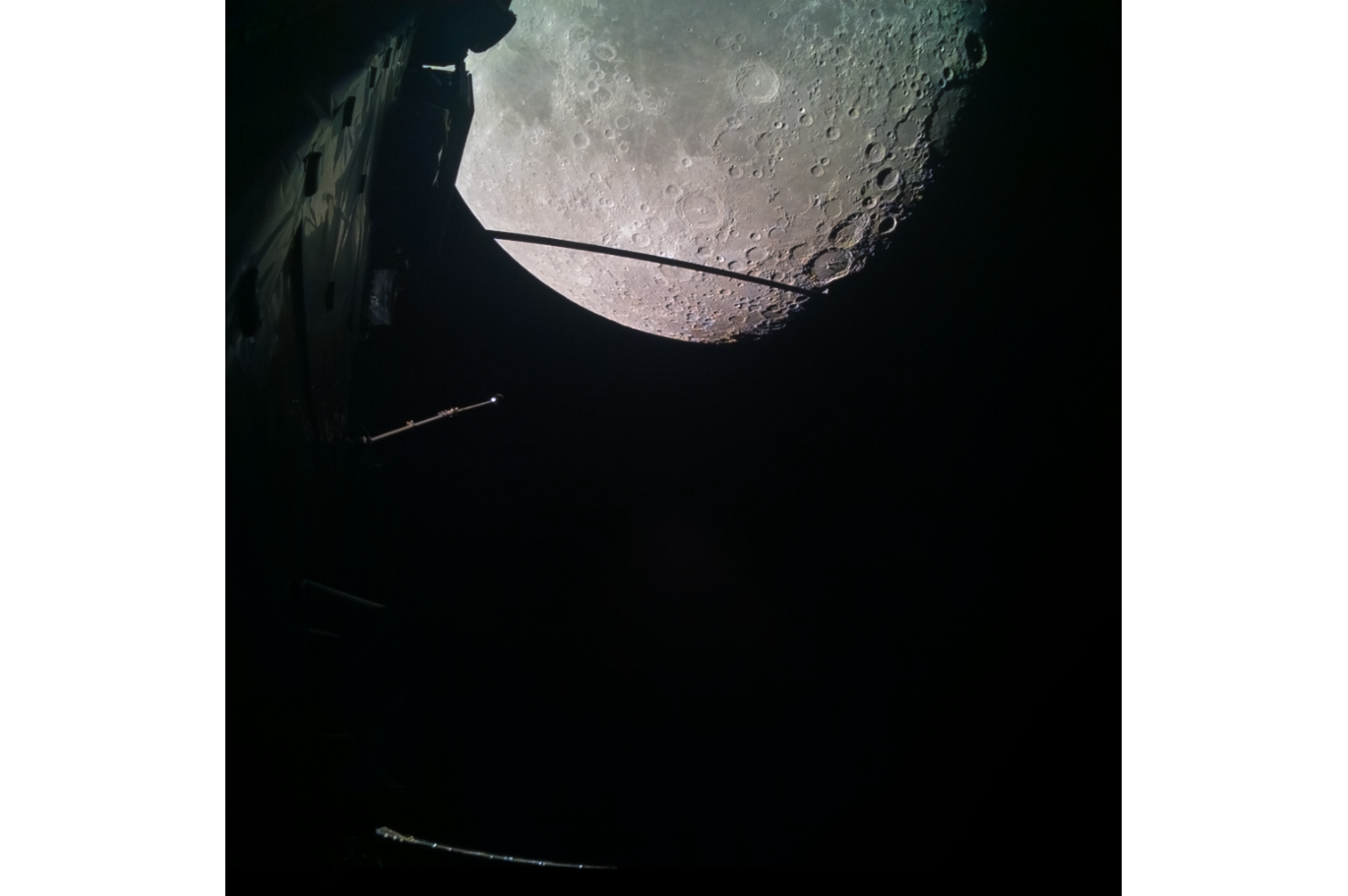
The manoeuvre marked the first of a series of complex fly-bys for the probe – launched in April 2023 – all of which are designed to accelerate it to a speed of 2.7 km per second and throw it out towards Jupiter’s orbit, where it will intercept the planet in 2031. As noted in my previous report, the Moon fly-by on August 19th saw Juice pass around the far side of the Moon at just 700 km above the lunar surface, allowing the spacecraft’s course to be precisely adjusted for its passage around the Earth, which it reached on August 20th, passing around the planet at a distance of 6,807 km.
The manoeuvre acted as a slingshot, accelerating the spacecraft and hurling it back around the Sun ready for its next planetary encounter, this one with Venus in August of 2025. After this, JUICE will swing by Earth twice more, in 2026 and 2029 – the latter of which will boost it away from the inner solar system and an 18-month voyage to Jupiter.
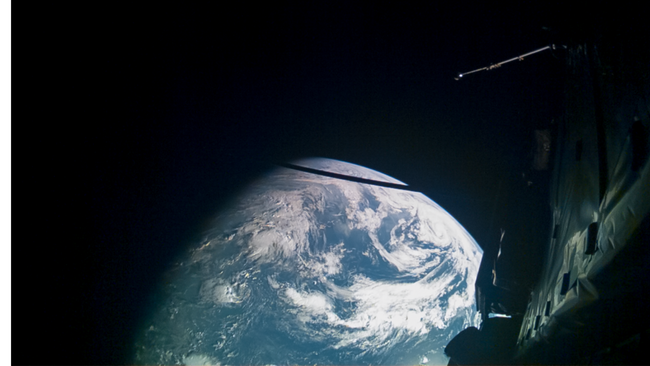
The images here show both the Moon and Earth on August 19th and 20th respectively, with the spacecraft visible in both as a result of its orientation during the fly-bys.
 Inara Pey: Living in a Modemworld