Logos representative only and should not be seen as an endorsement / preference / recommendation
Updates from the week through to Sunday, July 28th, 2024
This summary is generally published every Monday, and is a list of SL viewer / client releases (official and TPV) made during the previous week. When reading it, please note:
It is based on my Current Viewer Releases Page, a list of all Second Life viewers and clients that are in popular use (and of which I am aware), and which are recognised as adhering to the TPV Policy. This page includes comprehensive links to download pages, blog notes, release notes, etc., as well as links to any / all reviews of specific viewers / clients made within this blog.
By its nature, this summary presented here will always be in arrears, please refer to the Current Viewer Release Page for more up-to-date information.
Note that for purposes of length, TPV test viewers, preview / beta viewers / nightly builds are generally not recorded in these summaries.
Official LL Viewers
Release viewer: version 7.1.8.9375512768, formerly the Graphics Featurettes RC viewer dated June 5 and promoted June 10th.
An artist’s impression of the Chandra X-Ray Observatory orbiting Earth. Credit: NASA
Twenty-five years ago, on July 23rd, 1999, the Chandra X-Ray Observatory was launched aboard the Space Shuttle Columbia as a part of STS-93. At the time of its launch, it was the third of NASA’s four Great Observatories, the other three being the Hubble space Telescope (HST), launched in 1990; the Compton Gamma Ray Observatory (1991–2000) and the Spitzer Space Telescope launched after Chandra, in 2003 and operating through until 2020.
Originally called the Advanced X-ray Astrophysics Facility (AXAF), Chandra can trace its history back to the mid-1970s. Originally intended for operations in an orbit similar to that of Hubble, thus making its servicing and upgrade possible using the space shuttle, the observatory went through various design changes during the 1980s and 1990s, with its overall mission being redefined in 1992. This saw Chandra have four of it planned 12 mirrors eliminated from the telescope, together with two of the six planned science payloads. To compensate for this, the telescope’s mission was revised so that it could be placed in an orbit well above Earth and well clear of the planet’s radiation belts, allowing it to have a clearer view of deep space.
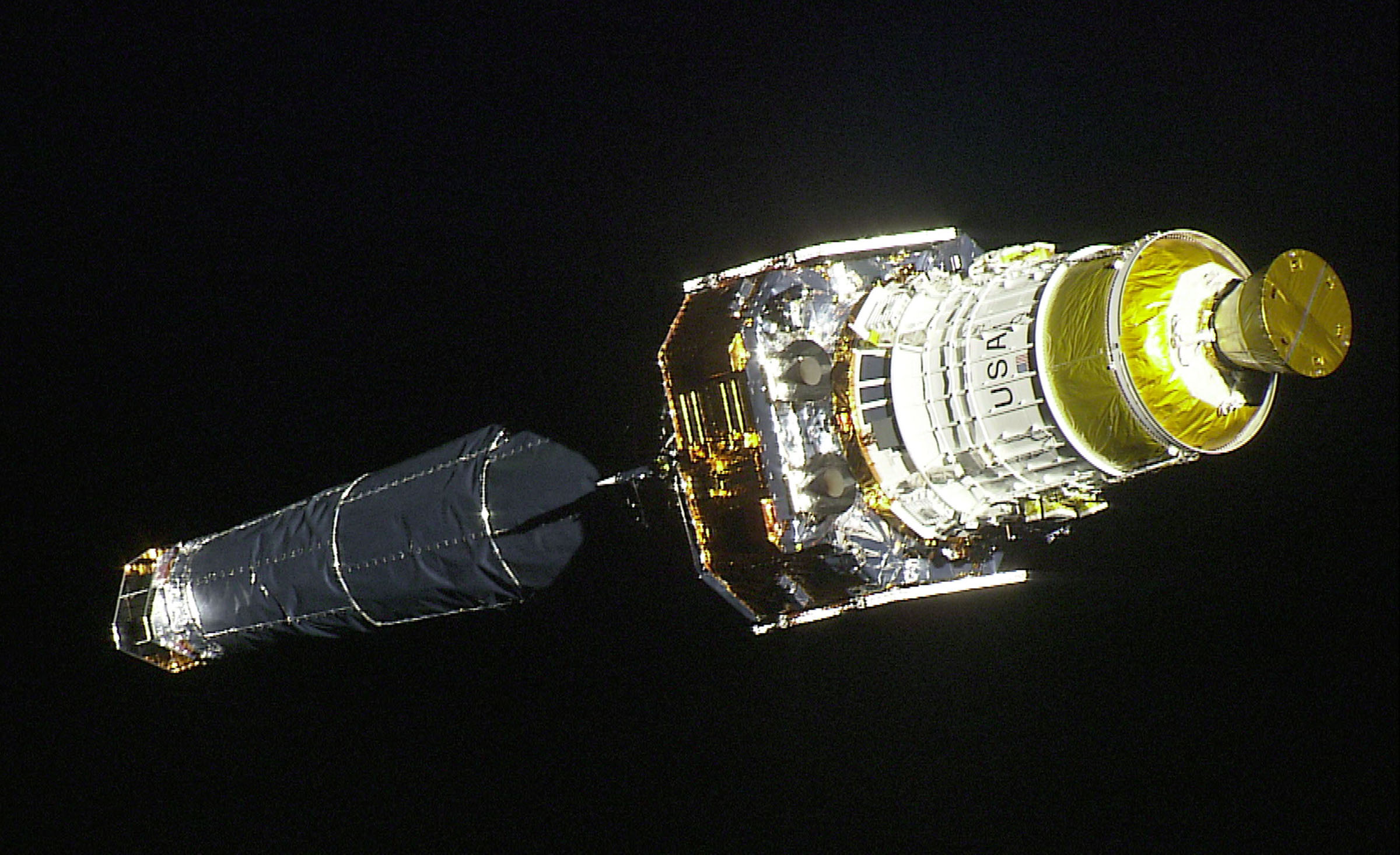
The Chandra X-ray observatory, wrapped it its thermal protection blanket, attached to its IUS space launcher, images from the space shuttle Columbia shortly after the latter had deployed them from its payload bay, July 23rd, 1999. Credit: NASA
Renamed in 1998 in honour of Nobel Prize-winning astrophysicist Subrahmanyan Chandrasekhar, Chandra was deployed from Columbia’s payload the same day as it launched, attached to a 2-stage Boeing Inertial upper Stage (IUS) space launch system. Together, they represented the heaviest payload ever carried to orbit by the shuttle system, massing 22.75 tonnes.
Once the shuttle had moved to a safe distance, the IUS first stage fired for 125 seconds, boosting Chandra away from Earth (and beyond any capacity for it to be upgraded or serviced), followed by a 117-second burn of the IUS upper stage motor. The later placed Chandra into a geocentric orbit with a perigee some 14,307.9 km from Earth and an apogee of 134,527.6 km, roughly one-third of the way to the Moon.
Following a short period of commissioning, Chandra started returning data to Earth within a month of launch, and has continued to do so almost without interruption through to 2024 – although its primary mission period was placed at a conservative 5 years. Through this time, only one system on board has suffered significant damage, but it is still operational alongside the other science instruments, and only one significant glitch – lasting three days in October 2018 – when the observatory entered a safe mode as a result of a short-term issue with one of the gyroscopes used for pointing it at targets and holding it steady during observations. All science functions were fully restored once the issue had been resolved.
Chandra X-Ray Observatory diagram. Credit: NASA Chandra Space Centre
Over the years, Chandra’s import and discoveries have tended to be overshadowed by Hubble and, more recently, the James Webb Space Telescope (JWST). These have included the first observations of a “mid-sized” black hole, claimed to be the “missing link” between stellar-sized black holes and the super massive black holes found at the centres of galaxies; making one of the most accurate measurements of the Hubble constant; observing the most massive X-ray flare yet recorded from the super massive black hole Sagittarius A* (pronounced “Sagittarius A star”) at the centre of our galaxy; and making possibly the first observation of an object (possibly an asteroid) crossing the black hole’s event horizon; and also making potentially the first indirect observations of an exoplanet in another galaxy.
In additional to all of this, Chandra has supported Hubble in making significant observations of the planet and dwarf planets and moons in our own solar system, and also like Hubble, has benefitted the work of early career researchers, helping them to become established in the fields of astronomy, astrophysics and space science.
To mark Chandra’s 25th anniversary, NASA has issued a wallpaper featuring 25 of Chandra’s most stunning images captured in the X-ray wavelengths. The official announcement of the images can be found on the Chandra website, and the images are previewed in the video below, as well as being available for download as a wallpaper mosaic for computers.
Sadly, the celebration is a potentially bitter-sweet affair. Currently, Chandra has the ability to remain operational for at least another decade – possibly long enough to see the European Space Agency launch what might be seen as its successor, the Advanced Telescope for High-ENergy Astrophysics (Athena), which is due to be launched sometime in the early-to-mid 2030s. Unfortunately, this is may not now be the case; Chandra could cease operations within the next 12 months.
The reason for this is that NASA’s space science budget is being tightly squeezed, largely as a result of the rising costs associated with Project Artemis and returning humans to the surface of the Moon. In 2024, the space science budget had been due to get a US $500 million boost. Instead, Congress actually cut it by that amount. For 2025, Congress is looking to cut NASA’s space science directorate’s budget by almost US $1 billion.
Cassiopeia A, a supernova remnant 11,000 light-years away, imaged in X-ray & Infrared light, with the x-ray image produced by Chandra. Credit: NASA / ESA / CXC
As a result NASA has been looking at programmes to cut – and Chandra has been one to top the lists, with NASA management suggesting its US $67 million budget could be cut by 40%. The reaction to this was swift, with those managing Chandra both from within and without NASA pointing out that a cut that large would effectively end Chandra’s science mission forthwith. Thus, in an attempt to find some middle ground that would allow both Chandra and Hubble to continued to be operated, various ideas were put forward as to how Chandra’s costs could be reduced and / or how both the Chandra and Hubble science missions could be redefined, in order to allow both to continue for the next few years.
In response to this efforts, NASA authorised an Operations Paradigm Change Review (OPCR) to look at all of the suggested options and make a determination on their viability to reduce costs. The findings of this review were presented on the very day of the 25th anniversary of Chandra’s launch, during a meeting of the Astrophysics Advisory Committee, or APAC, the body, chartered to provide advice to NASA’s astrophysics programme. And the news was not good.
Having reviewed all the options weighted the costs and saving, the OPCR has essentially concluded that while they believe Chandra could be operated a a budget smaller than its present allocation, it would still require funding beyond what the new science directorate budget can afford – at least not without putting programmes and missions outside of it and Hubble at risk. Therefore, it may not be feasible for Chandra to continue from 2025 onwards.
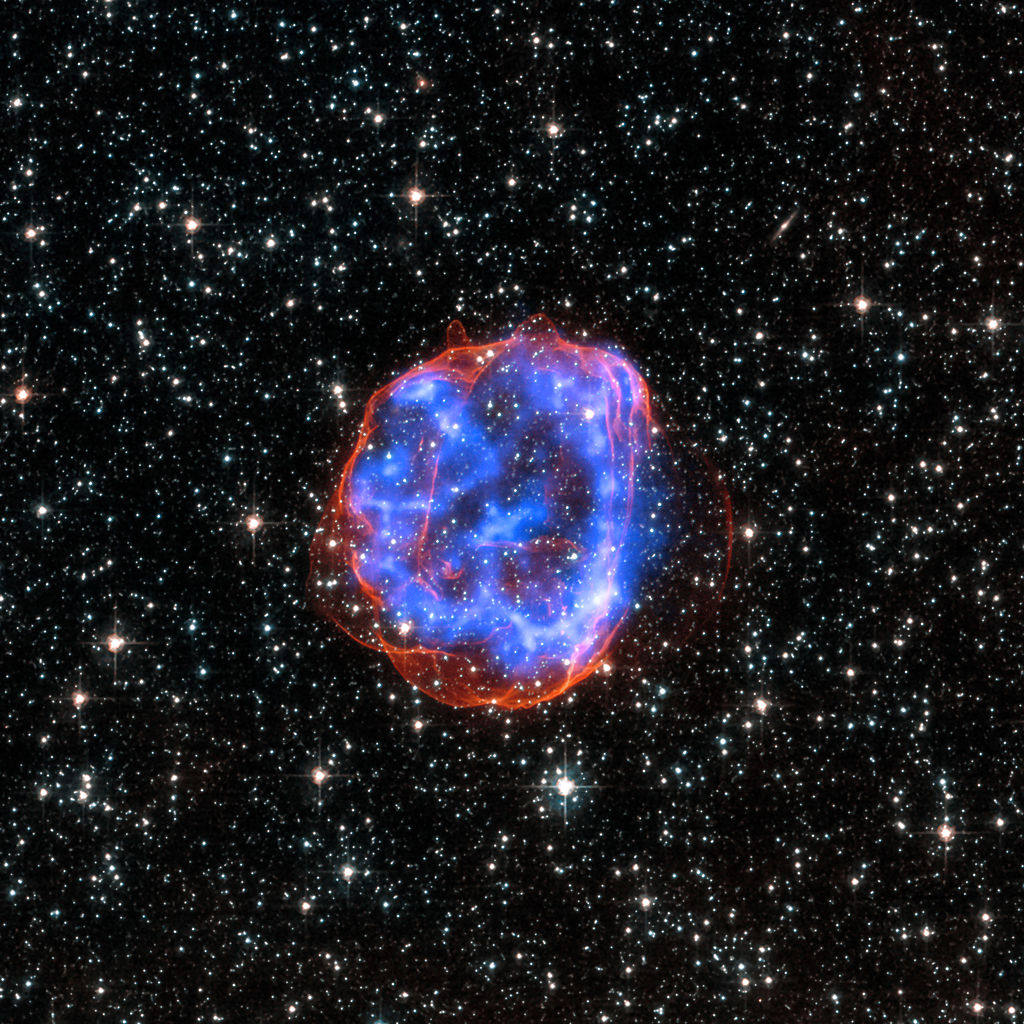
When a massive star exploded in the Large Magellanic Cloud LMC), a satellite galaxy to the Milky Way, it left behind an expanding shell of debris called SNR 0519-69.0. This image shows a composite of the debris gas field using Chandra to reveal the multimillion degree gas cloud (blue) and Hubble to reveal the expanding edge of the explosion (red) and the stars of the The outer edge of the explosion (red) and stars of the LMC. Credit: NASA / STScl / CXC
The OPCR findings drew some frustration from APAC members, in part because APAC was itself excluded from any involvement in the OPCR process and was not given the opportunity to review the report ahead of the announcement. In response, OPCR members stated the review had to be handled on a short-term turn-around so that if a way forward could be identified and which offered a reasonable compromise on costs, it had to be published rapidly, so as to allow NASA and the agencies responsible for both Chandra and Hubble (the Chandra X-Ray Centre and Space Telescope Science Institute) to assess the overall feasibility ahead of staff layoffs across both programmes that are due to commence in September 2024.
The report does not automatically seal Shandra’s fate, options may yet arise where it is allowed to continue – such as through the support of one or both of the houses in Congress – but right now, it does make Chandra’s future appear to be grim.
SpaceX Resumes Starlink Flights with Falcon 9; Announces Dragon Splashdowns to Move back to US West Coast
In my previous Space Sunday article, I noted that SpaceX Falcon 9 flights were suspended pending the results of a Federal Aviation Administration (FAA) Mishap Investigation relating to the loss of a Falcon 9 upper stage and its Starlink payload during a July 11th/12th launch.
On July 25th, SpaceX announced the root cause of the loss had been traced to fatigue causing a a crack in a redundant “sense line” in the upper stage, resulting in “excessive cooling” of engine components, causing the rocket motor to fail. A near-term fix – removing the redundant line – has been identified pending a more in-depth fix, and this has been enough for the FAA to clear Falcon 9 to resume commercial launches. As a result, on July 27th, a Falcon 9 lifted-off from Kennedy Space Centre’s Launch Complex 39A, carrying 23 of the company’s own Starlink satellites.
One Falcon 9 stands on the pad at Space Launch Complex 40 while another lifts off from nearly by Launch Complex 39A early July 27th, 2024, marking the resumption of non-NASA related Falcon 9 launches. Credit: SpaceX
Whilst successful, the flight does not mean Falcon 9 flights to the International Space Station will necessarily immediately resume. NASA still plans for a “rigorous certification” of Falcon 9 and the software associated with the sensor to which the sense line had been connected, once SpaceX has completed all modifications to the upper stage of the vehicle. As such, the agency is not committing to going ahead with the launch of the 4-person Crew 9 mission to the ISS, due to lift-off on August 18th, 2024. However, whether this also means the planned launch of an automated Cygnus resupply vehicle to the station due on August 3rd remains on hold, is unclear; NASA’s had previously indicated all Falcon 9 flights to the ISS would be suspended pending re-certification, but following the July 27th launch, the agency specifically only mentioned the Crew 9 flight.
In a separate press release, SpaceX has indicated it will be switching Dragon splashdowns to off the west coast of the United States from 2025 onwards, rather than bringing them down off the Florida coast.
The decision is in the wake of significant pieces of debris from the Dragon vehicle’s trunk (effectively the power and propulsion “service module”) surviving re-entry into the denser atmosphere to fall to ground in places as wide apart as Australia, North Carolina and Saskatchewan. The change means that from 2025, instead of being used in the initial de-orbit burn and and then jettisoned from the Dragon capsule, which then performs its own final de-orbit burn, leaving the trunk to decay in its orbit and later re-enter the atmosphere a burn up, dragon vehicles will remain attached to the trunk throughout both de-orbit burns, with the trunk being jettisoned just before both reach the re-enter interface.
This means the the capsule and trunk will come down over the Pacific Ocean, rather than passing over the North American continent, with any trunk debris surviving its re-entry hitting the water somewhat up-range from where the capsule will splash down under parachutes.
Boeing Starliner Remains at ISS Amidst More Media Alarmism
The past week saw NASA provide an update on the Boeing Starliner situation, in which the CST-100 Calypso remains docked at the International Space Station, where it has been for some 50 days, despite the first planned crewed flight of the vehicle only being intended to last some 6 days in total following its launch in early June 2024.
As noted previously in these pages, issues occurred during the vehicle flight to the ISS, when it suffered a series of thruster failures – an issue that has been dogging the Starliner programme for some time. While the vehicle, carrying astronauts Barry “Butch” Wilmore and Sunita “Suni” Williams managed to safely docked with the ISS, its return has been repeatedly delayed leading to highly inaccurate references in the media and on social media to the idea that Wilmore and Williams are somehow “stranded” in space.
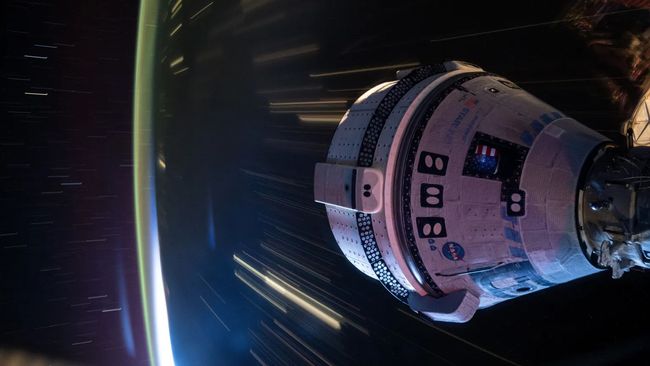
A time-lapse photograph of the CST-100 Starliner Calypso docked at the International Space Station as both orbit the Earth. Credit: NASA
This is far from the case, again as I noted as recently as June 30th (see: Space Sunday: of samples and sheltering); the delays have been purely to allow Boeing and NASA to conduct further comparative tests between systems on the ground and those aboard the Starliner docked at the ISS to better understand precisely where the issue lies. These tests are necessary inasmuch as the service module of the vehicle – which is home to the problematic thruster systems –will not be returning to Earth, but will burn-up in the atmosphere when Calypso does eventually make its return. Ergo, keeping it in space and carrying out these tests is the only means of verifying the findings of on-going Earthside investigations.
With further tests taking place over the weekend of July 27th/28th, both NASA and Boeing believe they are honing into on the root cause. Starliner has four clusters of thrusters gathered around the outside of the service module. These clusters, comprising a mix of four larger orbital manoeuvring and attitude control (OMAC) thrusters and smaller reaction control system (RCS) thrusters (28 in total, of which only one has completely failed) are housed in protective units call “doghouses”. Both the OMACs and RCS units are required during flight operations, often firing in sequence.
What appears to be happening is that under orbital conditions, pulse-firing the RCS thrusters (a rapid series of short, sharp burst of firing) immediately following the use of the OMACs thrusters in a doghouse can cause the temperatures inside the unit to rise well above anticipated levels. This causes the helium purge valves to leak, causing problems.
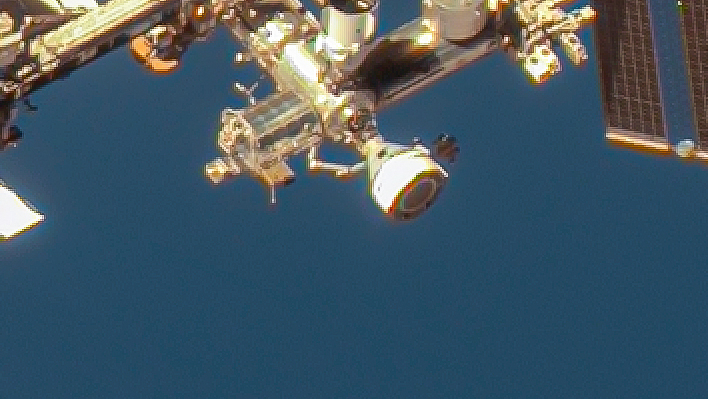
Boeing’s Starliner capsule is seen docked to the International Space Station in this zoomed-in and slightly pixelated view of an image captured by Maxar Technologies’ WorldView-3 satellite on June 7th, 2024. Credit: Maxar Technologies
Because of this, engineers, together with Wilmore and Williams, have been looking to make operational changes to how the OMCS and RCS system are used – such as by reducing the number of pulses the RCS makes when fired, or by reducing the number of times OMACs and RCS need to be fired either individually or in sequence, thus preventing the temperature spikes within the doghouse units.
During the update, NASA clearly stated that if the July 27th/28th tests yield good results, then an agency-level review on clearing Starliner for a return to Earth could take place within a week of the test results being confirmed. However, this still didn’t stop some media continuing to report Wilmore and Williams as continuing to be “stuck” or “stranded” in orbit, because drama maketh the headline.





 Inara Pey: Living in a Modemworld