
Ingenuity, the remarkable helicopter drone which forms a part of NASA’s Mars 2020 mission, has made its last flight and is now officially “retired” – and with full honours. Whilst very much an experimental vehicle, the craft achieved far more than the teams responsible for developing and building it and for operating it could ever have hoped for – and in doing to, the helicopter caught the imaginations of people around the world.
The vehicle’s remarkable history started in 2012 when the then director of NASA’s Jet Propulsion Laboratory (JPL) , Charles Elachi, met with members of the Autonomous Systems Division (ASD). They persuaded him that a concept study for aerial rover vehicles in support of surface missions on Mars had merit to the point where although NASA senior management had no interest in such a project, he used his influence to get the team sufficient funding for an initial design to be produced.
This demonstrator proved so impressive to NASA management that it was agreed the project should receive further funding to allow several engineering models to be built – even though there was still no mission on which any developed aircraft could join. It was not until March 2018, with the engineering models showing genuine promise for real flight capabilities on Mars that it was agreed that the helicopter project should go ahead – and should be flown as a part of the up-coming Mars 2020 rover mission, which was itself already at an advanced stage of development.

This resulted in a crash course of design and development – from engineering demonstrator to full-blown, mission-ready vehicle in just two years, including a deployment system which would allow the helicopter to be stowed against the rover’s belly and deployed from there once on the surface of Mars.
Originally called the Mars Helicopter Scout, the inclusion of the helicopter in the Mars 2020 mission angered some in the NASA hierarchy – and within the rover team itself. Jennifer Trosper, Perseverance’s mission systems development manager and project manager stated her belief that such were the capabilities of the rover’s autonomous driving system, it would simply outpace the helicopter, rendering any idea of the latter being a useful scout moot.
To help counter such opposition, the scope of the helicopter’s mission was intentionally limited. Named Ingenuity, as suggested by (then) schoolgirl Vaneeza Rupani as a name for the rover, it was related to the role of technology demonstrator and its mission initially limited to a 30-day period at the start of Perseverance’s time on Mars in order to limit any impact on the rover’s mission in having to sit by and observe what was expected to be a maximum of five flights. Even so, opponents of the helicopter’s inclusion in the mission remained vocal in their objections.
I have personally been opposed to it because we are working very hard for efficiencies and spending 30 days working on a technology demonstration does not further those goals directly from the science point of view [this] helicopter is a distraction from the priority scientific tasks, unacceptable even for a short time.
– Mars 2020 chief scientist Kenneth Farley voicing misplaced antagonism toward Ingenuity

This opposition is why Ingenuity’s project lead, MiMi Aung and her little team – who initially were not even awarded space in the Mars 2020 mission control room, but had to operate out of a meeting room they converted into their own operations centre – were so determined to see Ingenuity not only fulfil its initial primary mission but to exceed all expectations, even if it meant aggressively pursuing goals and extending flight parameters to a point of putting their little craft at risk.
The first opportunity for the team to prove their vehicle came on April 19th, 2021, almost two months after the mission had arrived within Jezero Crater, and almost two weeks after Ingenuity had successfully deployed onto the planet’s surface. In the intervening period, the helicopter’s electrical system had been charged and tested, the twin sets of contra-rotating blades unlocked for their stowed position and run through a series of ground tests – some of which didn’t quite go to plan –, with a finally high-speed test of the rotors being carried out 2 days prior to the first flight, confirming the motors could safely power the blades to their required 2400 rpm.
The first flight was brief: a simple lift-off to 3 metres above ground, then an axial rotation of around 90º prior to a descent and landing – simple, that is, until you consider that Ingenuity was attempting to take flight at within an atmosphere with a density equivalent to that of Earth’s at 34,000 metres (112,000 ft) – well above the capabilities of any Earth-based rotary craft.
The remaining four test flights came rapidly thereafter, initially testing the craft’s ability to transition from a hover to horizontal flight (covering 4 metres in its second flight, then just 3 cm shy of 100 metres in its third, before smashing its planned maximum horizontal flight capability (160 m) by covering 270 metres in its fourth flight prior to a more modest 130m in the final test flight). By this time, opposition to the helicopter’s presence on the mission was rapidly thawing, and continued operations were given the green light – providing they did not impeded on Perseverance starting into it primary mission of investigation and exploration.
This mission extension period saw the helicopter move from being a technology demonstrator to being more of a general testbed aircraft which could also gradually take up the mantle of its intended role as a scout for the rover. In this capacity it gradually flew flights of both longer duration (the longest being 169.5 seconds in August 201), and greater distance (peaking at 709 metres in a single flight on April 8th, 2022). But the end of 2022, Ingenuity was largely operating in support of Perseverance, not only keeping up with the rover in defiance of Trosper’s prediction, but also actually increasing the effectiveness of the rover’s autonomous driving capabilities by providing the mission team with data which allowed them to more efficiency plan routes wherein the rover could more easily navigate for itself, reducing the punctuation of drive, stop, survey and allow the drive team to plan and upload new instructions then drive, stop, survey and allow the drive team to plan and upload new instructions, common to a lot of the rover’s initial explorations.
Whilst there were some problems encountered with flight software and concerns over motor and rotor performance in the face of slowly decline electrical power generation, overall, Ingenuity proved remarkably robust and capable of exceeding many of the parameters originally set to safeguard it. On October 2023, for example, it achieved an altitude of 24 metres (79 ft) above the ground – over double the 10-metre maximum originally envisioned as its operational ceiling – and this during a time when several flights exceeded that limit. It also withstood the ravages of Martian winter with its harsh cold weather, as well as the challenge of seasonal dust storms.

Nevertheless, it was acknowledged that the longer the mission went on, the greater the risk of something happening that could unexpectedly curtail flights. And at the start of 2024, these risks were made manifest.
By this time Ingenuity was operating over what the flight team called “difficult” terrain. To explain: Ingenuity’s flights are entirely autonomous. They are planned on Earth in terms of timings, direction, altitudes, etc., together with waypoints – static ground features and rocks the helicopter can be told to identify using its navigation cameras, and use to make changes in direction or its orientation and as reference points for landing.
However, since its 68th flight, Ingenuity has been flying over terrain where such definable waypoints are few and far between. On the helicopter’s 71st flight – which took place on January 6th, 2024 – this sparseness of waypoints resulted in Ingenuity becoming confused as to where it was and where it was going, triggering automatic a landing. Unfortunately, it seems one of the rotors suffered a very slight deformation on touch-down, as revealed in post-flight images the helicopter took of its own shadow – a trick the flight team had long used to help assess Ingenuity’s status after each flight when Perseverance was too far away to provide suitable images.
As a result, it was decided that prior to continuing in its scouting mission, Ingenuity should complete a straight up-and-down hop to test the rotor systems. This took place on January 18th, 2024 and initially looked to be successful: the rotors spun up to speed, and the helicopter rose to 10 metres and then descended for a landing. However, as I reported in my previous Space Sunday update, communications abruptly cut-off when it was still around a metre off the ground, and took a little while to restore.
Once communications had been recovered, the helicopter was ordered to again image its own shadow to help in the assessment of its overall condition as the flight team went back through the flight data to try to determine what caused the communications drop-out. In one of the the returned photos, the shadow of a rotor blades clearly shows its end has suffered damage, appearing broken and buckled.

This image suggests that at some point Ingenuity ended up at an angle as it descended at the end of flight 72. Whether this was the result of the deformation in a blade seen at the end of flight 71 or has some other cause, is unknown. However, it is clear than whatever happened, it was sufficient to bring at least one blade tip in contact with the ground, even if for a fraction of a second, causing it noticeable damage.
Whether it was the sudden jolt which likely accompanied the impact which caused the drop in communications or whether there may have been a general electrical glitch which caused both the communications drop and the blade impact is currently the subject of JPL assessments of the flight data. But whatever the cause, and even if the damage is to the one blade-tip, it has put paid to Ingenuity’s ability to fly: the damaged blade will simply cause too much turbulence and vibration for the little helicopter to remain stable. Thus, the mission has been declared over and Ingenuity retired from active duty, an event marked with the release of a short video by NASA, celebrating the mission and its achievements.
And celebration is the right word. During its 32-month operational period, Ingenuity conclusively proved the viability and value of rotary drones on Mars operating in support of other missions. In doing so, it not only itself covered a horizontal distance of 17.242 km (reaching a maximum speed of 36 km/h during some flights) and clocking up a total of 2 hours 8 minutes and 55 seconds in the Martian air, it has successfully laid for foundation for future generations of automated and – come human missions to Mars – teleoperated drones on the Red Planet.
In additional to the “official” video, NASA JPL release a more personal video from some of the members of the Ingenuity team, allowing them to say some final words about the Little Helicopter That Could – And Did.
SLIM Landed… On Its “Head”
In my previous Space Sunday, as well as commenting on Ingenuity’s 72nd flight (which at the time had not been identified as terminating its flying career) I reported on Japan’s SLIM mission to the surface of the Moon, which had met with some mixed results.
As I noted in that report, SLIM – Smart Lander for Investigating Moon – had apparently successfully landed right on target to make Japan the fifth nation to have successfully landed on the Moon, but potentially incorrectly oriented for its solar array to capture sunlight and convert it into usable energy.
At the time of that article, it was unclear precisely what had happened to the lander. The telemetry received and broadcast during the livestream seemed to suggest it was upside down – which many saw as unlikely, particularly as the lander’s systems and science instruments did appear to be working. However, in the hours between touchdown and the lander being placed in a dormant mode as battery levels dropped to a critical level, some of the images returned by the lander seemed to back-up the livestream graphics portrayal that the lander was inverted.
Even so, it was not until the two tiny rovers – LEV-1 (for “lunar excursion vehicle”) and LEV-2, released by the lander shortly before touch down – reported in that the status of the lander could be confirmed. After establishing contact with Earth with LEV-1 acting as a relay for LEV-2 (also called “Sora-Q”), the rovers returned images of their immediate surroundings before being tasked with making their way over to the lander and imaging it; and both return some remarkable shots of the lander sitting on its head, one of its descent engine nozzles pointing up into the lunar sky.
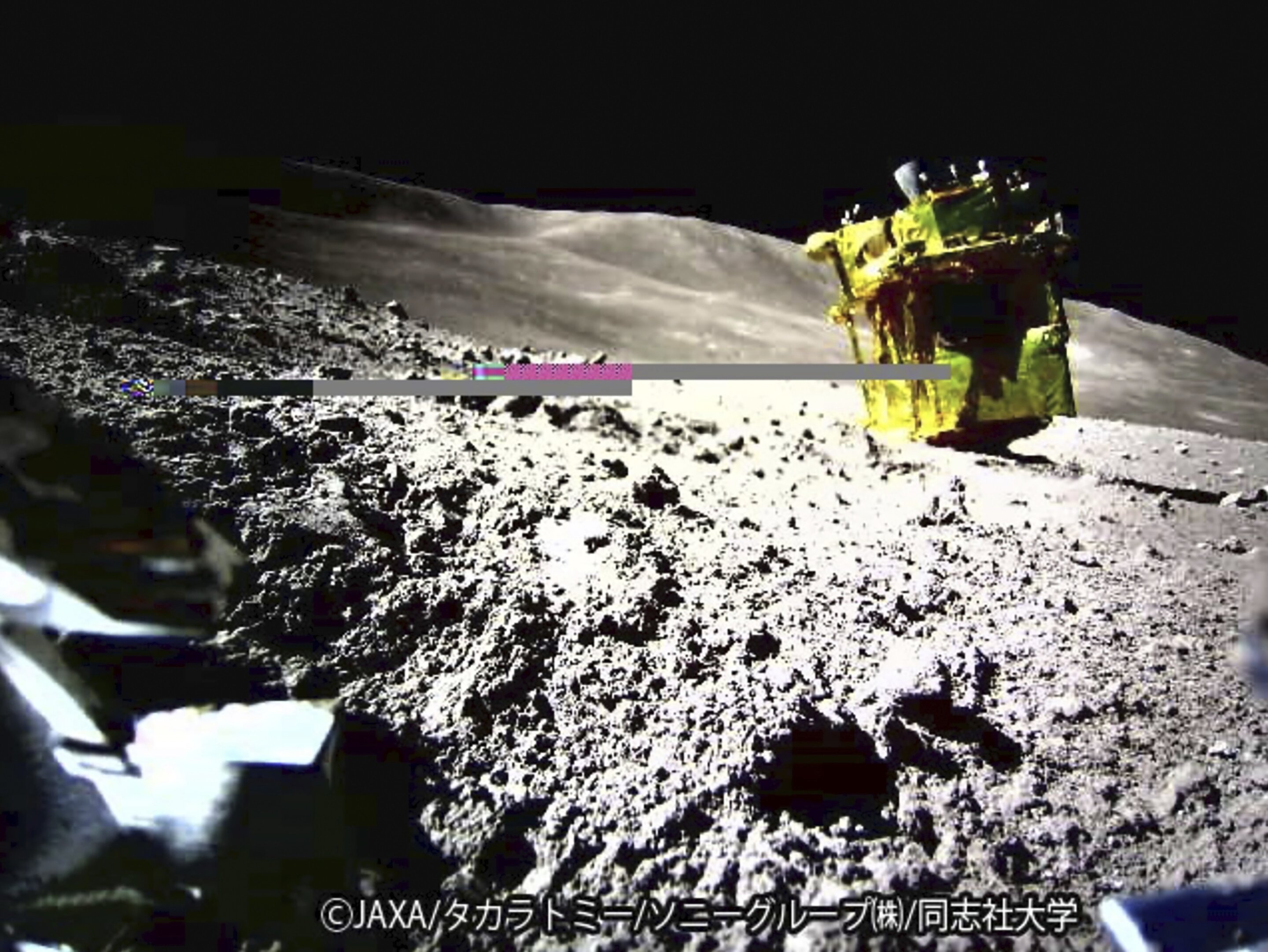
It’s not clear exactly what occurred, but JAXA – the Japan Aerospace Exploration Agency – believes one of the lander’s decent engines failed during landing, causing it to touch-down harder than intended and then toppling over as a result of landing on a slope, or possibly the off-axis thrust from the remaining descent engine cause it to flip over following initial ground contact.
As I previously noted, mission operators had hoped that as the lunar day progressed, the Sun would move into a position where light would strike SLIM’s solar array and perhaps furnish it with power. The images from the LEV rovers have confirmed this is indeed possible – the array is facing west, and so will encounter sunlight the the Sun moves towards the local horizon. However, given that nightfall commences of February 1st/2nd, and the lander is not equipped to withstand the harsh night-time lunar temperatures, SLIM may only have a couple of days in which to resume gathering data, even if it can be revived. Even so, the fact that the lander has gathered and returned images and data post-landing, and its two little rovers are operational means this mission can still be counted a success.

 Inara Pey: Living in a Modemworld