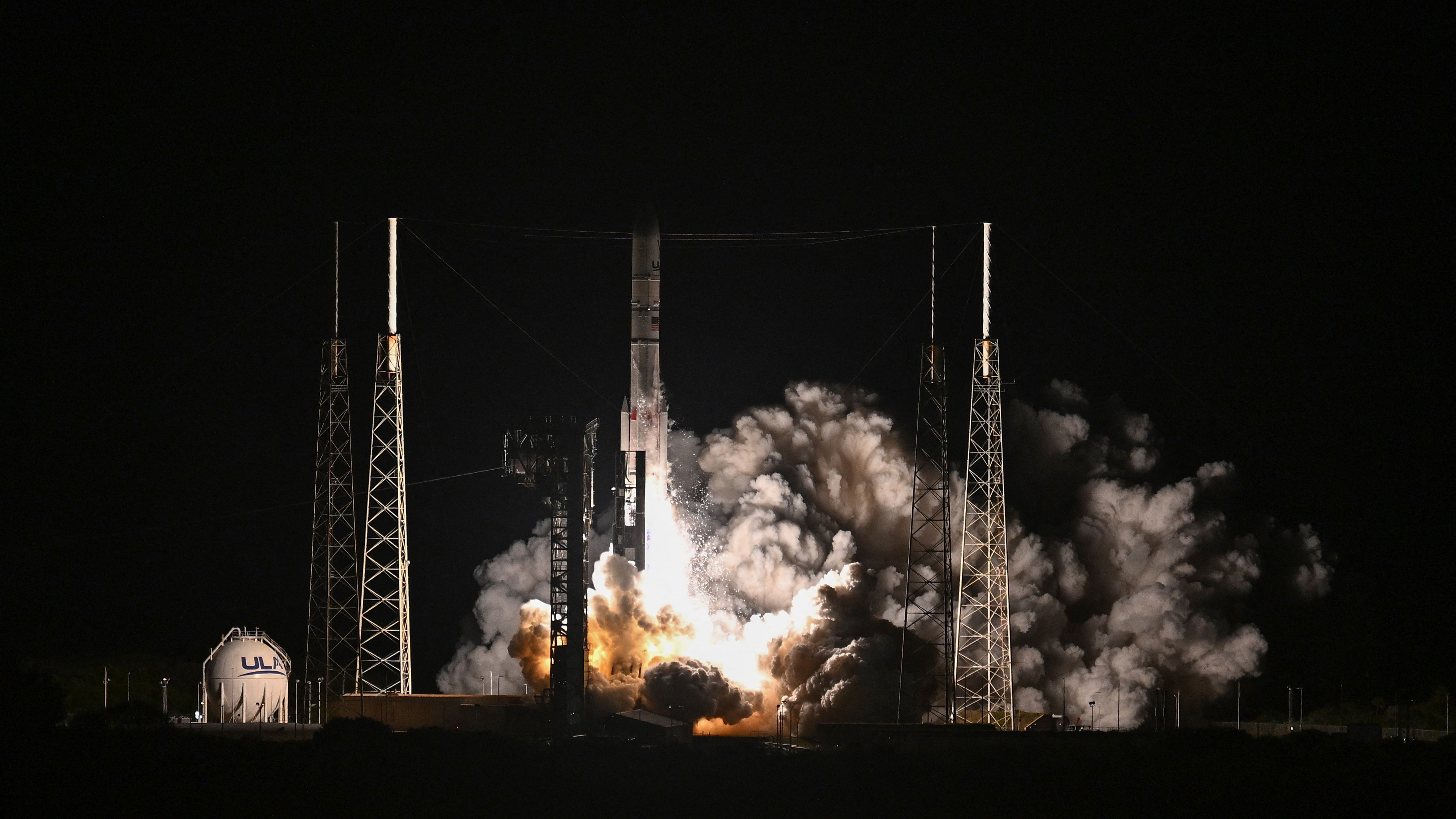
On Monday January 8th, 2024 United Launch Alliance completed the maiden launch of their Vulcan Centaur rocket with complete success, silencing critics and demonstrating that the caution and most recent delays around the launch (outside of those coming from the payload side) were worth it.
Lift-off came at 07:18 UTC as the two Blue Origin BE-4 motors of the 62-metre tall vehicle’s core stage ignited together with the two solid rocket boosters strapped on either side of it, lighting up the sky at Cape Canaveral Space Force station as the rocket climbed into a pitch-black sky. At 2 minutes into the flight, their job done, the solid rocket boosters shutdown and separated, leaving the rocket’s core to continue to power it upwards for a further three minutes before its liquid propellants were expended, and it separated to fall back into the Atlantic Ocean. The Centaur upper stage coasted for some 15 seconds before igniting it own pair of RL-10 motors in the first of three burns to place the vehicle and its payload into a trans-lunar injection (TLI) orbit and the first phase of what was hoped would be a looping trip to the lunar surface.
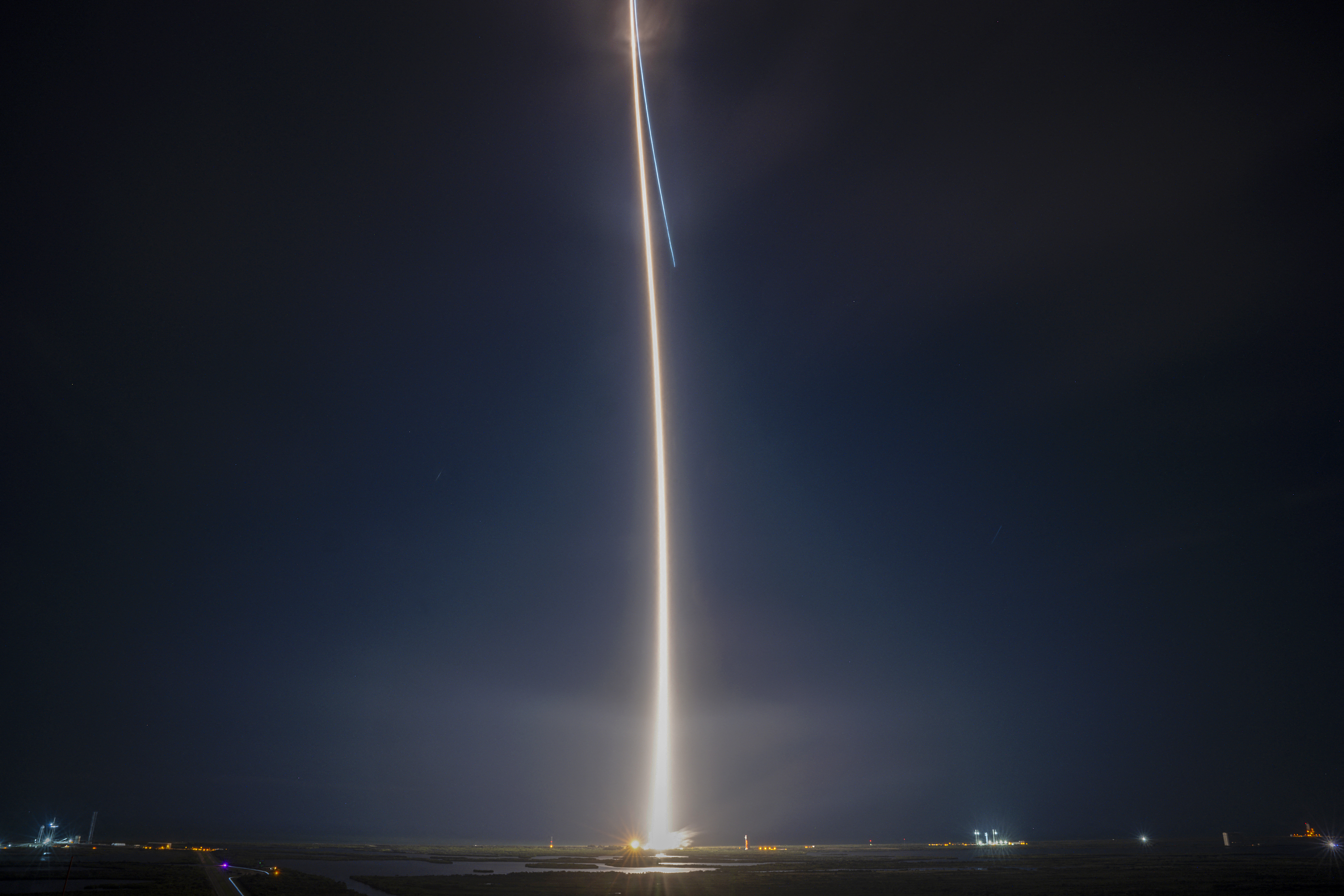
As I’ve previously noted, Vulcan Centaur is slated to replace ULA’s Atlas and Delta workhorses as a highly-capable, multi-mission mode payload launch vehicle in both the medium and heavy lift market places. Initially fully expendable, the vehicle may evolve into a semi-reusable form in the future, ULA having designed it such that the engine module of the core stage could in theory be recovered. It is also intended to become a human-rated launch vehicle. The Centaur upper stage is also designed with enhancement in mind, with ULA indicating that future variants might be capable of orbiting on an automated basis as space tugs or similar, once in orbit.
Whilst the vehicle carried a critical payload, the flight was actually regarded as a certification flight rather than an operational launch; one designed to gather critical performance and other data on the rocket which can be feed back into any improvements which might be required to make the vehicle even more efficient, etc.
A second certification flight is due to take place in April 2024, again with a critical payload – this one in the form of Sierra Space’s Dream Chaser cargo vehicle Tenacity, the first in a number of these fully reusable spacecraft which will help to keep the International Space Station (ISS) supplied with consumables and equipment, as well as helping in the removal of garbage from the station and the return of instruments and experiments to Earth.
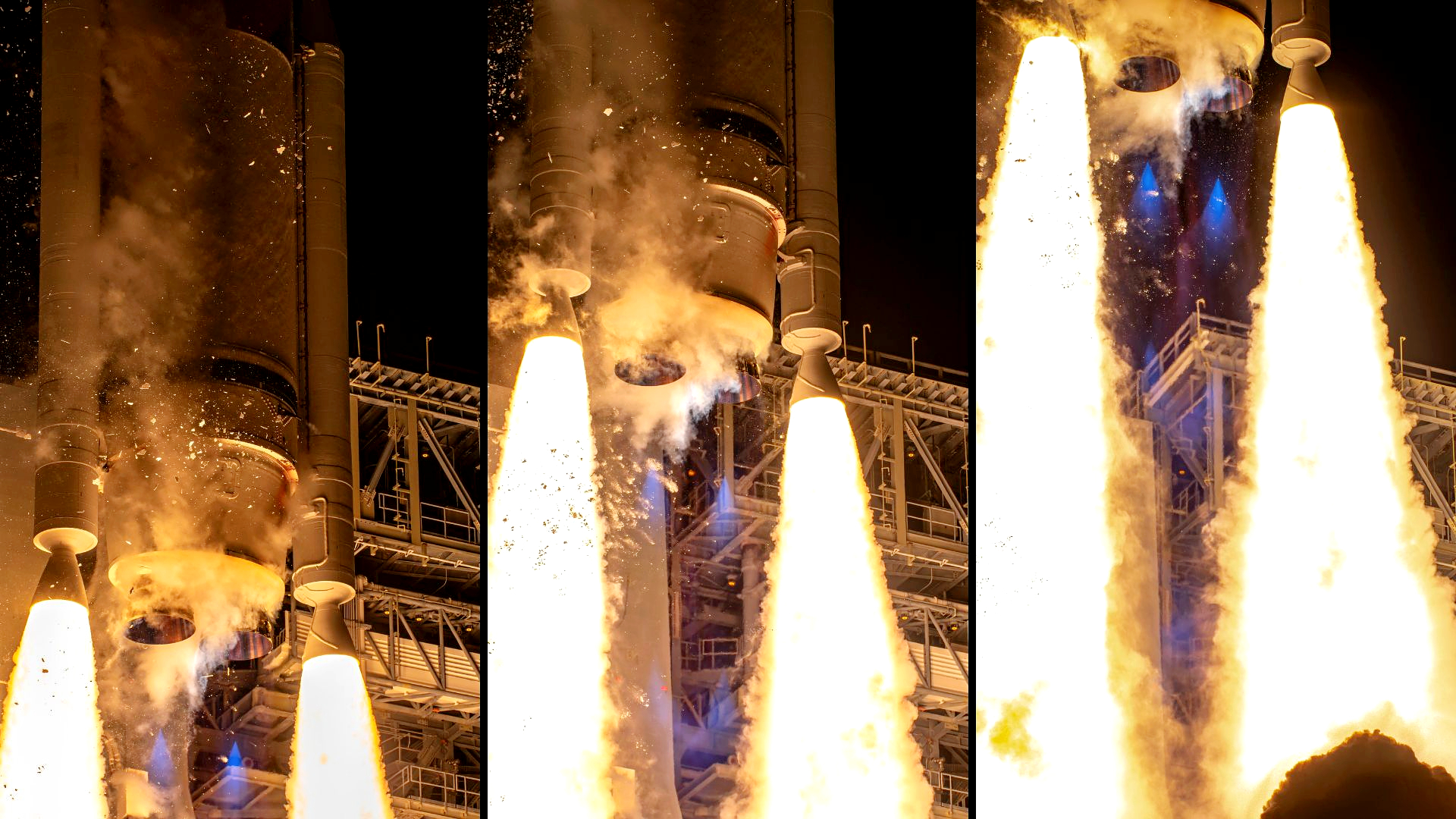
While the launch of the Vulcan Centaur was a complete success – doing much too potentially boost ULA’s position as it seeks a buyer – the same cannot be said for its primary payload, which now looks set to make an unwanted return to Earth.
Peregrine Mission One (or simply Peregrine One), was to have been America’s first mission to land on the surface of the Moon since Apollo 17 in 1972. Financed in a large part via NASA’s Commercial Lunar Payload Services (CLPS) programme, this mission is nevertheless regarded as a private lunar mission, carrying some 20 experiments and instruments allowing it to operate in support of NASA’s broader lunar goals.
At first everything seemed to be going well with the mission. The lander rode the Vulcan Centaur to orbit before it powered-up its own flight systems and ‘phoned home to say it was in good shape. Then, some 50 minutes after launch, and the Centaur upper stage having completed its final burn to set the lander on its looping course to the Moon, Peregrine One separated from its carrier.
All appeared to go well in the hours immediately following separation, but following an attitude adjustment, telemetry started being received suggesting the craft was in difficulties and was unable to correctly orient itself. It was not initially clear what was wrong with the lander, and in an attempt to find out, Astrobotic – the company responsible for designing and building it – ordered camera mounted on the lander’s exterior to image its outer surfaces for signs of damage. The very first image returned showed an area of the craft’s insulation around the propulsion system – required to make the descent and soft-landing on the Moon – had suffered extensive damage, with propellants leaking into space from around it.
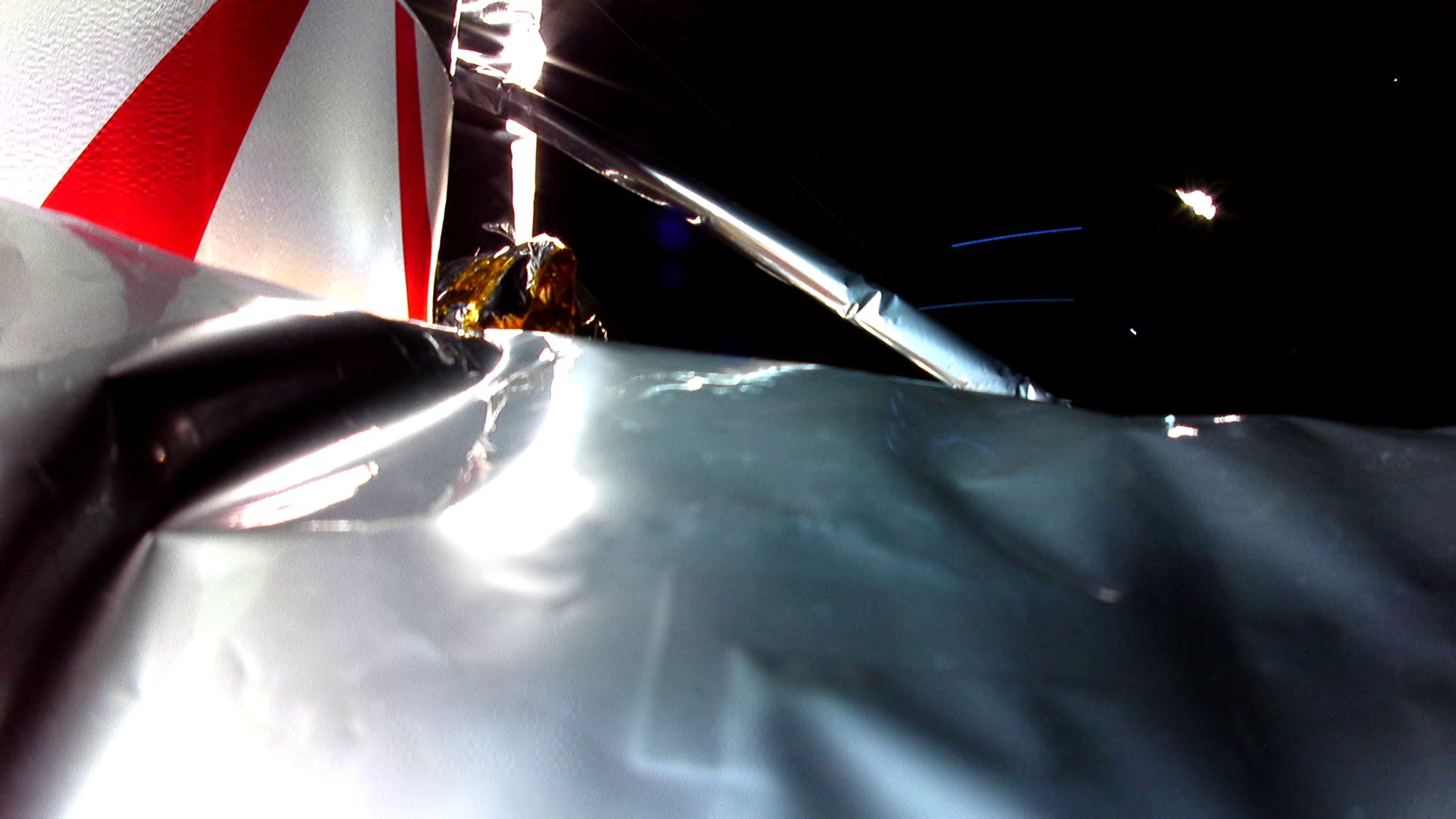
This, coupled with the telemetry gathered from the lander caused Astrobotic to determine that one of the vehicle’s attitude control system (ACS) thrusters was still firing well beyond expected limits, most likely due to a failed / stuck valve, placing the vehicle in an uncontrollable tumble.
If the thrusters can continue to operate, we believe the spacecraft could continue in a stable sun-pointing state for approximately 40 hours, based on current fuel consumption. At this time, the goal is to get Peregrine as close to lunar distance as we can before it loses the ability to maintain its sun-pointing position and subsequently loses power.
– Astrobotic statement, Monday, January 8th
Initially, it had been hoped that the craft would still reach the Moon and make what is euphemistically called a “hard landing” (that is, crash into it) around the time of the planned landing date of February 23rd, engineers having calculated that by then, even if the rete of propellant loss slowed over several days and ceased, the craft would have insufficient reserves to make a controlled landing. However, by mid-week it was clear even this would not be the case; the leak had put Peregrine One on a much more direct path towards the Moon’s orbit than had been intended such that on January 12th, an status update from the company noted:
Peregrine remains operational about 238,000 miles from Earth, which means we have reached lunar distance! Unfortunately, the Moon is not where the spacecraft is now, as our original trajectory had us reaching this point 15 days after launch, when the Moon would have been at the same place.
– Astrobotic statement, Friday, January 12th
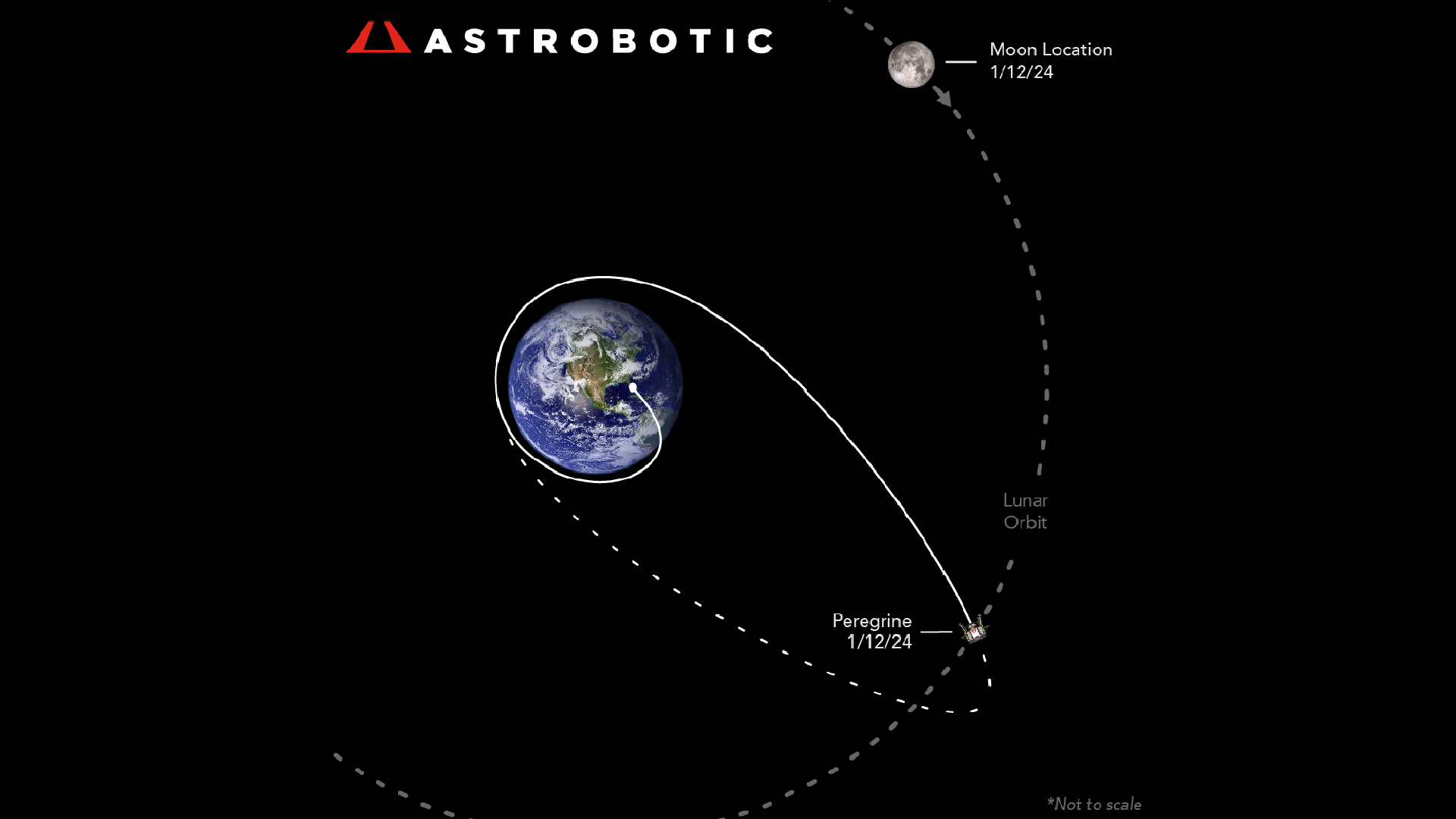
However, the one “good” piece of news through the week was that as time progressed, the propellant leak deceased, and some steps to help stabilise the vehicle – and maintain its orientation to the Sun such that its solar arrays could continue to received energy and power the vehicle’s systems – could be taken. These in turn allowed a number of the experiments on the lander to be powered-up. While they are not operating in their intended modes (or location), it is hoped that they will still be able to gather data on the radiation environment in interplanetary space around the Earth and the Moon.
The most recent projections from Astrobotic (January 14th) suggest that as the Lander has in sufficient velocity to complete escape Earth’s gravity well, it will likely start to “fall back” to Earth in the coming weeks, and orbital mechanics being what they area, most probably slam into the upper atmosphere and burn-up.
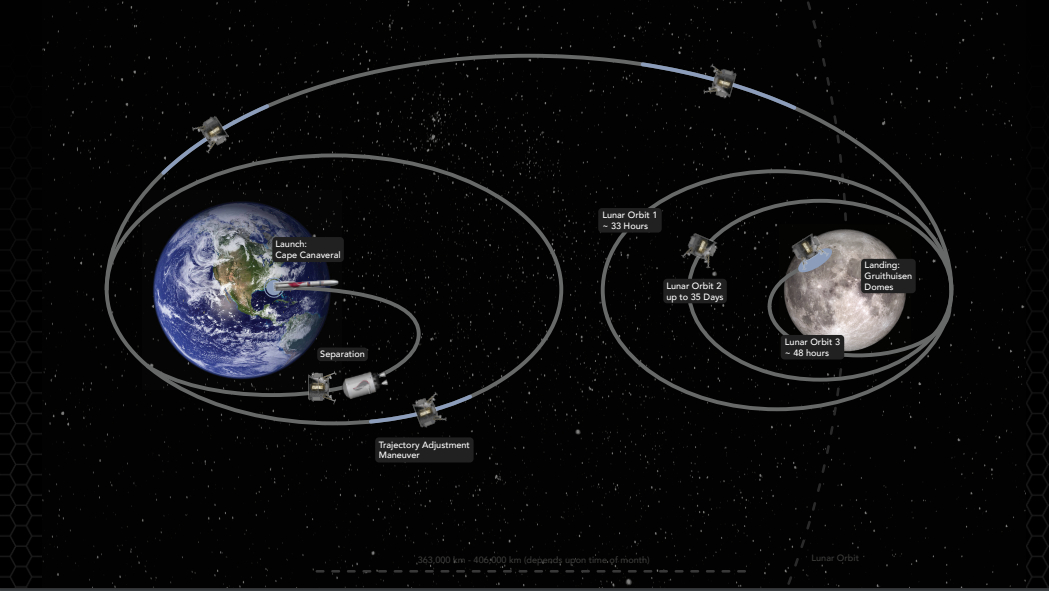
Given Peregrine One’s involvement in the CLPS programme, NASA has been monitoring the Peregrine One situation closely, and on January 18th the agency and Astrobotic are due to convene a telecon in order to review Astrobotic’s efforts to recover the craft and what they have learned. In the meantime, agency officials have noted that the failure of Peregrine One to successfully achieve a lunar landing will not in any way impact CLPS.
Artemis 2 and 3 Slip
On January 9th, 2024, NASA announced America’s return to the Moon with crewed missions at the head of Project Artemis is to be further delayed.
In the announcement, made in part by NASA Administrator Bill Nelson, it was indicated that the upcoming Artemis 2 mission around the Moon and back, and intended to take place in November 2024, will now not take place before September 2025. Meanwhile, the first US crewed mission to the surface of the Moon will now occur no sooner than September 2026.
The reasons given for the delays relate most directly to Artemis 2. In particular, there are a number of new systems and capabilities in development as a part of the overall Artemis programme which are now far enough along that it makes sense to delay Artemis 2 to leverage them, as they offer increased safety at the pad and prior to launch – such as improved means for crew egress from the launch vehicle in an emergency, and faster propellant loading capabilities.

Another cause for the delay is on-going concerns about the performance of the ablative heat shield on the Orion Multi-Purpose Crew Vehicle (MCPV). Whiles the shield did its job and protected the unscrewed capsule of Artemis 1 during its passage back into the Earth’s atmosphere at the end of that mission in November 2022, it still showed signs that rather than charring in place, some of the material actually peeled away from the vehicle as it charred, which is not supposed to happen.
Finally, concerns have recently been raised about the electrical system managing the crew abort system rockets, designed to haul the Orion capsule and its crew clear of the SLS rocket if the latter suffers a serious failure during the initial ascent to orbit. As a result, further tests have been requested on that system.
I want to emphasize that safety is our number one priority. And as we prepare to send our friends and colleagues on this mission, we’re committed to launching as safely as possible. And we will launch, when we’re ready.
– Jim Free, NASA’s Associate Administrator
The announcement was, oddly, seen as a cause for vindication among some SpaceX fans – the private launch company has been cited as a potential reason for delaying the Artemis 3 programme, given they are still a long way from demonstrating they have the ability to supply NASA with an operational lunar landing vehicle and the means to get it to lunar orbit.
However, even the addition of a further 11 months to the Artemis schedule still leaves SpaceX with precious little time to achieve those goals in a manner which meets NASA’s safety requirements. As such, the concerns about SpaceX being able to meet current Artemis time faces, as highlighted (again) in 2023 by the US Government Accountability Office (which has an uncannily accurate eye for predicting programme slippages and their causes) still remain valid.
Continue reading “Space Sunday: lunar losses and delays; strings and rings”
 Inara Pey: Living in a Modemworld