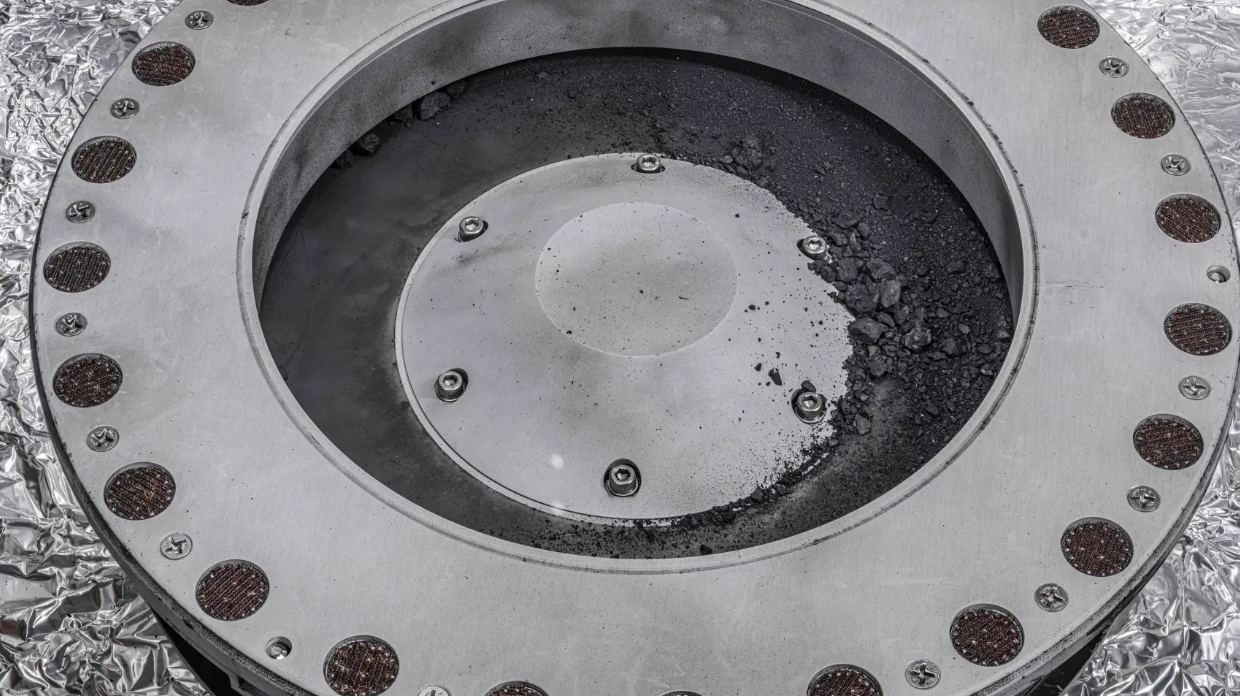
On October 11th, 2023, NASA revealed details of their first look at samples returned from asteroid 101955 Bennu, returned to Earth on September 24th by the OSIRIS-REx mission.
As I reported in Space Sunday: the return of OSIRIS-REx, the sample return capsule carried with it up to 250 grams of material from the carbonaceous asteroid – a lot more than had been anticipated, thanks to Bennu proving to be so brittle the sample mechanism smashed through its outer surface, clogging itself with material, rather than lightly “tapping, grabbing and departing”.

Following its recovery after landing in Utah, the capsule and containing the sample gathering head from the spacecraft was transferred to Johnson Space Centre and the Astromaterials Research and Exploration Science (ARES) centre (as I reported here), where for the last couple of weeks the sample container has been accessed and its contents subject to initial analysis.
It has still not been confirmed how much material has been obtained from Bennu; the opening of the sample canister revealed a fair amount of material was trapped between the lid of the canister and the membrane protecting the main bulk of the sample. This was painstakingly collected and formed the materials used for the initial analysis of the sample dust.
This initial analysis as revealed that – as expected, given it is a carbonaceous asteroid – the sample has within it evidence of both carbon and water, with the latter have a similar isotopic levels similar to those of Earth’s oceans. This was expected as it has long been the theory – supported by the examination of other asteroid samples returned to Earth by Japan’s Hayabusha and Hayabusha-2 missions – that C(arbonaceous)-type asteroids were responsible for bringing water and carbon to Earth early in its history.

Which is not to say that the samples do not offer a lot to learn; there is much that scientists do not know for certain about the Earth’s earliest history and its formation; much of what we do know is basis on hypotheses and scientific assumptions. The study of samples like those from Bennu samples could therefore allow many of those hypotheses to to more fully tested and the knowledge we lack or assume to be correct properly framed and understood.
Following extraction, the material from inside the sample container will be distributed to research centres in museums and universities around the world to enable a more extensive and as broad-ranging spectrum of independent analysis as possible over the coming months / years.
Psyche Launched
Following on from my previous Space Sunday article, and after being delayed almost 24 hours due to inclement weather, NASA’s mission to asteroid 16 Psyche got underway at 14:19 UTC on October 19th, 2023 when a Falcon Heavy lifted-off from Pad 39A at Kennedy Space Centre, Florida.
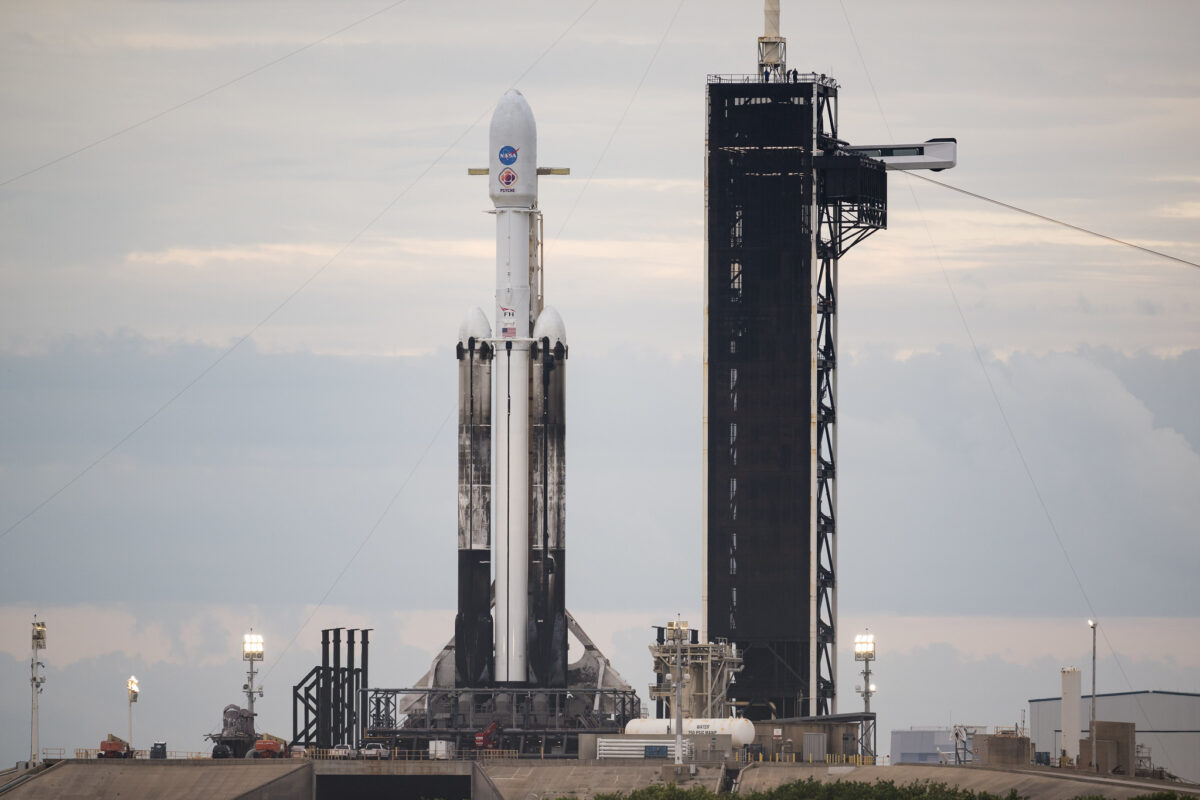
After a flawless launch the rocket – comprising a core Falcon 9 booster with two additional first stages of the same rocket acting as strap-on boosters – rose into a cloudy sky over Florida. Just over two minutes into the flight, the side boosters separated to complete a “burn back” manoeuvre allowing them to return to Florida to land at Cape Canaveral Space Force Base adjacent to Kennedy Space Centre a few seconds apart, the landings marking the 4th successful flight for both units.
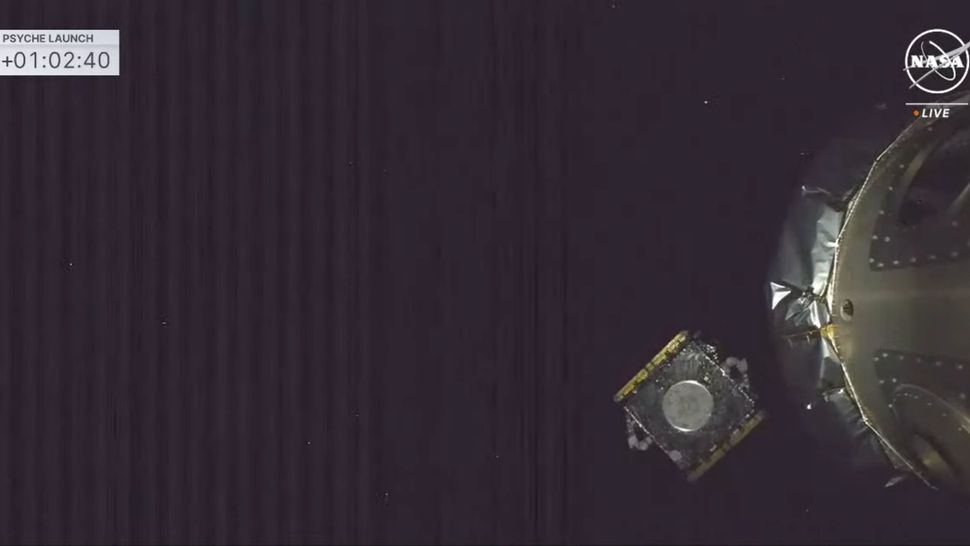
The spacecraft separated from the upper stage of the booster around an hour after launch, having been delivered to an extended orbit around Earth. There then followed a further 30 minute period of silence as the vehicle powered-up and oriented its communications system to call home with its first batch of data, indicating all was well and establishing a firm link with mission control.
The next 100 days will see the spacecraft comprehensively checked-out in terms of its flight systems – notably the four Hall-effect SPT-140 ion thrusters. This will be used serially throughout the flight to propel the vehicle to its rendezvous with 16 Pysche and enable it to slow down for an orbital rendezvous.
This checkout will be completed over the next week or so, and prior the vehicle being ordered to use the thrusters to start pushing itself away from Earth and into a heliocentric orbit around the Sun to reach Mays in 2026. Once there, it will use the planet’s gravity to help swing itself onto an intercept with 16 Psyche, where it will arrive in the latter part of 2029 to commence its science operations over an initial 21-month period.
As I noted last time around, the journey to Mars will see NASA carry out a test of their Deep Space Optical Communications (DSOC) laser communications system, which could greatly increase the data rate and bandwidth of communications used with deep-space missions. The first test for DSOC should come in about three weeks from launch, when the vehicle will be 7.5 million kilometres from Earth. They will then be periodically repeated and extended as the spacecraft reaches a distance of to 2.5 AU from Earth.
The launch marked the eighth for what is now the world’s second most powerful launch vehicle currently regarded as operational (the most powerful title having been taken by NASA’s Space Launch System), and the 4th for 2023. However, it was particularly noteworthy for SpaceX, as it marks the first time NASA has used the rocket, and several concessions had to be made in order for this to go ahead.
The booster is also set to become a mainstay for several major NASA missions over the next few years. These comprise the launch of the 2.8 tonne GOES-U weather satellite and Europa Clipper mission to the Jovian system (both in 2024), the Nancy Grace Roman Space Telescope in 2026/7 and – perhaps critically for NASA’s human spaceflight operations, the joint launch of the first two sections of the Lunar Gateway Station in the form of the Power and Propulsion Element (PPE) and the Habitat And Logistics Outpost (HALO), a launch currently targeted for November 2025.
In this, and in difference to the hype and questionable capabilities of the SpaceX Starship / Super Heavy system, Falcon Heavy is proving itself as reliable a launch vehicle as the rocket from which it has been formed.


 Inara Pey: Living in a Modemworld