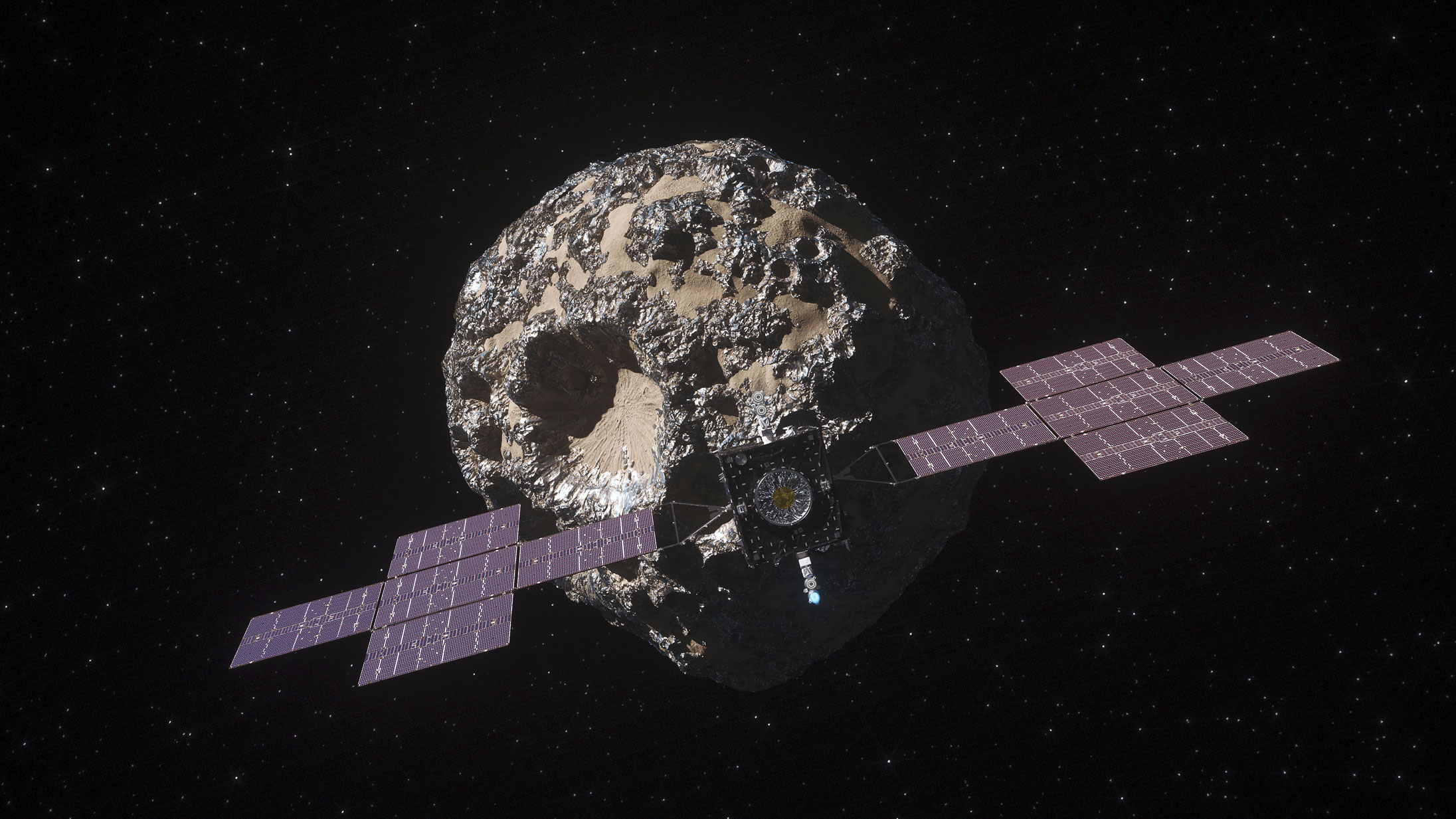
Asteroids have been something of a focus for Space Sunday of late, and they’re going to be again this week. Or at least, one is: 16 Psyche, as this is the target for a NASA mission which, if all goes according to plan, will launch from Kennedy Space Centre on October 12th, 2023.
16 Psyche was discovered by the Italian astronomer Annibale de Gasparis on 17th March 1852, and is named for the ancient Greek goddess of the soul. It has a shape consistent with that of a Jacobi ellipsoid, and measures some 278 km x 238 km x 171 km as it orbits the Sun between Mars and Jupiter once every 4.9 years at an average distance of 437 million km (2.92 AU). It is also the 16th minor planet to be found in the solar system by order of discovery (hence the 16 in its name).
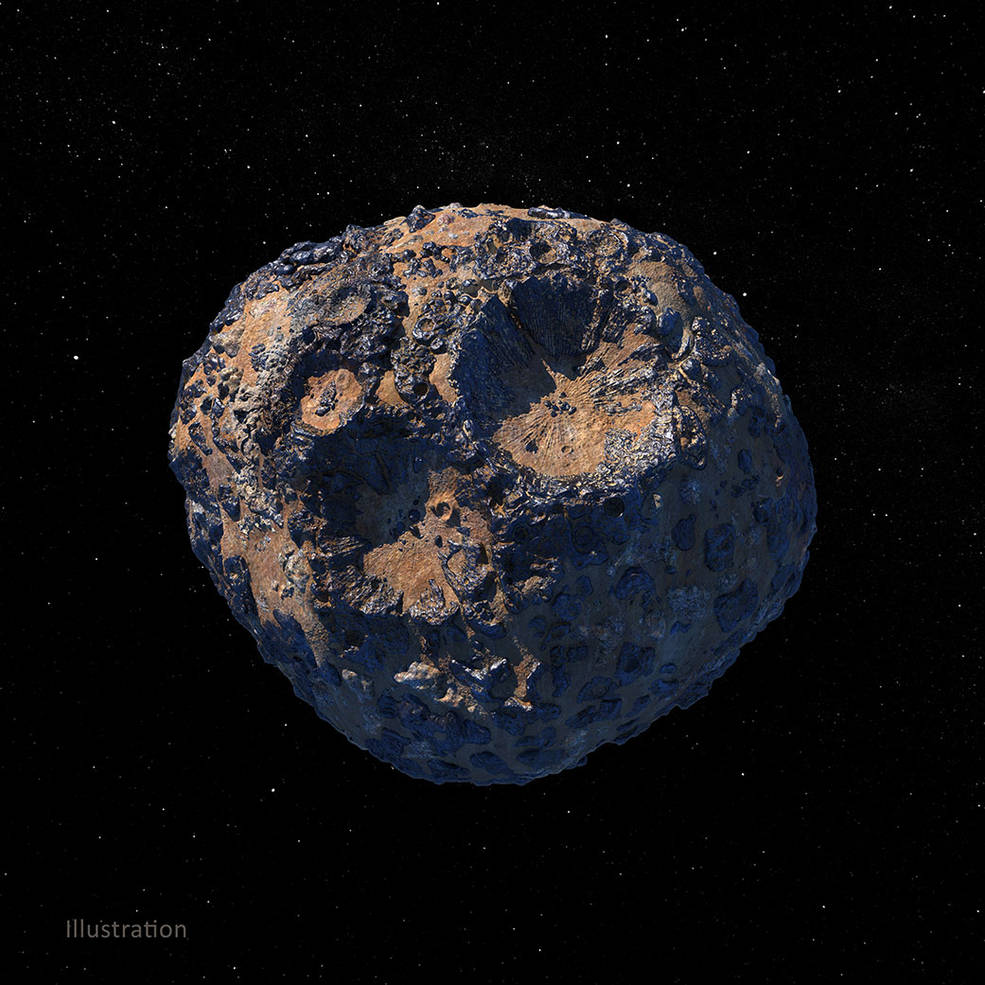
But what makes 16 Psyche a subject for detailed study is the fact that it is the largest and most massive M-class asteroid – a class of asteroids which appear to contain higher concentrations of metal phases (e.g. iron-nickel) than others within the asteroid belt – yet discovered in the solar system. So massive in fact, that it was long theorised that it was the exposed core of a protoplanet. These are bodies thought to have been created during the early history of the solar system from the collision and coalescing of planetismals, and which may have gone on to play a role in the formation of the inner planets of the solar system (in fact, for a time in the early 20th century, the coalescing of planetismals into protoplanets and protoplanets into planets was thought to be the process by which all planets were created, an idea long since proven incorrect; planetary formation is far more complex than things bumping into one another and gluing themselves together).
Thus, it is also possible that whilst a protoplanet, 16 Psyche evolved along lines which had nothing to do with planetary formation; thus, studying it might either help in our understanding of planetary formation and / or enable us to more fully understand the unique processes at work within these tiny (in terms to their relationship with planets) bodies, and the mechanisms which ultimate gave rise to their form and nature. Most intriguingly, a mission to 16 Psyche might even point to a different story as to how objects in the solar system formed.

Hence the upcoming NASA mission and spacecraft which bear the asteroid’s name. First proposed in February 2015 by Arizona State University, the idea was awarded a US $13 million grant under the agency’s ongoing Discovery Programme to allow the basic concept to be fully evaluated and the initial design for the spacecraft determined. As a result of this, the mission was officially adopted into the Discovery Programme at the start of 2017 with a budget capped at $1 billion.
At that time, the mission was targeting a later 2023 launch date; but such was the confidence in the vehicle’s development cycle that this was revised to a July 2022 launch opportunity. This would allow for a much faster mission, drastically reducing the transit time to 16 Psyche, allowing the spacecraft to reach it in 2026, rather than 2029 as would be the case with a 2023 launch. Unfortunately, COVID-19 intervened to delay the construction and testing of the spacecraft, forcing NASA to push the launch date back to October 5th, 2023. Then in September 2023, this was delayed a further week to allow time for adjustments made to the operational parameters for the spacecraft’s cold gas thrusters (used to orient the craft when manoeuvring) to be properly checked and verified.
Psyche (as in the spacecraft) will commence its journey atop a SpaceX Falcon Heavy rocket due to lift off from Pad 39A, Kennedy Space Centre, Florida at 14:16 UTC on October 12th. Once the craft has separated from the Falcon Heavy’s upper stage, it will deploy its massive solar arrays – a span totalling 25 metres and 7.3 metres across at its widest. Capable of generating 21 kilowatts of electricity whilst in the vicinity of Earth (which will decrease over distance to between 2.3-2.4 kilowatts when the spacecraft is orbiting 16 Psyche), these panels will not only provide electrical power to Psyche’s instruments, but will also power the vehicle’s primary propulsion system.

This comes in the form of four Hall-effect SPT-140 thrusters which will be used individually rather than collectively during the cruise stages of the mission, to both propel the spacecraft to its destination and slow it for orbital insertion around 16 Psyche. Each thruster uses some of the electricity generated by the solar panels to generate an electromagnetic field, which is in turn used to direct and accelerate a stream of inert xenon gas ions, expelling it as an exhaust mass to propel the craft.
The force of this exhaust is not huge – it’s about equal to that felt when holding an AA battery on the palm of the hand – but the key thing is, it can do so for weeks, and with a tiny amount of fuel, allowing for a constant acceleration, reducing the transit time to the asteroid compared to conventional meaning of transit (i.e. using momentum imparted by the launch vehicle coupled with multiple planetary flybys) and at a fraction of the propellent load (1 tonne or 10%) that would be required if conventional chemical motors were to be used.
Even so, the journey to 16 Psyche will still the 2.6 tonne spacecraft take 5 years 10 months. The first part will be a 2-year, 7-month outward spiral around the Sun so the spacecraft can perform a flyby of Mars in May 2026. This will allow it to both accelerate and swing itself onto a trajectory which crosses that of 16 Psyche in 2029, allowing the vehicle to slow itself into an initial orbit around the asteroid in August of that year.
During the initial part of the outward cruise, the spacecraft will be used to demonstration a potential new deep space communications technology – DSOC (“dee-sock”), the Deep Space Optical Communications system. This is a laser-based system which, if it works as planned, will increase communications performance and efficiency between Earth and a spacecraft in deep space by between 10 and 100 times, simply because of the removal of signal attenuation compared to radio signals and the greater bandwidth / throughput rates lasers can provide. DSOC will initially be tested through the first 12 months of the mission and, subject to results, the demonstration may be extended into the second year of the vehicle’s cruise phase, allowing the capability to be tested over distances of up to 2.5 AU.
On arrival at 16 Psyche, the spacecraft will enter the first of five orbital regimes (one if which it will use twice) in order to thoroughly map and study the asteroid. In particular, these will attempt to probe any magnetic field the asteroid might have (the presence of such a field would greatly lend itself to the idea the asteroid is in fact the core or partial core of a protoplanet). They will also enable the craft to completely map the surface of 16 Psyche and determine its surface composition and properties.
| Orbit | Duration | Inclination | Period | Duration | Mission |
| A | 92 days | 90º | 32.8 hours | 700 km | Magnetic field characterization and preliminary mapping |
| B(1) | 92 days | 90º | 11.6 hours | 303 km | Topography and magnetic field characterization |
| D | 100 days | 160º | 3.6 hours | 75 km | Determining the chemical composition of the surface |
| C | 100 days | 90º | 7.2 hours | 190 km | Gravity investigations and Magnetic field observations |
| B(2) | 100 days | 90º | 11.6 hours | 303 km | Topography and magnetic field characterization |

Given the nature of the spacecraft and allowing for its overall condition towards the end of the primary mission, it is possible that the Psyche mission could be extended beyond this initial 21-month period.
The launch of the Psyche mission will be broadcast by NASA TV, and can be watched via the link / preview below.
October 2023 Annular Eclipse
On Saturday, October 14th, 2023, nearly one billion people across the United States and the northern countries of South America will be able to watch an annular eclipse of the Sun (or at least a partial eclipse) – as the Moon crosses the Sun’s face as seen from Earth the last solar eclipse for 2023.
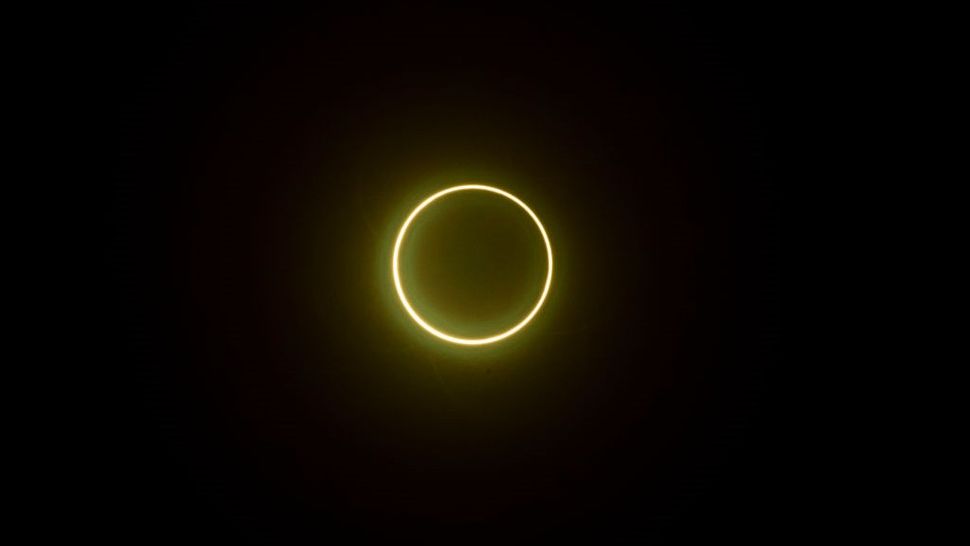
An annular eclipse difference from a total eclipse in that the Sun is never completely hidden by the Moon. In the case of October 14th, this will be because the Moon will be 4.5 days past apogee (the point where it is farthest from Earth, and so the tip of its umbral shadow cone misses Earth by around 19,200 kilometres, so the disk of the Moon will appear too small to completely cover the Sun; around 48% of the Sun’s diameter remains visible all around the Moon’s disk, creating what can sometime be a spectacular “ring of fire”.
Those able to see an annular eclipse in the United States are located along a line commencing in Oregon and passing directly through Nevada, Utah, New Mexico and Texas whilst touch the northeast of California and Arizona and the southwest of Colorado. In South America, the line of the eclipse passes through Mexico Nicaragua, Columbia and northernmost Brazil and touches on Costa Rica, Panama and Venezuela. Further afield, people will see a partial eclipse.
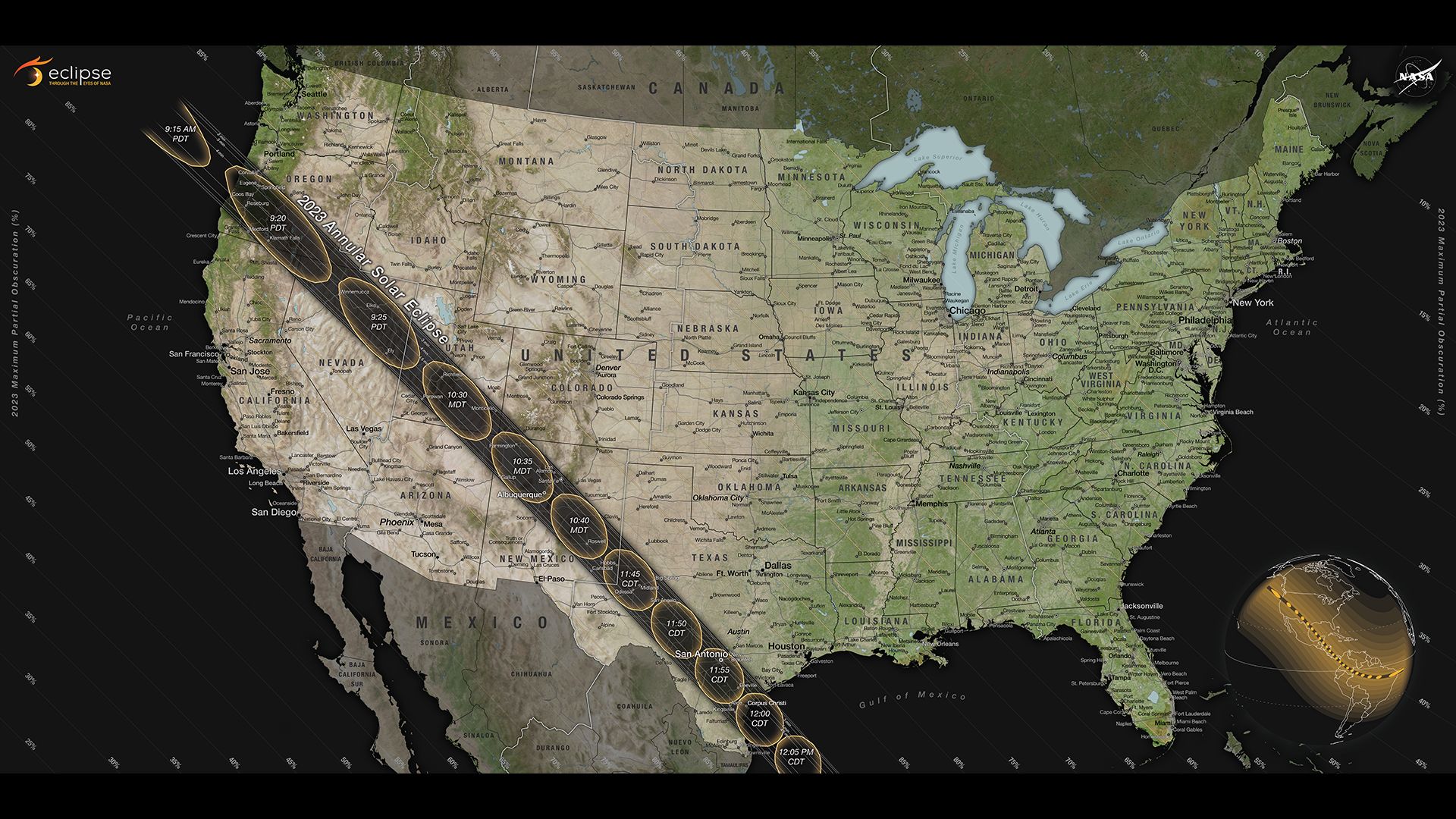
However, for those wishing to track the event, NASA’s 2023 Eclipse Explorer offers an interactive map detailing when and where the eclipse will be visible, including the path and duration of annularity (the areas from which the ‘ring of fire’ can be seen), allowing users to dive into the eclipse viewing experience like never before. Both the Time And Date and Virtual Telescope will be livestreaming the eclipse around the globe, as will Slooh via their You Tube Channel.
Of course, if you live along the line of the eclipse, you can always view it live. If you opt to do so (assuming the whether is clear), then remember: never look directly at the Sun either and especially through a telescope or binoculars or camera – don’t even use ordinary sunglasses. To view the eclipse safely you must use solar filters at all times on any optical equipment you are using to observe the Sun and / or wear solar eclipse glasses, regardless of whether your location will experience a partial solar eclipse or an annular solar eclipse. Serious eye damage and even blindness can result if you do not otherwise.
Also, don’t expect things to go really dark in the manner of a total eclipse or to be able to witness the Sun’s corona: that ring of the Sun’s disk peeping around the Moon may be small, but it is still bright enough to prevent that. But it will still be a spectacular event to see, and enthusiasts will go to whatever section of the eclipse track is most easily accessible for them in order to witness it.

 Inara Pey: Living in a Modemworld