Going Dutch with sailing in Second Life

Sailing the Bandit Skûtsje past Fastnet Light, Blake Sea

Analyse Dean was kind enough to forward a copy of her latest sailing creation to me, in the form of a popular type of Dutch barge called a skûtsje (which, I believe I’m correct in saying is pronounced skootshuh), a very unique sailing vessel with roughly 200 years of history and which today is prized as a houseboat, a unique sailing yacht and – perhaps most prominently – as a racing vessel.

The skûtsje was specifically a product of Dutch Frisia, first built in the 18th century (with construction of new vessels continuing through into the early 20th century), for the express purpose to hauling a wide range of goods designed to transport goods to and from what is now called the  province of Friesland and major commercial centres such as Amsterdam and also to / from the Wadden Sea Islands.

Slipping into Second Life and on the way home after a trip out across Blake Sea and back

To achieve this, skûtsje tended to have unique features: large forward cargo holds, cabins to the stern, a shallow draft, flat-bottomed and keelless hull, whilst being narrow of beam (no more that 4m) and with a maximum length of about 20m (the latter two being dictated by the inland waterways and locks they had to navigate.

All of this is very much captured within Analyse’s Bandit Skûtsje. At 23.5 metres, bow-to-stern and roughly 4.4 metres at the beam, it is scaled a little larger than an actual skûtsje – but is nevertheless properly proportioned and suitable for most SL avatar builds. It has the familiar bluff bow and stern, large rudder and paddle-like leeboards mounted on either beam, all found within the original. A capacious hold (potentially marking the skûtsje as ideal for participation in Get the Freight Out) occupies most of the length of the hull, with a low-slung, simple cabin to the stern.

I’ve not (as yet) done much to customise my skûtsje outside of giving it a name and the dolphin which usually adorns my boats

As is typical with Bandit designs, the vessel offers a choice of control options – keyboard, local chat, HUD options – to give the widest choice and combination of controls to owners when sailing. It is powered by the latest generation BOSS5 Dynamic Sailing engine, developed by Analyse and Dutch Mainsail, which gives a pleasingly smooth ride, the vagaries of Second Life allowing. Also like its physical world namesake, the Bandit Skûtsje is propelled by two sails: a gaff-rigged main sail and a jib. Both may seem oversized for the vessel, but this is in keeping with the type, their large size allow the vessel to better handle the wide range of sailing conditions (inland waterways, coastal exposed coastal shallows and the Zuiderzee), with which it had to contend.

It terms of that sailing, the Bandit model acquits itself with aplomb; it is surprisingly responsive to the tiller (although those more familiar with directing a boat using a wheel may have to go through a period of adjustment) and does tend to handle region crossings with ease. It also includes a couple touches from the original which add to the experience of sailing it. The first of these is the pair of very prominent leeboards mentioned above.

Under full sail

Intended for use individually, and according to need, leeboards were once in common use with boats operating in shallow waters, where a conventional keel often could not be used and vessels needed to be flat-bottomed. In short, they are designed to act in a similar manner to the central keel on sailing boat to both minimise the lateral motion of the vessel under sail (i.e. having the wind push it sideways) and to counter the roll (heel) that lateral force might induce, and which might threaten to capsize it. With the Bandit version the leeboards can be deployed as the boat heels, helping to maintain headway and speed – although they can also induce additional drag if used incorrectly, so practice in their use may be required.

The second touch is that the Bandit Skûtsje relies solely on wind for its primary means of propulsion; there is no engine to fall back on. This is again in line with the vast majority of physical world skûtsje, and means that when the sails are furled, it must be literally manhandled – punted along in the required direction using a “skûtsje pole” – one of which is supplied with the boat and can be attached to an avatar for use when required. This can make trying to moor the boat a challenge – particularly given it again reflects its physical world counterpart in having inertia – but it also adds a new dimension of fun to manoeuvring it sans any use of the sails.

A further novel aspect to the skûtsje is that for a good part of its life the type has been used for racing. This appears to have started fairly early on in the boat’s history, and may have naturally sprung out of commerce-driven competition between working boat owners. However, by the 19th century, races offering prize pots were being organised.

These regatta – called Skûtsjesilen – have a long and colourful history of their own, and they continue to this day, formalised by the Sintrale Kommisje Skûtsjesilen (SKS) since 1945. More recently – since 1981 and thanks to the growing popularity of restored skûtsje as pleasure craft / houseboats – by the Iepen Fryske Kampioenskippen Skûtsjesilen (IFKS). Such is the nature of these races, enthusiasts have even been known to convert their vessels so that for most of the year they can be used as a sailing home, but come the regatta season, entire cabins and all unnecessary weight can simply be removed from the cargo hold space, leaving a lean, clean boat available for racing.

This aspect of the skûtsje is also available to the Bandit version, thanks to the inclusion of a No Modify version of the barge specifically designed by Analyse to be raced; it is supported by a racing pack, allowing owners to organise races among themselves and set-up courses – although it would be nice to think a group similar the one formed for racing Bandit Folkboats (and which I blogged about way back in 2015!) might come into being.

Making speed along Blake Channel

At L$3750 (and that the time of writing, only available in-world but this may yet change), the Bandit Skûtsje is well-priced given the overall package. As well as all of the items mentioned above – two versions of the boat, the HUD (which can be used with either), skûtsje pole, and racing kit, the package also includes a textures set for re-texturing and customising the boat (just download the required PNG files and modify them), a collection of national ensigns for re-texturing the boat’s flag, a 20 LI display model of a skûtsje in full sail (supplied No Mod), a stand for mounting the boat when it is out of the water and a very comprehensive user guide which also offers a concise history of the skûtsje.

My thanks to Analyse for her generosity in providing me with a copy of the Bandit Skûtsje. I’ve had fun learning to get to grips with it – even to the extent of blue water sailing around and round Blake Sea – and have found it to be a lot of fun! So, if you’re interested, hop along to Dutch Harbor and try-out the demo version there for yourself!

2023 SL viewer release summaries week #37

Logos representative only and should not be seen as an endorsement / preference / recommendation

Updates from the week through to Sunday, September 17th, 2023

This summary is generally published every Monday, and is a list of SL viewer / client releases (official and TPV) made during the previous week. When reading it, please note:

  • It is based on my Current Viewer Releases Page, a list of all Second Life viewers and clients that are in popular use (and of which I am aware), and which are recognised as adhering to the TPV Policy. This page includes comprehensive links to download pages, blog notes, release notes, etc., as well as links to any / all reviews of specific viewers / clients made within this blog.
  • By its nature, this summary presented here will always be in arrears, please refer to the Current Viewer Release Page for more up-to-date information.
  • Note that for purposes of length, TPV test viewers, preview / beta viewers / nightly builds are generally not recorded in these summaries.

Official LL Viewers

  • Release viewer,  version 6.6.13.580918, formerly the Maintenance U(pdate) RC viewer, version 6.6.14.581101, promoted August 23.
  • Release channel cohorts:
    • Maintenance W RC viewer, version 6.6.15.581670, issued September 11.
  • Project viewers:
    • No updates.

Note: The Alternative Viewers page appears to have suffered a hiccup, listing version 6.6.12.579987 as the “Win32+MacOS<10.13” RC viewer.  However, the Win 32  + Pre-MAC OS 10.3 viewer was actually version 6.6.13.580794, promoted to release status on July 5; 6.6.12.579987  was the version number assigned to the Maintenance S RC viewer promoted to release status on May 16th.

LL Viewer Resources

Third-party Viewers

V6-style

  • No updates.

V1-style

  • No updates.

Mobile / Other Clients

  • No updates.

Additional TPV Resources

Related Links

Space Sunday: hycean worlds and seeking signs of life

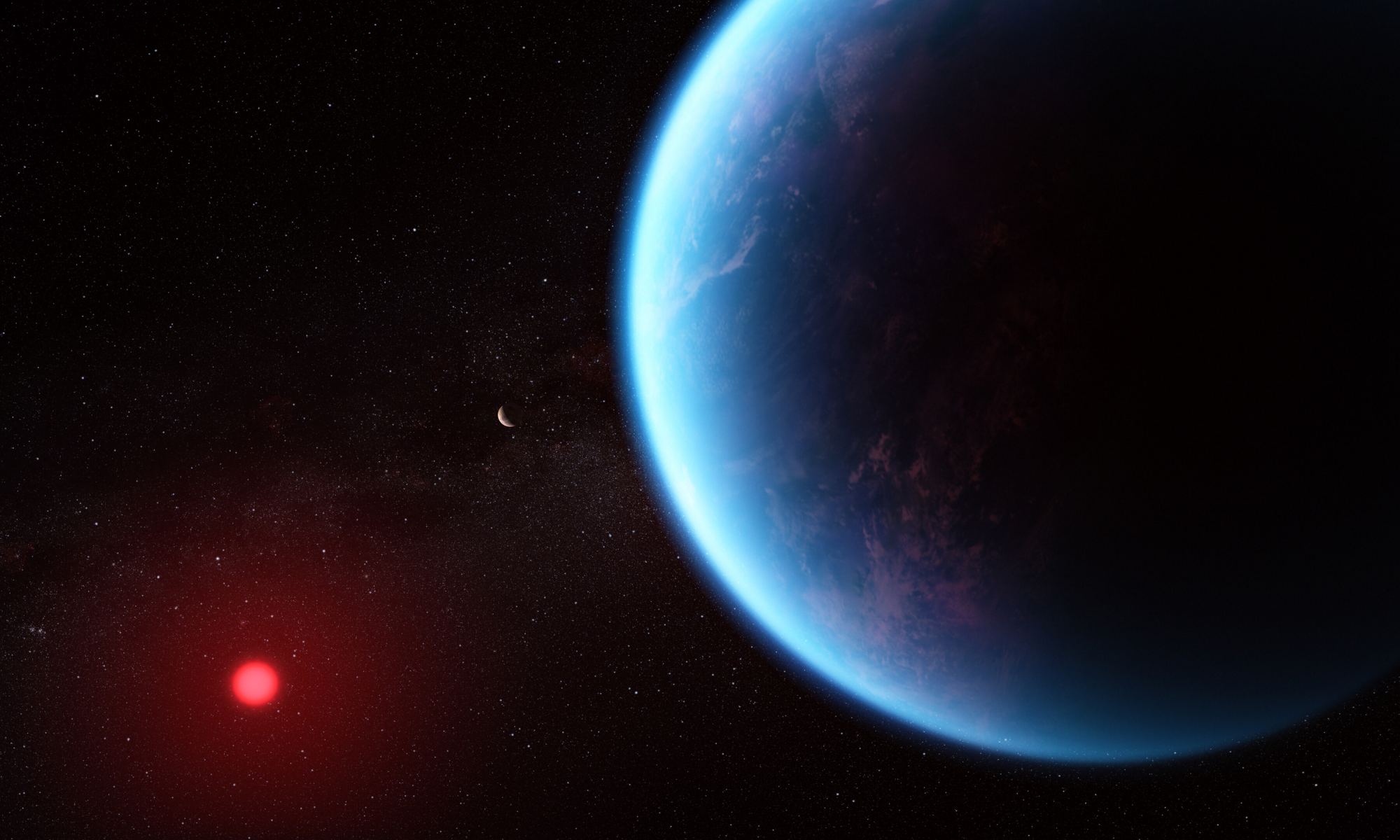
An artist’s impression of the (potentially) hycean world K2-18b. Credit: NASA, CSA, ESA, J. Olmstead (STScI), N. Madhusudhan (Cambridge University)

“Hycean world” may not be a term familiar to many. It refers to a type of hot, water-covered planet with a hydrogen atmosphere – “hycean” being a portmanteau from HYdrogen and oCEAN – sitting somewhere between Earth and Neptune in size, and which could be promising candidates for harbouring life, as they would be naturally warm and wet. However, there is a slight wrinkle in this theory: up until now, hycean planets have been purely hypothetical – although several contenders for the title have been identified.

One such contender is K2-18b, an exoplanet 124 light years away. It sits within the habitable zone of a relatively mild-mannered red dwarf star called K2-18 (and also EPIC 201912552), located within the constellation of Leo when viewed from Earth. First discovered by the Kepler mission in 2015, K2-18b is referred to as a “super Earth” because it is around 3 times the size and 9 times the mass of Earth, but smaller than Neptune (3.9 times the size and 17 times the mass of Earth).

From the start, it was known that K2-18b had an atmosphere dominated by hydrogen. Studies also showed that while it orbits in close proximity to its parent star, taking just 33 terrestrial days to complete an orbit – such is the star’s low energy output (just 2.3% that of the Sun), K2-18b receives a very similar amount of solar energy to the Earth: 1.22kW per square metre compared to our own average of 1.36kW per square metre. This means the planet likely has a global temperature range of between averages of −23°C at the poles and +27°C in the tropics, making it potentially ideal for hosting liquid water.

A hypothetical example of composition of an exoplanet’s atmosphere obtained during a transit, when the light from the star passes through the atmosphere of the planet to be captured by an observatory’s spectrograph, allowing it to be broken down and the elements within the planet’s atmosphere identified. Credit: NASA, ESA, CSA, STScI, Joseph Olmsted (STScI)

In 2019, the Hubble Space Telescope (HST) found evidence that water vapour is present in K2-18b’s atmosphere, further edging it towards hycean status. However, the jury has remained out on the matter. The HST observations of 2019, for example, appeared to also find traces of ammonia and hydrocarbons – two elements which should not exist if there is also a large amount of liquid water present (as it would absorb them). Further, a 2021 study suggested that if K2-18b is tidally locked with its star (that is, always keeping the same side facing towards the star, which given their proximity to own another would seem likely), then any water on the sunward side of the planet would likely be in a supercritical state, making any form of liquid ocean impossible.

However, using the Near Infrared Spectrograph (NEARSpec) and Near-Infrared Imager and Slitless Spectrograph (NIRISS) detectors on the James Webb Space Telescope (JWST) a team of astronomers from the UK and USA are attempting to build a comprehensive – if not yet complete – view of K2-18b’s atmospheric spectra. Their initial findings have been published in a new paper, and suggest that K2-18b might yet prove to be a hycean planet.

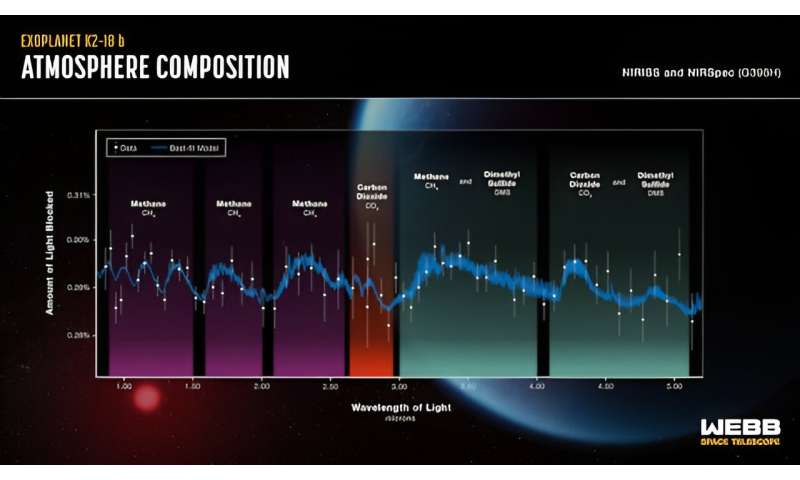
In particular, the paper confirms that HST did find water vapour in K2-18b’s atmosphere, it was wrong about the presence of ammonia and hydrocarbons; the team having found no trace of either – although they have found both methane and carbon dioxide in the atmosphere, both of which also lean themselves to a potential for the planet having a liquid ocean.

The chemical composition of K2-18b’s atmosphere. Credit: NASA, CSA, ESA, R. Crawford (STScI), J. Olmsted (STScI), Science: N. Madhusudhan (Cambridge University)

More interestingly, the team also appear to have detected dimethyl sulphide, (CH3)2S – DMS for short. This is potentially a critical discovery, and so far as we know, DMS is the result of a wholly organic process: marine life and plankton giving vent to flatulence. If this is as true for K2-18b as for Earth, then the case for that planet having a liquid water ocean becomes pretty clear.

However, a note of caution needs to be struck here. As the researchers themselves make clear, the signal for DMS within K2-18b’s atmosphere is only 2 sigma. While this equates to a 98% confidence level in the instruments on JWST having correctly identified it, the results nevertheless fall far short of the 5 sigma (over 99.9% confidence) required by science to indicate the instruments have correctly identified the presence of a particular element within the atmosphere of another world. As such, further examinations of K2-18b’s atmosphere need to be made to see if that 5 sigma level can be achieved – or if the DMS traces fade away to nothing.

And even if the DMS readings prove to be correct, it again doesn’t automatically mean the planet is home to life. Whilst the sole cause for DMS here on Earth is that of marine life farts, the same may not be true for other places in the galaxy; it might yet be show the some strange geological or chemical cause might be responsible for its presence. Nevertheless, the data thus far obtained by JWST do suggest that K2-18b could be a warm, naturally wet planet – and potentially points the way to other such worlds existing within the galaxy.

Are Pollutants a way to find Industrial Civilisations?

Using the transit method of analysing the atmosphere of a planet, as with the case of K2-18b above, is one of the best ways we have at our disposal to determine its potential to support life. However, it might also be the means of detecting technological life itself – as pointed out by an international team led by Canadian–American astronomer and planetary scientist Sara Seager.

As we’re only too aware, humanity has developed a nasty habit of buggering up Earth’s atmosphere with pollutants. Some of these have very clear spectral signatures and cannot be produced in quantity by natural means. As such, looking for them elsewhere might be indicative of the worlds where they are found being home to industrial civilisations.

Analysing the atmospheres of exoplanets through the transit method for signs of pollutants / inorganic elements in large qualities might indicate the presence of an industrial civilisation. Credit: sciencing.com

Take sulphur hexafluoride (SF6) and nitrogen trifluoride (NF3), as Seager and colleagues suggest. These are two inorganic greenhouse gases (NF3 for example, is 17,000 times more effective at warming the atmosphere than CO2). Both are artificially created, and are used by a number of modern industries. What’s more, they have very distinctive spectral signatures and very long half-lives; as such they have the potential to make ideal “technosignatures” if they were to be detected in the atmosphere of an exoplanet.

Of course, this also requires that any extra-solar civilisation follows something of a similar development path as we are on, but it is an intriguing idea. In fact, and as Seager and her team note, whilst fluorine might be the 13th most abundant element on Earth, very little of it occurs naturally in any form; most of it is produced (and used) in industrial processes. So again, should the analysis of an exoplanet’s atmosphere reveal multiple fluorine elements, there’s a fair chance (again using Earth as a model) they might point to a technological civilisation being present.

Resuming the Hunt for “Planet Nine” – Or Its Economy Sized Version

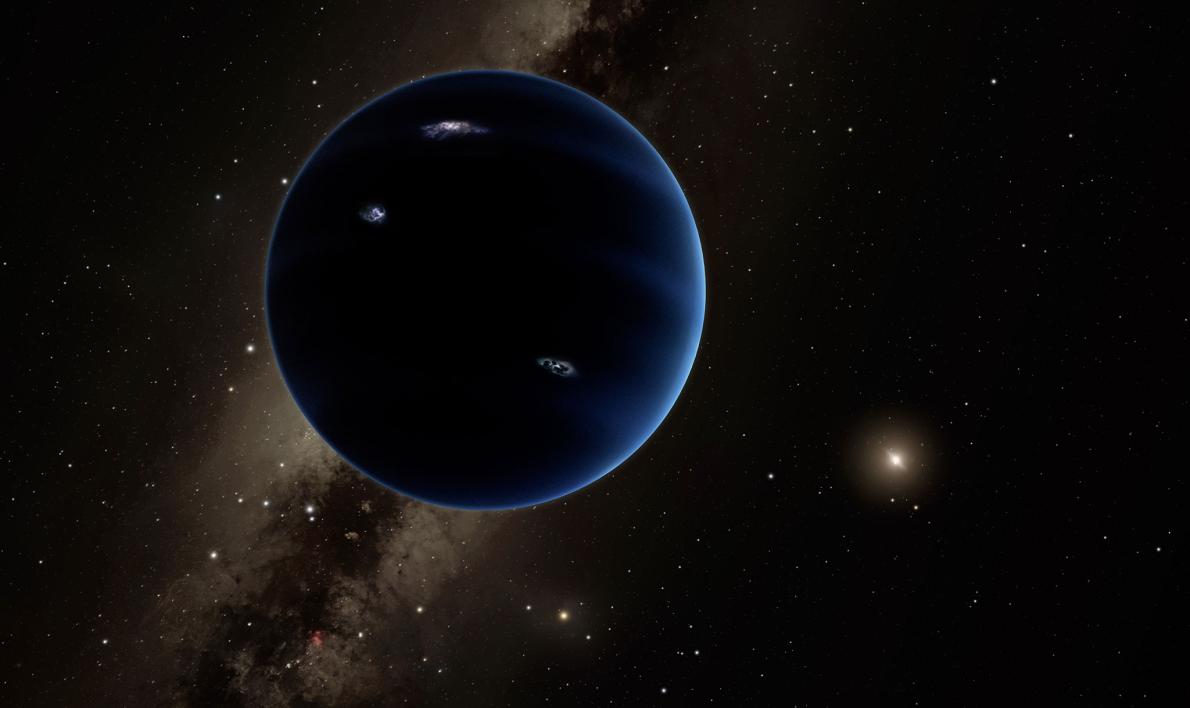
I’ve covered the conundrum of Planet Nine – the Neptune-sized planet some believed to be orbiting the Sun at an average distance of around 460 AU and responsible for chucking a number of Kuiper Belt Objects (KBOs) into highly unusual orbits of their own well outside of the plane of the ecliptic – numerous times (see here, here, and here, for more).

Most vigorously proposed and pursued by Mike Brown, a leading planetary astronomer at the California Institute of Technology, it was a contentious idea – most notably because of the small data pool from which Brown and his colleagues drew on to establish the whole idea of “Planet Nine”. It was also one that quickly came into doubt as repeated attempts to locate the mystical world failed to do so and evidence against such a large planet existing continued to mount.

It had been thought that Planet Nine, if it exists, might equal Neptune in size. However, a 2020 study largely pushed this idea out of the window. Now it has been suggested a smaller body – closer to Earth in size – might be lurking far out in the solar system and exerting a possible influence on KBOs / TNOs. Credit: Caltech / R. Hurt

When I last wrote about this situation, back in June 2020, it was to cover the work of Professor Samantha Lawler, an assistant professor of astronomy, University of Regina, Canada. Due in part to her involvement in the Outer Solar System Origins Survey (OSSOS), coupled with models such as the Nice Model (as in the town in France, not “nice”) of planetary migration, she was able to demonstrate the vast majority of eccentric KBOs could be accounted for through purely natural gravitational interaction. Most, that is, but not all; as she noted in her findings, small groups of KBOs remain a outliers, defying explanation for their eccentricities.

Some of the latter lie within a sub-category of KBOs referred to as trans-Neptunian objects (TNOs). These are objects with obits close enough to that of Neptune so as to be directly influenced by its gravity, which forces them into very defined modes of behaviour. However, a small percentage of TNOs (approx. 13% of the total) refuse to show any sign of being under Neptune’s influence, almost as if there is something else acting on them gravitationally and limiting Neptune’s ability to call them to heel; something perhaps like a yet-to-be discovered “Planet Nine”; albeit one on a much smaller scale than previously imagined – its economy-sized version, if you will.

The idea has grown out of unrelated research concerning the early development of the solar system. In running hundreds of simulations on how the solar system may have formed, and the planets – particularly the gas giants – migrated away from the Sun, researchers noted their models repeatedly formed multiple Earth-sized planets in the outer solar system. The exact number varied with each simulation, but they all shared the common fate of either being completely ejected from the solar system thanks to the outward migration of the gas giants, or – in the case of a small handful – being pushed into very distant orbits around the Sun where they have yet to be found.

Most interestingly, the researchers noted that if just one of these small planets – one with a mass around twice that of Earth – were to be pushed into a high inclination orbit – say 45º – and at an average distance of just 200 AU from the Sun, then it could have the potential to exert influence over the recalcitrant TNOs in a manner pretty close to their actually behaviour, and similarly affect other outlier KBOs.

Those behind the study are not proposing that there is a “mini-me” Planet Nine tap dancing its away around the Sun; merely that their work has thrown up some potentially interesting results. Nevertheless, in some quarters it has somewhat reinvigorated the whole idea of a distant planet (or even planets) still awaiting discovery as they make their way slowly around the Sun, and so the hunt may yet resume.

A Triple Sweet Café in Second Life

 Triple Sweet Café, September 2023 – click any image for full size

I’ve been back on my café-hopping again of late, with a recent stop being that of Triple Sweet Café, designed and operated by Nisha Nebula (StarfireNebula).

Located within a Homestead region and sitting on the largest of five islands located therein, the Triple Sweet Café would – but for the trees which form the island’s major occupiers – offer a commanding view out over the waters towards two of the other four islands. It would also provide a broke of the island’s foreshore, where a dock points out from the land, a place where rowing boats await those who fancy taking a trip out on the water. However, should you opt to do so, please note that with the exception of the little island closest to the café’s (and linked to it via a humpbacked bridge), the small islands are private residences, so please do not approach or explore without permission.

 Triple Sweet Café, September 2023

However, as noted above, the café is screened from the westward island by trees and they climb up the rugged hillside to its flat top, giving the café and its aged terrace and foreland a cosy sense of privacy and detachment; marking them as a place where people can come and forget worries and upsets and simply relax and let the time pass without care.

The converted cottage in which the Triple Sweet is located is the only building on the island. It offers a snug main room complete with a counter where coffee and pastries might be purchased and comfortable armchairs and sofas sit around an open fire – something likely to prove popular with visitors as the nights start to drawn in here in the northern hemisphere.

 Triple Sweet Café, September 2023

A second little snug space sits above, on a half-floor reached via a spiral stairway. Should the main room, with its armchairs and tables and chairs prove to be a little busy, a connecting hall offers the way to a glass-roofed side room. This also offers comfortable armchairs before a fireplace, together with counter seating. It’s a genuinely warm, friendly place, whilst the old terrace outside the front door has seating for those who enjoy coffee and sunshine.

The café shares the hilltop with a wooden deck presented as an event space; dances are available for the romantically-inclined, while tables to one side offer further places to sit and enjoy a drink and a nibble.

 Triple Sweet Café, September 2023

Nor is sitting in or close to the café the only options for visitors to the island. Follow the steps at the front of the café’s grounds to the lowland area, and it will not open lead to the small dock mentioned above, but also opens the way to most of the other places where people can sit and cuddle or chat and pass the time. One of these – the little campsite – has a path curving away to it to where a second set of steps descend the hill from the café to reach the stone bridge as it hops of the water to the little island I also referenced above.

Low-lying and circular in nature, the island is home to ruins of an equally circular form. What they may represent is up to the imagination, but with the surrounding trees and flow of vines over the stonework, it forms another place of romance for dancers, the fountain at its centre completing the attraction of this quiet location.

Triple Sweet Café, September 2023

Like many places in Second Life, Triple Sweet Café is dressed for the Autumn / Fall, with many of the trees around the café heavy with leaves turning brown, gold and red, while some of the leaves having decided to make the jump for the ground, where the colours also reflect the time of year, even as racoons and squirrels roam. Also given the time of year, the trappings of Halloween have started to appear, both indoors and out.

Highly photogenic and finished with a fitting local soundscape, Triple Sweet Café makes for an inviting and engaging visit. Now, if you’ll excuse me, I have a coffee and a cinnamon roll with my name on them 🙂 .

 Triple Sweet Café, September 2023

SLurl Details

Triple Sweet Café (Hydra, rated Moderate)

Art and a coffee in Second Life

LiThO – The Tiny Art(ist) Gallery

Two of the things I can appreciate in life are coffee and art. When it comes to the former, I take pride in being both an appreciator and a creator; I very much believe in the “old” saying life is too short for bad coffee, and always enjoy a well-made cup and genuinely enjoy making my own from beans to cup (by way of automatic prosumer coffee maker or a Cafetiere / French Press or a Moka pot, depending on mood / company). When it comes to the latter, however, I’m strictly an appreciator because I can neither draw nor paint. 

However, with LiThO Gallery I’ve found that I can enjoy both – and can combine my coverage of the arts in SL with my occasional series of cafés and coffee houses in Second Life whilst also making my way back to the Corsica South Coasters community, which I’ve also written about on numerous occasions (most notably in covering exhibitions at NovaOwl Galleries). Sub-titling itself the tiny art(ist) Café, LiThO offers a neat little play on words whilst also fulfilling its primary purpose: a place to relax and enjoy art.

LiThO – The Tiny Art(ist) Gallery

The play on words – as the notes from owners Lizzy Swordthain and Tom Willis available from the café’s terrace explain – first off takes the short-form of lithography, the planographic method of printing developed by author and actor Alois Senefelder, and most frequently used initially for musical scores and maps. In the second, it is a tease on their SL names. It occupies one of three parcels the couple have developed, the one alongside the café offering an open-air event space (although the café also has one of its own up on the roof and reached via stairs to one side of the building). The reaming parcel, to the rear of the café, is a private home, the two separated by the gully and bridge – the latter marking the limit of public spaces.

As a gallery space, the café hosts modest exhibitions in casual boutique style. Pieces from the invited artist are displayed the the two covered wings of the terrace and on the walls of the café’s rooms. At the time of my visit the gallery was playing host to an exhibition of Second Life landscapes by Michiel Bechir  – an artist whose work is always worth seeing. It opened on September 3rd, 2023, so has a while to run for those wishing to visit without feeling rushed. The select of pieces – 15 in total are well-suited to the ambience of the café and offer engaging views of some of Second Life’s most popular public regions, past and present.

LiThO – The Tiny Art(ist) Gallery

Cosy and nicely presented, LiThO makes for an easy-going visit, and the trails and paths around it offer opportunities for exploration.

SLurl Details

2023 SL SUG meetings week #37 summary

The Shambles, July 2023 – blog post

The following notes were taken from the Tuesday,  September 12th Simulator User Group (SUG) meeting. They form a summary of the items discussed and is not intended to be a full transcript. A video of the entire meeting is embedded at the end of the article for those wishing to review the meeting in full – my thanks to Pantera for recording it.

Meeting Overview

  • The Simulator User Group (also referred to by its older name of Server User Group) exists to provide an opportunity for discussion about simulator technology, bugs, and feature ideas.
  • These meetings are conducted (as a rule):
  • They are open to anyone with a concern / interest in the above topics, and form one of a series of regular / semi-regular User Group meetings conducted by Linden Lab.
  • Dates and times of all current meetings can be found on the Second Life Public Calendar, and descriptions of meetings are defined on the SL wiki.

Server Deployments

  • On Tuesday, September 12th, SLS Main channel was updated to simulator update 581292, previously on the majority of the RC channels.
  • On Wednesday, September 13th, the “Dog Days” update should be deployed across all RC channels. This update includes:
    • The unbinding of the Experience KVP database read / write functions from land (users will still require an Experience to access the KVP database).
    • A scripted ability to set CLICK_ACTION_IGNORE, allowing an object to be clicked-through to reach an object behind it – a flag supporting this is included in the Maintenance U RC viewer promoted to Release status in week #34.
    • PRIM_CLICK_ACTION is added to llSet/GetPrimParams so you can set the click action on prims in a linkset.
    • It was noted that as LL has “changed some of the tools that we use for simulator builds … the version number is now longer”.

Viewer Updates

No updates to the official SL viewers at the start of the week, leaving the current list as:

  • Release viewer, version 6.6.14.581101, promoted August 23.
  • Release channel cohorts:
    • Maintenance W RC viewer, version 6.6.15.581670, September 11.
    • glTF / PBR Materials viewer, version 7.0.0.581684, September 8.
    • Inventory Extensions RC viewer, version 6.6.15.581692, September 8.
    • Emoji RC viewer, version 6.6.15.581551, August 31.
    • Maintenance V(ersatility) RC viewer, version 6.6.15.581557, August 30.
  • Project viewers:

Note: the alternate viewer page also lists “Win32+MacOS<10.13 – 6.6.12.579987” as an RC viewer. However, the Win 32 + pre-Mac OS 10.13 was promoted to release status on July 5th, and viewer version 6.6.12.579987 points to the Maintenance S viewer, promoted to release status on May 16th.

Potential for Improving Vehicle Control Options

Further to recent meetings, Leviathan Linden gave the following update.

Last week it was suggested (although I missed it, Signal later pointed it out to me) that instead of using a new specific library for detecting devices we should use SDL (Simple DirectMedia Layer) since it is already used by various 3rd party viewers for Linux support. So, I’ve gone ahead and starting walking that road, FYI. This will bring the official SL viewer closer in compliance to some 3rd party viewers and won’t add a new dependency.

This led to an interim agreement that the API could be analog_control, and a discussion on the control events it should recognise / support, how the data should be transmitted, etc. This conversation commenced during the last 20 minutes of the meeting and continued through until then end.

In Brief

Please refer to the video for:

  • A potential issue with llRezAtRoot generating unexpected results.
  • Rider Linden indicated he’d like to implement an extended rez function similar to BUG-233084 “Rez function with prim properties, primarily for projectiles”, “soon”.
  • a discussion on llkeyframedmotion. and whether or not an object using can reliably differentiate between “I stopped moving because I ran out of keyframes” and “I stopped moving because someone with edit perms selected me”, which broadened into a discussion on kfm objects.

† The header images included in these summaries are not intended to represent anything discussed at the meetings; they are simply here to avoid a repeated image of a rooftop of people every week. They are taken from my list of region visits, with a link to the post for those interested.