
July 1st, 2023 saw the launch of a new space telescope – the European Space Agency’s (ESA’s) Euclid – on one of the most intriguing space missions yet started.
Classified as a M(edium)-class mission within ESA’s Cosmic Vision campaign, Euclid was originally to have been launched via Russian Soyuz ST-B; however, following Russia’s invasion of Ukraine, ESA ended all partnerships with Roscosmos, the Russian space agency, and the mission was – with NASA’s assistance – shifted to using a SpaceX Falcon 9 rocket launching out of NASA’s Kennedy Space Centre (KSC), Florida.
Following a flawless launch from Pad 39A, KSC at 15:12 UTC, the booster lifted the observatory to orbit, the second stage of the rocket successfully sending it on its way towards the Earth-Sun L2 Lagrange point, with the telescope will commence observations, in a 30-day gentle transit. Along the way, the instruments and systems on the spacecraft will be powered-up and go through check-out procedures so as to be ready for commissioning as the craft arrives at the L2 position.
For those unfamiliar with the term, the L2 position is one of five points of equilibrium for small-mass objects under the gravitational influence of two massive orbiting bodies (points where the gravitational influences of the larger bodies effectively “cancel one another out”). Also known as libration points, they are: the L1 position sitting between both bodies, but nearer the smaller than the larger; L2, located on the opposite side of the smaller body relative to the larger; L3, located on the opposite side of the larger body relative to the smaller; and L4 leading the smaller of the two in it orbit around the larger, and L5 trailing.
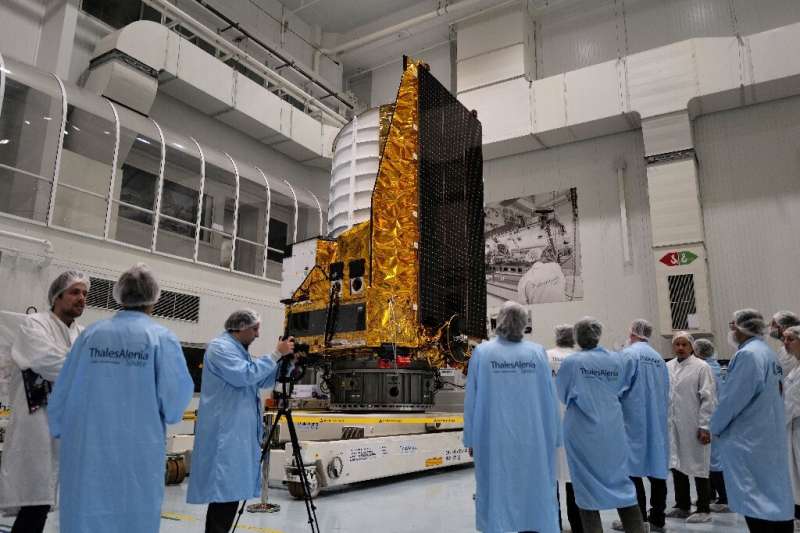
Those familiar with the Lagrange points will likely recognise the L2 position as being the focal point for the James Web Space Telescope (JWST) in its journey around the Sun. On arrival, Euclid will enter a similar 1-million km wide elliptical orbit around the L2 position in a manner which will prevent it ever falling into Earth’s shadow. once in place, the 1.4 billion Euro spacecraft will spend a nominal 6 years within this orbit using a combination of a visible light camera and a near-infrared spectrometer/photometer in an attempt to gain a better understanding of dark energy and dark matter.
Sometimes (often in bad science-fiction) conflated as the same thing, dark matter and dark energy are two different entities. In simple terms, dark matter is a hypothetical form of matter with a physical mass, and thought to account for the so-called “missing mass” of the universe (some 85% of its expected mass). The “dark” of the name refers to the fact that it does not absorb, reflect, or emit electromagnetic radiation, making it extremely difficult to defect. However, various gravitational effects which can be observed can only take place if there is more matter involved than can be detected – thus implying dark matter’s existence.
Dark energy, however, is an unknown form of energy which was first suggested in 2011. Up until that point, it had been believed that the expansion of the universe – the result of the big bang – was slowing imperceptibly down through the aeons, the result of the gravitational mass of the billions of galaxies within it gradually overcoming the momentum imparted to them by the big bang. However, careful analysis of the measurement of numerous supernovae suggest that the expansion of the universe is actually accelerating – which could only be due to some unknown force acting on all the galaxies. Thus, the concept of dark (again meaning hard / impossible to directly detect) energy was born, a force potentially responsible for as much as 68% of the total energy contained with in the present-day observable universe.

To try to better pin down both dark matter and dark energy, Euclid will use its instruments to chart some 2 billion galaxies across one third of the night sky relative to Earth, capturing light that has taken up to 10 billion of the universe’s 13.8 billion-year lifespan to reach us. In doing so, it will measure their shape and the degree of red shift evident, whilst also using the effects of gravitational lensing on some to reveal more data about them. From this, it is hoped that astrophysicists might be able to construct a model to explain how the universe is expanding which might both explain the nature and force of dark energy and potentially offer clues as to the actual nature of dark matter – the mass of which must be having some impact on dark energy as it pushes a the galaxies.
However, this is going to take time; from the start of operations in a couple of months, it will take the Euclid team 2 years to gather sufficient data which can start to be meaningfully analysed. After that, it will take four years of gather additional data which might be used to refine and improve the initial analyses, and offer up at least some answers.
Urine is a Key to Mars
If humans are to travel to and from Mars, there are a number of issues which need to be addressed, among them the issue of drinking water for the 6-9 month trips to / from Mars (assuming the use of chemical propulsion).
One of these is how to supply the crew with water. NASA state that trained astronauts required 4.4 litres of water per day for drinking, food preparation, hygiene and cleaning. For a crew of four going to Mars that’s between 3.16 and 4.75 tonnes of payload mass alone (+ reserves for emergencies on top of that). While that mass might also be used to supplement a vehicle’s radiation shielding, the fact remains that carrying large amounts of water is just so much deadweight compared to other, more efficient means of providing radiation protection (such as Kevlar and high density polyethylene, or HDPE). To make water efficient, it needs to be recycled.
This is already the case on the International Space Station (ISS). As a part of the Environmental Control and Life Support System (ECLSS), the US / International element of the ISS has long been able to supply recycle water back into usable drinking water (the Russian segments of the station rely more heavily on resupply from Earth for water, as the Russian saw this as the easier solution to developing efficient and space-taking recycling systems).

Within the US ECLSS are two water recycling systems – the primary Water Purification Assembly (WPA), which literally plucks water out of the station’s atmosphere in the form of condensate, sweat, exhale water molecules, water drops escaping during food processing and other acts, and water used for hygiene, and the Urine Processor Assembly, a subset of the WPA, which does exactly was that name suggests.
However, both systems have always been limited in their efficiency (the UPA to just 85% of all urine being recycled to a state where it is properly purified water). But over the last several years, various improvements have been made to the systems, raising their overall efficiency to 93.5%. In particular, urine recycling efficiency was raised to 87% through improvements in 2019/2020 and by cycling the semi-clean water through the primary WPA system to produce purified water suitable for drinking. However, a sticking point remained urine brine – a mix of water and body chemicals which could not be put through the WPA, but was simply tanked and disposed of.
Now water can even be extracted from that brine for recycling, thanks to a new addition to the ECLSS recently installed on the ISS and which has been undergoing evaluation. Called the Brine Processor Assembly (BPA), it is a combination of filter membranes and a heating system. The former traps the chemicals in the brine whilst allowing the water through. The water is then heated by the elements in the unit, forming a humid air flow which is then fed to the WPA, where the water is extracted alongside that gathered from other humid air captured by the WPA, and purified for re-use.
The result: up to 98% of all water consumed or used on the international segments of the ISS can now be recycled – an additional 4.5% compared to pre-BPA amounts. This is significant because NASA has always seen a 98% water recycling capability as a break-point for long duration space operations. It doesn’t eliminate the need for some measure of reserve supplies – but it drastically reduces the additional mass of water that might otherwise need to be carried, bringing the potential for crewed missions to Mars a little step closer to being practical.
In Brief
JWST Looks at the Solar System
Whilst the majority of its science mission is focused on the cosmos beyond our solar system, the James Webb Space Telescope (JWST) has the ability to reveal much about our own solar system. A UK team, for example, have recently been informed their proposal to use the telescope to study Jupiter’s upper atmosphere has been approved – and images of Jupiter taken in the infra-red by JWST have already wowed astronomers around the world.
One of the reasons for using JWST in this way is because the wavelengths in which it operates, coupled with its wide field of view means it is potentially ideal for spotting hitherto unknown moons orbiting the planets, as well as other small phenomena in the solar system. And it’s fair to say the proof of this is in the first of the cleaned-up images of Saturn recently capture by JWST which has been released by the science team.

True, the planet isn’t in the same glorious depth of colour we’re seen thanks to the Hubble Space Telescope (but again, JWST doesn’t operate in the visible light spectrum), but the detail is still revealing. Not only is the complex ring system surrounding the plane clearly visible, despite being almost edge-on to JWST, it reveals three of the planet’s tiny Moons, including Enceladus, while the strange hexagonal “storm” is also visible at the planet’s pole as a dark shape.
A further image, yet to be released, apparently shows the trail of ice and other matter which is being ejected by cryovolcanoes on Enceladus, spiralling back to Saturn’s E-ring.
Virgin Galactic Completes 1st Commercial Flight
Virgin Galactic has completed the first paid commercial flight of its sub-orbital space plane, VSS Unity.
The mission, called Galactic 01, took place on June 29th, 2023, when the carrier aircraft MSS Eve took-off from Spaceport America, New Mexico at 14:30 UTC, with the Unity slung beneath it. After climbing to altitude, the carrier aircraft release Unity, which then fired its rocket motor for 60 seconds, allowing it to climb to an altitude of 85 km.
Aboard the space plane were Colonel Walter Villadei and Lieutenant Colonel Angelo Landolfi of the Italian Air Force and Pantaleone Carlucci of the Italian National Research Council, who were aboard to carry out a series of 13 experiments ranging from biomedical data collection to microgravity studies of fluid mechanics and combustion. Also aboard as a liaison for the mission was Virgin Galactic’s lead astronaut instructor, Colin Bennett, on his second sub-orbital flight, while the vehicle was operated by flight commander Mike Masucci on his forth sub-orbital trip, and former member of the Italian Air Force and now one of the Virgin Galactic pilots, Nicola Pecile, making his first sub-orbital flight.
It’s not clear how many research flight of this nature has been arranged with Virgin Galactic, although the company is said to have a number of its books. It’s also not clear when they will take place: from August 2023, the company plan a monthly cadence of flights to try to start clearing the backlog of some 800 people who have purchased “tourist” flights, whilst also seeking to complete flight tests with the newest space plane in the fleet, the VSS Imagine.
Doughnuts on Mars and Ingenuity ‘Phones Home
On June 26th, NASA released an intriguing image captured by the Mars 2020 rover Perseverance on June 22nd – the 832 Sol of the mission. Taken by the Remote Microscopic Imager (RMI), a part of the rover’s SuperCam instrument, it shows an oddly-shaped rock apparently with a hole through the middle, giving it the appearance of a squashed doughnut.

Such rocks are not uncommon on Earth, and are generally the result of water-based erosion, and while various missions have in their time imaged some very odd-looking rocks on Mars, there planet hasn’t had the kind of water flow that could form a rock like this in a very long time – if it ever did – leading to some head-scratching as to how it might have been formed.
One suggestion, given the fact the rock seems to sitting all on its own in a broad expanse of sand, is that it might be a rock fragment thrown to its present position after a meteorite impact, the force of its landing shattering its middle to leave the additional fragments scattered around it.
Whilst people were puzzling over the rock, NASA received a call from the Ingenuity helicopter drone which is accompanying the rover in its exploration of Jezero Crater. Contact with the little helicopter was lost on April 26th, 2023, following its 52nd (of a planned 5!) flight as it scouted the terrain ahead of Perseverance to provide mission controllers on Earth a better idea of the lay of the land.

At the time, the Mars 2020 team were not unduly panicked; the flight had placed the helicopter well ahead of the rover – which it needs to use as a relay station for communications with Earth – and the uneven nature of the terrain meant that on landing, it would lose the line-of-sight link to the rover that is required for communications. Thus, it was expected that it would remain silent until such time as the rover once more entered line-of-sight communications, at which point Ingenuity would call home. This is precisely what happened on June 28th, 2023, when 63 days after going silent, the helicopter sent a message to mission control with what amounted to, “Coo-eee! I’m here and feeling good! What kept you?”
The flight team are now reviewing Ingenuity’s flight status ahead of prepping it for its 53rd flight, which could come before the end of July.

 Inara Pey: Living in a Modemworld