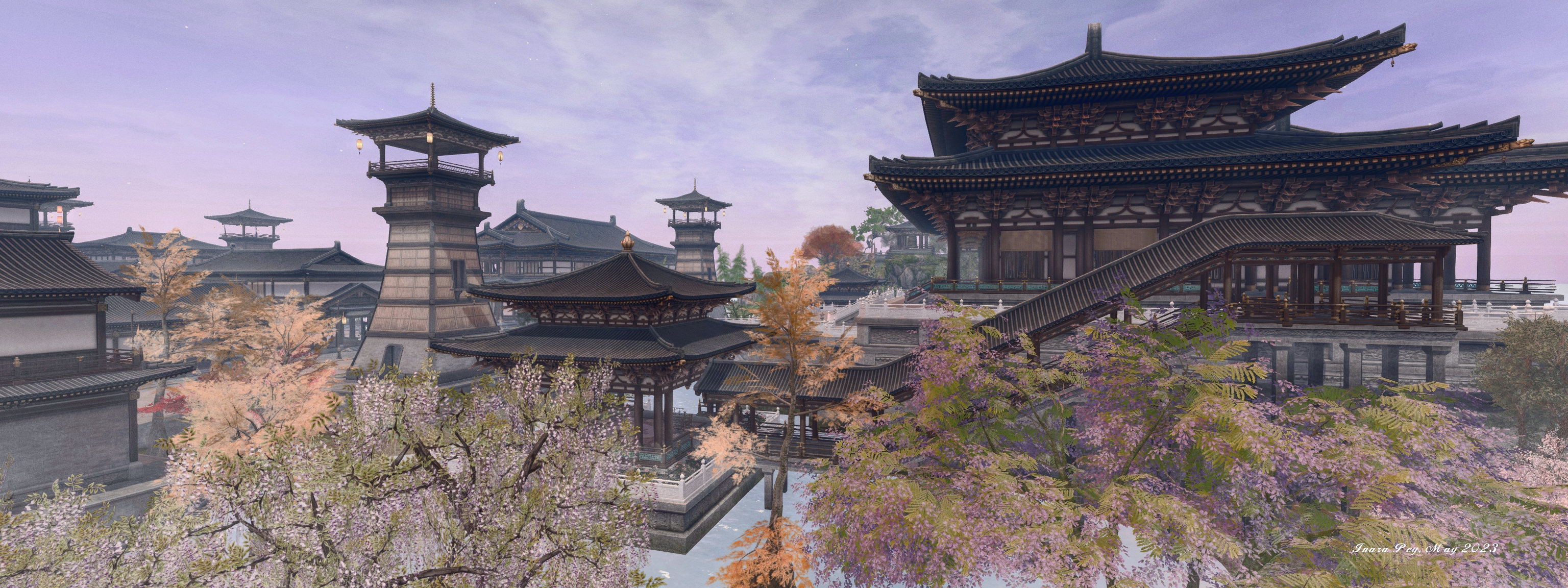
It’s pretty well established in these pages that I tend to be drawn to things with an Oriental theme running through them in much the same way as a moth is drawn to a source of illumination. Part of this is doubtless the result of having spent some of my childhood years in Hong Kong (and some of my early adult years traveeling to places on that side of the world). However, it’s also likely born of the rich history of the Far East, a history which I’ve always found to be more engaging than the histories of western nations.
Which is a roundabout way of saying that when I copped the Destination Guide entry for Chang’an, I knew it would be skating up my list of places to visit; if nothing else, the DG description was enough to raise my eyebrow as curiosity was piqued.
Explore the virtual Chang’an, the capital of the Tang Dynasty (AD618-907) in China. You can see ancient Chinese (East Asian) cultural factors, including palaces, Buddhism temples, and gardens. Here you can dance, sing, entertain, and shop.

This is an introduction which immediately gives a first hint of this Full private region’s over-arching theme: that of a fusion of Oriental / East Asian elements with a particular (but not exclusive) emphasis on China and Chinese history. Not that the setting is intended to be purely historical in context; in much the same way as it offer a fusion of influences, so too does it present a combining of periods, ancient and modern.
Designed and built by 大鱼 (Deo Rain), the region’s DG and About Land descriptions tell only a small part of Chang’an’s long history. The name belongs to what is now regarded as Xi’an, the capital of Shaanxi Province, and the third most populous city in north-western China. Over the last 40-ish years, and keeping pace with China’s overall modern economic development, Xi’an has re-emerged as an industrial, political and educational centre and, particularly, a cultural centre of note.
As a centre of import, Xi’an’s roots go back to Neolithic times when it was a centre for the Yangshao culture, and areas within the city and its surroundings were used by several Chinese dynasties as their capital. These included the first half of the Zhou Dynasty, with centres at Feng Jing and Haojing, the Qin Dynasty, thanks to China’s first emperor Qin Shi Huang (he of the Terracotta Army fame and responsible for starting construction of the Great Wall), moved the Qin capital to Xianyang in what is now the northern part of Xi’an. From here, it became central to the majority of the major dynasties through to the Ming and Qing Dynasties (the latter being the last imperial dynasty of China prior to the country becoming a republic in 1911).
The city of Chang’an is generally regarded as coming into being in 200 BC, when Emperor Liu Bang of the Han Dynasty ordered the construction of Weiyang Palace and, six years later, that of the first of the Chang’an city walls. However, it is under the Sui and – as noted by Deo in his descriptions for the region – the Tang Dynasties (which consecutively spanned a period from 581 CE through 907 CE) that Chang’an came to full prominence. This was kicked-off during the Sui Dynasty, when a new city was built south and east of the Weiyang palace, when it was initially called Daxing before being renamed Chang’an (meaning Perpetual Peace or Eternal Peace) during the Tang Dynasty.
During this period, and prior to its destruction in 904 CE, Chang’an grew to enclose an area of some 84 km2 within its walls, split into three major districts: the civilian city, the imperial city and the palace itself. During this period it was the third largest city in the world, boasting centres of commerce, learning, religion and culture, with paved roads and avenues of impressive proportions (Zhuque Avenue, the city’s grand street, was an impressive 155 metres across!).
As well as the palace, the city featured the Giant Wild Goose Pagoda, which together with the Small Wild Goose Pagoda survived the destruction of Chang’an (although it did suffer extensive earthquake damage in 1556 CE). It was built as the repository for sutras and figurines of Gautama Buddha that were brought back to China from India by Xuanzang, who also brought over 600 Sanskrit scriptures to Chang’an, where he established a centre for their translation, work which contributed enormously to the growth of both Chinese and East Asian Buddhism.
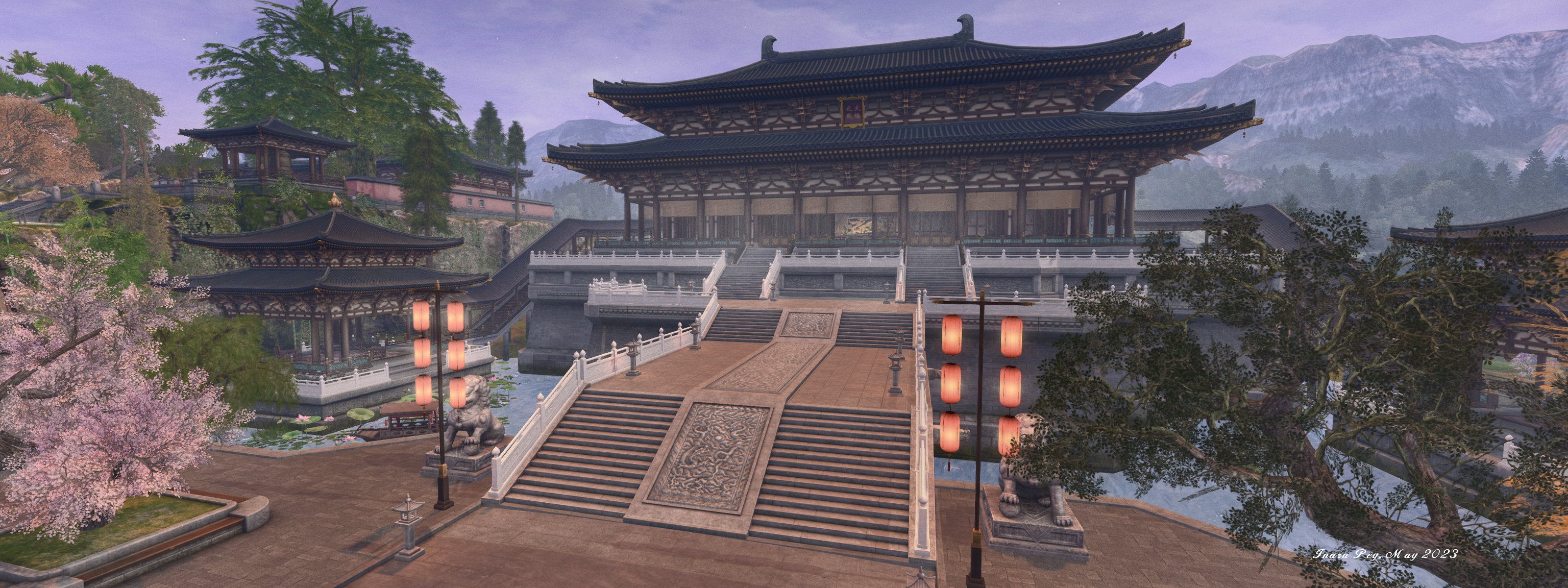
Much of this is celebrated in Deo’s build. Like its namesake, the later can be broadly split into three areas: the commercial centre (with stores available for rent), a cuisine district, and the palace-like Taiji Hall, sitting elevated at one end of the region, a broad paved footway running to it in the manner of Zhuque Avenue from the citadel gates, neatly separating the commercial and cuisine districts from one another in the process. The hall sits apart from most of the rest of the citadel as befitting its status as a near-palatial building, thanks to a broad body of water almost completely slicing through the northern part of the region.
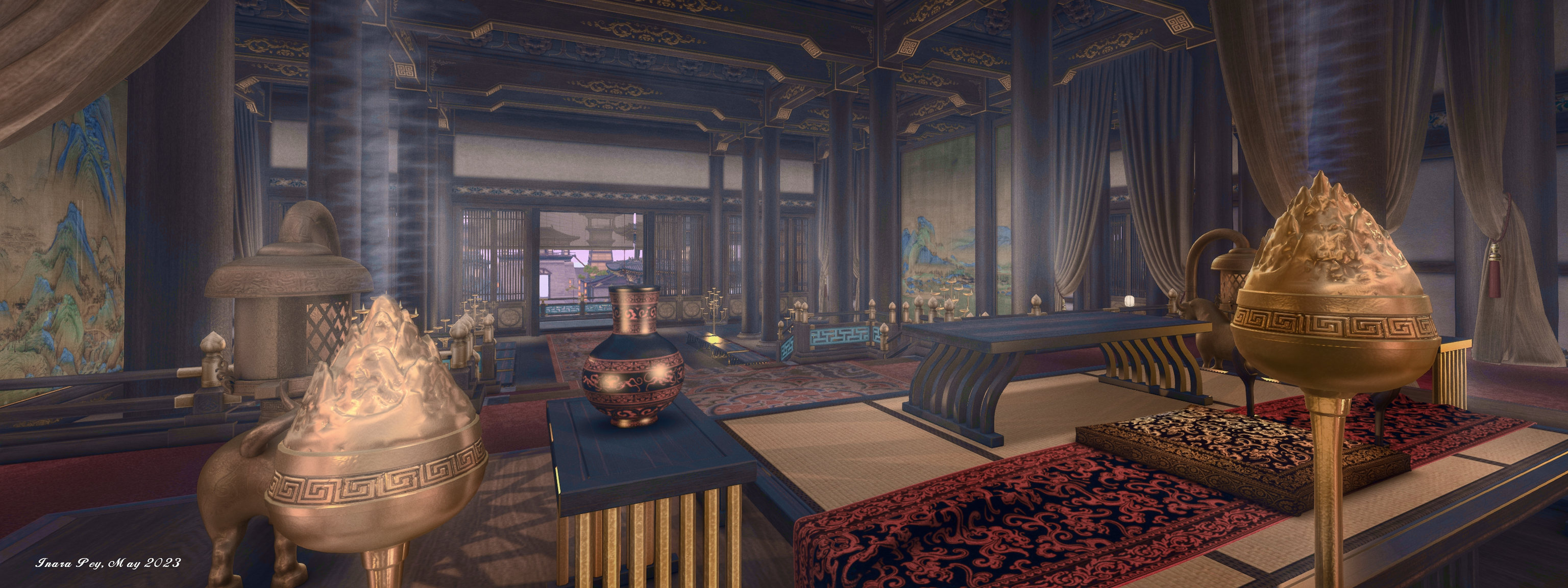
Two tall watchtowers stand guard on either side of the broad stepped bridge spanning the water to reach the main hall, and while these may not be particularly pagoda-like, but it is hard not to imagine them standing in for the Wild Goose pagodas of Chang’an. Taiji Hall itself is huge and of genuine beauty and craftsmanship (although apparently still under construction in places from what I saw whilst taking a sneaky cam around it!), which speaks to Deo’s skills as a designer: like the rest of the buildings within the region, it is entirely his own design.

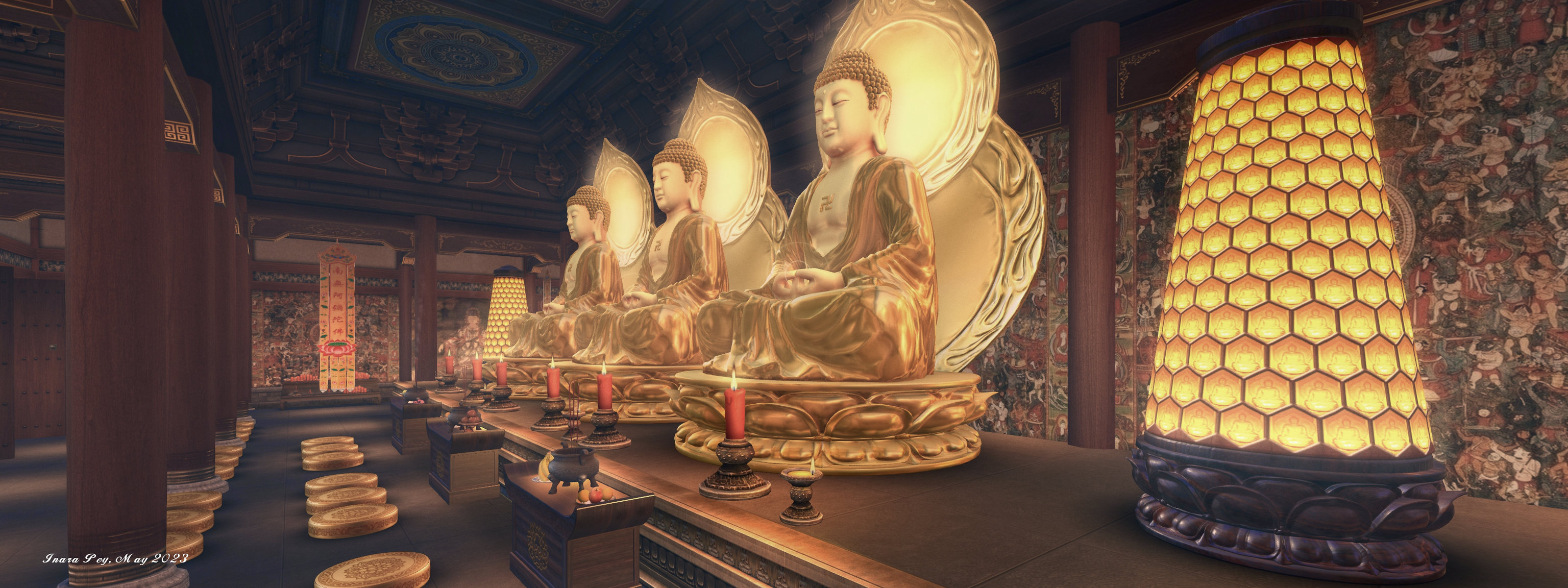
The most prominent elevated element of region sits to the north-west as a high plateau. It is topped by a temple which appears to offer a nod towards the Republic of China, carrying as it does the name of Anping. Built around a main courtyard, the temple has two primary buildings, the larger of the two dominated by three large figures of Buddha, and the smaller by a gold-covered figure of Guanyin, the East Asian representation of Avalokiteśvara. Thus, this retreat would seem to be an acknowledgement of Xuanzang and his seat of translation / study founded at Chang’an. But – how does one reach it? From the terraces of the palace and the paved streets below it, there does not seem to be an obvious route.
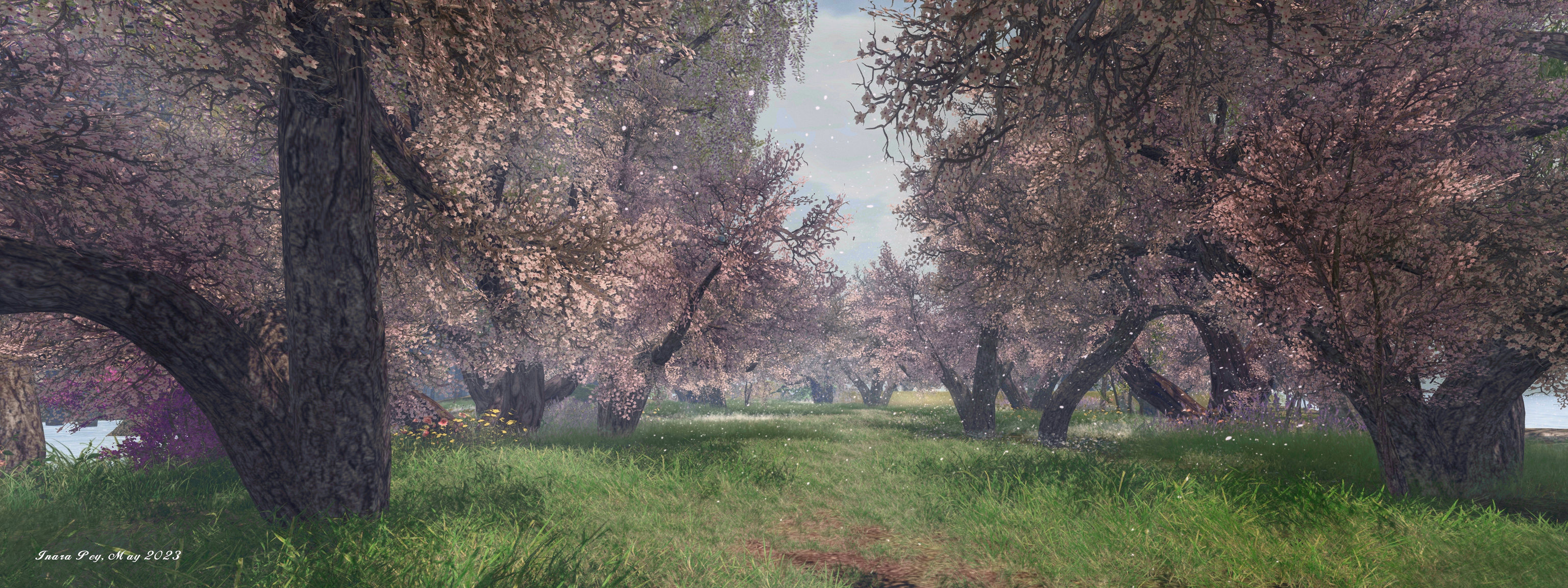
The answer lay close to the southern gateway where, between the eatery and the club-come-bathhouse which help fuse past and present within the build, a covered walkway might be found. Not only does this provide access to the engaging south-west section of the build (which hides its own pavilion and butterfly garden), and thence north to where a paved footpath meanders back towards the palace. As it does so, the paved path passes the start of a second, loosely-laid path winding into a gorge as it cuts into the base of the plateau. The far end of this path marks the start of a winding climb upwards. It’s a route of exploration I highly recommend, as it offers a sense of pilgrimage it is meandering route, as means to see parts of the region which might otherwise be missed, and a superb way to look out over the citadel as the path is climbed to reach a promontory just below the temple proper.
When visiting Chang’an, I would recommend taking time out to study the map provided close to the landing point, as it will help point out the locations within the region – including those I’ve not mentioned or really described in this article. I would highly recommend a visit, as the region does offer an interesting fusion of ideas, and – quite frankly – Deo’s architecture is gorgeous.
SLurl Details
- Chang’an (Changan, rated Moderate)
 Inara Pey: Living in a Modemworld