Logos representative only and should not be seen as an endorsement / preference / recommendation
Updates from the week through to Sunday, April 16th, 2023
This summary is generally published every Monday, and is a list of SL viewer / client releases (official and TPV) made during the previous week. When reading it, please note:
It is based on my Current Viewer Releases Page, a list of all Second Life viewers and clients that are in popular use (and of which I am aware), and which are recognised as adhering to the TPV Policy. This page includes comprehensive links to download pages, blog notes, release notes, etc., as well as links to any / all reviews of specific viewers / clients made within this blog.
By its nature, this summary presented here will always be in arrears, please refer to the Current Viewer Release Page for more up-to-date information.
Note that for purposes of length, TPV test viewers, preview / beta viewers / nightly builds are generally not recorded in these summaries.
Official LL Viewers
Release viewer: Maintenance R viewer, version 6.6.10.579060, dated March 28, promoted March 30th – NO CHANGE.
glTF / PBR Materials project viewer, version 7.0.0.579401, April 10 – This viewer will only function on the following Aditi (beta grid) regions: Materials1; Materials Adult and Rumpus Room 1 through 4.
An artist’s impression of the European Space Agency’s JUpiter ICy moon Explorer (JUICE). Credit: ESA
What is widely regarded as one of the most important space missions yet undertaken has been successfully launched to much acclaim and excitement.
No, I’m not talking about the SpaceX Starship / Super Heavy orbital test flight – of which more anon – but that of the European Space Agency’s JUpiter ICy moons Explorer (JUICE) spacecraft, a 1.6 billion Euro (US $1.7 billion) mission designed to gain a more thorough understanding of Jupiter’s three major icy moons – Europa, Ganymede and Callisto.
JUICE started life in 2008 as part of a joint NASA/ESA mission which had the rather clunky name of Europa Jupiter System Mission – Laplace (EJSM-Laplace), a US $4.7 billion mission to study Jupiter’s moons with a focus on Europa, Ganymede and on Jupiter’s magnetosphere. The mission would have comprised at least two independent elements, NASA’s Jupiter Europa Orbiter (JEO) and ESA’s Jupiter Ganymede Orbiter (JGO), with the potential for involvement on the part of Japan and Russia.
By 2011, it was clear to ESA that NASA would not have the budget to fulfil its part of the mission by the 2020s, and the JGO element morphed into JUICE, which was selected for the agency’s first L-class mission in May 2012, with ESA being proven correct in regards to NASA’s involvement in EJSM-Laplace in 2015, when the US agency reformulated its plans into the Europa Clipper mission.
JUICE was launched on 14 April 2023 at 12:14:36 UTC on the penultimate flight of an Ariane 5. The launch has been delays by 24 hours due to weather concerns, but on the 14th, the launch vehicle lifted-off smoothly, the satellite successfully separating from the rocket’s upper stage some 26 minutes after launch prior to commencing an internal systems check, after which it was due to ‘phone home and say, “Hi there!”
This call came a little later than the mission plan had estimated at some 40 minutes after launch, but still within the overall expected time frame. Following confirmation from ground control, the 6-tonne space vehicle deployed its 27-metre spans of solar arrays, completing the task a little ahead of schedule, reporting the arrays to be fully deployed and active.
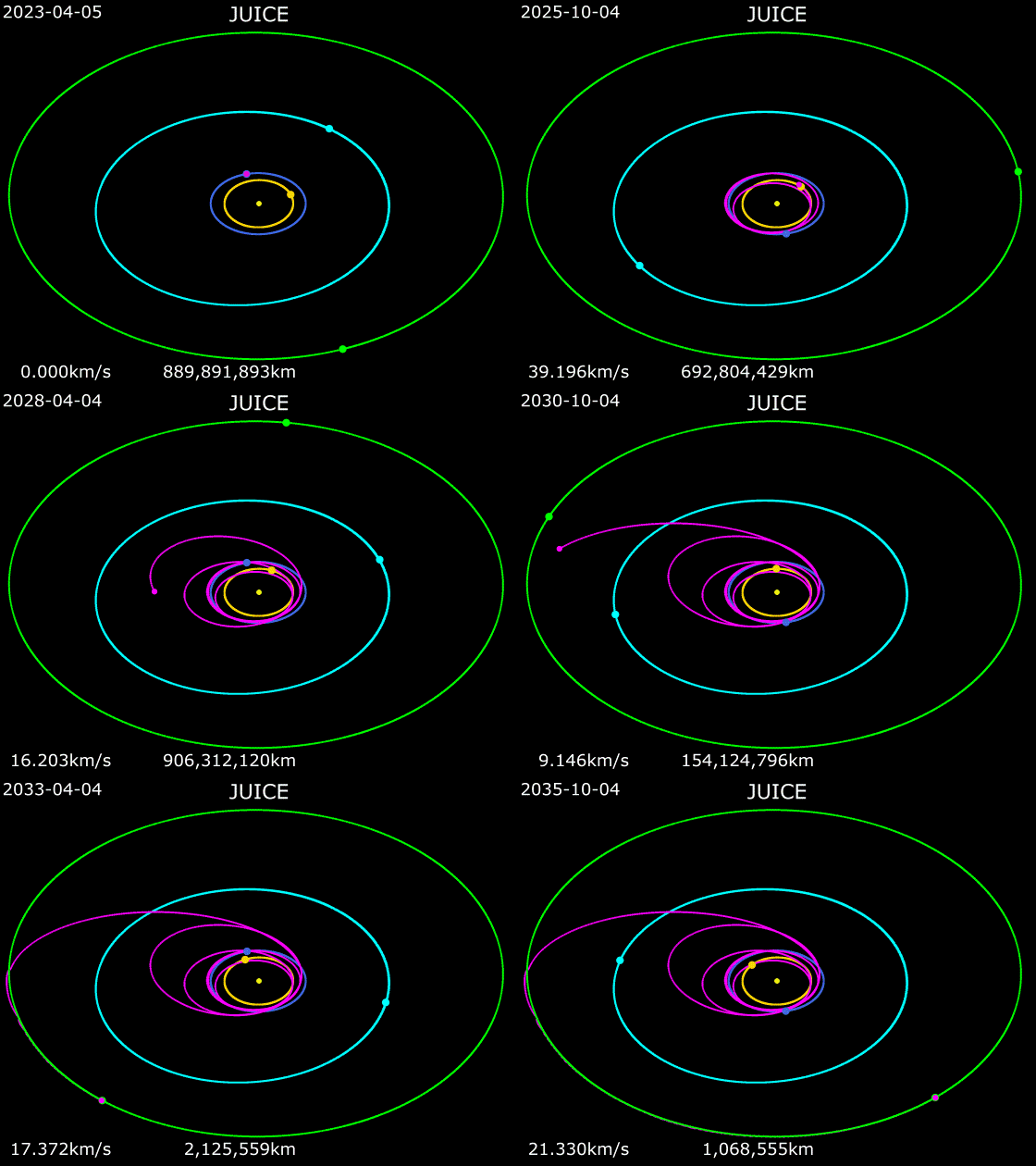
The deployment marks the start of a complex 8-year coast to Jupiter which includes four gravity-assists from the inner planets to both boost the spacecraft’s velocity and to help swing it onto the required trajectory required for a successful Jupiter rendezvous (and a possible fly-by of the asteroid 223 Rosa in October 2029). These flybys will comprise:
August 2024 – a return to Earth, using both the Moon and Earth to accelerate and adjust course. This will be the most accurate gravity assist manoeuvre ever carried out by an interplanetary vehicle.
August 2025 – a flyby of Venus whilst travelling around the Sun, again accelerating the spacecraft whilst angling it onto a trajectory that will see it swing by Earth
September 2026 a second flyby of Earth (confusingly called “Earth flyby I”, which will throw it out into the solar system almost as far as Mars before it swings back around the Sun.
January 2029 – a third flyby of Earth (“Earth flyby II”) which will slingshot JUICE on a two year journey to Jupiter, with the possible asteroid flyby along the way.
An animation of the Earth / Venus flybys JUICE will perform, and its flight to Jupiter. Credit: Phoenix7777
On arrival in the Jovian system, in July 2031, JUICE will first perform a flyby of Ganymede in preparation for Jupiter orbital insertion about 7.5 hours later. This will place the vehicle in an elongated orbit around the planet, allowing it to perform some 35 flybys of the target Moons. The orbit around the planet will gradually becoming more circular over time, and will have an inclination that will allow JUICE to also study Jupiter’s Polar Regions and its magnetosphere.
The flybys will allow JUICE to observe its targets over a 3.5 year span of time, with a major focus on Europa. However, in December 2034, the focus of the mission will shift as JUICE enters an extended, 5,000 km elliptical orbit around Ganymede. This will be rapidly circularised to 500 km in 2035, allowing the vehicle to carry out an in-depth study of Ganymede’s composition and magnetosphere.
It is anticipated that the vehicle’s fuel reserves will be depleted to a point where accurate guidance and manoeuvring cannot be maintained by the end of 2035, and the last remaining reserves will be used to impact the craft on Ganymede at the end of that year or possibly very early in 2036.
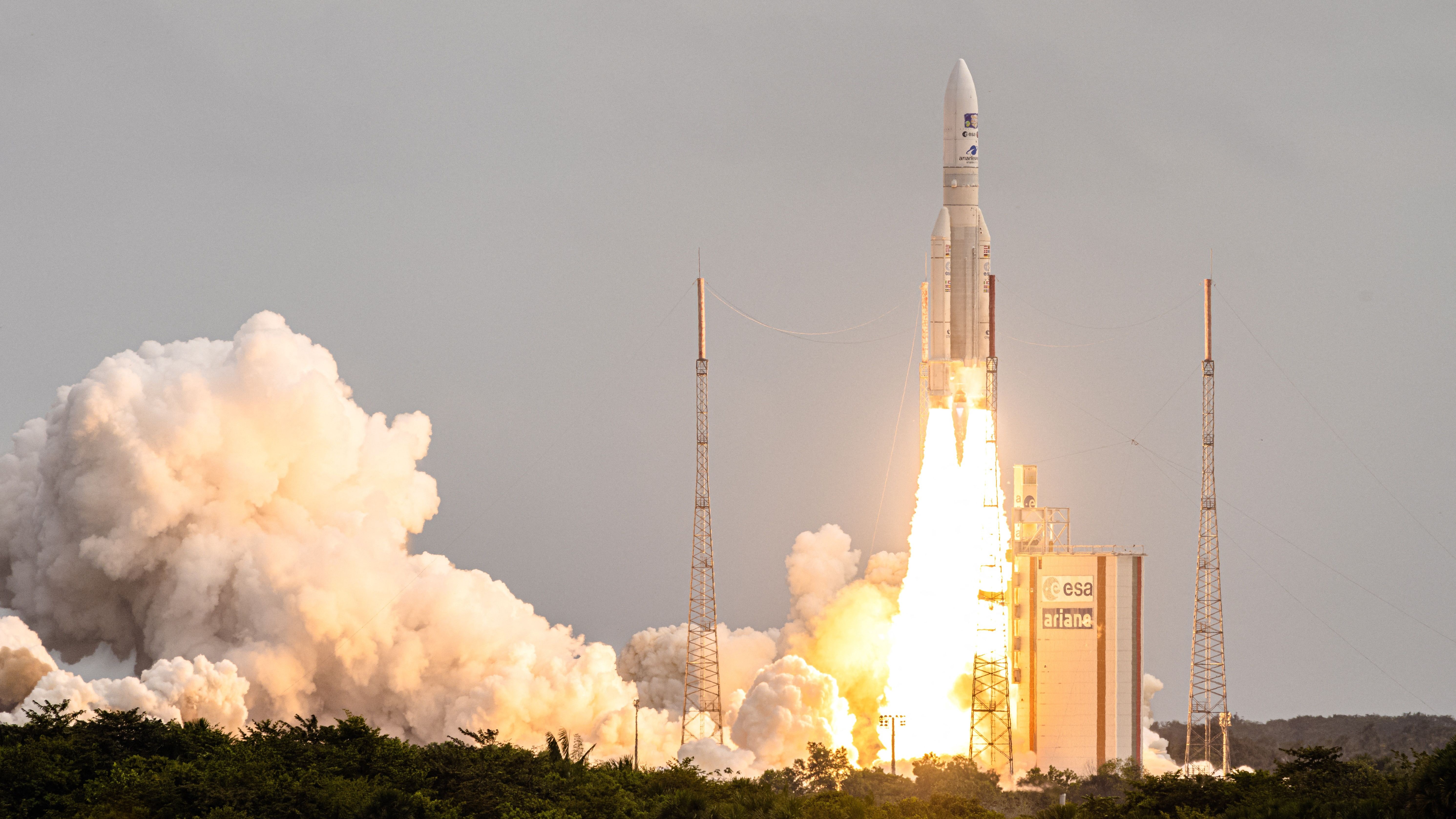
The Ariane 5 rocket carrying JUICE lifts-off from Europe’s Spaceport in Kourou, French Guiana, April 14th, 2023. Credit: JODY AMIET/AFP
The primary aim of the mission is to more fully characterise the overall surface and (particularly) sub-surface conditions on (notably) Europa and Ganymede, and also on Callisto. As regulars to this column (and to space exploration in general) will know, Europa is believed to have a surface crust of ice covering what could well be a deep liquid water ocean, heated and kept in a liquid (or near-liquid) state by the moon being constantly “flexed” by the gravitational influences of the other Galilean moons as they orbit Jupiter, and Jupiter itself.
With this in mind, JUICE will specifically study Europa to understand the formation of surface features and the composition of the non-water-ice material. In particular, it will attempt to gather information on any chemistry essential to life which may be present on Europa’s surface, including organic molecules, and it will carry out the first sub-surface soundings of the moon in order to try to determine the thickness of the icy crust over the most recently active regions of the moon, and attempt to gain a clearer understanding of what lay beneath it – such as liquid water or icy slush.
While further away from Jupiter and with a more one-side “pull” being exerted on them, it is believed that both Ganymede and Callisto might also have oceans of liquid water (or perhaps icy slush) under their surfaces, so the main science objects for these moons – with the particular emphasis on Ganymede comprise:
Characterisation of the ocean layers and detection of putative subsurface water reservoirs.
Topographical, geological and compositional mapping of the surface.
Study of the physical properties of the icy crusts.
Characterisation of the internal mass distribution, dynamics and evolution of the interiors.
Investigation of Ganymede’s tenuous atmosphere.
Study of Ganymede’s intrinsic magnetic field and its interactions with the Jovian magnetosphere.
In all, the information gathered on the three moons should help scientists better assess their potential as havens of basic life within any warm oceans which may exist within them.
I think this is something that Europe can be extremely proud of. This is a mission that is answering questions of science that are burning to all of us.
– Josef Aschbacher, ESA Director General
The launch was the sixth Ariane 5 flight to carry an ESA mission, a total that includes the December 2021 launch of NASA’s James Webb Space Telescope that features significant ESA contributions. It was the 116th Ariane 5 launch overall, dating back to 1996. However, it was also the last flagship mission launch for the ESA workhorse; after an upcoming launch of two communications satellites, for the French and German governments respectively, Ariane 5 will make way for its Ariane 6 successor, with the first launch of the new rocket – which has had a troubled development cycle – is due towards the end of 2023 or early 2024.


 Inara Pey: Living in a Modemworld