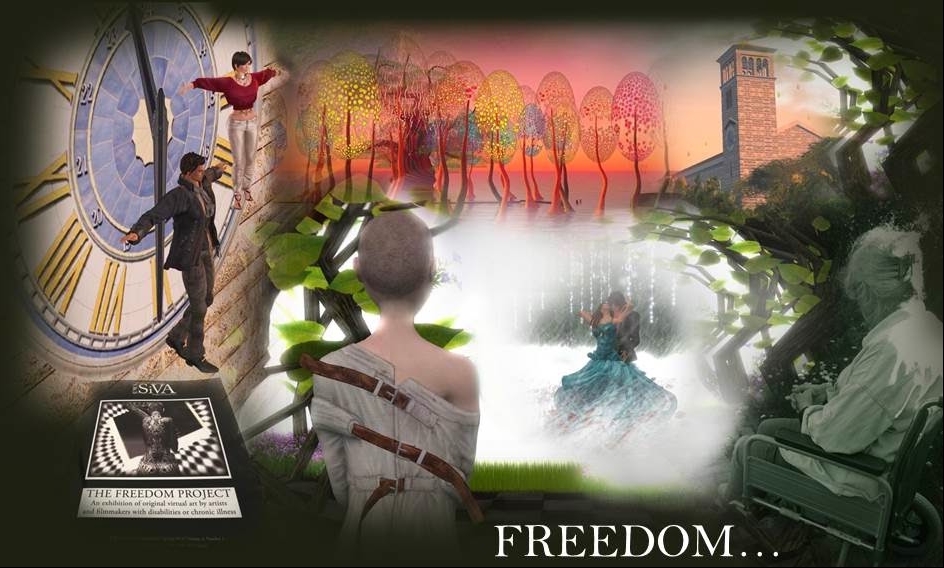
The single image Jay Jay Jegathesan used in his 3-minute presentation on his PhD research on community and collaboration through virtual worlds
I’ve frequently blogged about the work of the University of Western Australia in Second Life; with an active presence in SL since 2009, the University has gained a first-class reputation for sponsoring and promoting art in virtual worlds through initiatives such as the MachinimUWA competitions, and activities such as their current Transcending Borders challenge, the Freedom Project, and Project Homeless, as well as supporting the LEA’s Full Sim Art series, all of which I’ve had the privilege of covering in this pages.
The Freedom Project, one of many community-focused activities undertaken by the UWA within Second Life
The UWA’s involvement in Second Life came about as a result of PhD student Jay Jay Jegathesan (Jayjay Zifanwe in-world), who founded the University’s virtual campus in Second Life, which has grown to include academic teaching activities across Business, Law (including the use of SL machinima in a post-graduate degree course), the Arts, Anatomy, Physiology & Human Biology, and Education (including providing resources essential it helping educators and new users get started with SL).
In particular, as a result of Jay Jay’s work the University has become recognised as a world leader in global community development through virtual worlds technology. This in turn has encouraged Jay Jay to make the topic of global community development and collaboration through virtual worlds, particularly in reference to people with disabilities, the focus of his PhD thesis.
Currently, Jay Jay is participating in the UWA’s 2014 3-Minute Thesis competition, in which students were asked to speak for 3 minutes on their PhD research using no technology or props aside from a single image. His presentation, directly referencing the power of virtual worlds to help those with disabilities – indeed, all of us -, is both beautiful and direct; so why not take a moment to listen to his impassioned explanation of the empowering freedom virtual worlds offer?
I’d also like to take this opportunity of thanking Jay Jay for his generosity and kindness in sending me a copy of the Freedom Projectbook, which is a fabulous publication, lavishly illustrated with pictures of the works submitted to the project, biographies of the artists, and much more besides. It is very much a must-have for anyone with and appreciation of virtual world art. Copies can be obtained for L$5000 (around $20.00 US), shipped anywhere in the world. Those wishing to purchase a copy should contact Jayjay Zifanwe in-world for ordering information.
Mistero Hifeng: I … io (click any image for full size)
Further art entires – including the first machinima pieces – have been received in the UWA’s Transcending Borders combined Art and Machinima Challenge which offers a combined prize pool of some L$1,030,000 for entrants, plus L$240,000 in audience participation prizes.
The latest art entrants and entries are (in no specific order):
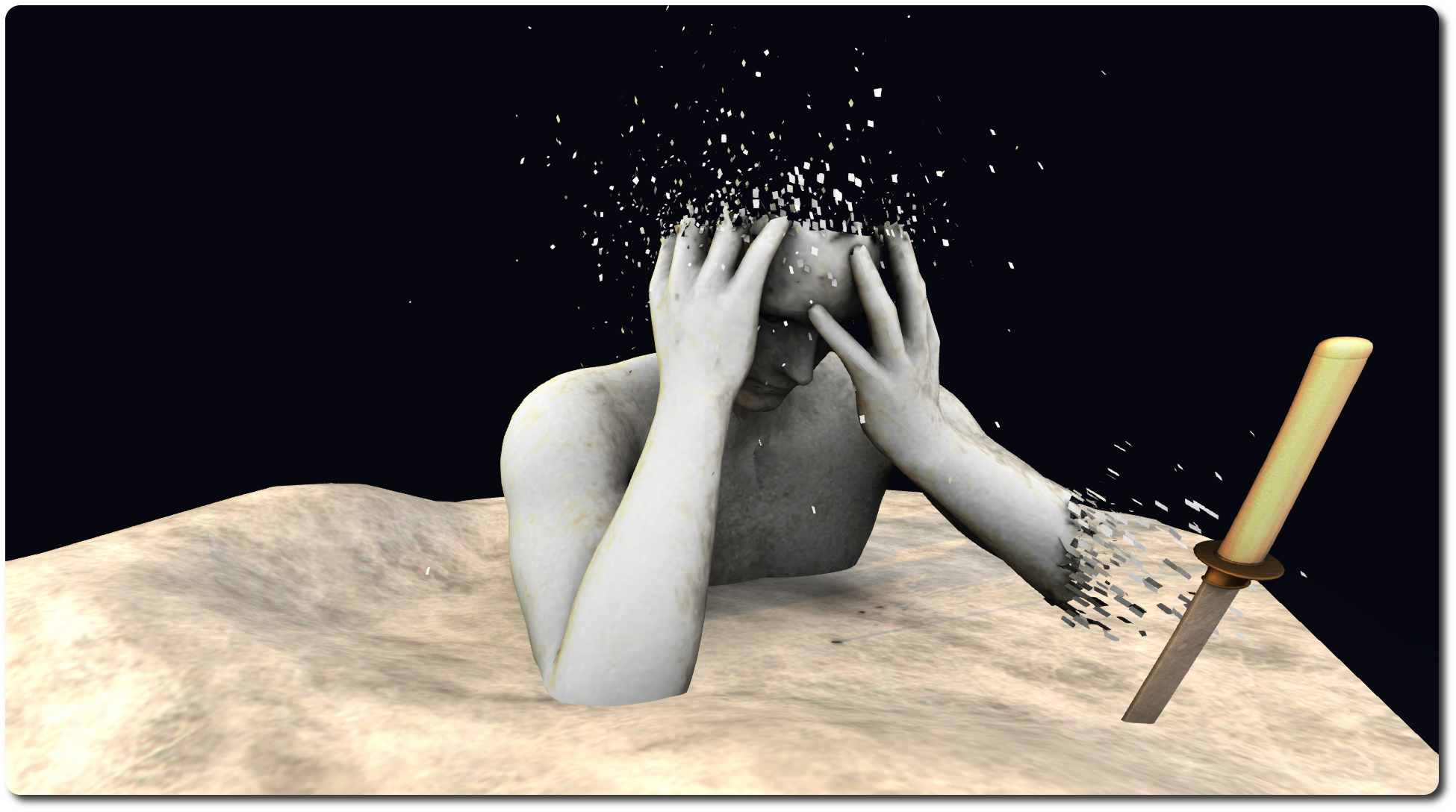
Mistero Hifeng, who presents I … io (seen at the top of this article), a representation of what it means to risk losing oneself by exceeding one’s limits, seen as the figure slowly dissolving into a thousand pieces.
Takni and Misio2, who have entered the very interactive Offworld. Take the teleport ot ring the bell to ride a train off world – from the colourful station to a sky platform where a question – bordering on a riddle – is asked: Ever wondered how many shapes you can build with 30 equal cubes? Touch the cubes and find out not only the simple answer to the question, but also to the underpinning riddle, as the artists state, “A shape made of cubes is a ‘shape’ not because the cubes are arranged in a certain way, but because it summons shapes in your memory. So virtual worlds are basically made of inner worlds.”
Corcosman Voom: The Tribes Go Up
Corcosman Voom, presents The Tribes Go Up (above), of which he says, “When I read the theme Transcending Borders, I thought about tribes meeting on neutral ground for the purpose of trade and other mutually beneficial activities. Butterflies don’t do that, of course……but that’s what I thought about.”
Misio2 also presents Pendant “Planet Takni”, a piece featuring meshwork by Zoran, and which “was inspired by SL toy maker Takni, executed in RL in sterling silver with opal, pearl and diamond, and imported to SL , to make us all fly.”
Touch the Wall by Yepar Saenz is another interactive piece inviting you to do just that – touch the wall of cubes, which will rearrange itself into iconic structures or national flags, symbolising the struggle for national identity.
iSkye Silverweb: Nature Sees No Borders
iSkye Silverweb considers the artificiality of national borders in Nature Sees No Borders (above), commenting, “The borders of the earth only exist in the minds of its human occupants. Look upon the earth from space. You won’t see any lines. They are only drawn on maps – artificial, imposed for the convenience of mankind.” And just as nature ignores these artificial boundaries, sharing its bounties among all of us, so should we endeavour to cease being divided by the borders of out own making, be they lines on a map, division of race or culture or wealth or social status or physical ability.
Ronin1 Shippe’s The Lute Player “is about transcending the borders between the “real” and the imagined, between music (the theme is a lute player) and the mind, and between the western and the eastern (the woman depicted is a Japanese geisha, her face a mask of concentration, as her fingers dart over the strings).
Quantum Shift – A Journey into Perpetual Motion and Organized Chaos, by Slatan Dryke, represents the development of the human brain from cro-magnon man to modern times; a journey that has led us from “stone knives and bearskins” to understanding the human genome itself. All acheived through “the perpetual motion and the organized chaos of the brain’s synapses, neuro-transmitters have as border only a subtlety of their actions, that does not seem to belong to the real world but at the same time is our time, our world every second, every day for a life in constant evolution.”
All of the art entries for the challenge can be viewed in the UWA’s Transcending Bordersgallery space.
All of the machinima entries for Transcending Borders will be available via the SLArtist website.
Full details on the challenge, including all rules and details on how to submit art and machinima entries can be found on the UWA blog. Note that if you intend to enter, all submissions must be received no later than midnight, SLT on October 31st, 2014.
Not an Artist or a Machinima Maker? You Can Still Win a Prize
There are special prizes on offer in the audience participation part of the challenge (a total of L$135,000 for participating in the art section and a total of L$105,000 in the machinima section). All you have to do is list your personal Top Ten entries in either the art or the machinima sections of the challenge (or both!). Prizes will be awarded to audience members whose top 10 lists most closely align to the final juried top 10. Keep your eyes on the UWA blog for details on how to enter.
Note: the images and machinima included in this article should not be taken as any indication of my personal preferences as a member of the Transcending Borders jury. They are included purely for the purposes of illustrating this article.
Follow Your Soul is the title of Eliza Cabassoun’s new exhibition of photography and art now open at LEA6 as part of the Linden Endowment for the Arts Full Sim Arts series sponsored by the University of Western Australia (UWA).
The exhibition features a mixture of Eliza’s physical world photography, her Second Life photography and sculptures, and her poetry. It is very much a personal piece, although one with a message for everyone, as reflected in Eliza’s own words usefd to introduce it:
Everyone has a place where they found their soul. This is where I found mine. I found mine in a cabin by a lake where the fog rises in the morning into the mountains like a warm blanket. I began writing novels here and taking photos here. Nature can bring forth great inspiration, simply from towering trees or just the midnight sounds of tree frogs and rain hitting a tin roof … This lake is where I followed my soul to realize I have two gifts–writing and photography–and a part of my soul will always be here.
Follow Your Soul
The Lake is represented by the flooded centre of the region and features a central island topped by a rounded pavilion, connected to the shore by a long wooden bridge. The cabin Eliza writes about is represented by a LAQ cottage, which serves as the landing point for visitors and the teleport point for reaching other elements of the exhibit.
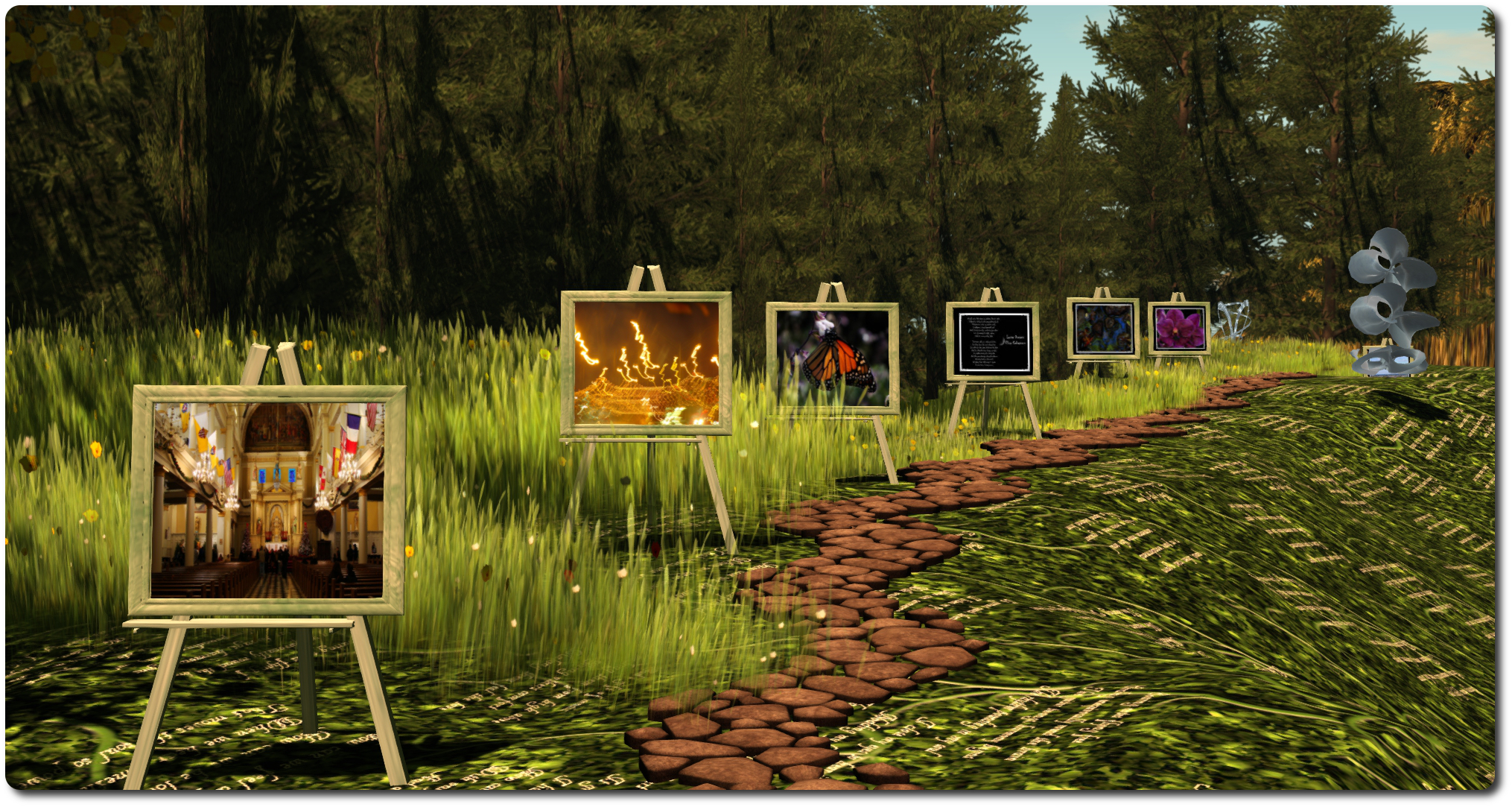
From the cottage, one can follow a path around the periphery of the lake, viewing Eliza’s physical world photography along the way, the path bordered on either side by easels displaying her work, the very ground beneath them displaying the stanzas of her poem Follow Your Soul. Some of the images on the easels also form backdrops for her poetry, while scattered among the easels are some of Eliza’s SL sculptures.
The walk around the lake has a slightly seasonal feel to it, with some of the trees coloured in the reds and yellows of autumn, their leaves falling gently to the ground and others – while admitting they are fir trees – are a rich green and suggestive of summer. There’s even a section where the ground is covered with snow, and pictures here all of a decidedly wintry theme.
Follow Your Soul
The teleport system will carry you up to the poetry garden, where there are make images of Eliza’s photographs forming backdrops to her poems, many of which will undoubtedly strike a chord or two in the hearts of those reading them. The teleporters also provide access to a small gallery of Eliza’s SL photography, which should not be missed during a visit.
Sponsored by the Parramatta City Council, and a part of the Parramatta Sci-Fi Film Festival activities, the 2014 Project Sci-fi competition, in partnership with Screen My Shorts, challenges filmmakers from around the globe to write, film, edit, produce and upload to YouTube a 3-10 minute long film with a science-fiction theme. On offer are prizes totalling $5,500 Australian dollars.
The competition is open to both live action and machinima entries, and filmmakers are responsible for putting together a team, cast and crew (producers, directors, cinematographers, writers, etc..), as well as securing equipment, locations, and costumes. Each team needs to be represented by a Producer. The challenge sets no limits on age or budget and welcomes all filmmakers.
Films can be submitted by individuals and groups but those wishing to participate must register with the competition by October 3rd, 2014.
When submitting their entires, participants are asked to nominate two of the following themes for their film:
Sci-romance – love between aliens, robots and more! (Can be happy, sad, tragic)
Sci-comedy – sci-fi that is humorous in nature. The Hitchhiker’s Guide to the Galaxy is a good example of sci-fi comedy
Save the Environment: a theme focuses on saving the dying planet and/or ecosystem
Zombie / disease: a theme focuses on the effect of a disease in the future
Apocalyptic / post-apocalyptic sci-fi: stories about the extinction or near extinction of humankind either by forces of nature or by our own means. Post- focuses on telling the tale of the survivors of an apocalypse
Spy-fy: Science fiction about futuristic spies and espionage, and the effects of technological advancement on their professions
Super hero: stories related to super heroes who get their powers from technology or because they are from another world. Often focuses on futuristic superheroes
Robots / AI – fiction in which the science of Artificial Intelligence and robotics is a central theme, typically relating to Robot stories
First contact / alien: the various scenarios in which humanity makes contact with other civilizations
Social sci-fi: – fiction in which future societies are extrapolated, explained and often criticised, usually for the purpose of social satire. The social sciences are the over-riding theme in this type of fiction; however, science and technology will usually play a central role in the structure of the extrapolated society.
Prior to Kick Off of the competition on Friday, 3rd October 2014 at 7 pm (19:00) local time in each participating city and town , the organisers will then e-mail each entrant with one (1) of their nominated subjects/topics. The entrants then have 30 days in which to make and edit their film. All films must be uploaded to YouTube (and set to Private) no later than midnight local time in each participating city and town on Sunday November 2nd November 2014. An e-mail with the YouTube link should be sent to info@scifilmfestival.com as notification of the film’s completion.
Above: Tutsy Navarathna’s “The Residents“, overall winner in the machinima category of the 2013 Project Sci-Fi challenge
The total prize list for the competition comprises (all in Australian dollars):
SciFi Best Film $2000
Project SciFi Runner Up Film $1000
Project SciFi Best Performance – $500
Project SciFi Best Cinematographers – $500
Project SciFi Best Special Effects – $500
Project SciFi Best Production Design/Art Direction – $500
Project SciFi Best Machinima Film – $300
Runner up Machinima Category – $200
In addition, the UWA has determined that machinima makers wishing to enter the same film to both this challenge and the UWA’s Transcending Borders Machinima Challenge may do so, providing the theme requires of both challenges are met in the same film.
Judging will be by a panel of selected jurors, and a special awards ceremony will be held on Sunday, November 16th 2014 at the RiversIde Theatres, Parramatta, commencing at 18:30 local time, as a part of the Parramatta Sci-fi Film Festival.
For further information, please refer to the links below.
Further art entires have been received in the UWA’s Transcending Borders combined Art and Machinima Challenge, on which I’m privileged to sit as a member of the judging panel. The challenge is open to entries through until midnight, SLT on October 31st, 2014, and offers a combined prize pool of some L$1,030,000 for entrants, plus L$240,000 in audience participation prizes.
Entrants are invited to interpret the challenge theme, Transcending Borders, in any way they please. It might refer to transcending borders between space and time, or the past and present or the present and future, the divisions between dimensions, the borders separating nations or cultures or languages, or any one of the many borders we encounter as we navigate our physical and virtual lives.
Cherry Manga: Imagination Transcends Borders – click any image for full size
Submissions may be either a piece of art (one item per entrant) or a short film preferably no longer than 4 minutes and 30 seconds (as many films as entrants wish to submit, as long as they have been filmed specifically for the challenge). All submissions should allow casual viewers to interpret how the theme is represented, or provide a means by which the piece can be understood in the context of the challenge theme.
Cherry Manga, Kicca Igaly and Nino Vichon are the latest entrants to the challenge, and they each off three unique 3D art pieces.
Cherry’s piece Imagination Transcends Borders is an evocative and powerful piece speaking to the transformative power of the imagination when we allow it flight, and how it in turn can feed back to, and affect us.
Kicca Igaly: Transcending Borders
Kicca’s piece is similarly evocative, edged with a touch of the surreal. It presents an office environment where a laptop is being used to create a prim figure. Through the window one can see the cartoon world in which the office is located. Beyond that lies SL itself, where sits the partially complete prim figure. Through these three environments – the physical office, the cartoon world and the digital domain, Kicca raises the question, is there really any boundary between real space and virtual space?
In Bob and the Box, Nino explores the relationship between language and humour – both spoken and visual, though a series of plays of the word “box” as seen in through various depictions of the innocent Bob and his slightly sarcastic companion, the Box. The images are grouped by various common themes, and serve to illustrate how humour can transcend the barriers of language and culture.
Nino Vichon: Bob and the Box
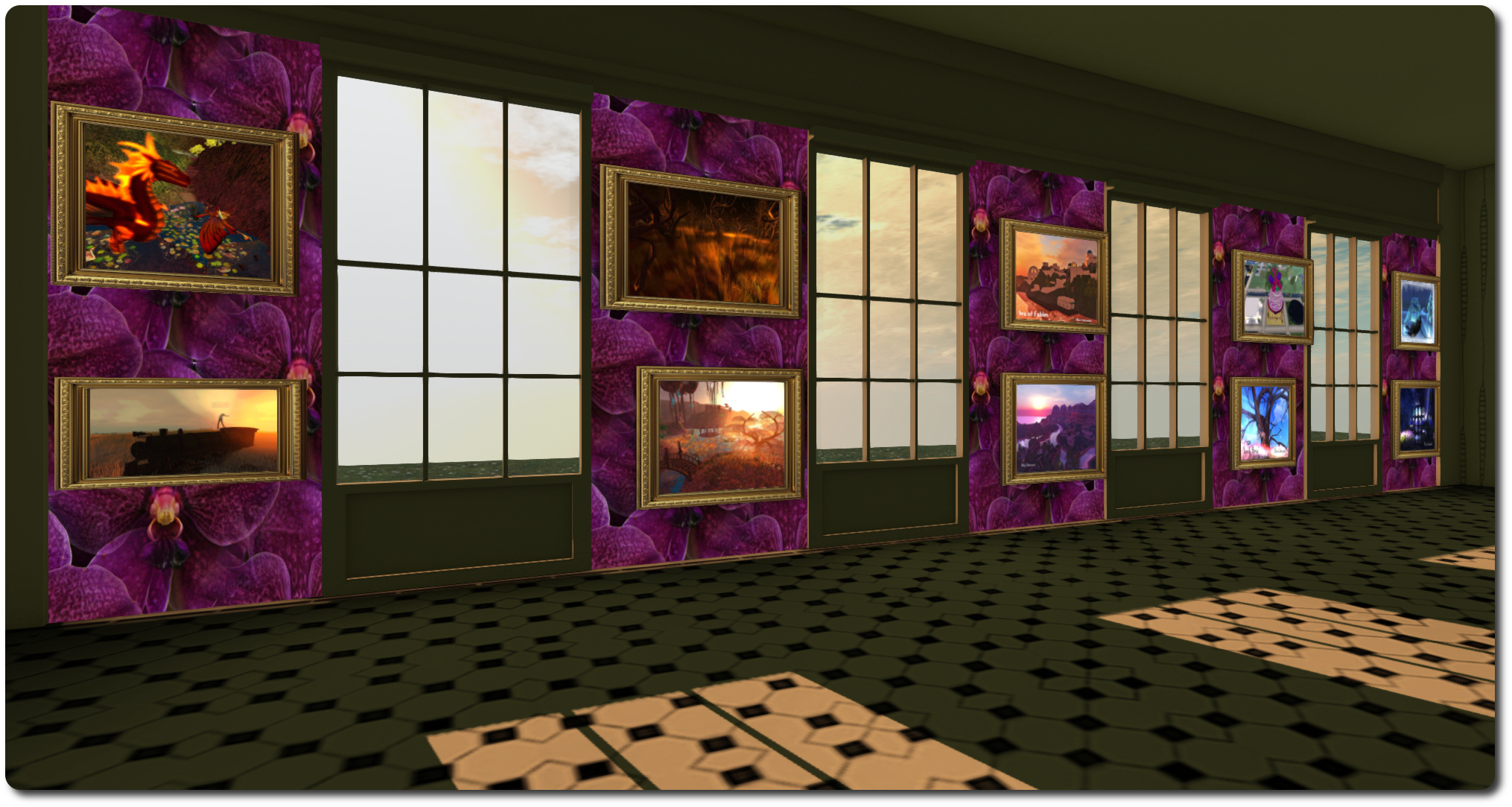
Art entries for the challenge are on display in the Transcending Bordersgallery area above the UWA’s home regions. Machinima entires will be listed on the SLArtist website as they are received.
Full details on the challenge, including all rules and details on how to submit entries can be found on the UWA blog.
A 2D and 3D art and film event, the project extended an open invitation to artists suffering from a disability or chronic illness, or associated with those suffering from either, to demonstrate how virtual life has enabled them to engage in activities and interact with others in ways which may not be possible in the real world.
I covered the launch of the project at the time, and subsequently reported on the opening of the Freedom Project art exhibition in the UWA’s gallery spaces in March of 2014 (the exhibition is still open for viewing at the time of writing for those who would like to visit, although the exhibition will be taken down in the next two or three weeks to provide the UWA’s Transcending Borders project additional display space.
At the time the challenge was announced, it was indicated that art pieces submitted to the Freedom Project would feature in a commemorative book – both digital and orinted – in the hope that both the book and the exhibited pieces and films will inspire others, and will demonstrate how virtual worlds can be used to help some people who may have had difficulties finding other means of expression to believe in themselves more, or to connect with others.
The Freedom Project book is now available in print or electronically as a part of the UWA’s Studies in Virtual Arts (SiVA) series of e-journals
On Friday September 5th, FreeWee Ling, curator of the UWA’s gallery spaces and co-ordinator of the UWA’s virtual world art projects, announced that the Freedom Project book is now available.
Lavishly produced and illustrated, the book tells of the origins of the project and provides an overview of the global nature of the project and the events which took place within Second Life where it was represented; information on the project’s partner and sponsor organisations is also provided.
Central to the book is the art itself and the artists. The illustrations throughout are beautiful, with many of the pieces being given wonderful two-page spreads. The artists’ stories, told in their own words, are equally as moving, making this a powerful piece of reading.
The Freedom Project book is lavishly compiled and presents both the artists and their work beautifully
The electronic version is available on-line as a part of the UWA Studies in Virtual Arts e-journals series. The printed version can be obtained for L$5000 (around $20.00 US), shipped anywhere in the world. Those wishing to purchase a copy should contact JayJay Zifanwee of the UWA for ordering information.
Artists and groups who participated in the challenge can also claim a free copy of the printed book – again, please contact JayJay Zifanwee for ordering details.





 Inara Pey: Living in a Modemworld