Exploring disability, new cultures and self in a virtual realm

Krissy Sinclair: Virtual Worlds, Disability, and New Cultures of the Embodied Self
Krissy Sinclair: Virtual Worlds, Disability, and New Cultures of the Embodied Self, Ethnographia Island

In January 2016, I wrote about an interview with Tom Boellstorff (Tom Bukowski in Second Life),  a professor of anthropology at the University of California, Irvine, and which appeared in that august body’s newsletter, UCI News.

Within A (virtual) world without Parkinson’s, Heather Ashbach discussed Tom’s work, touching on the fact that it is now part of a National Science Foundation funded study examining how on-line environments affect social interaction and self-understanding as well as physical-world experiences of disability. Having commenced in July 2015, this study will run through run through until June 2018, and one element of the work is currently taking place in Second Life at Ethnographia Island. Jadyn Firehawk, one of the participating artists in the Ethnographia Island study, IM’d me about it, prompting me to hop over and take a look.

The formal title of the research at Ethnographia is Virtual Worlds, Disability, and New Cultures of the Embodied Self,  and Tom is co-Principal Investigator alongside Donna Z Davis (Tredi Felisimo in Second Life), a strategic communications professor at the University of Oregon. Donna specialises in mass media & society, public relations, strategic communication, virtual environments and digital ethnography.  The work they are undertaking focuses on the experiences of people with disabilities who are using immersive virtual spaces to represent themselves free of the shadow of any disability, and do things they may not be able to do in the physical world.

In their introduction to the work, Donna and Tom describe it thus:

Since some early human first picked up a stick to use as a cane, people with disabilities have been at the forefront of technology innovation. What can their creative uses of and adaptions to on-line social interaction teach us? The researchers will explore this question by studying how people with disabilities create and interact socially in virtual worlds, and how they use different kinds of devices in their homes to experience these on-line environments.

Donna Z Davis and Tom Boellstorff (Tredi Felisimo and Tom Bukowski in Second Life), co-researchers in Virtual Worlds, Disability, and New Cultures of the Embodied Self, supported by the University of California, Irvine; the University of Oregon; and the National Science Foundation.

Twenty 32×32 metre studio parcels have been made available to applicants with disabilities, who have been invited to share their experiences, insights, and thoughts on their disability: what impacts has it had on them in terms of their experiences, social interactions, dreams, and how have they used it? How have they used it to change their  experiences living with that disability?

How applicants use their space has deliberately been left open, although some pointers were given as to how they might think about using it: for expression through 2D or 3D art, thought media presentations / displays, as a space in which they can develop art or expression through external media such as blogs, or the creation of interactive spaces designed to give others insight into their experience or as a game – or any combination of these ideas.
Jadyn Firehawk at her installation, Reconstructing Identity After Disability, Virtual Worlds, Disability, and New Cultures of the Embodied Self
Jadyn Firehawk at her installation, Reconstructing Identity After Disability, Virtual Worlds, Disability, and New Cultures of the Embodied Self, Ethnographia Island

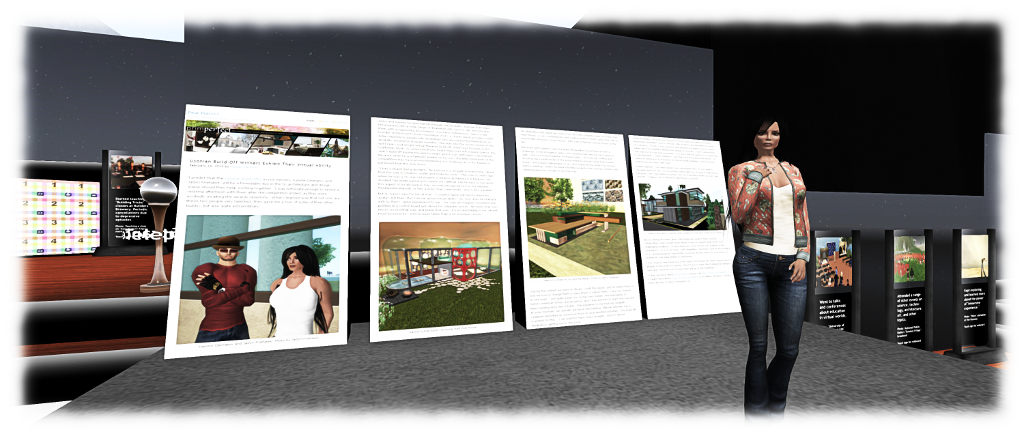
The result is a series of studies, widely varied in nature and content, some of which – such as Jadyn’s own Reconstructing Identity After Disability. This is a beautifully presented and moving story of how she has come to deal with her bipolar disorder after the condition left her unable to continue in her career as an assistant professor at the University of Texas, Austin, and how the use of virtual spaces in Second Life and the friends she has made here have empowered her creativity in both the digital and physical realms.

“When I sent in my application to participate in the project, I did not know yet what I wanted to build,” Jadyn says of the installation. “All I knew was, I wanted to create an installation that somehow represents the many-faceted, (re)enabled life that SL has made possible for me, but I had no idea exactly what I was going to build.

“I started looking back in my inventory to things that dated back to my earliest days in SL, and realised it essentially documents my entire time in SL. From that I got the idea of perhaps doing my build as a sort of museum exhibit, telling the story of my time in SL.”

Involvement in the project has been both cathartic and insightful for Jadyn, providing her with a clearer view of the last fifteen years of her life, the changes her condition has wrought and  a understanding of ow she has come to terms with it.

Solas NaGealai: Virtual Worlds, Disability, and New Cultures of the Embodied Self
Solas NaGealai chose to produce a 3D representation of Edmund Blair Leighton’s 1901 painting The accolade, allowing visitors to become a part of the setting, sharing in both her creativity and her love of nostalgia.

“I met Tom and Donna through the Parkinson’s disease support group at Creations Park four years ago, and I’m thrilled to be taking part,” Solas NaGaelai says of her involvement in Ethnographia. “Not just for the creative aspect but to be amongst others that have disability. I have a hunger for learning and adapting, and from what I see so does each individual involved in the project. The insight of dealing with their life challenges to me is a very enlightened experience, and helpful one.”

Solas was diagnosed with a particular form of Parkinson’s Disease known as Young Onset Parkinson’s Disease (YOPD) – the same form of the disease which struck Michael J. Fox. When first diagnosed, she was a full-time fashion designer. However, as the illness progressed, she was forced to leave that career behind. Fortunately, her discovery of Second Life provided Solas with a means to re-engage in her passion for design, notably through her Blue Moon Enterprise label.

For her piece, Solas has created a model based on Edmund Blair Leighton’s 1901 painting The Accolade. It’s an interactive piece in which visitors will be able take free costumes she has designed and dress as either the queen or the knight and take their places within the scene. As such it reflects both the creative freedom Solas has found in Second Life, and offered her the mean to present visitors with the opportunity to share in her love for a bygone era, as depicted by Leighton and his peers.

Slatan Dryke: Virtual Worlds, Disability, and New Cultures of the Embodied Self, Ethnographia Island

Virtual worlds, as Tom and Donna note, are just a part of the much larger domain of internet technology and on-line presence which we can use to define ourselves and potentially reach beyond our personal limitations, whatever form they may take. But studying the “whole” of the digital environment really isn’t that possible; as such, smaller scale studies like Virtual Worlds, Disability, and New Cultures of the Embodied Self allow researchers to focus down on smaller communities and groups and investigate specifics.

Through it, and the involvement of those participating in it, both Donna and Tom are confident they will be able to present a better understanding about how new on-line technologies influence how we think about our bodies, how we think about social interaction, and how we think about the role of the internet in everyday life, all of which will have implications for improving health care and social support for people with disabilities.

Visitors are welcome to tour the installations, and I recommend taking a look at the accompanying website when doing so – the links are given again below for convenience.

STOP PRESS NEWS

Having opened its doors in November 2015, Ethnographia Island had originally been set to run through until March 2016. However, as I worked on this article, Tom and Donna were in discussions concerning additional funding for the work.

On Friday, February 19th, they were able to tell me that the funding had been confirmed, and that as a result, Ethnographia Island is set to double in size with the addition of a second region.

“This means not only more spaces for individual disabled folks to have parcels for some creative building, but also some larger, collaborative parcels where groups of people with disabilities can let their imaginations run free!” Tom said as they passed on the news to me.

So, if you have a disability of any kind and would be interested in a parcel, please IM Donna (Tredi Felisimo in SL) or Tom (Tom Bukowski in SL), or email them at dzdavis@uoregon.edu or tboellst@uci.edu. They would love to have you participate!

SLurl and Website Details

This article is a joint presentation with the March Edition of Windlight Magazine.

The Drax Files 31: digitising ethnography in Second Life

Tom Boellstorff: digital ethnographer extraordinaire - and the focus of World Makers #31
Tom Boellstorff: digital ethnographer extraordinaire – and the focus of World Makers #31

It is directly because of Tom Boellstorff‘s influence that I have tended to cease referring to what goes on the physical world as “real life” and use the term “physical world” instead – as regular readers here may have noticed. As Tom once pointed out to me, such are the complexities of our digital activities and interactions, they are in fact no less “real” than almost everything we do in the “real” world.

I mention this because Tom is the subject of episode #31 of the Drax Files World Makers, and within it, he excellently expands upon this idea. Around half-way through the segment, he focuses down onto the issue of the artificial divide that is consciously established in the mind when one employs the term “real world” to differentiate between physical world interaction and digital interactions. As he points out, given the nature of both, is one any the more “real” than the other? Not really; both have multiple levels of activity and interaction which freely encompass both.

Really, the only thing the use of the term “real” does is perhaps instil a subconscious or active bias against anything related to immersive digital space interactions. As evidence of this, we need only look back as far as  Pamela in the 8th segment of The Drax Files Radio Hour. She is openly dismissive of Second Life for a number of reasons, not the least of which is that it is “not real”.

Tom openly challenges the the use of the world "real" to differentiate between our physical world and digital world activities and interactions
Tom openly challenges the use of the world “real” to differentiate between our physical world and digital world activities and interactions

As an ethnographer and professor at the Department of Anthropology at the University of California, Irvine, Tom has devoted a solid portion of his time to digital ethnography within Second Life. He signed-up to the platform in 2004 – when, as he notes, there were only around 2,500 total users, with an average concurrency of a couple of hundred, and you could fly over every region across the grid and witness what was going on in each of them in a the space of a week.

Since then, he has studied social interactions through Second Life at length, and has written two books on the subject as a result: Coming of Age in Second Life: An Anthropologist Explores the Virtually Human, (Princeton University Press, 2008), and Ethnography and Virtual Worlds: A Handbook of Method (Princeton University Press, 2012, co-authored with Bonnie Nardi, Celia Pearce & T. L. Taylor).  So when it comes to matter of social interaction, interpersonal relationships, the exploration of self and issues of identity, Tom has a lot to say that is directly relevant to today’s world – and not just in terms of virtual spaces like Second Life.

Digital environments like Second Life are unique in the added depth of interaction, self-identity and self-awareness and presentation they offer us

Ethnography, be it studied in either the physical or the digital, is a huge topic to try to encapsulate in just five minutes – and it is to Tom’s credit and Draxtor’s post-production skills that so much is encompassed within the time frame, given this is a very different – and potentially (with no disrespect to the content creators generally features in the series) a lot deeper subject into which to plunge.

Thus it is that as well as an intriguing exploration as to the validity of the word “real” when applied to the digital, we get a measured look at the virtual and all it can encompass to empower us in many ways. Tom encourages us to consider the social and personal interactions we have, which can be as rich and engaging as anything we might experience elsewhere; he highlights the emotional depth offered through even the most simple of digital interactions such as texting one another; and he opens the door to much broader aspects of self and identity, such as in matters of gender. This latter aspect is beautifully underlined with a fine reference to Cecilia D’Anastasio’s Motherboard piece from April 2015, Avatar IRL (which I reviewed here).

a powerful aspect of virtual spaces like Second Life is the power they give individuals to explore matters of their own identity, including issues of gender - as explored with Veronica in Avatar IRL, touched upon visually in World Makers #31
a powerful aspect of virtual spaces like Second Life is the power they give individuals to explore matters of their own identity, including issues of gender – as explored with Veronica in Avatar IRL, touched upon visually in World Makers #31

In discussion matters of identity, there’s also a reflection on the likes of Google, Facebook and other companies who wish monetise everything they can possibly learn about us. The activities of these companies do highlight the importance of identity, and of the need for us to have a freedom to choose how we represent ourselves to the digital world.

Certainly, Second Life stands to give the lie to the idea that anonymity is “about” deception and questionable activities, as some have in the recent past have tried to project. If anything, as a Tom points out, the anonymity embodied in Second Life in terms of user-to-user interactions is a major contributor to people’s willingness to be creatively expressive, and  their ability to establish their own digital business and revenue streams.

Tom participates in, and observes, a group of us engaged in a Digital Cultures Chat

This is another outstanding segment in a series which has never faltered through the 31 episodes to date deliver a relevant commentary on our digital lives and activities. It is also one that perhaps has a somewhat different audience among those outside of Second Life from past segments, highlighting as it does the extreme relevance of the platform to the likes of researchers, academics, etc. It might also, for those willing to listen, offer food for thought to businesses on the benefits of allowing us greater freedom in how we represent ourselves to one another through their platforms and services – and in allowing use to have more say in how the personal information we provide to them directly might be used.

I could prattle on, but really, Tom says everything so clearly and succinctly, that any further observations or interjections I might have are superfluous. Better to watch the segment yourself!

P.S. Tom, if you get to read this – you still owe me a round of golf! 🙂

The Drax Files Radio Hour interviews: defining the real and the virtual

radio-hourEpisode #22 of  The Drax Files Radio Hour was posted on Friday June 6th. With the “live” podcasts currently on hiatus until August 2014, this is the first of a series of more in-depth interviews with people from across Second Life and beyond.

As usual, and as well as being available on the show’s website and on Stitcher, episode #22 is also on YouTube, and embedded at the end of this article.

This first interview show primarily focuses on Tom Boellstorff (Tom Bukowski in SL), a professor of anthropology at the University of California, Irvine, who has studied such subjects as the anthropology of sexuality, the anthropology of globalisation, the anthropology of HIV/AIDS, and linguistic anthropology, publishing numerous books and papers along the way.

Tom has been involved with and in Second Life for over a decade, being one of the early pioneers on the platform, at a time (2004) when there were perhaps 2,000 active SL accounts and concurrency was measured in the hundreds. He has authored and co-authored two notable titles on the subject of virtual worlds in that time, namely Coming of Age in Second Life: An Anthropologist Explores the Virtually Human, (Princeton University Press, 2008), and Ethnography and Virtual Worlds: A Handbook of Method (Princeton University Press, 2012, co-authored with Bonnie Nardi, Celia Pearce & T. L. Taylor).

Tom’s name may also been familiar to some for his involvement in the story of Fran Swenson (Fran Seranade in SL), a Parkinson’s Disease sufferer, whom I wrote about in 2013, and who was also featured in The Drax Files: World Makers segment #13, in November 2013.

Tom Boellstorff (image: Univ. of California)

This is a wide-ranging interview, commencing at 05:06 into the recording,  which encompasses, but is not limited to, such diverse but inter-related topics as how we define – or perhaps should define – virtual worlds; the differences (and similarities) between virtual worlds and other digital spaces; the challenges of defining what is meant be “real” and what is meant by “virtual”; and a discussion on communities of intent and their role within Second Life – and SL’s role with them. Along the way there are some thought-provoking challenges to how we perhaps think about SL and how we may actually contribute, to a degree, to the broader misconceptions surrounding SL simply through the language we use when referring to it.

In terms of providing a definition of virtual worlds and virtual environments, Tom offers up the idea that they can be defined as any place or activity which allows you to “go AFK” (away from keyboard) – that is, you can stop interacting with others involved in the same space / place / activity and then return, and whatever was going on prior to your stepping away continues (and perhaps, in some cases, evolves) during your absence, and is still there where you return.

This is something of a mind-boggling concept and definition, particularly when Tom goes on to suggest that the very first virtual environment came about not in the digital era, but in the earliest days of the telephone, when two people were engaged in a conversation, and one momentarily put the telephone handset down to do something, then rejoined the conversation without actually hanging-up. As such, it’s liable to have some frowning at the idea.

However, when taken alongside his comments about place (or the sense of place), one can see where he is coming from. With place entered into the equation (actually, one of the foundations of the discussion), then it is easier to understand his contention, and to agree with his view that standalone games, as immersive to the individual as they may well be,  are not really virtual spaces in the sense that Second Life, or even a Skype call, can be considered virtual spaces. Second life continues after we log-off, the same way that life at either end of Skype call continues after the call ends; stop playing a standalone game, and that’s it, there is nothing else until you start playing it again.

Such definitions of virtual worlds might sound very academic: interesting for a thesis or a book, but with little other meaning. However, as Tom goes on to explain, this is actually not the case:

I actually think it’s very important because it is amazing how much confusion there is out there about all of these technologies. There’s a lot of misunderstanding and confusion, and so … I spend a lot of time doing definitions, and i think it is just as important as the interesting, sexy stories about the cool things people are doing, because if we don’t have a basic understanding of what we’re looking at, it really makes it hard to figure out why its important.

Continue reading “The Drax Files Radio Hour interviews: defining the real and the virtual”

Disability and Virtual Worlds: New Frontiers of Appropriation

Virtual AbilitySaturday October 26th will see three well-known figures from Second Life sit as a panel at the Association of Internet Research (AoIR) conference, which takes place in Denver, Colorado between October 23rd and October 26th.

Together. they will be presenting Disability and Virtual Worlds: New Frontiers of Appropriation, and the event will take place simultaneously in real life and Second Life on Saturday 26th October, commencing at 09:30 SLT. Following their initial presentation, all three panellists will be answering questions from both their real life and virtual audiences.

The three researchers are:

BoellstorffTom Boellstorff (Tom Bukowski in SL), a professor of anthropology at the University of California, Irvine. His interests have included the anthropology of sexuality, the anthropology of globalization, the anthropology of virtual worlds, Southeast Asian studies, the anthropology of HIV/AIDS, and linguistic anthropology.

The winner of the 2009 Dorothy Lee Award for Outstanding Scholarship in Ecology of Culture, Media Ecology Association, his has authored several books, including Coming of Age in Second Life: An Anthropologist Explores the Virtually Human, (Princeton University Press, 2008), the result of two years fieldwork in Second Life, living among and observing its residents in exactly the same way anthropologists traditionally have done to learn about cultures and social groups in the so-called real world. He has also co-authored Ethnography and Virtual Worlds: A Handbook of Method (Princeton University Press, 2012) a concise, comprehensive, and practical guide for students, teachers, designers, and scholars interested in using ethnographic methods to study online virtual worlds, including both game and non-game environments.

davisDonna Davis (Tredi Felisimo) is a strategic communications professor at the University of Oregon who specialises in mass media & society, public relations, strategic communication, virtual environments and digital ethnography.

Her research focuses on Second Life culture and the influence it has on our physical lives, which is currently centred on individuals with Parkinson’s disease. Within Second Life she founded and runs Frantastica, which is located alongside the Creations (for Parkinson’s) Park region, and is dedicated to the research and support of individuals touched by Parkinson’s Disease.

KruegerAlice Krueger (Gentle Heron) is the president and co-founder of Virtual Ability Inc, a 501(c)(3) non-profit corporation based in Denver, Colorado, which is dedicated to empowering people with a wide range of disabilities  by providing a supporting environment for them to enter and thrive in on-line virtual worlds like Second Life.

Virtual Ability operate a number of regions within Second Life, centred on Virtual Ability Island, and offer a range of programmes for those with disabilities who enter Second Life, as well as providing in-world residential opportunities, events, activities, and talks and presentations on a range of subjects which are geld throughout the year and are open to all.    

Those wishing to attend the panel in-world can do so at the Sojourner Auditorium, Virtual Ability Island. Voice + text transcription will be available.

The Sojourner Auditorium, Virtual Ability Island -
The Sojourner Auditorium, Virtual Ability Island – setting for the in-world presentation by Tom Boellstorff, Donna Davis and Alice Krueger on Disability and Virtual Worlds: New Frontiers of Appropriation, Saturday October 26th, 09:30 SLT

Related Links