Slipping inside the mind of Hieronymus Bosch

The Garden of Earthly Delights, LEA 12, March 2014
The Garden of Earthly Delights, LEA12, March 2014

There have been some ambitious art installations displayed at the LEA; some have been elaborate, some have been fantastical, some have been immersive, some have been mysterious, some have been slightly disturbing, and some have been challenging to the eye and to the mind.

At LEA12, as a part of the Artist in Resident series, theoxyz (Thomm Pye) combines all of the above, from ambitious undertaking through to challenging the eye and the mind, as he seeks to present a 3D interpretation of The Garden of Earthly Delights by Hieronymus Bosch.

The Garden of Earthly Delights, LEA 12, March 2014
The Garden of Earthly Delights, LEA12, March 2014

The painting, dating from between 1490 and 1510, is regarded as Bosch’s most ambitious complete work, and one which experts and commentators have struggled to interpret over the centuries.

A triptych in form, the original comprises a central square panel with a rectangular “wing” on either side, each of which is hinged to close over the main panel. When closed, these show a grisaille painting of the biblical Creation. When open, the side panels offer two distinct images, the one on the left showing God presenting Eve to Adam, and the one to the right depicting the torments of hell.

The Garden of Earthly Delights, LEA 12, March 2014
The Garden of Earthly Delights, LEA12, March 2014

It is the central, square panel which forms the main focus for the LEA12 installation, and it is also the panel which has caused the most debate among scholars as to its intended meaning. It is believed that the painting is designed to be read from left to right, and so the central panel has most frequently been interpreted as a warning of the perils of temptation. However, it is also seen as possible representation of paradise lost.

Within LEA12, the major elements from this central panel are represented, but so to are elements form the other two panels (perhaps most noticeably the panel on the right), all of which come together to provide a unique interpretation of the original, which is not in any way intended to be an accurate reproduction, as theoxyz points out in the welcoming notes.

There are two structures within the installation which are not a direct part of any interpretation of the painting. The first, reached via steps leading up from the piece, presents a copy of the Bosch’s triptych together with theoxyz’s own interpretation of its meaning, and which also includes pictures of some of the elements of the original alongside images of their representations within the installation. Follow a glass walkway to the second structure, a dome set above a part of the work, and you’ll find links to additional resources about the painting, including a BBC documentary.

The Garden of Earthly Delights, LEA 12, March 2014
The Garden of Earthly Delights, LEA12, March 2014

As noted above, theoxyz indicates that the installation is not intended to be a 3D representation of Bosch’s original piece, but rather a reflection of the painting’s surrealist atmosphere. This is something which is, to my mind at least, achieved in spades.

Related Links

The {Lost} Garden: The Akasha Mechanicum

The {Lost} Garden: The Akasha Mechanicum
The {Lost} Garden of Sundarya Lahari: The Akasha Mechanicum (click any image for full size)

Earlier in the week, I dropped in to LEA13 and Xineohp Guisse’s The {Lost} Garden of Sundarya Lahari, his mythology-in-the-making, and the first part of which I visited on February 9th.

At the time I dropped in, the second chapter of the tale was being installed – most notably, a huge creature rising from the sea, but the book had not been updated, so I tiptoed away to wait to see what transpired.

I didn’t have long to wait, as a couple of days later, Honour McMillan and I bumped into one another exploring Cica Ghost’s Little Village, and Honour dropped me a note card containing chapter 2 of story. Even so, it wasn’t until this weekend that I managed to hop back over to see what else had been added.

The {Lost} Garden: The Akasha Mechanicum
The {Lost} Garden of sundarya Lahari: The Akasha Mechanicum

In the first part of the story, we learned how the Ancients discovered a kind of reed capable of resonating a sound frequency when touched. Harvesting the reeds, the Ancients used them in a meditative and spiritual garden. When the Ancients discovered a symbiote, which they called the Pentapuss, and which fed off the sound waves made by the reeds, they created biospheres in which to nurture juvenile Pentapuss, helping them to reach maturity.

And so the story was told; that many moons had passed, and the Ancients had built their garden of tranquility – a place of musical beauty providing solace and much enjoyment.

So opens the second chapter of The {Lost} Garden, which continues:

A wondrous creature rose from the waters one day. With fear in their hearts and in haste, the Ancients captured and killed the “beast”.

The Ancients realised, that in their foolish haste, they had killed the mother to the creatures they had so lovingly nurtured, and that Mother had only arisen from the depth of the blue waters to the call of her younglings.

So the Ancients built the Mechanicum – to keep mother alive so that her species live on …

The {Lost} Garden: The Akasha Mechanicum
The {Lost} Garden of Sundarya Lahari: The Akasha Mechanicum

It is the Mechanicum that forms the great sea-beast rising from the waters near the Garden’s arrival point. Beneath it lies a wondrous underwater garden, which can be reached either by stepping off the side of the walkways leading from the arrival point, or by falling up to the headless maw of the creature and then walking down through it.

This latter route will see you fall through an organ which appears to be laying eggs. More of these eggs are cradled in shell-like cups. Rolling around the seabed beneath these are young Pentapuss, while swimming around them are one-eyes larvae which occasionally penetrate the eggs, causing them to glow. Around all, nutritional spores fall from the mother-beast and rise from the eggs.

The {Lost} Garden: The Akasha Mechanicum
The {Lost} Garden of Sundarya Lahari: The Akasha Mechanicum

The symbolism evident in the eggs and the swimming creatures is clear  – and quite visual, given the nature of the texturing on the eggs themselves. It’s also entirely intentional, given that this represents the birthplace of the symbiotic Pentapuss. Photos alone actually don’t do the Mechanicum or the undersea scenes justice; there is far too much movement and changes of colour for a still image to capture; rather, it is best witnessed and experienced.

More chapters of the story are due to be added in the coming months. In the meantime, if you have not already done so, I do urge that you visit The {Lost} Garden; it really is visually stunning.

Related Links

Of monsters and B-movies

Creature from the Black Lagoon

While poking at Flickr, I was caught by an image posted by Livio Korobase. An Artist In Residence for the 5th round of that programme, Livio really caught my eye with his Musiclandia installation, so knowing he’d received a region from the LEA as a part of AIR round 6, I was intrigued to find out more, particularly as the image included a SLurl.

Creature from the Black Lagoon is very different from his earlier work, and yet at the same time somewhat similar in that there is strong subtext here, if one is willing (or familiar enough) with the imagery to see it.

Creature from the Black Lagoon

This is gorgeous homage to the B-movies of old, focused primarily on the 1954 Bill Arnold monster movie from which the piece takes its name.  The choice of the film is actually clever on a number of levels – including the fact it was originally a 3D production using polarised light projection (so that audiences used glasses similar to those us use in cinemas today rather than those of the anaglyph 3D type), so seeing the creature rendered in 3D in-world fits very much with the original format of the film.

It’s also a somewhat whimsical piece as well. In the midst of giant monsters from the deep, cards commemorating some of the great (and not so great!) B-movies of old and oversized animals, floor polishers motor themselves industriously back and forth across the beautiful, reflective floor of the piece. The whimsy in their presence is not only that they are there, but in that you can ride them … However, they also have a place in the larger scheme of things; how often have we watched a film in which, late at night, the hero (or more usually the heroine) passes a lone worker busily polishing a floor, only for the machine to suddenly stop and / or the worker to vanish from behind them? It’s a signature scene telling audiences to get ready to jump as Something Is About To Happen.

Creature from the Black Lagoon

Similarly, the installation includes the familiar – dare I say clichéd – indicators beloved of B-movie directors to identify the scientific mind in their story: the horn-rimmed glasses and briar pipe. There is something of a romance here as well; although it’s not necessarily centred on any hero and his heroine; rather it seems as though our creature may have romantic inclinations towards his leading lady …

For those wishing to immerse themselves in the genre, there’s a movie theatre where you can climb the ladder and watch scenes from the movie; you can grab a packet of popcorn from the vendor amidst the cards. However, I feel I must advise those of a particularly nervous disposition that unfortunately there is no sofa to hide behind during the scarier moments … 😉

Creature from the Black Lagoon

The installation is still something of a work-in-progress, although Livio is happy to receive visitors there. When you do  visit, please use the region windlights; they are quite striking and provide wonderful additional texture to the piece.

Related Links

{Lost} in a garden of sounds

The {Lost} Garden of Sundarya Lahari (click for full size)

According to myths, the Ancients discovered a botanical species; a kind of reed that was capable of resonating a sound frequency when touched. The Ancients harvested these reeds and created a meditative and spiritual garden.

Quite by accident, the Ancients also discovered a symbiotic creature to the reeds; which they named the Pentapuss. The Pentapuss has the same form and biological structure as the reeds, and fed off the soundwaves made by the reeds. In doing so, their movements amongst the reeds nurtured the growth of the reeds to maturity.

The {Lost} Garden of Sundarya Lahari (click for full size)

So opens the first chapter of The {Lost} Garden of Sundarya Lahari, which is also the name of the first part of Xineohp Guisse’s interactive environment, located at LEA13, and part of the 6th round of Artist In Residence installations for the first half of 2014. The story goes on:

The Ancients built BioPods and BioSpheres; to nurture these reeds and the young, juvenile pentapussies. They built contemplative Elemental pods at the Chamber of the Ancients, to observe these creatures and plants. They built a music chamber, where they can physically interact with the reeds……

The {Lost} Garden of Sundarya Lahari (click for full size)

In time, the garden grew to become a beautiful space – to contemplate and be as one with the beings that surrounds them.

As you might expect, given the story, this is a place where you’ll need to have sound on – though not media enabled – in order to fully experience this city-like garden with its tall structures and musical chambers. The music, produced by Xineohp plucking the strings of a cello, can initially sound random and tonal (and at times faintly memorable of a guzheng); however, when walking through the interactive chamber, it is possible to produce something more melodic and soothing.

The {Lost} Garden of Sundarya Lahari (click for full size)

This is only the first chapter in what promises to be an unfolding story (and environment) which will be added to each month. As such, it is doubtless one you’ll want to return to as it progresses. I know I will.

Oh, and don’t forget to pick up a copy of the book at the arrival chamber.

The {Lost} Garden of Sundarya Lahari (click for full size)

Related Links

Enter the Dragon Curves

Dragon Curves
Dragon Curves

In January I visited a Cathedral Dreamer, Gem Preiz’s Full Sim Art  installation at the LEA featuring images of his amazing fractal art. At the time, I commented to Honour McMillan that I’d love to see something like his work translated into in-world, real-time constructs which could be explored. Little did I know that Mac Kanashimi would be on-hand from February through June to provide something very close to what I’d been musing about!

Dragon Curves is Mac’s installation as a part of the LEA’s round 6 AIR selection. Despite the fact the regions were only handed over to the artists at the start of February, it is already open to the public. Don’t let the quick opening deceive you – there’s some six months of work gone into the piece – and it is simply stunning, particularly if you’re of a mathematical bent.

Dragon Curves
Dragon Curves

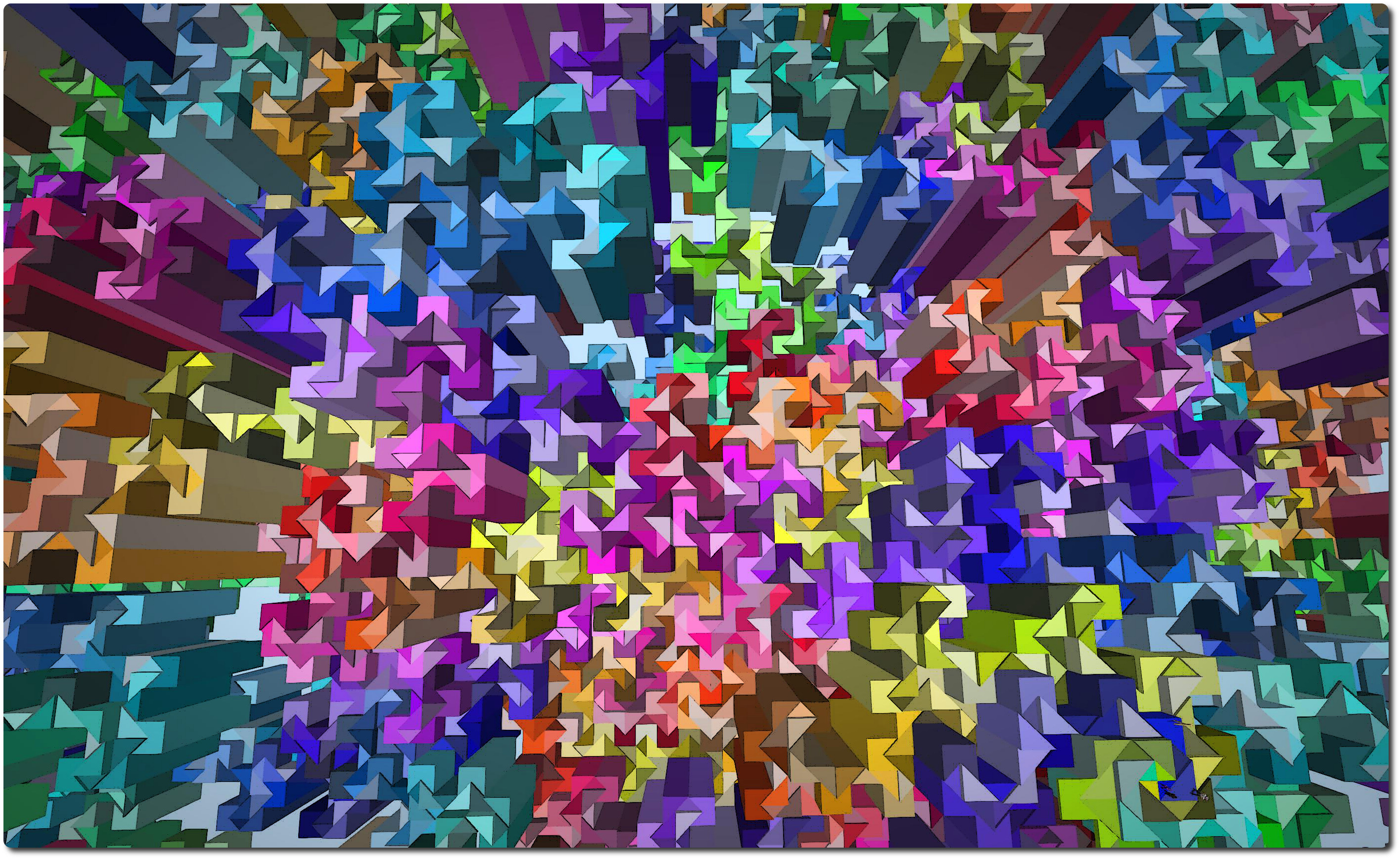
Mac says of the 1216-metre high piece, floating over LEA 26: “The Dragon Curves exhibit showcases sim-wide variations of dragon curve art. The spectacular script-controlled dragon curve landscape changes continuously.”

For those unfamiliar with the concept of the dragon curve, the concept grew from the Harter–Heighway dragon first investigated by NASA physicists John Heighway, Bruce Banks, and William Harter, and documented in 1967 in Scientific American. Essentially, it is any member of a family of self-similar fractal curves, as depicted by Heighway, Banks and Hartner.

When seen from above, this pattern of self-similar curves is visible throughout this remarkable, ever-evolving piece in which the landscape within the three levels constantly changes as elements rise and fall and change colour (their colour being derived by height), and even resize themselves.

Dragon Curves
Dragon Curves

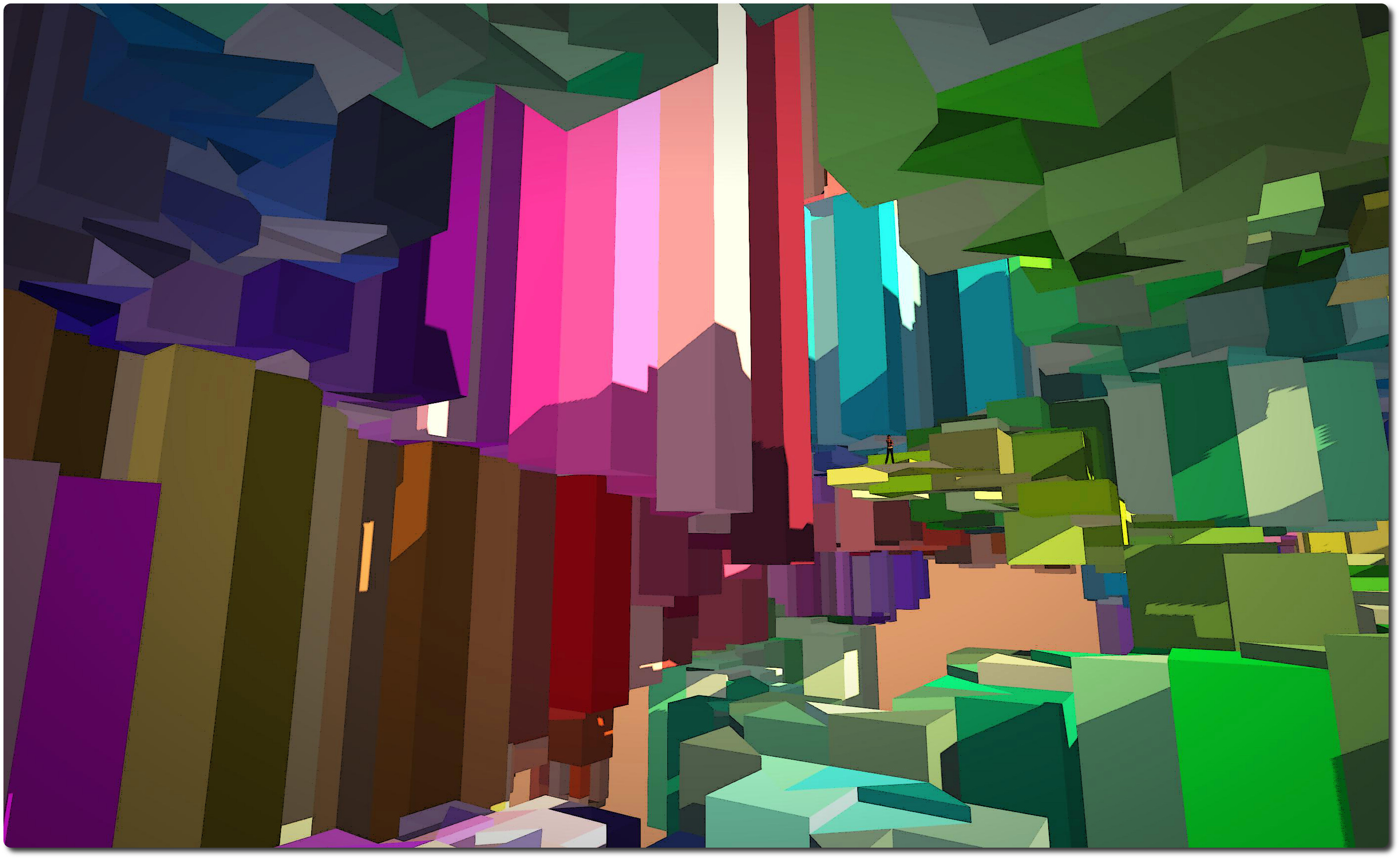
It is possible to find your way down from the arrival point at the top of the build to the lower platforms by way of the “dragon stair”, an 8 kilometre long, 1024m high stairway, itself a dragon curve, while each of the levels within the build comprise 10 dragon curves apiece and individual objects within the build comprise 1, 2, 4, 8, 16, 32 or 48 prims.

It really is an amazing and dramatic piece, a companion to Mac’s Mandelbrot Art, which was featured on an LEA region in early 2013. When visiting, set your draw distance to around 500 metres, if possible, in order to see the installation more fully. Also note that there are six safe junctions (including the landing point) where you can stand as the landscape on each level changes. Mac also notes that there is an “Emergency button to derez the dragon curves in case of crises”(!).

Dragon Curves
Dragon Curves from the inside as I descend

Related Links

Addendum, April 4th: Teno Theriac sent me a machinima of Dragon Curves he’s made of Dragon Curves:

LEA announce AIR 6 selection

LEA_square_logo_60On Monday January 27th, the Linden Endowment for the Arts announced the successful applicants for the 6th round of the LEA’s Artist-in-Residence (AIR) programme.

They are: Solkide Auer, Canary Beck, Tyrehl Byk, Glyph Graves, Xineohp Guisse, Mac Kanashimi, Livio Korobase, Yooma Mayo, Mimesis Monday, Maya Paris, Tomm Pye, SodaGnome Resident, Tansee Resident, TheRealKarenEliot Resident, Sniper Siemens, Storm Septimus, Pixels Sideways, Nexuno Thespian, Lorin Tone and Eupalinos Ugajin.

Musiclandia by Livio Korobase, a successful AIR 5 bid

The LEA received over 40 applications, and those selected were viewed as presenting “truly outstanding proposals that represent a diverse range of virtual art.”

The successful applicants will each be allocated a full region within the LEA for a 6-month period. They have up to four months to prepare their projects, which range from full-sim immersions, to innovative builds geared specifically for multimedia works such as sound and machinima. Each installation must be open for a minimum of two months of the 6-month allocation, and it is expected that some will be open in advance of the four-month build deadline. All exhibits must be open to the public by the end of May 2014 at the latest.

All openings will, as usual, be announced in the LEA blog.