An unorthodox challenge

Cyber Orthodox
Cyber Orthodox

Igor Ballyhoo’s Cyber Orthodox  opened on Sunday May 11th, the first installation in the 4th round of the Linden Endowment for the Arts Full Sim Art series.

Born of the artist’s fascination with the amount of time and energy humans spend trying to convince the world at large that their way is the “right” way, hence the “orthodox” of the title, and his overall response to such attempts: that perhaps we cannot know, and that as such, it is better to keep an open mind to all possibilities, rather than in trying to constrain thinking.

Cyber Orthodox
Cyber Orthodox

The term “orthodox” implies religion; and there’s certainly there is much in the installation which does poke at religious dogma. However, it would not be fair to classify cyber Orthodox as “anti-religion”. While the symbolism in places is clear, there is much else commented upon here than may at first be apparent to the eye.

The setting for the installation is somewhat industrial; great steel scaffolds stand on two sides of the flooded region, supporting two mammoth curved walls made up of overlapping metal plates. At the base of these are piled the kind of concrete forms sometimes seen in parts of sea defences, designed to break-up the force of incoming waves.

To the north side of the region stand four large concrete piers, towers rising from their northern ends. Sculptures stand both at the ends of these piers and atop their towers, while steel frames supported thick glass form bridges between them, alternately connecting tower with tower, pier with pier, and thus to a further walkway at the foot of the high wall which forms a route around the installation.

Cyber Orthodox
Cyber Orthodox

The sculptures on the piers range from a piece called The Processing of Splitting Things, through Icarus, the all-seeing eye (with it’s religious and cult related meanings), the cross, a stylised mosquito, to the remnants of a great model of Titan. What do they mean? And what of the ornate cube, suspended between four great concrete piles between two of the piers, within which sits a strand of the double helix?

Out on the water are four more pieces. There’s another gigantic scaffold, the upper parts of which resemble the masts of the ship. This shares the space with a cross of transparent cubes, within which sits a chariot, as if surrounded by clouds, a pair of stylised winged horses, flames rising from them, the entire piece, at first suggestive of Apollo riding his chariot across the sky. Not far from this is an apple floating in the centre of an Esher-like staircase, and a group of slowly rotating minarets floating among clouds. Meaning here is layered.

Cyber Orthodox
Cyber Orthodox

To take one of these pieces, the apple within the Esher staircase, for example. At first look, it might be taken as a comment upon how the strictures of religious belief (represented by the apple and its association with humanity’s fall from grace). The adherence to the orthodox dogma of a religion can ultimately be circular in nature, appearing to go somewhere whilst ultimately going nowhere.

However, closer examination of the apple reveals it to be etched with a grid work of lines, suggestive of some form of digital mapping, perhaps indicative of the creation of the perfect apple. So is the apple perhaps a metaphor for our hunt for perfection (as modern society perhaps tries to impress upon us through advertising, etc.) in looks and form? The comment again being on the circular nature of such pursuits?

Cyber Orthodox
Cyber Orthodox

Thus, the various pieces within the installation appear open to more than one interpretation, something which itself underlines the central theme of the piece, that insistence upon orthodoxy is a negative presumption on our part which, in the face of all that surrounds us, tends to limit our understanding more than it gives us growth?

In this, three of the pieces might be seen as particularly poignant: Icarus, the sailing-ship like scaffold and that of chariot lifted aloft by winged horses. These seem to be encouraging us all to keep an open mind, to spread our wings and set our thinking free as we voyage the sea of infinite possibilities, considering all and rejecting none.

Cyber Orthodox
Cyber Orthodox

Which brings me back to The Process of Splitting Things and the cube housing the DNA strand. Both might be seen as reflections on the reality of life and how it has over the eons, through the simple act of division  – the process of splitting things – gone from the most basic of single-celled organisms to the very richness and diversity of life as we know it today, as exemplified by the DNA strand.

Here, perhaps, stands another message which can be addressed to those seeking to impose the confines of their own orthodoxy on us all, a message perhaps best summarised in a quote from Rad Bradbury: Life was its own answer. Life was the propagation of more life and the living of as good a life as possible.

Cyber Orthodox will be open through until the end of May 2014.

Related Links

Contemplating the art (and meaning) of time

The Timewalkers, LEA15

Time present and time past
Are both perhaps present in time future,
And time future contained in time past.
If all time is eternally present
All time is unredeemable.
What might have been is an abstraction
Remaining a perpetual possibility
Only in a world of speculation.

These words from the opening of Burnt Norton, the first of T.S Eliot’s Four Quartets, were the first to enter my head while visiting LEA15 and Solkide Auer’s The Timewalkers, an installation which encourages you to contemplate time and its meaning, as you ride a pod up through the giant clock, and upwards into the wealth of colour, pattern and light, set against the backdrop of night.

The Timewalkers, LEA15

Riding the pod up through the installation, I personally found a strong resonance between the piece and Eliot’s contemplation of time. Time is the one immutable force we cannot deny. It rules every aspect of our lives, past, present and future. It surrounds each of us as we live our lives of colour and light.

When contemplating time in reference to our own lives, we so often we look back; wondering what might have been, had a different path been taken. So even as we look back, we also catch a glimpse of a future that might have been. Thus our thoughts themselves  span the past, present and future, even as well continue to travel forward.

The Timewalkers, LEA15

And yet, here lies a conundrum: to be conscious of time  is to be apart from our understanding of time, for consciousness implies a fixed perspective while time is characterised by a transient relativity focused on a fixed point in the present. Yet at the same time, the contemplation of time is also the contemplation of the eternal, as Eliot himself noted when he wrote:

Time past and time future
Allow but a little consciousness.
To be conscious is not to be in time
But only in time can the moment in the rose-garden,
The moment in the arbour where the rain beat,
The moment in the draughty church at smokefall
Be remembered; involved with past and future.
Only through time time is conquered.

The Timewalkers, LEA15

Wherever your thoughts take you, Solikide offers a stunning display, rich in colour while deeply evocative of the passage of time itself, be it through obvious elements such as the clock, the pendulum and the metronome, or in more subtle fashion through the slowly rotating circles which suggest the never-ending cycle of time, or the slow rocking of the bell-like objects hanging below them, or the colour terrible clefts which seem to fall like dying leaves, their time of growth now done, and which also carried more of Eliot’s evocative poem to my mind.

The Timewalkers, LEA15

And what then of life and death? Time is all-encompassing, and a journey through it can hardly be devoid of thoughts on where we all are destined to travel. The symbolism here also seems apparent as one ascends up through the piece, rising towards the light, passing the “bells” tolling silently (and perhaps causing an echo of another writer’s words – those of John Donne), to arrive at a place of intricate beauty.

Wherever your own thoughts take you, do make sure you spend time – no pun intended – as a Timewalker. It’s a visually stunning installation, and one that stirs the grey matter. Recommended.

The Timewalkers, LEA15

Related Links

Ascend through chromatic atmospheres

The Ascension
The Ascension

This project began as a self guided spiritual learning path but quickly became an all-encompassing Journey of Ascending To A Higher Place with each individual choosing how they want to perceive the experience and to what degree of Complexity and learning they choose. Life is a continuous journey of choices, represented by the many choices provided for you at many levels.

So states Tansee in her opening remarks about her new exhibition at LEA16 on Sunday May 4th.

Ascension is further described as “a celebration of colour, sight, sound and  spirit”, and presents a series of themes and ideals in the form of an exploratory journey. This starts at an underwater landing point, where you can take a note card on the installation (recommended). Seven tunnels, each a particular colour intended to represent a specific chakra, all  lead to an undersea environment which can be explored before selecting one of seven ropes and climbing up to the Ascension island.

The Ascension
The Ascension

Here one can take one of seven further tunnels, each leading out to an encircling garden which is divided into seven areas, each representing a state / mood reflective of one’s state of self (“I  Know”, “I Do”, “I Feel”, etc.). Here, different activities are presented to be shared and enjoyed, with each area having a slide show present thoughts on self and one’s being.

The circular nature of the garden, complete with path leading the way between each of the seven areas, represents the endless infinity of birth and rebirth. The areas bordering the path are intended as places where people can seek refuge, relaxation, renewal and a sense of spiritual growth.

The Ascension
The Ascension

As well as providing access to the garden, the central Ascension island offers visitors a very literal journey of ascension, flying up through a series of chakra spheres, each one offering the opportunity to learn about the chakra in question, and the emotional states associated with it. Each sphere provides a place of rest and meditation, so one’s journey need not be rushed. For those who prefer, teleport boards offer a means of moving up and down between the spheres – although I recommend flying, as it’s easy to miss things along the way when teleporting.

At the very top of the installation is a MerKaBa, a vehicle of Ascension, which it is believed can be activated by certain principles in meditation. These involve breathing changes, and mind, heart, and body changes that alter the way a person perceives the reality. A fully activated MerKaBa field enables you to turn your body into a ball of light and bring it with you as you travel between worlds on different spiritual planes.

The Ascension
The Ascension

Towards the back (north side) of the installation is the International Mountain of Peace, a place where visitors are invited to use a series of direct input boards to leave their own thoughts with the world on matters of wisdom, love, hope, peace and more, either signed or anonymously.

As well as representing a spiritual journey and an encouragement for us all to celebrate joy, compassion and understanding, and carry these ideals into the world at large, the Ascension also represents a personal journey undertaken by Tansee herself, who notes, “When I began this project in December, I was not sure what a script did, had no idea what a particle was, and did not really know how to form a group. What a Beautiful Challenge it has been! This opportunity was a facing of fears for me personally.  I wanted to prove to myself that despite my personal challenges, determination and success can and will prevail if you believe in yourself.”

The Ascension
The Ascension

To mark the opening of the installation, The Ascension will be hosting a special live performance. Sky Fires, will feature the work of Particle Tom and Lexi, with music by DJ Sunshine. The event will take place at 14:00 SLT on Sunday May 4th, on the Chromatic Atmospheres particle platform.

Related Links

The virtual reality of the Russian avant-garde

Alpha Auer / El Lissitzky's "For the Voice", The Golden Age of the Russian Avant-Garde, LEA8
The Golden Age of the Russian Avant-Garde, LEA8

History has a tendency to be a little ironic at times. Thirteen months ago, the United Kingdom and Russia issued a joint declaration that 2014 would be the bi-lateral UK-Russia Year of Culture. At the time they sat down to sign that agreement, little did Sergey Lavrov, the Minister of Foreign Affairs of the Russian Federation and William Hague, Secretary of State for Foreign and Commonwealth Affairs of the United Kingdom, would be facing one another across a quite different table and under less convivial circumstances in April 2014.

Not that the one should in any way negate or cancel the other. Rather the reverse, in fact. In the face of mounting political tensions, one would hope that the events staged in both the UK and in Russia as a part of the bi-lateral UK-Russia Year of Culture would stand as a reminder of each side’s humanity and the benefits of people of different nationalities looking beyond superficial national boundaries and collaborating with one another.

Bryn Oh / Vladimir Tatlin: Monument to the Third International, The Golden Age of the Russian Avant-Garde, LEA8

And collaboration is very much the focal-point of one of the pieces selected by the British Council for display in Russia, and it is one that crosses not only the political divide, but also the digital divide as well.

The Golden Age of Russian Avant-Garde is a large-scale exhibition project, created especially for the main exhibition hall of Moscow’s Manege Museum by Peter Greenaway (UK) and Saskia Boddeke (Holland) supported by the British Council. The primary part of this exhibition opened in Moscow on April 15th, and will run through until May 18th, 2014, in an exhibition space totalling some 5,000 square metres – which is enormous by any standards. This multimedia installation will feature, in the words of the British Council:

Polyscreen installations made with the help of the most up-to-date projection, light and sound equipment. It will represent a new approach to the history of art, creating new visuals and new possibilities for learning about the world around us through images. Using polyscreens as an artistic method not only allows us to explore new aspects in paintings or sculptures: synchronised images, bound together by a single idea, create new architectonics, bringing another dimension to the exhibition. Combining film and painting, animation and 3D technology helps create a unified atmospheric work, drawing the viewer into the space of Russian avant-garde.

But this is more than a real-world exhibition. A major element of the piece exists not in the real-world, but in Second Life, at LEA8, to be precise.

It is here that Saskia Boddeke, perhaps better known to many of us as artist Rose Borchovski has brought together seven artists from around the world, each with the task of recreating a famous element of the Russian avant-garde movement, also known as Constructivism, in-world (and some in the real world as well), and which forms a part of the overall exhibition space, real and virtual.

Nessuno Myoo / Lubov Popova, the stage for Meyerhold's production of "The Magnanimous Cuckold", The Golden Age of the Russian Avant-Garde, LEA8
Nessuno Myoo / Lubov Popova, the stage for Vsevolod Meyerhold’s production of “The Magnanimous Cuckold”, The Golden Age of the Russian Avant-Garde, LEA8

A post-World War I development of Russian Futurism, Constructivism became a movement combining art and architecture as a means of illustrating and expressing the ideals of the socialist system. It encompassed artists, sculptors and designers such as Vladimir Tatlin, one of the pre-eminent Russian Futurists, Antoine Pevsner, Naum Gabo Liubov Popova, Alexander Vesnin, Aleksander Rodchenko, Varvara Stepanova, and Vsevolod Meyerhold and the theorists Alexei Gan, Boris Arvatov and Osip Brik.

The SL exhibits are placed on multiple, interactive levels within a pseudo-industrial setting. Here direct re-interpretations of famous elements from the Constructivist movement – such as Bryn Oh’s representation of the never-built (at least in full size) Monument to the Third International by Tatlin (and also known  as “Tatlin’s Tower” and regarded as a key work of the movement) and Popova’s stage design for theatrical director / actor Vsevolod Meyerhold, recreated by Nessuno Myoo through to broader pieces drawn from within and beyond the Constructivist movement and presented in both 2D and 3D installations.

Alpha Auer /El Lissitzky's + V. Mayakovsky's "For the Voice", The Golden Age of the Russian Avant-Garde, LEA8
Alpha Auer /El Lissitzky’s + V. Mayakovsky’s “For the Voice”, The Golden Age of the Russian Avant-Garde, LEA8

A further cross-cultural element is evident in the SL installation. When exploring, you might come across avatars named AvanteGarde001 through AvanteGarde004. These are in fact controlled by visitors to the Manege Museum in Moscow, who are invited to extend their visit to the real-world pieces there into the realm of the virtual – and have been able to do so since the real-world exhibition opened.

Exploration of the SL exhibit space requires a reasonable amount of time – there is a lot to see; even the environment itself, designed by Bryn, makes a powerful statement. Not only does it frame the pieces on display and provides the means by which they can be explored, it also reflects the form and context of the Constructivist movement and the age they represented.

Eupalinos Ugajin / Yevgeny Zamiatine's "We", The Golden Age of the Russian Avant-Garde, LEA8
Eupalinos Ugajin / Yevgeny Zamiatine’s “We”, The Golden Age of the Russian Avant-Garde, LEA8

In terms of the pieces on display, each offers a unique view on the movement and / or the era. In this, I found Eupalinos Ugajin’s interpretation of We, Yevgeny Zamiatine’s dystopian novel particularly interesting, given its historical context. While the Constructivist movement celebrated and promoted the ideals of the socialist state, Zamiatine’s novel painted a far more negative image of socialism: that of a repressive police state. In doing so, it became the first work to be banned by the Soviet censorship board shortly after its publication.  The inclusion of a piece reflective of We is given greater depth when one considers the manner in which Constructivism itself was to be suppressed (and some of its proponents forced into exile or murdered) following Stalin’s rise to power and repressive leadership of the state machine.

Soror Nishi / Wassily Kandinsky's abstractions, The Golden Age of the Russian Avant-Garde, LEA8
Soror Nishi / Wassily Kandinsky’s abstractions, The Golden Age of the Russian Avant-Garde, LEA8

However, perhaps the most remarkable piece  in the installation is Jo Ellsmere’s representation of V. Meyerhold’s biomechanics, a system he developed for training actors. This uses five beautifully scripted avatars moving in a series of synchronised movements which sees them move both as an individual unit, and as five unique elements of the whole, a slight syncopation to their movements giving them a time-lapsed grace which cannot easily be captured in still images and really has to be seen to be appreciated. There is much here that reaches beyond the immediacy of the installation and offers a lot of potential for synchronised movement in art and dance.

As one might expect, a piece of this magnitude, whether real or virtual, takes a huge amount of effort to bring together, and I am for one very glad that RL events didn’t result in either the real or the virtual aspects of this remarkable celebration from being derailed. This is not an exhibition to be missed  and if you are fortunate enough to be able to see the real-world elements at the Manege, I envy you.

Jo Ellsmere / Vsevolod Meyerhold "Biomechanics", The Golden Age of the Russian Avant-Garde, LEA8
Jo Ellsmere / Vsevolod Meyerhold “Biomechanics”, The Golden Age of the Russian Avant-Garde, LEA8

Definitely one for the books – and kudos to all those involved. When visiting the LEA installation, don’t forget you can also pick-up one of several  (or all, if you like), avatars near the arrival point and make yourself a part of the exhibits offered for your delight and consideration. For my part, the LEA installation only presents one problem; such are the pieces on display here, that they each really deserve an individual review / exploration.

Related Links

Your gateway to the LEA

LEA_square_logo_60Most people in SL are familiar with the Linden Endowment for the Arts (LEA) at least in name, if not in purpose.

The LEA is a collaborative venture between Linden Lab and the arts community, established to help create a center of arts activity in Second Life. It is committed to providing access to engaging experiences in the arts for the SL community, through exhibitions, programmes and events, all helping to foster awareness of artists’ contributions to our virtual world and encouraging others to get involved or to be inspired.

While the regions used by the LEA (some 29 in total) are provided by Linden Lab, the LEA itself is run by a committee of SL artists and residents, supported by an advisory board. However, given the LEA does have 29 regions, all playing host to a range of art installations (some permanent fixtures, others representing the LEA’s Artist In Residence programme or other dedicated activities), finding one’s way around all the regions and knowing what is going on at any given time isn’t always easy.

One of the art pieces (by Maya Paris)  at the new LEA gateway
One of the art pieces (by Maya Paris) at the new LEA gateway

True, there is the LEA blog, with notifications of upcoming openings and events, and there’s the LEA website, for information on the various LEA programmes, and the regions almost always offer visitors the opportunity to grab a HUD to help them navigate their way around all the exhibits. However, there has never really been anything resembling a central gateway, a place where visitors can go to and find out what is going on and where, ask questions, and have the means to teleport to anything that interests them, and then back again should they wish to continue their explorations.

Until now.

A part of the new LEA3 gateway

LEA Committee member Honour McMillian recently blogged on behalf of the LEA that LEA3 is being re-purposed as a gateway / hub for the LEA regions. The work is being carried out by LEA committee members and volunteers (of which more in a moment), and while it has yet to be completed, much is already in place.

Central to the gateway is a map to all 29 LEA regions, complete with teleport links, while nearby is an event board listing all upcoming events and activities. A short walk from this is a set of information givers which provide note cards on the various installations within the LEA. Around these areas is a mixed land / water park wherein a number of pieces from various SL artists are displayed and open to be explored. The selected items will change over time, helping to reflect the diverse range of art on offer within the LEA regions.

The information boards
The information boards at the LEA gateway

The welcome area will be staffed, as time an availability, by the LEA Volunteers, overseen by Honour herself. Although there are over 40 volunteers already, they undertake a variety of tasks, including providing guided tours of the regions, assisting the artists using the regions, helping with opening events and other activities, and so on. As such, new recruits are always being sought; so if you’re of a mind to volunteer your time, contact Honour in-world, and she’ll get you into the group and onto the training and orientation course.

As noted above, there’s still more work to be done at the gateway, but it as now open, so if you’re thinking of exploring the LEA regions, there’s now an even easier way to get yourself started!

Related Links

Take a walk in The Wild Side

Heartseed: The Wild Side, April 2014 by Inara PeyHeartseed: The Wild Side, April 2014

One of the things I love about creating in this medium is that you can express the energy so easily.

– Jedda Zenovka

Heartseed: The Wild Side is a Full Sim Art series immersive environment which opened on LEA6 on April 12th and will remain open through until the end of the month.

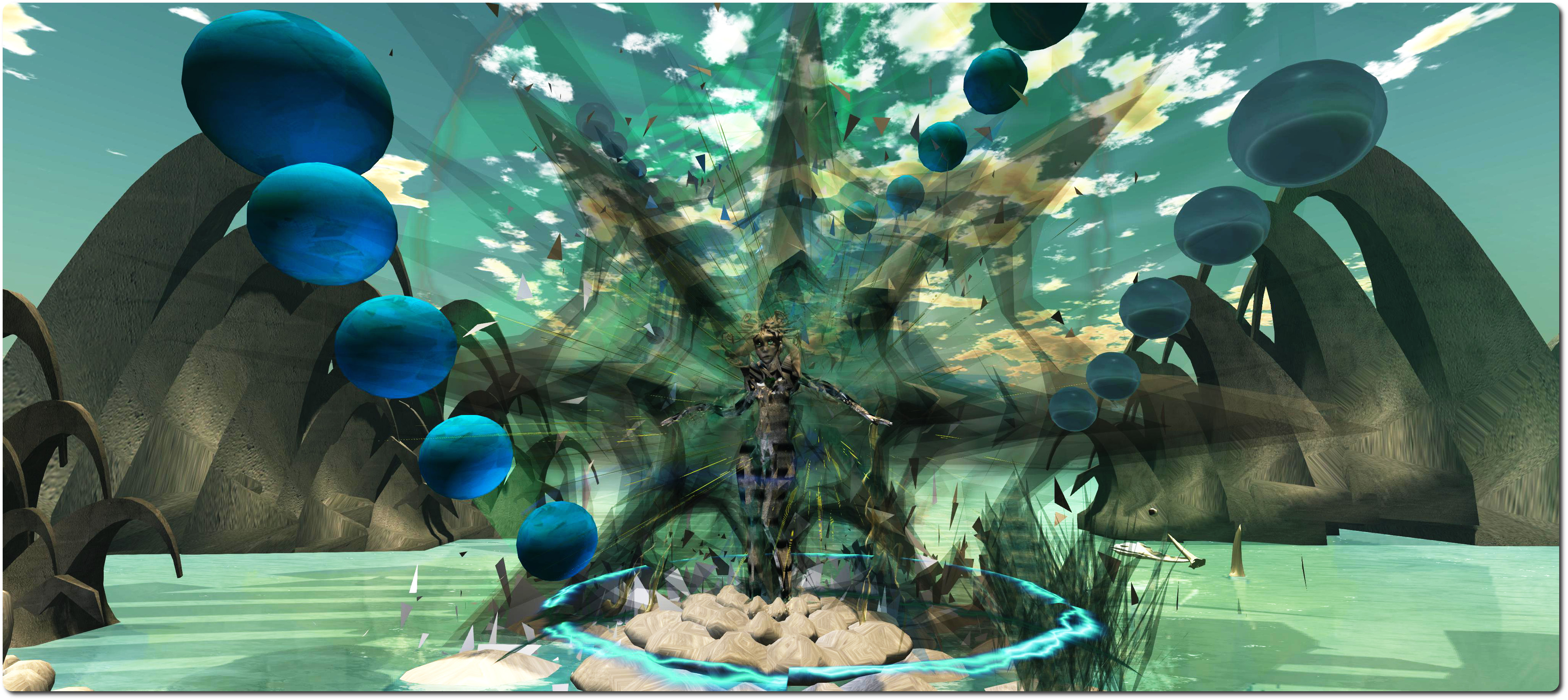
Precisely how to describe the region is a little hard – other than to say it is a most fantastical landscape, one which extends both above and below the water. So I’ll let Jedda Zenovka, its creator, carry the load, description-wise:

Animism is the spiritual belief that everything is alive. I try  to recreate this within the digital domain. Cybertech designs that fuse naturally with organic forms; water, sounds, plant-creatures, inter-dimensional entities that blend into the ocean forest ecology of my environments so that it is impossible to tell where one ends and another starts.

Take a wander  through a textured cyboriginal landscape which evokes healing emotions and crystallises into moving, living sculptures; descriptions of ideas and experiences inspired by both human life of aspirations and necessities and with the practicality of hands-on permaculture in the rain forest.

Heartseed: The Wild Side, April 2014 by Inara PeyHeartseed: The Wild Side, April 2014

From the landing point, one steps out in to what might at first appear to be a fountain and water feature of a formal garden; it is not until one is fully outside of building that one fully appreciates the sheer alienness of what is presented here: a rocky landscape upon which the strangest plant life grows, some of it seemingly part plant, rock, some of it sculpted into anthropomorphic shapes, much of it appearing as if it has perhaps evolved from underwater life, and has found a new home on land.

Look up, and you’ll see more strange  – if not bizarre – forms sitting still in the air or moving through assigned orbits; inanimate objects which are both animated and filled with a life of their own. Here and there electrical discharges flicker across this strange landscape like cybernetic will o’ the wisps while other plant-like forms flicker in and out of existence.

Heartseed: The Wild Side, April 2014 by Inara PeyHeartseed: The Wild Side, April 2014

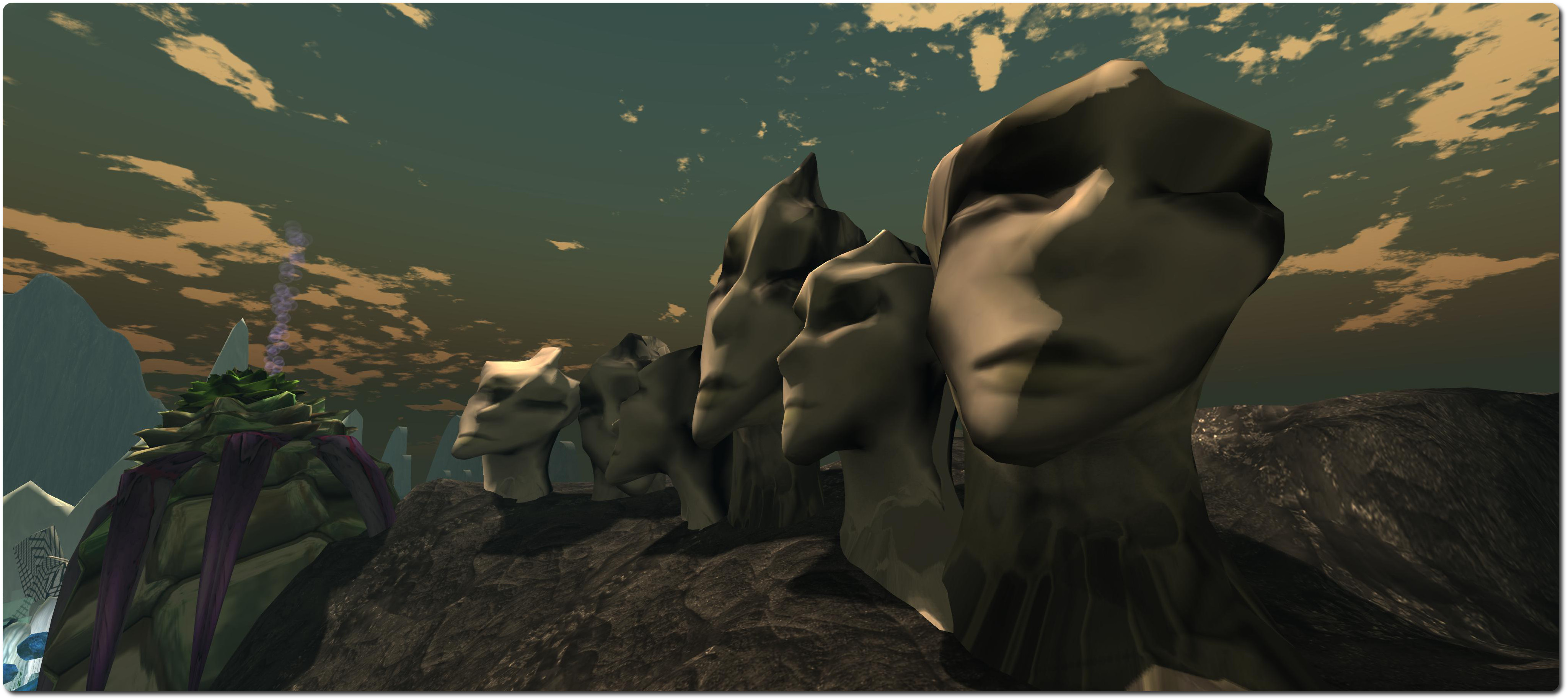
The cumulative effect of all this is to create a dream-like environment which can be degrees be soothing, filling with the gentle chiming of prayer bells but which can in places offer s hint of something darker, such as the rows of odd television-like formations, each with what appears to be a disembodied head within it.

The dreamlike feel of the installation isn’t accidental, as Jedda’s description explains:

While our minds and imagination evolves into the digital domain, our hands and naked feet remember the earth and other elements from which we are made. Dreamtime in this sense is the crossing over of two worlds; vision becomes solid and solid becomes visionary. It is instinct and the heart which guide us into and through this journey. The freshness of water, the spirit of a particular plant or mineral, is crafted into new form; the artist becomes the living conduit through which such essences express themselves.

Heartseed: The Wild Side, April 2014 by Inara PeyHeartseed: The Wild Side, April 2014

Exploring here take takes time – several items are interactive (including the trained attack fish, which can be set to chase others!), and there are number places where one can simply sit and enjoy the immersion – a music stream offers a suitably cyber-istic background for those who like to have more than just the ambient sounds around them while exploring. A particularly interesting interactive piece can be found at the end of one of the pier-like walkways, where visitors can sit and have their camera slaved to a script which will either move their camera through a series of “live” views of the installation, presenting a tour of many of the different elements in the build, or which allows the visitor to select specific views of the installation, moving their camera directly to the selected point.

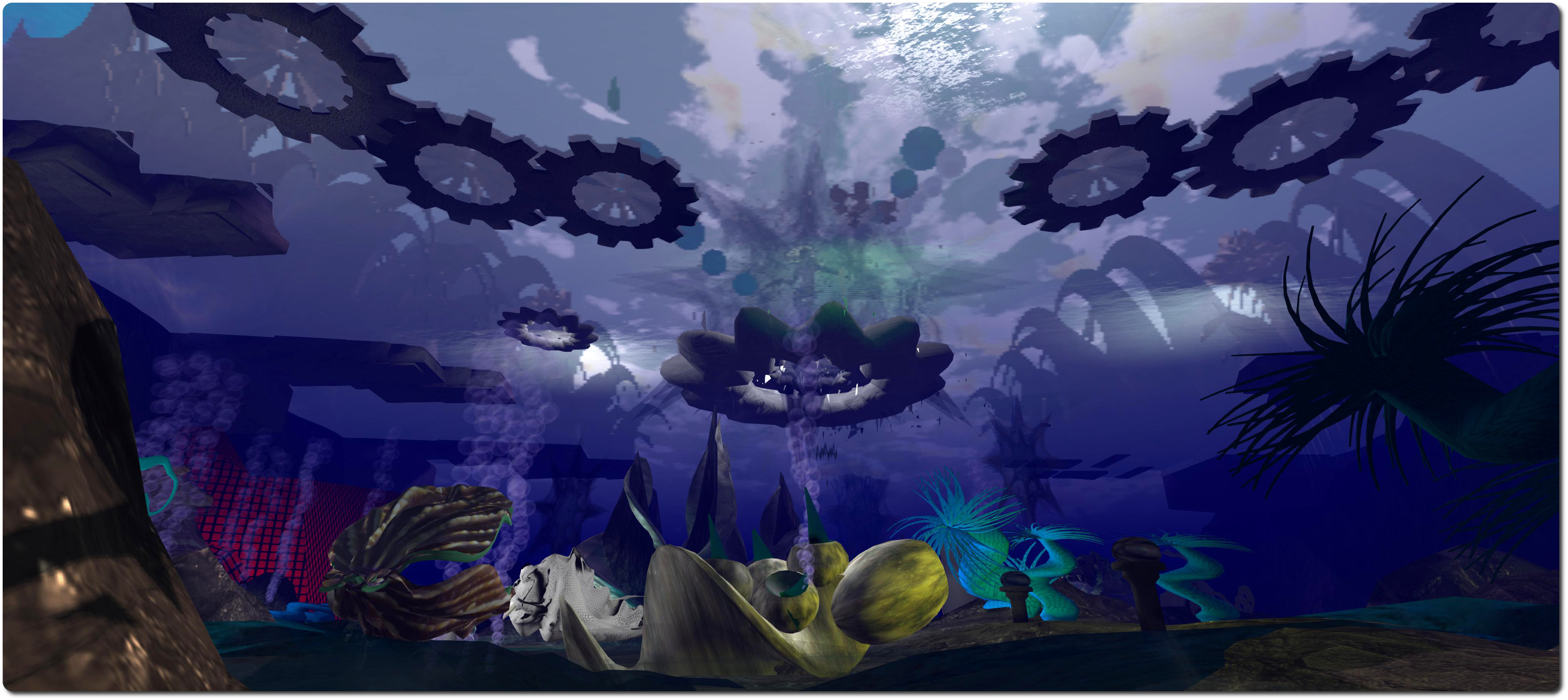
And speaking of the piers – don’t forget this piece extends underwater as well.

This is  quite fascinating build, and if you like your art with a twist of the unusual and a hint of organic cybertech, taking a walk in The Wild Side may be just for you!

Related Links