Blériot Plage, June 2025 – click on any image for full size
In 1909, on a broad stretch of sand just outside of Calais, a new-fangled flying machine took to the air shortly after sunrise on July 25th. Heading out over the English Channel, it followed the French naval vessel Escopette as it steamed towards the English coast. Aboard the vessel was Alice Blériot. Flying the aeroplane – one of his own designs – was her husband, Louis Blériot, on his way to becoming the first man to fly across the English Channel in an aeroplane.
Flying at 76 metres above the water and without a compass, Blériot quickly passed his naval “escort”, reaching the English coast after a little over 30 minutes. The weather and wind hadn’t been entirely helpful and he reached the coast somewhat further east of where he intended, forcing him the follow the Dover cliffs to find his landing zone.
Blériot Plage, June 2025
Fortunately, his colleague, Charles Fontaine, had travelled to England in advance to locate a suitable place for the aeroplane to land. He’d carried with him a large French Tricolour, which he waved as a signal as Blériot approached, allowing the pioneer to make a successful – if heavy – landing not far from Dover Castle after a total flight time of 36.5 minutes. Thus, Blériot became the first man to make a powered flight across the Channel, claiming a £1000 prize (over £130,000 today) in the process.
However, it might have been otherwise. Six day before Blériot, his fellow Frenchman, Hubert Latham set out from Cap Blanc-Nez not far from the sands of Sangatte. Unfortunately, just 13 km after taking off, Latham’s aeroplane suffered an engine failure, and he instead became celebrated as the first person to land an aeroplane on the sea.
Blériot Plage, June 2025
So it is that today the sands from which Blériot took-off are called Blériot Plage (Blériot Beach). They also serve as the inspiration for another superb region setting by Jade Koltai. I’ve admired Jade’s work for years, covering many of her region designs in these pages, and her Blériot Plage continues this tradition.
A part of a chain of beaches running west from Calais, the modern Blériot Plage is backed by the town’s suburbs, and presents a popular destination for holiday makers. Little chalets line the beach in almost neat rows set back from the high tide mark. Grassy dunes separate the beach from the nearby houses and roads, but there is no mistaking the beach is not far from civilisation.
Blériot Plage, June 2025
Jade’s Blériot Plage, takes the familiar elements of its namesake – notably the rows of chalets and wide sands – but presents them with a marvellous sense of the remote, a place of beauty clearly popular to those who know it, but isolated enough to feel far from anywhere – and all the more romantic for it. Neatly merging with the sandy dunes of a region surround on three sides, the north side of the region is open to the sea, the sands wide and soft, the Sun low on the horizon.
The Landing Point sits as a car park close to the mouth of a tunnel, giving the impression of having just arrived after a road trip. A short path through the nearest dunes leads to the beach proper with its rows of white-painted chalets remarkably similar to those found on the actual beach.
Blériot Plage, June 2025
Signs warn about feeding the seagulls and cleaning up behind your dog while the self-same seagulls turn overhead or stand on vantage points looking for the opportunity to swoop and grab an easy snack. Across the sands are places to sit – deck chairs, ordinary chairs, blankets, family play areas – whilst off to one side the bulk of a much darker time in the history of France – of Europe as a whole – raises itself from behind the dunes and broods silently. As one stares out towards the lowering Sun, a coaster from some nearby port chugs it way past the beach, belching smoke but otherwise leaving the scene undisturbed.
In all, another outstanding setting from Jade, not to be missed.
Zaanse Schans, January 2025 – click any image for full size
Some 15 kilometres north of central Amsterdam and on the east bank of the Zaan river, sits Zaanse Schans. Today regarded as something of a neighbourhood of Zaandam, it is a place of historic and cultural significance. It is also a destination for tourists, forming as it does a part of the European Route of Industrial Heritage (ERIH).
Originally a fortification – or sconce – built during the country’s Eighty Years’ War for independence from Spain, it became particularly famous in the modern era after a huge preservation operation was put into motion in the 1960s through early 1970s. This saw traditional Dutch Zaanse houses and windmills considered to be of cultural and historic value being carefully uplifted and moved from the area referred to as the Zaanstreek, north of Amsterdam, and relocated at Zaanse Schans, where they joined two windmills already in existence on the bank of the river there.
Zaanse Schans, January 2025
Today, backed by tulip fields, Zaanse Schans is home to around a dozen windmills, seven museums, craft shops, historic Zaan-style houses, public gardens, and so on, all linked together by footpaths, cycle tracks, bridges, and waterways to offer an informative and cultural visit.
But most famously of all, there are the dozen windmills, many of which are also open to visitors, and which collectively demonstrate some of the many different uses to which these mills were put: cutting wood, grinding chalk, grinding seeds to make oil – even making paint! They stand as a living reminder of a time when wind was a major source of power, and when the region in which they stand was once home to an estimated 600 windmills to form a vital part of Netherland’s economy.
Zaanse Schans, January 2025
Even the names of the mills at Zannse Schans are somehow magical, breathing further life into them: De Bonte Hen (an oil mills dating back to 1693); De Zoeker (an oil, paint, and cocoa mill); De Kat (built in 1781, and the only working paint making windmill in the world); De Gekroonde Poelenburg (a Dutch paltrok mill, specifically design for sawing wood, and one of only five of it kind to survive to this day); and so on. Along the Zaanse, they stand brightly painted and well-maintained, and for those of us in Second Life who cannot get to see them first-hand, Jade Koltai presents a setting inspired by their timeless presence with her latest region design, Zaanse Schans.
Caught under a slowly brightening morning sky with the lowlands seeping mist into the air above them, this is an immediately visually engaging design. Visitors are greeted on one side by neat rows of tulips marching across the region, and on the other by the shadowy forms of four tall windmills guarding what might be taken as the bank of the broad river, the far side of which is little more than a misty silhouette. Like those of the real Zaanse Schans, not all of these windmills are the same, although all four carry their hoods and sails, some turning lazily in the breeze.
Zaanse Schans, January 2025
Rutted trails border the tulips in their field, and like the tracks and paths of its physical world namesake, these trails can be cycled along, courtesy of the rezzer near the landing point, or one can walk across the grassland to the windmills, all but one of which offers sitting of some from without itself or close by. Further places to sit await discovery along the banks of the “river” and the bays to either side, the walk / ride to them allowing visitors to engage in a little bird-watching along the way.
One of these places to sit appears to have been set-up by an angler eager to get an early start on a day’s catch; four fish already lie in a crate for transport home, while the little makeshift bohemian bench and sun shade they’ve erected is a cosy spot for two. Elsewhere, bees are being cultivated for their honey, their hives adorned with flowers to reduce their journey time, and the air is rich with the early morning calls of birds eager to start their day.
Zaanse Schans, January 2025
No Zaan-style houses are to be found here; instead something of a counterpoint between ancient and modern is offered: across the fields from the old windmills, three giant wind turbines raise their slender fingers to the sky, their great blades turning slowly.
Whilst the old windmills with their four sails apiece might not fool Alonso Quijano into thinking he was facing giants, one wonders what he might make of the great towers and pumping arms of the wind turbines. Indeed, seeing them across the fields perhaps causes another pause for thought: the windmills of Zaanse Schans have stood for around 400 years; would our our modern alternatives stand nearly so long?
Zaanse Schans, January 2025
Atmospheric and best seen under its Shared Environment, photogenic, tranquil and perfectly stated, Jade’s Zaanse Schans is an absolute delight to visit and see. Those wishing to rez props for photographs should join the local group (but please clean-up after!).
Loch Dhoire an Chláir, September 2024 – click any image for full size
Ireland (or Éire if you prefer) covers an area of just under 70,300 square kilometres; but while small (ranking 118th on the list of countries by total area), it is one of the most stunningly (and romantically) beautiful to visit, its comparatively small size allowing so much of it to be easily appreciated in a single visit.
One of the most beautiful parts of Ireland – for me, anyway – is Connemara, County Galway. Located on the west of Ireland and facing off against the Atlantic, Connemara has a magnificent coastline with multiple peninsulas, whilst just s short distance inland lay mountains such as the Twelve Bens / Pins (Na Beanna Beola) and the Maumturks / Maamturks (Sléibhte Mhám Toirc) together with the Pantry and Sheffrey ranges, all of which border the magnificent Connemara National Park, numerous rivers and lakes and lochs.
Loch Dhoire an Chláir, September 2024
Connemara is also famous for its strong roots in traditional Irish culture, the fascinating history of mining within its borders (tours of some of the mines are available) and which sought Connemara Green Marble, copper pyrite, and minerals and gemstones in general. It’s also the point of arrival for Alcock and Brown and the end of their 1919 historic non-stop trans-Atlantic flight – and a lot more besides.
However, it the the region’s lochs that were the focus of my most recent excursion within Second Life. This is because Jade Koltai recently overhauled her Homestead region of Overland Hills to present another setting inspired by a physical world location: Derryclare Lough, a freshwater lake within Connemara located near the southern end of the Twelve Bens, and from which she has borrowed its Irish name, Loch Dhoire an Chláir.
Loch Dhoire an Chláir, September 2024
Sitting at the mouth of the Inagh Valley and fed by water flowing to of the nearby Lough Inagh further up the valley, Derryclare Lough is so-named as it is close to the Derryclare mountain as it sits at the southern end of the Twelve Bens range. It is a lake perhaps most famous for its fishing, its conifer woods, its distinctive island reached via a stone causeway cutting through its shallows, and for being a favourite spot for photographers who have visited it from across the world.
The latter have, over the years, produced an plethora of beautiful images of the lake and its dramatic surroundings. Most of these feature the lake and its island under balmy summer skies, often at sunset. They are images that soften the area’s ruggedness into a more romantic idyl-like beauty. However, Jade eschews such a look for her design; offering something more in keeping with the weather that can sweep into Connemara from the nearby Atlantic, presenting a setting that is heavily overcast, the clouds lowering and spitting forth rain; the mountains and hills cast into the role of brooding hulks as they rise from the more distant landscape, their peaks silhouetted against the clouds and their shoulders wrapped in misty haze and their feet lost in shadow.
Loch Dhoire an Chláir, September 2024
It’s an excellent choice, giving the entire setting an air of mystery and intrigue which helps set it as a place very much inspired by rather than modelled on the actual loch. This allows Jade to present a setting that carries the essentials of Derryclare Lough – the waters of the lake, the island within it, the peaks of the Twelve Bens – whilst also potentially casting her net wider to capture more of the essence of Connemara as whole.
Thus, within the setting come much of the rugged beauty of the peat bogs and moors of the region, a hint of the loneliness of crofting – even something of Connemara’s Medieval history. This takes the form of ruins of a castle / fortified house (courtesy of Marcthur Goosson, whose work forms the backbone of my own island home in Second Norway), which perhaps offers a hint of Clifden Castle with it arched entrance and single tower.
Loch Dhoire an Chláir, September 2024
Jade’s use of region surrounds to create a sense of the mountains bordering the lough and to give added depth and life to the setting is simply superb; it’s easy to imagine you could just step off the region itself and strike out towards the rising peaks and perhaps find yourself on the Glencoaghan Horseshoe. Closer to home, the little crofter’s cottage located to one side of the setting perhaps also stands in place of the numerous small cottages that can be found along the shores of the lake and which can be used (with a suitable licence) as a base to go fishing on the waters of the lake and the rivers flowing into and from it.
Fishing on the lake is most often carried out from the “butts” – piers extending out from the shore -, and these are also represented within Jade’s build, as is the distinctive wooded island and the long stone causeway reaching out to it. The latter allows visitors walk out to the island and, should the need to escape the rain be felt, the tents set out on the island might provide it. Forming a little camp site, they are one of several places visitors can sit and pass the time to be found throughout the setting. Another such place sits to the south of the land, not too far from the ruins. A single wooden chair sits looking out over the the more distant land, a blanket draped over it and a lantern illuminating the ground in which it stands. To one side of the chair is a flat-topped boulder suggestive of a flat cairn topped by a cross and a vase of red roses. It’s a poignant little vignette, one suggestive of a place of memory and solace; one that adds yet more depth to the setting.
Loch Dhoire an Chláir, September 2024
However, the best way to appreciate the setting is obviously to visit it. When you do so, make sure you have local sounds enabled to capture more of the region’s ambience. I’d also advise sticking with the local environment to fully appreciate Loch Dhoire an Chláir as intended by Jade. All told, another beautiful and atmospheric setting – and one not to be missed.
Nong Han Kumphawapi, June 2024 – click any image for full size
Far to the north of Thailand and located within the Udon Thani province lies the lake of Nong Han Kumphawapi. According to the folklore of the region (lore which encompasses both northern Thailand and neighbouring Laos), the lake plays a pivotal role in the tragic love tale of Phadaeng and Nang Ai, as do the flows which bloom within it (in their memory) and the wetlands within which it sits – wetlands that were designated as being of international importance in 2001, due to their biodiversity.
Nong Han Kumphawapi, June 2024
The lake is also, as of June 2024, the latest setting Jade Koltai has used as inspiration for an in-world region design. In doing so, Nong Han Kumphawapi joins Jade’s Painjin (2023) in depicting another of the physical world’s wetland areas within Second Life (see: A Red Beach in Second Life).
Covering an area of just under two square kilometres, with the surrounding wetlands covering a total of just over 4 square kilometres, the lake is also known as Talay Bua Daeng – Red Lotus Sea or Red Lotus Lake – due to the fact that while the water is more open that the surrounding wetlands, it is home a huge array of flowers which, which in bloom, turn the lake into a carpet of pink and red.
That the plants are tropical water lilies rather than lotus plants makes no difference – the sight of the flowers blooming across the water from around late November through until around late February give it both a mystical air and mark it as a tourist attraction. The lilies serve to hide a secret of the lake: whilst it may well cover an area of almost two square kilometres, it is for the most part little more than a metre in depth.
Nong Han Kumphawapi, June 2024
As noted, both the lake and the wetland are noted for their biodiversity, sustaining as it does a variety of fish, birds and plants. Water from the area also serves part of the Udon region to the south, providing them with water for agriculture, etc. However, it is within the tale (or rather, tales, as the story takes multiple forms) of Nang Ai and Phadaeng that the lake is best known to the peoples of northern Thailand and neighbouring Laos.
In essence the story goes that Nang Ai (and also known as Aikham), daughter of King Ek-Thita, became famed for her beauty, bringing forth suitors from far and wide; one of whom was Prince Phadaeng. Another was Prince Pangkhee (or Pangkhii to some), the son of the Grand Nâga, ruler of the deep. He was said to have been married to Nang Ai in at least one past incarnation and was determined to be so again. As neither Despite Nang Ai clearly being in love with Phadaeng, her father insists a contest is held for her hand – and neither Phadaeng nor Pangkhee succeed in winning it. Nang Ai’s uncle does, but he’s disbarred from wedding her, leaving everyone a tad miffed. However, both Pangkhee and Phadaeng determine they will each see the princess again.
Nong Han Kumphawapi, June 2024
Being the son of a shape-shifting deity, Pangkhee turns himself into an albino squirrel for his visit. In doing so, he successfully finds himself on the menu when Nang Ai sees him and decides stewed squirrel would go down rather well for lunch. Killed by Nang Ai’s hunter, with his dying breath, Pangkhee requests that his father avenge him and kill all who eat squirrel – and just to help sort out who this should be, turns himself into 8000 cart loads of ready-to-cook squirrel meat. This goes down very well (literally) for the townsfolk – and Nang Ai even serves the visiting Phadaeng squirrel soup.Enter the Grand Nâga and his angry horde to carry out the requested vengeance. As the killing rages, Phadaeng and Nang Ai attempt to flee on horseback, but the Grand Nâga floods the land, creating the lake and Nang Ai carelessly falls into it and drowns. Stricken with grief Phadaeng dies as well – only to bounce back as a ghost leading an army of ghosts, no also out for vengeance, this time on the Nâga’s horde, who are indeed defeated, but not before the land around the lake is flooded, forming the wetlands.
Nong Han Kumphawapi, June 2024
With her design, Jade particularly captures the flowering nature of the lake, although the setting perhaps suggesting it has been transposed to a more coastal location. The waters are shallow, the lilies in bloom, and here and there the land rises above the water. On one sits the remnants of an ancient temple, while more ruins and the remains of wood houses rise from the waters like romantic apparitions, watched over by cranes. A modern raised deck sits out over part of the water, clearly awaiting the arrival of tourists, whilst sampan-like boats float out among the lilies, just like the ones used to carry visitors over the shallow waters of the real Nong Han Kumphawapi.
Rich in bird song and setting under s sky in which a westering Sun is slowly setting, the region includes multiple places to sit and be serenaded by bird song and the gentle sounds of lapping water. Recommended.
Hotel Del Salto, April 2024 – click any image for full size
In May 2020 I visited a region design by Jade Koltai which – as with her work with the much-missed Serene Footman – was based on a real world location: the Hotel De Salto, Columbia. It was a fascinating visualisation of a place with an equally fascinating history, some of which I touched upon when writing about my 2020 visit.
Well, Jade’s Hotel De Salto is once again open to tourists to visit in Second Life, and as with the original, again sits above the gorge of the Salto del Tequendama, or Tequendama Falls. With the return of the build come some new elements I don’t recall from the first iteration – although they could be things I simply missed back in May 2020; either way, they provided an added bonus in re-visiting this eye-catching build.
Hotel Del Salto, April 2024
As I noted back in my original piece, the Hotel Del Salto is located some 30 km south-west of Bogotá, Columbia’s capital city, and within an area steeped in legend. The waterfall, for example, is believed by the indigenous Muisca people (also known as the Chibcha, also the name of their language) of the Andean plateau to have been created by Bochica, the founding hero of their civilisation, who (amongst other feats of leadership) used his staff to break the rocks of the high savannah plateaus to release the waters covering them, providing the Musica with rich and fertile lands for settlement. In fact, Tequendama, an ancient settlement close to the falls, is regarded as one of Colombia’s earliest permanent settlements.
Measuring 132 metres in their main height, the actual falls are an impressive sight, and the location of another Musica / Chibcha people’s legend, being the place where it is said that in order to escape the Spanish conquest and its violently enforced evangelization of the Americas, the indigenous people of the area would leap from the falls, becoming eagles able to fly to their freedom.
Hotel Del Salto, April 2024
The story of the hotel commenced in 1923, and became wrapped in its own semi-tragic legend. Designed and built by Carlos Arturo Tapias at the behest of the 11th President of the present-day Republic of Columbia, Pedro Nel Ospina Vázquez, the building reflected French architectural lines. Its original purpose was to be a private mansion where the elite of Bogotá could gather and celebrate their wealth and elegance in a setting of supreme beauty and breath-taking views – the building built against the very lip of the gorge carved by the nearby waterfall.
By 1928, the building had become a more formalised hotel, opening its doors to visitors from around the world, a role it was to perform for around 50 years. With its spectacular views of the falls, available from both the rooms and suites on the gorge side of the hotel and – especially – from the broad dining and tea terrace extending from the rear of the hotel to the edge of the gorge, the hotel did attract many. However, not all of them were happy visitors, with the hotel gaining a reputation for attracting the broken-hearted who would – perhaps as a result of the ancient Chibcha legend of people throwing themselves from the nearby falls to escape the terror of the conquistadors – throw themselves to their deaths from the nearby cliffs. These tragedies further enhanced the Hotel’s reputation, as it was said the cries of those taking their own lives could be heard from within the hotel, leading to claims that it was also haunted.
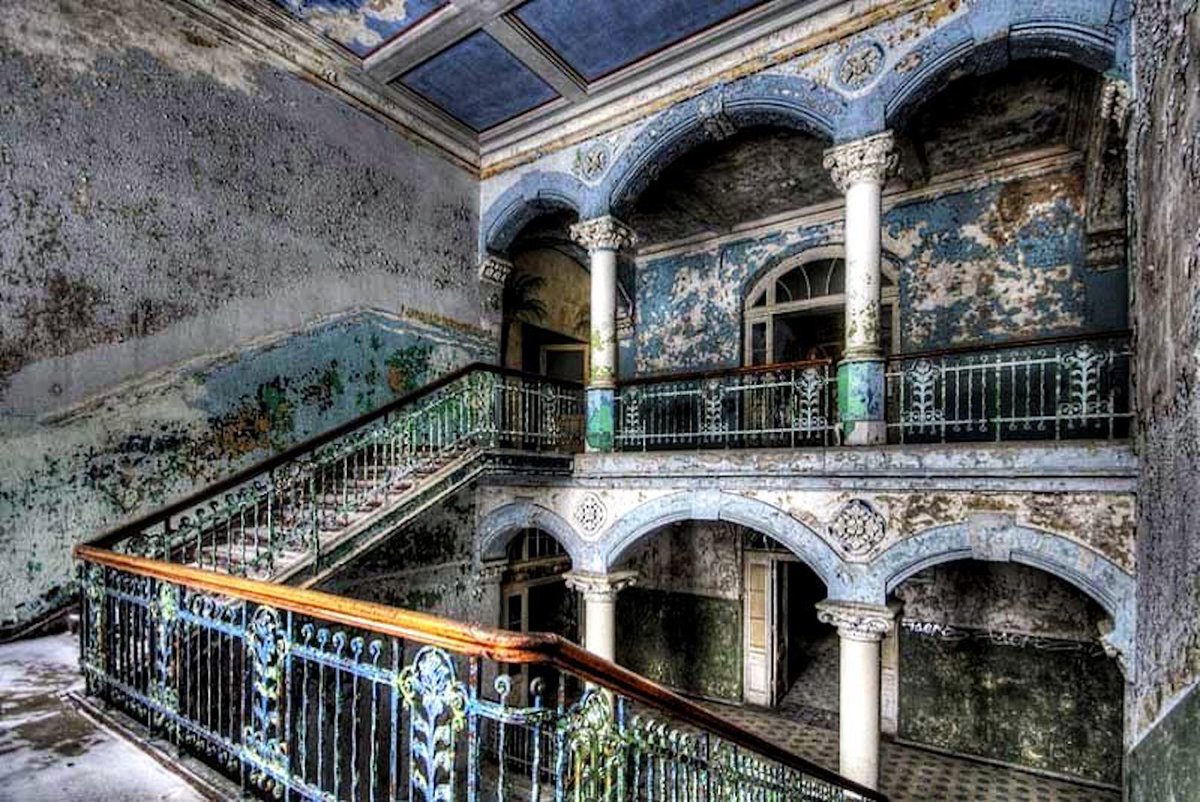
An interior view of Hotel Del Salto taken as work to restore the building was underway in 2011. Credit: National University of Colombia
However, in the 1970s, the Hotel’s fortunes entered a decline. Bogotá has undergone expansion at a pace that far outstripped its supporting infrastructure. As a result, the river serving the Tequendama Falls and following through the gorge below the hotel has become the city’s primary sewer. This became so bad that the falls gained the dubious distinction of becoming “the largest wastewater falls in the world”, and the river regarded as one of the most contaminated in the world, with its stench rising to the level of the hotel. A dam built across the river above Bogotá further restricted the flow of water reaching the falls whilst conversely increasing the among of raw sewerage it contained, and by the 1990s, Hotel Del Salto had closed its doors and was simply left to nature and to rot.
It is in this state that Jade has again chosen to represent the Hotel: an empty, mouldering shell. Rooms lay deserted, vines and creepers scale walls and hang from rafters, the branches of bushes and trees intrude through windows that have long since lost their glazing; paint fades on walls and doorways gape slack-jawed onto balconies, their doors also long-since vanished.
However, within its empty bulk, there are still reminders of the hotel’s glorious past, together with echoes of the ancient history of the Tequendama area and of the Musica / Chibcha.
Hotel Del Salto, April 2024
For example, one of the broad terraces offers a parasol-shaded lounger from which to appreciate the full glory of Salto del Tequendama, here depicted long before any upriver dam stemmed the full spate of the the river. Directly behind the Hotel, another terrace presents an ornate cast-iron table and chairs set for tea offering, again offering a view of the falls and one down the lush gash of the gorge, humming birds and a parakeet adding to the exotic sense of indulgence.
Meanwhile, a balcony serving one of the long-since deserted suites of the hotel offers both a comfortable bed for use as a latter-day chaise lounge, a gramophone on the floor for those requiring music perhaps reflective of the hotel’s early years. Watched over by a cockatoo, this balcony carries some of the echoes of the ancient past in the form of painted skulls displayed on the parapet guarding its edge.
Hotel Del Salto, April 2024
A further suggestion of the region’s ancient heritage might be found by descending the stairs which cling to the stone walls of Jade’s built as they support the Hotel from the rocks below, offering a route down to the water’s edge facing the foot of the falls. Here Jade has taken a little artistic liberty, turning the river into an enclosed body of water, allowing her to present evidence of ancient structures which help acknowledge the rich history of Tequendama, as well as providing a further retreat for those who wish to tarry for a while within the region.
Another place in which to pass the time can be found on the steps of the north face of the gorge. This takes the form of a sturdy, if rusting tower topped by plants and places for couples and individuals to sit. Reaching it, however, does require a sense of adventure and a trip along one of Cube Republic’s excellent rope climbs!
Hotel Del Salto, April 2024
For the last 14 years, the original Hotel Del Salto has been undergoing restoration, initially as project undertaken by the National University of Colombia’s Institute of Natural Sciences. This was part of a broader (and on-going) effort “to recover the region and make it free, clean, and surrounded by a healthy ecosystem.” Initial exhibitions at the Hotel under the Institute’s umbrella commenced in 2013, with the museum officially opening to the public in 2016.
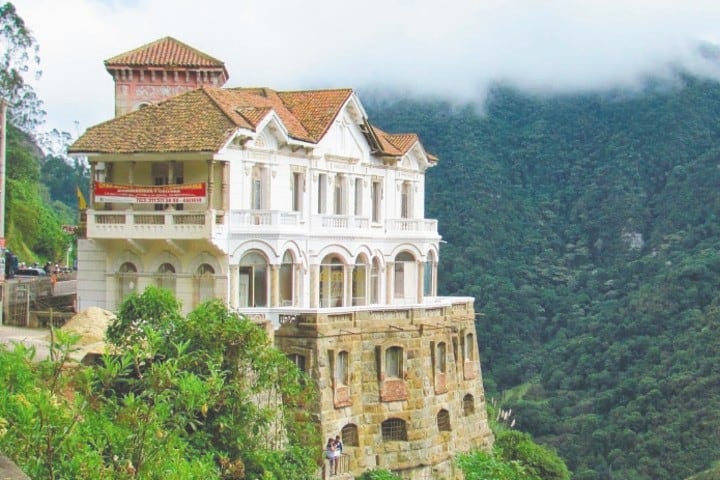
However, according to several reviews of the restored building, much of this work involved a complete abandonment of its original interior décor, settling instead for a modern, clinical white plaster finish, leaving the building’s interior a faint shadow of its former self. Similarly, much of the exterior of the building has been whitewashed, possibly in an effort to protect the stone and brickwork against the ravages of the local climate, although visitors have again critiqued this as eliminating much of the building’s splendour.
The Hotel Del Salto in 2023 with its whitewashed frontage overlooking the Tequendama Falls. Credit: El Espectador
But however one might find the original Hotel Del Salto – should one opt to visit Columbia! – there can be little doubt that Jade’s interpretation is a welcome returnee to Second Life, and represents a vision of what might actually be the most evocative era of the real Hotel’s history, and does so in a manner that both pays homage to the broader historical context of the Tequendama area whilst perfectly fitting the constraints of a Second Life region.
Panjin, February 2023 – click any image for full size
Jade Koltai is back with another region design which continues the work she began with the late Serene Footman: delivering to Second Life a setting reflective of one of the more intriguing and/or unusual locations to be found in the physical world.
Located in the biggest wetland and reed marsh in the world, some 40 kilometres from Panjin City, Liaoning Province, northeast China, is Bohai Bay. It sits at the mouth of the Panjin Shuangtaizi River, and it is home to the Panjin Honghaitan Scenic Area. Composed of shallow seas and tide-lands, the location is also home to an extensive growth of Suaeda salsa, one of the few species of plant that can live in highly alkaline soil to which it has given the region its more well-known name: the Red Beach.
Panjin, February 2023
This is because the Suaeda – also known as seepweed – turns the river-mouth red between the months of mid-summer and September and October every year, when the colour of the plant reaches its deepest, richest crimson ahead of the onset of winter. From a distance, it causes an 18 kilometre long stretch of the river and bay to look like it has a beach of red sand, although there is no actual sand between the plants.
An obvious tourist attraction, the area is mixed with paddy fields and hosts one of the most complete ecosystems that can be found: more than 260 kinds of birds, including the endangered black beaked gulls and crown cranes (thus giving it another name – “home of the cranes”), and 399 species of wild animal. In 1988, the area was awarded state-level nature protection, and has also been nominated to join the International person and biosphere protectorate network.
Panjin, February 2023
Cut through with river channels, much of the landscape is off-limits to Chinese nationals and tourists alike, although there are a number of vantage point people can go to – locations such as Yishui Yunzhou and Langqiao Aimeng – where wooden boardwalks have been built out over the seepweed, allowing visitors to see the plant without actually interfering with its growth. For those who would like a closer look, there are also boat rides along the river channels, which may offer a better way to see some of the local wildlife.
All of this has been marvellously captured – as one would expect – by Jade in Panjin, a stunning Homestead region design. Caught in the arms of an off-region surround, the region offers an estuary-like setting, open waters to the west and the shallows with the year’s growth of seepweed protected by the arms of the bay.
Panjin, February 2023
From the landing point on the west side, wooden walkways point eastwards, vying with the splayed fingers of water channels which appear to reach inwards over the red plant from the coast, rather than reaching outwards from the river towards the sea.
Steps descend to the red spray of plant growth, allowing visitors the wade through them, whilst open-sided pavilions might be found on the boardwalks or surrounded by the static tide of seepweed, offering places for visitors to sit and pass the time. Further seating is to be found along the banks of some of the water channels, places which are also home to red-crown crane, a frequent visitor to the actual Red Beach.
Panjin, February 2023
This is a genuinely elegant region design, of which elegantly captures many different aspect of the both the Red Beach and the Panjin Honghaitan Scenic Area., with the flat aspect to the region, the extensive use of canola flower cut through with water channels and dotted her with hints of green to suggest rice growths and presided over by the odd tree and the outstretched boardwalks, gives the impression the region is a lot bigger than first appears.
As always, this is definitely a location in Second Life worth visiting, given most of us likely wont get to witness it first-hand in the physical world.






 Inara Pey: Living in a Modemworld