Firestorm: SL, MOSES, OpenSim and the future

firestorm-logoLogging-on to SL today, I notice from the Firestorm MOTD that Jessica Lyon brings word on Firestorm and what is going on with SL’s most stable and most popular viewer – and the viewer of choice for many OpenSim grids.

The team has been hard at work on the viewer while LL have been busy sorting out stability and crash issues on their own beta. As Jessica comment in her blog post, one of the reasons Firestorm is on a long release cycle is that until now, she has preferred to see the viewer go out with significant updates which users will want to have / see (both new capabilities and bug fixes), rather than pushing out much smaller, more incremental releases which might get on people’s nerves the their frequency. The next release will be no different in that regard, with a range of further fixes and well as a host of new features, including William Weaver’s marvellous Phototools, which I simply adore. William (Paperworks Resident in SL) has been working closely with Firestorm developer Ansariel Hiller to get the tools integrated into Firestorm. I’ve been able to use the integrated version ahead of the release, and love the work both Ansariel and William have put in on this.

Phototools, fully integrated into Firestorm in the next release, allows stunning images to be produced from within the viewer without necessarily relying on external processing through PhotoShop, etc. (image courtesy of William Weaver)

However, in the future, it seems things will be changing, as Jessica states:

We plan to make that updating process easier for you by setting up seamless behind-the-scenes updates you will hardly even notice, allowing us to provide more frequent updates and even hotfixes to improve your experience faster!

This sounds like the team will be implementing an automatic update process similar to that used by LL to update the official viewer. It will be interesting to see how this is implemented and how people respond to it. While it is likely most people won’t mind  / will welcome the move, some may prefer to keep the option turned off (if possible) so they can track what changes are being made to their viewer installation.

MOSES: collaboration with Firestorm

An intriguing part – for me at least – of Jessica’s news is that the team are liable to be working with Doug Maxwell and his MOSES team.

This is interesting for me as I covered MOSES last year in an article in this blog, and also covered a major upgrade to the platform after meeting Doug at a presentation he gave on the project. He’s looking to enhance OpenSim security for the MOSES grid, and it appears he’ll be working with the Firestorm team on security aspects affecting the viewer, which will in turn be fed back into the OpenSim community.

In terms of direct OpenSim support, Jessica has this to say:

While Second Life still remains the primary focus of our development efforts, we have begun working towards bringing Firestorm Viewer into better compatibility with the OpenSim Platform. It is important to point out where the extent of that effort ends, though. We are making Firestorm work better on the “base” OpenSim Platform, but we cannot fix problems that arise on specific OpenSim grids because of changes those particular grids have made to their OpenSim code. For those issues to be fixed, we will rely on those grids to provide us code contributions to address those issues.

This is a pragmatic and sensible approach and typifies the considered manner in which Jessica approaches projects.

To help support the OpenSim effort, Firestom had two regions on OSgrid donated to them for their use, one of which has been outfitted to serve as Firestorm’s OSgrid headquarters and which has been named, somewhat appropriately, Firestorm Island. Directions for visiting it can be found in Jessica’s post.

All-in-all, an interesting update.
Firestorm’s 2 and 1: celebrating the highs and lows of a TPV

Firestorm achieved a number of significant milestones recently, all of which are worthy of note.

  • On Sunday September 2nd, the viewer was officially two years old
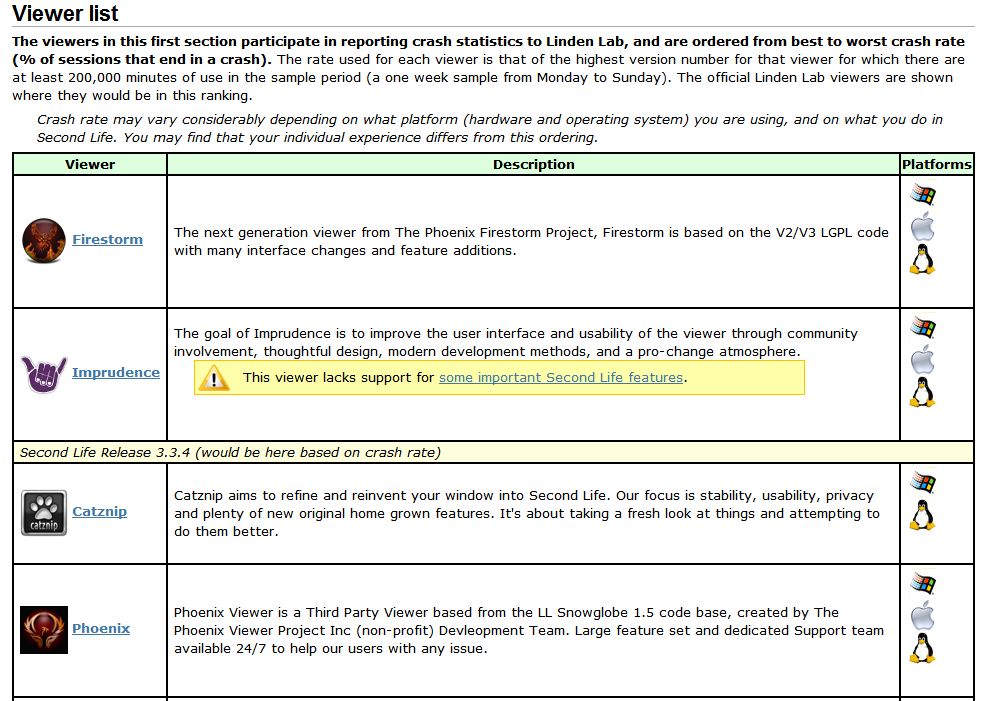
  • On Tuesday September 4th, version 4.2.2.29837 officially achieved the lowest crash rate for any V2/V3-based TPV at just 8.54%. This is even lower than LL’s own 1.23.5 viewer, which although long in the tooth and increasingly out-dated, is still regarded as very stable.
Extract from the Third-party Viewer directory listing, showing the most stable viewers at this time

Also on Tuesday 4th September, the team received official notification from LL that Firestorm has taken over from Phoenix as the most popular viewer in use in Second Life. This was marked by Oz Linden putting out an e-mail through the open-source development mailing list:

“On behalf of Linden Lab, I’d like to extend congratulations to the Firestorm Viewer team.

Last week, Firestorm took over the #1 spot on the list of Second Life viewers in terms of total user time, surpassing its elder cousin, Phoenix. The Phoenix viewer still has a slight lead in number of sessions, but Firestorm viewer sessions are on average significantly
longer – which may in turn be due in part to its substantially better stability.

“The Firestorm team has worked long and hard to support users who want both the latest Second Life features being developed by Linden Lab and the additional capabilities you provide, and this achievement is one you can all be proud of.

“Thank you.

Congratulations to everyone at Firestorm for all the time and effort devoted to the project.

Helping the community: the Phoenix Firestorm Support region

Update Aug 25th: The region is now open. See the link at the end of this article to visit.

This weekend, the Firestorm team will be launching a new in-world venture: the Phoenix Firestom Support island.

The region is designed to serve two purposes. One is to provide help and support for users of any calibre, via the use of in-world tutorials supported by real life help in the case of users new to SL, and via the provisioning of an area more focused on providing real life help for users more familiar with SL and the viewer. The second is to provide an in-world base of operations to support Firestorm users in particular.

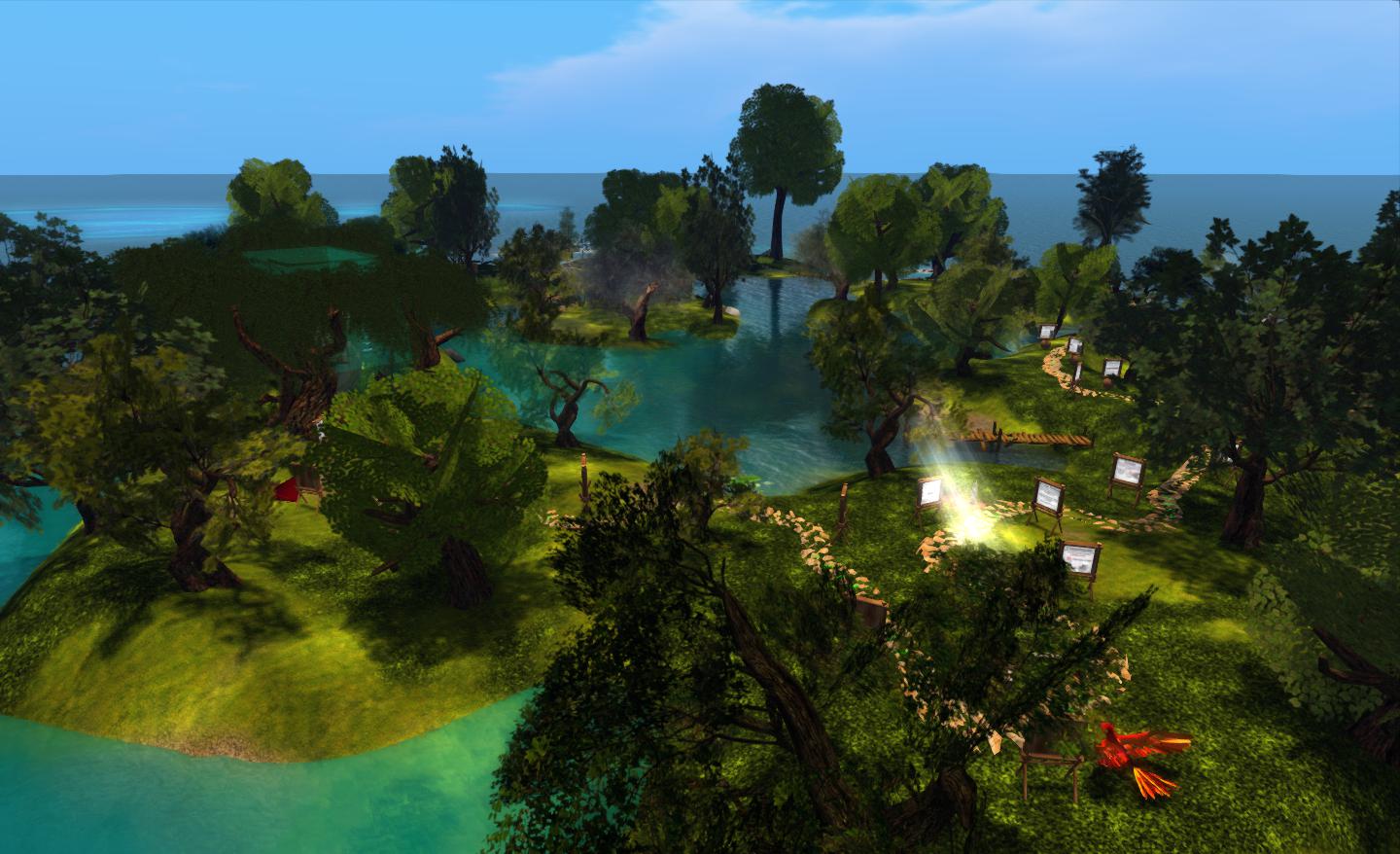
Firestorm’s new support island

The region is somewhat mindful of the old SL Orientation Islands where new users to SL learned about the basics of the viewer and how to do things – so much so, in fact, that I was half-expecting to find a beach ball and table during my preview explorations :). While neither turned up, I did smile on coming across a large and talkative phoenix, itself a reminder of the OI parrot…

However, this is not to say that the region has been deliberately modelled on the old Orientation Islands. As Jessica Lyon, the Phoenix / Firestorm project lead pointed out to me as we discussed the island and the ideas behind it, it’s a matter of form following function. A relaxed and visually pleasing tutorial path with few distractions naturally lends itself to this kind of open-air approach.

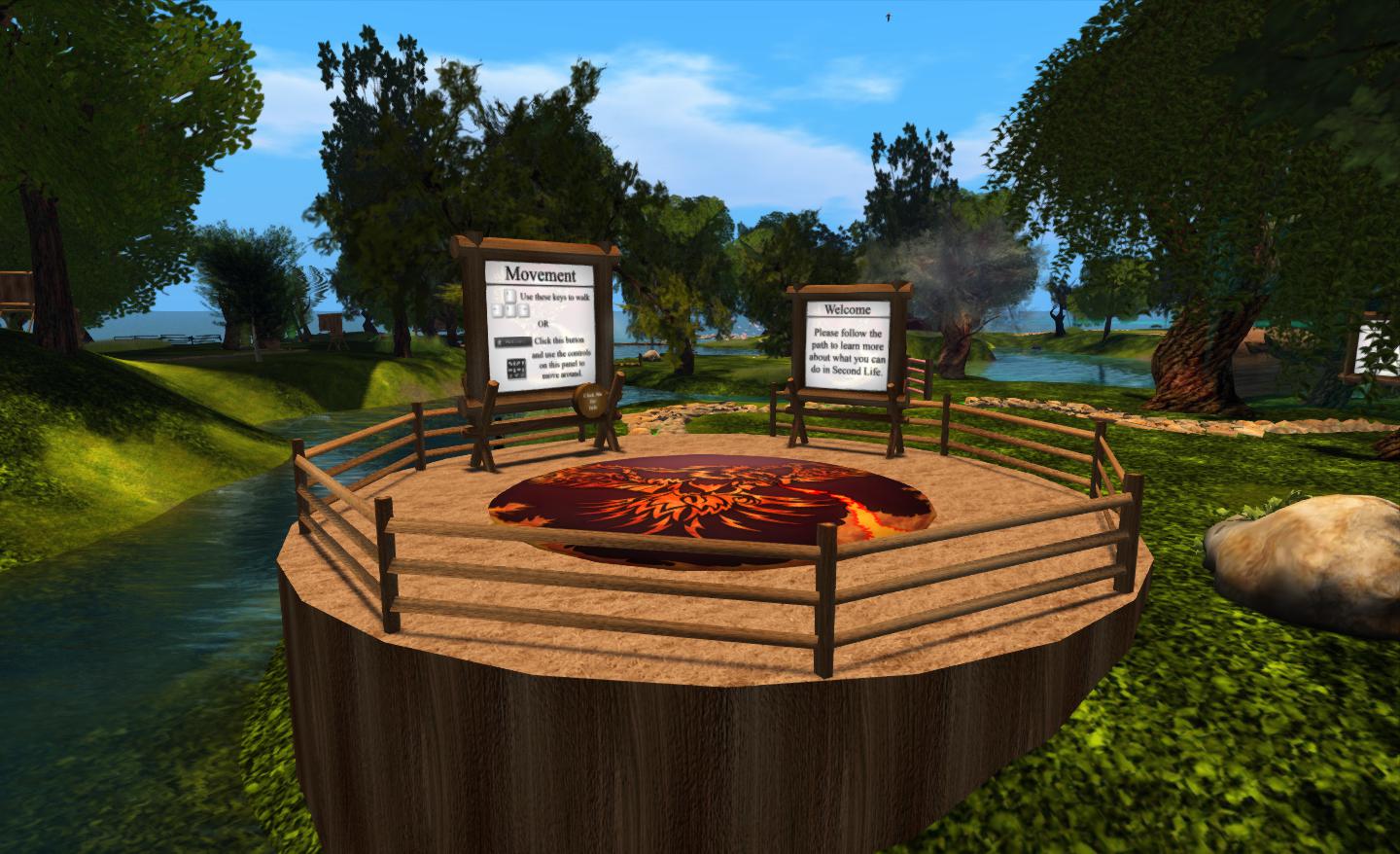
The main element of the region is a path which leads people around the island from the arrival point, taking them past various lessons in gaining familiarity with Second Life and the viewer. These are very much focused on “learn by doing” – such as jumping over a fence to understand walk / jump – and are very clearly and cleanly presented, and obviously intended for the more novice user.

Arrival point

The signs are clear and concise, and while based on Firestorm running in a default mode (i.e. with the pie menu active), they easily translate to other viewers, whether they are using pie or context menus.

Within this sits a central area where questions about Second Life and viewer use that go beyond those that tend to be asked by “new” users can be addressed. This can be reached via a bridge from the outer area of the island or via a teleporter located at the arrivals point.

The central area, where the more experience user can seek focused assistance from staff and mentors

A key aspect of the region is that is designed to be staffed. Although it had originally been hoped that in-situ help relatively small, things haven’t quite work out as originally envisioned. “Our original plan,” Jessica told me, “Was to have a first entry to SL region for zero – 30 day accounts only, and would staff it with our own support staff and a careful selection of mentors/helpers. We have a RegAPI from LL [which would allow Firestorm to run a sign-up page and deliver new users directly to the region]. Unfortunately, it doesn’t work with “Resident” last names, so we had to switch to plan B. Plan B is to open the region to the public, and heavily staff it with mentors and helpers to ensure new and old residents alike get real help from real humans.”

As a result of the switch to “Plan B”, and to ensure the island is properly staffed, invitations to participate have been sent to the RHN, White Tiger Mentors, Mental Mentors and other groups. One potential benefit of this is it will help ensure there’s a much more diverse wealth of experience on-hand to deal with viewer-centric questions than might otherwise be the case were the island solely staffed by Firestorm-focused volunteers.

Continue reading “Helping the community: the Phoenix Firestorm Support region”

Firestorm announces pathfinding support

Following-on from the TPV/Developer meeting on the 13th July, during which pathfinding was discussed, and the recent roll-outs of pathfinding functionality to the Magnum  Release Channel, the Firestorm team have announced that they will be adding pathfinding support to upcoming releases. The announcement reads in part:

What’s next…Pathfinding!
We’ve decided to release LL’s Pathfinding work in Firestorm in two stages.

Stage 1 (next release).
Pathfinding Tools. Not to be confused with theHavok library, which is used to display Navigation Mesh (NavMesh), thePathfinding Toolsare what you will need to optimize your regions once Pathfinding goes live.

Unless LL changes the current plan, when Pathfinding goes live, all regions will have pathfinding enabled by default, and all objects that contain scripts will be treated as “Movable Obstacles.” Movable Obstacles will have an impact on region performance, so region owners will need tooptimize their regionsby setting scripted objects that don’t move to “Static Obstacles.” To do this, you will need Pathfinding Tools!

So our plan with our next release is to get Pathfinding tools out as soon as we can. This will be based on our 28744 release + post 28744 crash fixes + LL Pathfinding code. There have not been many new additions beyond that since the release, and this is for the best: we expect this code will destabilize the viewer to a degree, since it will be a large merge, and we’d rather base this version on a solid release than on a wild card.

Stage 2 (follow-up release).
Release with the Havok Library for NavMesh. Havok will be used to enable viewing of NavMesh, display of object types and AI Preview of object paths.So the second Firestorm release from now will have Havok + stability fixes to the previous release + more of our own goodies.

The two-stage release is unsurprising, given Lorca Linden’s recommendations at the meeting on the 13th July.  At this time, no time-scales are available for the releases, because, as Jessica points out in the post:

How soon?
Great question, and a very tough one to answer since there are many factors involved that we have little control over. Like…

  • LL’s timeline to release Pathfinding;
  • How much Linden code we have to merge into Firestorm;
  • How many regressions and new bugs we pick up from that merge;
  • How long it’ll take us to fix them, etc.

But we want to get these out as soon as we possibly can once it’s live on the grid.

Phoenix

Phoenix will not immediately be getting pathfinding due to the amount of work involved in getting the capabilities integrated into Firestorm. Region holders using Phoenix will still be able to disable/enable pathfinding using a viewer-independent console, but for all else they will need to switch to a viewer that supports the full pathfinding tool set.

Related Links

Kokua and Firestorm: moves and views

It’s been relative quiet on the Viewer front of late. However, there is now news emerging about two TPVs: Kokua and Firestorm.

Kokua

Nicky Perian has updated the Kokua code on Bit Bucket to release 3.1.1.22989(Beta-1), dated June 11th. Available for Windows and Linux, it is unclear as to how “official” this release is  – there is no blog post associated with the release, nor does it appear on the Kokua wiki download page. Notice of its arrival has, however, been doing the rounds on Twitter.

I’ve not had a close look at it as yet, but it appears the release is more about bug-fixing and general enhancements of the current code (with fixes code that addresses both SL and OpenSim) more than prepping a major release and shouldn’t be treated as such – or even as a recognised experimental until the team release further information. As it stands, the release still references itself in places as the “Second Life Viewer” rather than Kokua, again indicative that this is very much still a work in progress. One thing it does do away with is the console window that would open on starting the Windows version of Kokua (and which you had to keep open while logged-in to SL in order to avoid the Viewer crashing).

I’m not recommending the release be put to general use – that is down to the Kokua team; rather I’m reporting that the version’s availability has been reported on via Twitter. Those wishing to know the exact status of the project should keep an eye on the Kokua blog, where hopefully there will be an update soon.

Firestorm

After an extended period of quiet from the Firestorm end of things, I recently noticed Jessica Lyon logging back in to SL once more after what appeared to be something of a period of absence. She’s provided a blog post at Firestorm entitled “Progress Report” , which indicates that the team had in fact  eased off from development; with some taking an outright break from things, as burn-out was becoming a factor.

The announcement highlights three things:

  • The team has new developers in the form of Holy Gavenkrantz, who has been a regular code contributor to both Firestorm and Phoenix, and Armin Weatherwax who, co-incidentally enough given the information on Kokua above, was formerly a lead developer on that project
  • And update on the status of the Firestorm 4.1.1 release, which is still officially labelled “coming soon” but which will include various requested tools and capabilities including Growl support, an LSL pre-processor, additional Windlight effects an “improved build floater”, and a host of goodies
  • The news that the team is branching development for Firestorm between Second Life and OpenSim.

This last point is interesting, as Firestorm has been gaining popularity among OpenSim users (Kitely even set it as their default Viewer).

The use of Viewers to access both SL and OpenSim has been the subject of much debate in the last couple of months since Linden Lab announced they were sub-licencing elements of the Havok physics engine. This requires that any applicable Viewer using the licenced code to only connect to LL’s own servers. In May, Jessica gave a hint that the Firestorm team were considering their options vis-a-vis SL and OpenSim, commenting on SLU that:

There is the possibility that we could have Havok code disable when the viewer is not logged into the SL grid. I have asked Oz if this would be acceptable and he is looking into it. If it turns out this is NOT acceptable, we will provide two versions of our Firestorm viewer. One for SL and one for everything else.

While she has not followed-up the comment with further information directly, it would appear from the blog post that – for whatever reason – the Firestorm team has opted to take the route of developing two flavours of the Viewer. It will be interesting to see how this actually plays out.

Phoenix / Firestorm Q&A

I’ve been asked to pass on the following – and while only too happy to do so, I’m closing the item to comments as it is important anyone who has questions and who can’t attend the event, post their question to the official Phoenix Firestorm blog.

The Phoenix / Firestorm team are holding a public Q&A session this coming Saturday to answer questions and concerns relating to both the Phoenix and Firestorm Viewers.

The meeting will take place at 13:00 SLT at the 4-region auditorium at Rockcliffe University and will be hosted by Nigma Sterling of Rockcliffe University.

Those wishing to attend are advised to arrive early, and using the following SLurls according to the first initial of your FIRST name:

A – I:http://maps.secondlife.com/secondlife/Rockcliffe%20I/2/32/29
J – R:http://maps.secondlife.com/secondlife/Rockcliffe%20Library/227/5/30
S – Z:http://maps.secondlife.com/secondlife/Agile%203D/227/250/31

The event will be recorded and made available online after the fact (no live streaming planned at this point).

Note that the focus of the event is to discuss genuine concerns relating to either Viewer and their future development, and to answer questions and address specific critiques.

You can read the entire post from Jessica here.