Where a journey can begin in Second Life

Where Our Journey Begins, September 2020 – click any image for full-size

Open for the Autumn period (or spring, for those living in southern latitudes) is Where Our Journey Begins (I’m assuming the “begings” apparent in the name at the time of our visit is a typo), a Homestead region  designed by Vivian Ewing and Dream Shadowcry.

Offered as a place to relax and take photographs (which can be shared through the region’s Flickr group), it’s a setting that appears to be caught in a forever sunset, quite the romantic time of day (although admittedly, I opted to run my own daylight settings while visiting), and which is visually impressive both in its layout and for one or two ideas it might give to those who like to fiddle with their own homes.

Where Our Journey Begins, September 2020

Where Our Journey Begins sits with a north-south orientation as a horseshoe shaped island, the open end of which looks westward towards the lowering Sun. Cupped within the arms of this horseshoe is a deep inlet, no doubt cut by the waters falling from the high curtain of rock that forms a major part of the island’s eastern aspect, the falls within it sitting as a series of high steps down which the waters tumble to reach the curved bay.

The open end of this bay is spanned by a broad stone bridge that connects the north and south aspects of the island and provides visitors with a landing point. Whatever traffic this bridge once witnessed has now largely passed: its stone surface is now the home of long grass and even young trees have gained a foothold at either end of it’s span. As well as being the landing point, this bridge offers a place to sit and the first opportunities to take photographs within the region as it is subject to the periodic sweeping gaze of the off-shore (but still within the boundary of the region) lighthouse.

Where Our Journey Begins, September 2020

The northern and southern arms of the island offer places to visit and appreciate. To the north, the bridge leads visitors to where a flat-topped table of rock thrusts out from the much higher curtain of waterfalls. A path curls up the side of this table, the easiest way to reach the top. As it does so, it passes the flat toes of the cliffs, a place of long grass shaded by autumn-shaded willows and green fir trees and is the home of a old carousel and its ticket booth and pipe organ.

The top of the table presents a summer house set within its own grounds (but open to the public) and with plenty of detail within and without – I admit to particularly liking the manner in which a glass-walled pavilion has been converted into a cosy outdoor bathroom warmed by its own wood-burning stove.

Where Our Journey Begins, September 2020

Stone steps guarded by old concrete gate posts point the way down from the terrace behind the summer house to a broad lip of rock that offers a secluded hideaway and place to sit. A second path just to the right of the one that rises up the the plateau, slopes gently down to where a small meadow sits under the arms of two huge oak trees and sheltered by a rich growth of the bushes, the home to a wooden gazebo warmed by a stone-built fireplace.

The southern end of the island presents a further table of grass-topped rock, this one lower than the one to the north. It is home to what may have once been farm outbuildings – a windmill and a couple of barns. However, while one of the barns still provides shelter for sheep, this area now looks to be more of a garden space; the second barn has been converted into another little summer house / music room, three of its walls now fitted with windows, the space between it and the other barn fenced as a little wild garden.

Where Our Journey Begins, September 2020

From this southern spur, it is possible to walk down to the island’s shoreline and the shingle beaches that border three sides of it. Two of these beaches offer further places to sit – an open deck to the south, and a little beach house with canvas sides and roof and extended deck to the west. Looking towards the lighthouse, this beach house is fronted by an old pier, matched by one at the foot of the lighthouse, both of them suggest a route between island and lighthouse, although sadly, there is no rowing bone to traverse it. However, you can cam-sit yourself onto the boat tied-up at the lighthouse pier – a method that also lets you avoid the disapproval of the seagulls who have laid claim to both of the old piers!

I’m not sure how long Where Our Journey Begins will remain open to the public. As noted, it’s About Land details indicate it is available for public visits for the “Fall season”, so I presume that as it has apparently only opened recently, it’ll remain available to the public until at least mid-to-late October – but don’t quote me on that!

Where Our Journey Begins, September 2020

Overall, the region makes for a photogenic and engaging visit, although some adjustment to viewer settings might be required to get the best FPS when wandering (I had to switch to a lower draw distance to keep my FPS at least in the teens). It’s a setting that is well put together and offers a lot to discover and appreciate.

SLurl Details

A Thousand Windows in Second Life

A Thousand Windows, September 2020 – click any image for full size

Lotus Mastroianni and Fred Hamilton (frecoi) are back with another region design that will likely be around for a month(ish) for people to enjoy. Their most recent builds have tended to have an urban design rooted in the physical world, starting with their take on a Brazilian favela back in May of 2020 (see:  Visiting A Favela in Second Life), and this latest design continues this theme, appearing to be inspired by a part of a place that lies very close to my heart.

With A Thousand Windows, Fred and Lotus seems to take as their inspiration the tight-knit tenement blocks located in the Mong Kok district of Hong Kong’s Kowloon peninsula. Mong Kok is a place I’ve visited on numerous occasions in my life (notably as a result of once living in Hong Kong many, many, years ago). I say this because, while there is no outright pointer to Mong Kok within the build, parts of it appear to pay clear homage to the district.

A Thousand Windows, September 2020

Take the 737 airliner passing overhead, for example; to me, it sits as a reminder that the district once lay beneath one of the approaches airliners had to make in order to touch-down at Hong Kong’s former airport at Kai Tak, a short distance away.  An approach that had aircraft practically scraping the roofs of the tenements, as made famous in many a photograph.

Elsewhere, in fairness, the region could have been inspired by any number of densely-packed housing units in the orient, but for me, Mong Kok is the place it brings to mind, even if Kai Tak did cease operations more than 20 years ago, having been replaced by a much larger, purpose-built facility built (much like Kai Tak) on reclaimed land, but out at Chek Lap Kok island, sitting off the north coast of Lantau. However, the focus of the build isn’t airlines or airports, but rather the densely-packed nature of the old tenements and the lives that go on within them.

A Thousand Windows, September 2020
There is a huge world out there, but what happens behind all those windows? what lives and worlds are hiding there? How many eyes peer into the fleeting reflections of so many lights?

– About Land, A Thousand Windows

This is actually a question I can remember asking myself, both as a youngster living in Kong Kong, and as an adult tourist who has made many return visits. With their shoebox sized (by western standards) living spaces, stacked one atop the next in grey, slab-like concrete towers cut through with narrow roads and alleys set back from the broader through routes of places like Yua Ma Tei occupying the main thrust of the Kowloon peninsula, parts of Mong Kok always struck me with a sense of mystery as to what was going on behind the blinds-shouded windows and narrow verandahs strung with laundry that so often formed the face of the squat tor blocks as they looks at the world.

All this is marvellously captured with Lotus and Fred’s design, which has been ideally set within a twilight environment to emphasise the volume of windows representative of people packed into so tight a space.

A Thousand Windows, September 2020

Set within four façades representative of five floors of apartment blocks, the region presents a number of tower blocks of similar height with narrow streets and alleys running between them. Neon signs hang from the sides of buildings and laundry hangs from verandahs – again a common sight I remember from Mong Kok. Most of the buildings within the setting are shells, although one or two contain interiors, making exploration worthwhile.

As well as the narrow streets sitting within their concrete canyons, the region offers elevated walkways from which the view can be appreciated, as well as offering the way to some outdoor spaces. And if you look hard enough, you might find an elevator leading up to the rooftops of one gathering of blocks, a couple of seats located just a across the roof from the elevator top from which to admire the view of the 737 passing overhead – and the visitors passing below.

A Thousand Windows, September 2020

Opportunities for photography, either by day or night, can be found throughout – as can be seen in the Flickr stream Lotus and Fred use for their builds. I admit to finding the sound scape accompanying the build a little odd – particularly the loud buzzing of flies (although that could perhaps be hornets of wasps, both of which could be a summertime nuisance in Hong Kong when I was little) but this can easily be ignored, leaving one to remain fully immersed in the setting.

All told, another enticing, attractive build. And just in case you haven’t seen photos of airliners over the actual Mong Kok district, I’ll leave you with the following.

A 747 passing over the broader streets of Mong Kok as it descends into the former Kai Tak Airport, Hong Kong – catch the 737 sitting above A Thousand Windows

SLurl Details

A new Muse in Second Life

The Muse, September 2020 – click any image for full size

In February 2020, we visited The Muse, a Homestead region designed by the superbly named “United Nerds of Building” (see: Finding The Muse in Second Life). Earlier this month, I received a note from Liss Beattie, that The Muse’s owner, Tribish Tammas, has both relocated and redesigned The Muse, so we took the opportunity to hop over and take a look.

Still occupying a Homestead region, The Muse retains some elements from the design we saw back in February, whilst also offering an entirely new look. As with the previous design, The Muse remains split between a core ground-level build and a sky platform, with the stated aim of the region being to offer a “space for couples, lovers, and friends to relax and spend time together”.

The Muse, September 2020

The main landing point is located in the the ground-level setting, on the south side of the region. Backed by a flat-topped bluff with grassy slopes to its seaward side, the landing point sits within the ruins of an ancient building – perhaps an aged temple – with a westward view towards the surrounding mountains. These sit beyond a small island that appears to have been formed by the local water cutting a channel to separate what had once been a headland.

Reached via a stone bridge that arches between two weather-beaten and somewhat decrepit gates, this little island is home to one of the elements seen within the previous design: an open-air Elven Ballroom.

The Muse, September 2020

The bluff behind the landing point runs east and then north, forming a low-lying table of land, its landward faces formed by rocky cliffs over which a waterfall tumbles to feed a stream that winds its way across the region. In doing so, it neatly cuts the lowlands into two unequal parts. On one of these sits a single barn, converted to an adult play area, surrounded by a sea of flowers. On the other, close to the rocky plateau, is a more expansive ruin that sits close to a place that winds up to the top of plateau.

Two bridges span the stream,providing easy passage between the two parts of the lowlands, while a third bridge reaches across a further channel of water to reach a north-eastern island.

The Muse, September 2020

The north-eastern island has a backbone of cliffs against which the intriguing bulk of The Retreat from The Looking Glass sit.. In the last iteration of The Muse we visited, this formed a mystical library. Now it fulfils more of the role of being a home, its westward aspect commanding a view across the region’s lowlands, ruins, barn and Elven Ballroom all visible among the trees sprinkled across the landscape. Also visible from this vantage point is a large garden bar sitting at the north end of the main island, a comfortable walk from both this house and the barn.

The sky platform is reached via teleport from the landing point (you’ll need to accept the region’s experience when asked). As  per the previous iteration of the design, it offers a large dance floor with and animated finish and now bracketed by a pair of floating islands  – one the teleport point, the other offering space for Tai chi exercise. It is watched over by a blue whale that swims through the air above it, and the eye of a large moon that slowly orbits the dance floor along with the stars and nebula of skybox surrounding the platform.

The Muse, September 2020

Throughout both settings, ground and sky, are numerous opportunities for dancing and / or sitting and relaxing, whilst on the ground, the islands are nicely rounded-off by a natural sound-scape.

One of the charms of The Muse when we last visited was the manner in which it comprised a series of individual vignettes loosely woven together by the setting in which they sat, rather than presenting a truly contiguous whole. It was both eclectic and yet complete, the various areas offering their own individuality but nevertheless flowing together as a whole.

The Muse, September 2020

This new iteration presents farm more a feeling of being a contiguous whole at ground level, a single environments with multiple points of interest. On the one hand, this means the current Muse perhaps lacks the eclectic mix of the old, but on the other, it means it offers its own unique look and feel – that of a temperate island that has seen the passage of time and human habitation, and is now a retreat from the pains and pressures of the world, ready to greet and comfort all who visit it.

SLurl Details

  • The Muse (Consensual Kinks, rated Adult)


Wandering Poughkeepsie in Second Life

Poughkeepsie, September 2020 – click any image for full size

Poughkeepsie is a parcel covering just under a quarter of a Full region which has the bonus LI capacity applied, that was recently highlighted in the Destination Guide, prompting me to hop over and take a look.

Held and in part designed by Peresphone Kore (LeriaDraven) – Loly Hallison performed a lot of the general landscaping -, the parcel has an interesting description and greeting, reading in turn (via About Land and a sign post at the landing point):

An amazingly whimsical photography sim with plenty to see and do. From date night, chilling by the fire, relaxing in the library, or taking on a game in the arcade (yes the games really work!) This is all my own creation and I’m super excited for this!
Warning. You are about to enter someone else’s dream.
Poughkeepsie, September 2020

Both the description and the sign present a huge promise, and visually, the parcel does deliver on this promise. Located in the north-west of the region, it offers a north-facing beach cupped between a curtain wall of rock that runs diagonally across the back of the parcel from east to south-west, and an upland area. The curtain of cliffs neatly separates Poughkeepsie, with the western table plateau overlooking the north beach and the lowlands running back from it to the feet of the cliffs.

Topped to a large house, the rocky plateau falls directly to the sea to the west, but also hides a low-lying corner of the parcel in which sits a second house complete with a west-facing beach of its own, both screened by giant oaks. This house, and the one top the plateau appear open to the public, with the latter reached by curving stone steps rising from the landing point, the former by following a winding path that curls around the base of the rocky table. This second house, sitting within its screen of giant oaks has something of a Halloween feel in the grounds on its landward side, whilst the shingle beach on its waterside offers the opportunity for a game of chess.

Poughkeepsie, September 2020

Each of the houses is fully furnished, offering multiple rooms to explore, while the house on the plateau additionally offers a rock-and-wood terrace / deck for outdoor seating and an outbuilding that looks like a greenhouse converted for use as a little café. A barn and field, home to cattle and sheep may at first give the impression this is a working farm. However, given the expansive nature of the house, and the small number of animals, it’s hard not to wonder if the latter are more a hobby for the owners, rather than a working source of income.

The lowlands of the parcel offer their own attractions. There’s the sandy, north-side beach, with multiple places to sit and a view of an off-shore (and off-region, although it doesn’t appear to be phantom / without physics) fairy-tale castle. On the grass behind the beach is a little open market area offering fresh fruit and veg, with a seating area ranged before it, complete with cakes, toffee apples and drinks available to visitors. It again suggests that maybe the house up on the plateau is might be a working farm – but equally, it also stands as a vignette on its own.

Poughkeepsie, September 2020

Also to be found in the lowlands are ruins, a folly and the unexpected – an old British red telephone box – as well a sculptures and a fair amount of local wild life. There’s even a touch of Tolkien waiting to be found, although saying Mellon before it as instructed by the runes didn’t result in the expected (and by “saying Mellon” I do mean touching it to see if anything happened, given its scripted nature).

Photogenic, rich in detail and with much to see, Poughkeepsie makes for a rewarding visit – but I say so with a caveat: a visit does come with something of a performance hit. How much of this is down to what is in the parcel itself, and how much is down to what’s in the region as a whole, is hard to say (some of the sculptie giant oaks in the parcel do have high render costs). I found my system peaked a 7 fps with shadows enabled at a moderate draw distance, mostly hovering at 4-5 fps. Disabling shadows raised this to the mid-teens., although even this could drop into single-digits – so be prepared to make adjustments if you’re on  a mid-range system and are used to having things like shadows on all the time.

Poughkeepsie, September 2020

Nevertheless, Poughkeepsie offers a rewarding visit for those willing to make any necessary adjustments.

SLurl Details

The penguins of Boulder, in Second Life

Boulder, September 2020 – click any image for full size

Note: membership of the [valium] group is required to access this region – see below for why.

We first visited Boulder, the latest region to be opened by Vally Lavender (Valium Lavender) back at the time of its opening at the end of July  2020.  At the time, I admit I held off on writing about it, as both Caitlyn and I found the region somewhat heavy-going – which can often be the case with terry Fotherington’s regions designs (as Boulder is) when heavily populated by avatars. As such, I had intended to drop back in August, once the initial rush of a new region opening had passed and Boulder would be quieter. But things bring what they have been, I’ve only just managed to make good on that plan, so my apologies to Vally for only now getting around to re-visiting and writing about Boulder.

Boulder, September 2020

Since that first visit, summer has come to the region – which might seem odd to those of us in northern latitudes, where we’re now entering the autumn period. However, Boulder is inspired by Boulders Beach, Simon’s Town, South Africa, sitting in the southern hemisphere, and which is enjoying its spring season; so presenting the region in a summer setting makes perfect sense.

Boulders Beach is most famous for being the location of a penguin colony, the land-based and endangered species Spheniscus demersus, the African Penguin (also called the Cape Penguin or South African Penguin). A part of the Table Mountain National Park, the Boulders Beach is also a focal point of operations for  SANCCOB, Southern African Foundation for the Conservation of Coastal Birds. It is in support of SANCCOB’s work that Vally established Boulder: the money raised through people joining the [valium] group go directly towards adopting penguins in SANCCOB’s care, helping to provide the money needed for their welfare.

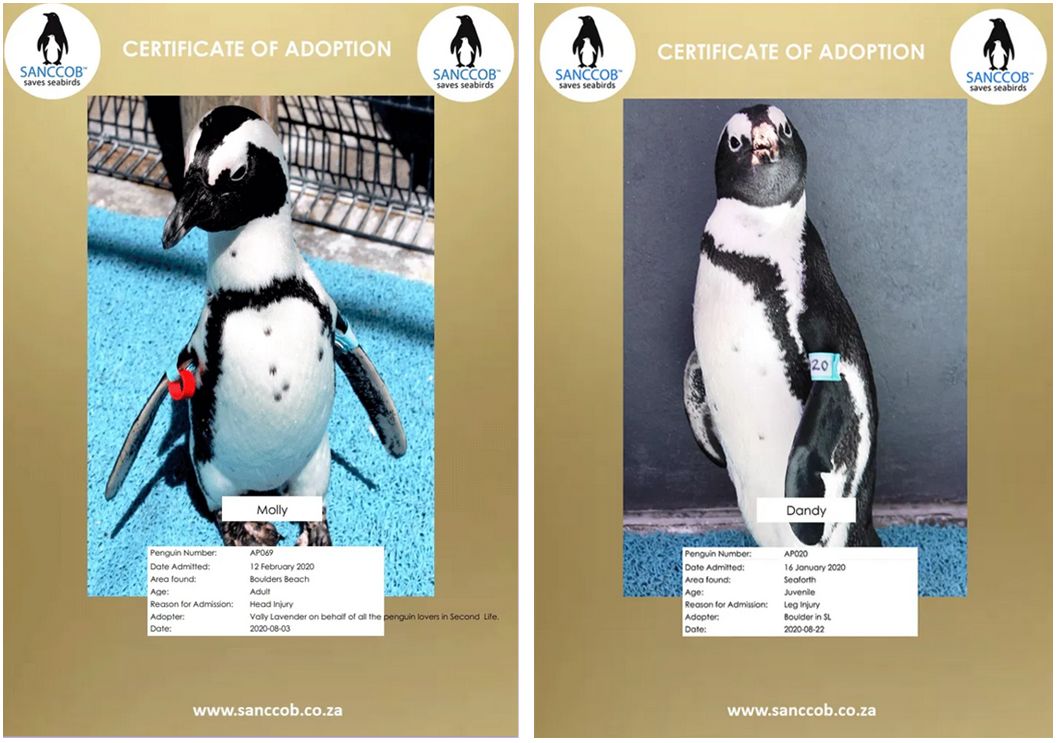
The two penguins from SABCCOB so far adopted with the assistance of donations at Boulder

The Penguin colony is a relatively “recent” addition to the Western Cape of South Africa: there is no record of any penguin colony in the region prior to 1983.  A series of sandy inlets sheltered by granite boulders from which it takes its name, the beach provides a perfectly sheltered environment for the penguin colony, which is also under the protection of the Cape Nature Conservation programme, due to their extremely endangered status.

Hunted on both land and sea by natural predators, it is thought that the Boulders Beach colony was made possible by the reduction in land-based predator threats thanks to the local human presence at Simon’s Town. In these respect, the arrival of colony has been mutually beneficial for both the penguins and townsfolk: the humans have kept land-based predators at bay, whilst the penguins have allowed the town to enjoy controlled interest as a tourist destination; and during the SARS-CoV-2 lockdown, the penguins even took to providing “street patrols” as shown in the SACCOB tweet, below!

Within Boulder, Second Life, both the beach and its penguins and a portion of Simon’s Town are nicely represented adjacent to one another. The landing point offers a map of the region, together with copies of the Certificates of Adoption for Molly and Dandy, the two South African Penguins thus far (at the time of writing) that have been adopted.

The beach offers open aspects looking north and west, the land to the south of it rising steeply in a series of rocky, palm-crowned cliffs and plateaus within which are nestled additional attractions – a shanty-style event space reached via stone steps that climb the cliffs, and beyond it a secluded plateau of trees and waterfalls. For the daring, there are places to quite literally hang out waiting to be found, both in terms of swing seats in the trees and a zip line; however, do be aware that the house on the highest plateau is a private residence. A high, tunnel-like arch of rock bores through these uplands to reach the south side of the region, and a ribbon of beach backed by sheer cliffs that runs westwards to join the main beach as it curls around what might be regarded as a low-lying headland.

Boulder, September 2020

The latter is home to the Boulder Art Gallery which, at the time of both of my visits, was featuring the art of two more renowned region designers: Fred Hamilton (frecoi) and Lotus Mastroianni.  The gallery is watched over by a penguin carved from stone, and overlooks a further stretch of sand occupied by penguins.

The waterfront town at Boulder is a take on the historic centre of the town – Simon’s Town ((Afrikaans: Simonstad) has been in existence for over 200 years, being located in a large bay of strategic importance (the South African Navy still has a major facility there). The historical centre offers a range of colonial-style buildings that could look as at home in Australia or America as they do in South Africa. Within Boulder, this colonial style of building is retained, if presented in a more colourful manner than might be the case with the actual Simon’s Town – not that this detracts from the region’s design.

Boulder, September 2020

I’m not sure if the waterfront itself is taken from a part of the actual Simon’s Town, which appears in photos to have a lot more of a modern look, with a large yacht marina and the aforementioned naval base. However, if it is more a flight f fancy than pulled from Simon’s Town, that doesn’t change the fact that it works perfectly within the region, ideally rounding it out.

During our first visit, I noted the region had at least two Firestorm parcel-level Windlight settings in place (day and night) which I found jarring when moving between them simply by stepping on / off the beach. I’ve no idea if this is still the case, as I’ve transitioned entire to EEP-based viewers. However, the performance hit is still there, and can make itself apparent for those on mid-range systems who like to go around SL with things like shadows enabled; so if you do, you might like to consider turning them off when exploring the region. But that said, neither the potential impact on viewer performance nor any Windlight changes that may occur should deter anyone from visiting. And if you haven’ already visited, I do recommend you consider joining the [valium] group to help support the work of SANCCOB and pay a visit.

SLurl and Links

Bungenäs at Binemust in Second Life

Bungenäs, Binemust, September 2020

For her latest region design at Binemust, Biné Rodenberger offers visitors a most unusual taste of Sweden’s Gotland.

The largest of Sweden’s islands, and also a province, county, and municipality in its own right, Gotland is a fascination place, rich in culture and opportunities for exploration and discovery, offering many unique experiences (ever had a fish cooked using molten glass? If not, Gotland’s Restaurant Rot is the place to go).

Bungenäs, the inspiration for Biné’s design, lies at the opposite end of Gotland to Restaurant Rot, and is perhaps one of the island’s most unusual attractions. During the 20th century, the peninsula was home to a limestone quarry marked by a pair of unique kilns, and a large Swedish Army training zone, complete with bunkers, barracks, and open and wooded training areas. The quarry enjoyed a 50-year run from 1910 to 1960, while the rest of the 160-hectare site was used by the army through until 1963, when it was also abandoned.

The Bungenäs peninsula showing the former army training grounds in the foreground and and the limestone quarry, centre left. Credit: Gunnar Britse

For the 40 years that followed, the peninsula was closed to the public, until moves were made to re-open it as a park / tourist destination in the early 2000s. However, entrepreneur Joachim Kuylenstierna – whose father had served in the army and trained at Bungenäs – was concerned about  such a move would do to the unique aspects of the location: the ageing bunkers, the run-down buildings and deserted quarry facilities, and so on, if the peninsula was turned into some sort of tourist resort with all the modern trappings – an up-to-date hotel, a golf course and so on.

To ensure this did not happen, Kuylenstierna purchased the land himself and turned it into a most unusual development: a new community location without roads or houses. Instead much of the existing infrastructure of bunkers and buildings would be be converted into unique homes, with the bicycle the primary mode of transport. He employed a specialist architecture firm to convert the bunkers and other buildings into homes and community facilities, and to zone the remaining landscape into plots and parcels that clients could purchase and have homes built to their  own specification and fully in keeping with the existing structures and integrated into the natural environments found across the peninsula, and also carefully redeveloped by the architects in keeping with Kuylenstierna’s broad vision.

We don’t design and build buildings – we work with the landscape and the existing constructions to create structures that are formed after their surroundings. We’re not the least interested in creating “boxes” on the ground. Each plot of land is specifically laid-out and, in turn, has its very own zoning plan. The peninsula was also divided into different regions with their own defined type of nature, which required different types of structures.

– Lisa Ekström, Skälsö Arkitekter, developers of the Bungenäs site

Bungenäs, Binemust, September 2020

Within Binemust, Biné offers her own take on this unique setting, centred on the the old limestone quarry, its kilns and outbuildings. These sit within a low-lying part of the region, the quarry itself flooded, the kilns and outbuildings rising above its rocky ring. Cold sands border the east and south sides of these lowlands, merging with grasslands cut by a fast flowing stream. As the sands curve around to the south, so the land rises to form a bluff between sea and inland quarry, a number of aged bunker-like shells among the sand a grass, hinting at the old military preserve that once existed at Bungenäs.

To the west, a ribbon of sand continues along the coast, marked on one side by old piers that may have once served the lime factory, and a line of old beds that offer a most unusual sun loungers, Biné suggesting they might have been pulled from the old barracks, as is the case at the physical Bungenäs in Gotland.

Bungenäs, Binemust, September 2020

The north side of the region is marked by a highland plateau, rich in fir trees and crossed by tracks and paths, representing the more natural aspects of the Bungenäs peninsula and, perhaps, the 3 km tour trail that winds through the region – as noted, road vehicles are generally banned from the region to help preserve its natural state. These highlands are also split by the stream, which drops by way of a single waterfall to continue its way the the sea across the lowlands.

There are differences between Biné’s vision of Bungenäs as the real thing: houses at Binemust are represented more by modern structures than converted bunkers; there is a camp site at Binemust, although as Bine notes, there doesn’t appear to be anything like it within Bungenäs. She’s also added horses to roam alongside the sheep (which are a feature of Bungenäs).

Bungenäs, Binemust, September 2020

However, she’s also replicated some of the original’s cosier features: the mess hall at Bungenäs, for example has been converted into a café with a small suite of hotel rooms above it that visitors can book for short stays.  Bine offers the same through a small bed-and-breakfast house tucked away in the region. She also includes bicycles, which for the common mode of transport within the community. Finally, and in a touch of her own, she’s included a small selection from her personal art collection from SL, located in the limestone warehouse, which doubles as the region’s café.

All of which makes for an engaging and educational visit – be sure to look up Bungenäs on the interwebz for yourself when visiting.

Bungenäs, Binemust, September 2020

SLurl Details