About a week ago, I bumped into Hera (zee9), creator of the ever-popular Drune series of region designs and during the course of our conversation, she mentioned that while the last (at that time) iteration of the city – Drune Diesel (see: Drune’s diesel-deco delight in Second Life) – had now gone, she was nevertheless working on a smaller-scale redux of the more dystopian versions of the city.
The result is Drune Sleazy Street, and at the weekend, Hera extended an invitation to visit and explore.
Drune Sleazy Street, June 2021
As the name might suggest, the new build only replicates the main street of the dystopian Drune. Given the design is sitting within a Homestead, it’s a little hard to reproduce all of the city; but what Hera has produced is nonetheless engaging and rich in detail, both echoing the older Drune builds and offering some touches of its own.
Drune Sleazy Street, June 2021
Awash with the neon that always gives Drune a pulse of life, the street is home to the passage of hover vehicles along the main carriageways, the adult-themed emporiums and the eateries, all overseen by hovering bots, quietly parked police spinners, and elevated walkways.
Among the buildings that line the street are two clubs, one with the familiar Alien-esque theme, the other offering a more grunge feel (and called appropriately enough, Biohazard). Also awaiting discovery is opulent delight of the Shanghai Dragon. While for those who seek it, an elevator will lift them up to the Exotic lounge.
Drune Sleazy Street, June 2021
But rather than being written about, Drune Sleazy Street – like the various iterations of the full-scale Drune – is a place that should be seen and savoured while it lasts and which will appeal to anyone with a love of sci-fi (the Blade Runner references are clear in the design, and really don’t need mentioning alongside those of the Alien franchise). As such, I’ll just leave images here as encouragement (I hope!) for you to hop over and take a look for yourself.
Bella’s Lullaby, June 2021 – click any image for full size
Bella’s Lullaby is the name Bella (BellaSwan Blackheart) has given to her Homestead region design I had occasion to visit in June, courtesy of another pointer from Shawn Shakespeare.
A quiet, natural setting of two main islands surrounded by off-region hills and embellished with a subtle and fitting sound scape, this is a delightfully tranquil setting that sits easy on the eye and most likely will soothe troubled nerves.
Bella’s Lullaby, June 2021
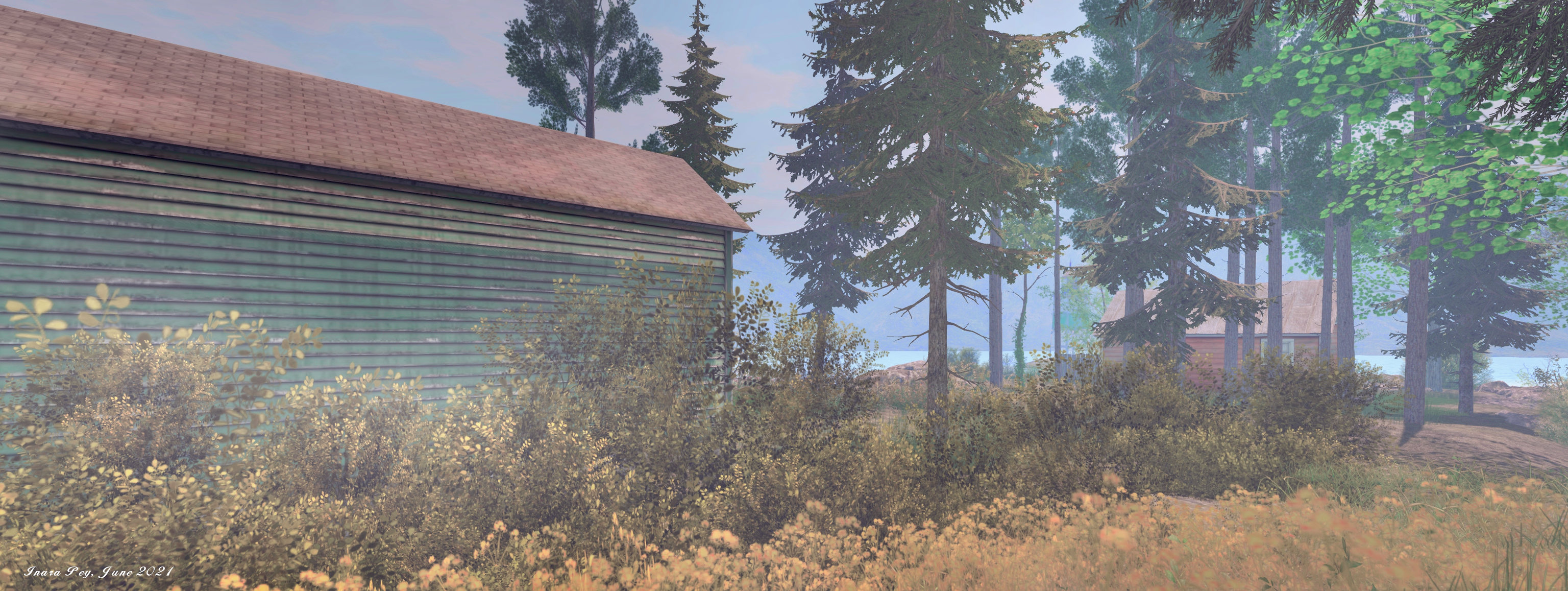
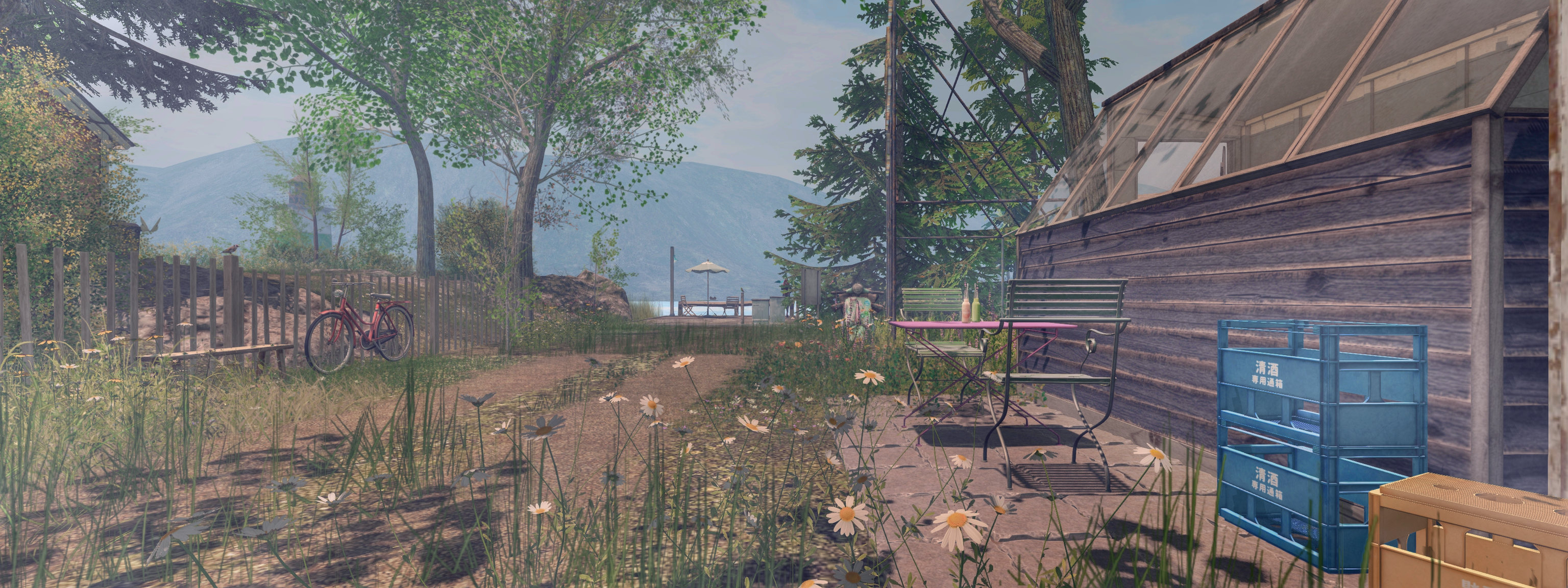
The larger of the two islands is home to a variety of trees scattered across its low form – Scots pine, fir, oak, linden, and so on, giving it a temperate feel. Between the trees, and occasionally shaded by them, is a smattering of small buildings – cabins, sheds, Tuscan style house – that give the suggestion this may once have been a farm smallholding, but which has now become a retreat of some kind.
Nor do the trees or buildings dominate the island; there is plenty of open grass where the young shoots of the rapeseed plant (which tend to be called by their Japanese name nanohana) freely grow, giving a sense of open space and room to wander and breathe.
Bella’s Lullaby, June 2021
The smaller of the two islands sits to the west, separated by a shallow channel marked by rocks that rise above the water, and by snakeweed and water moss. Devoid of trees, it is home to more nanohana and grass, curtains of shrubs partially lining the low hump of its pate like hair on an old man’s head.
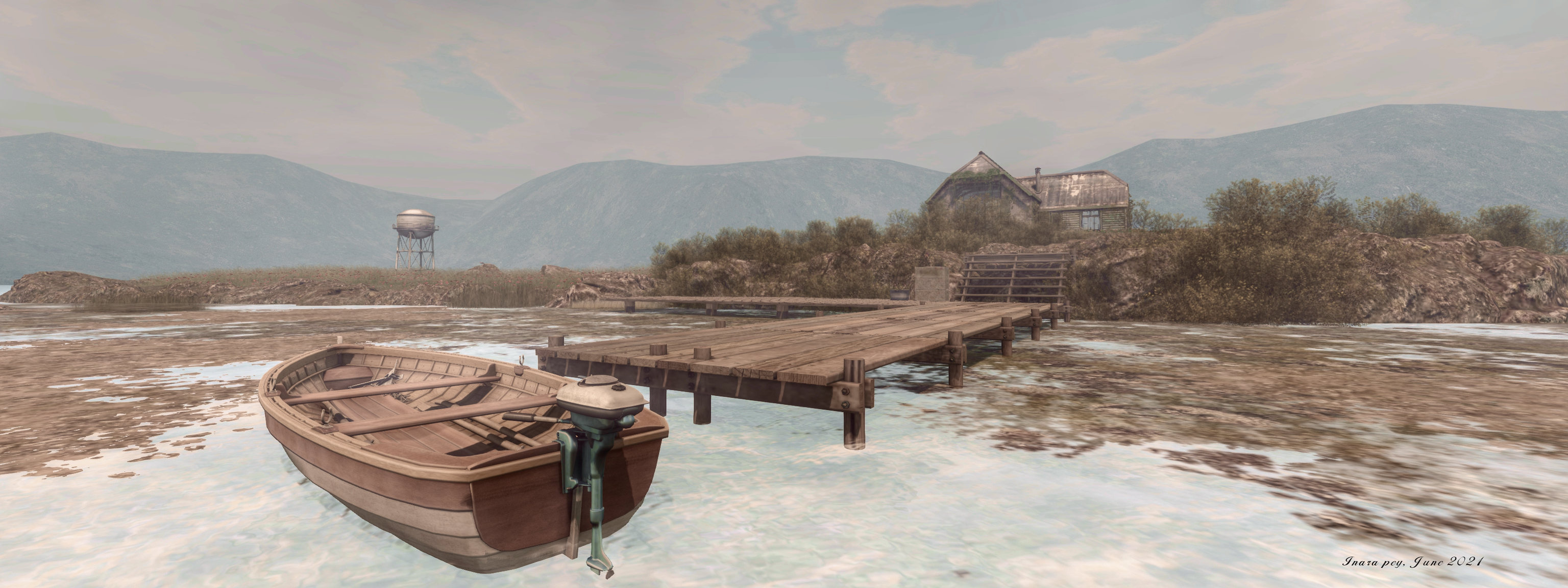
This smaller island is dominated by an old warehouse unit – what role it might once have served now lost, although the passing trawler suggests that perhaps, once upon a time, it may have had something to do with local fishing. Now it sits as another isolated retreat, partially furnished, a little (static) boat with outboard motor sitting at the dock apparently the means to travel back and forth to the large island.
Bella’s Lullaby, June 2021
The southern end of this smaller island forms a slender finger, edged by rock, a place where the nanohana gives way to poppies and daisies and other meadow flowers that offer a splash of colour to the island and which wash around the feet of the oblate water tank atop its sturdy tower.
There are a couple of tiny islets that also make up the setting. One is a flat-backed slab of rock, is home to a small lighthouse; the second is a little more robust, a rocky table with its own sandy-shale beach. In difference to the rest of the region, this little corner sports palm trees that grow alongside what appears to be an old rail carriage long ago separated from its bogies and converted into a cosy two-roomed shack.
Bella’s Lullaby, June 2021
These two southern islets are overlooked by the region’s main landing point (although this is not enforced), sitting on a square deck built out over the shallows surrounding the main island.
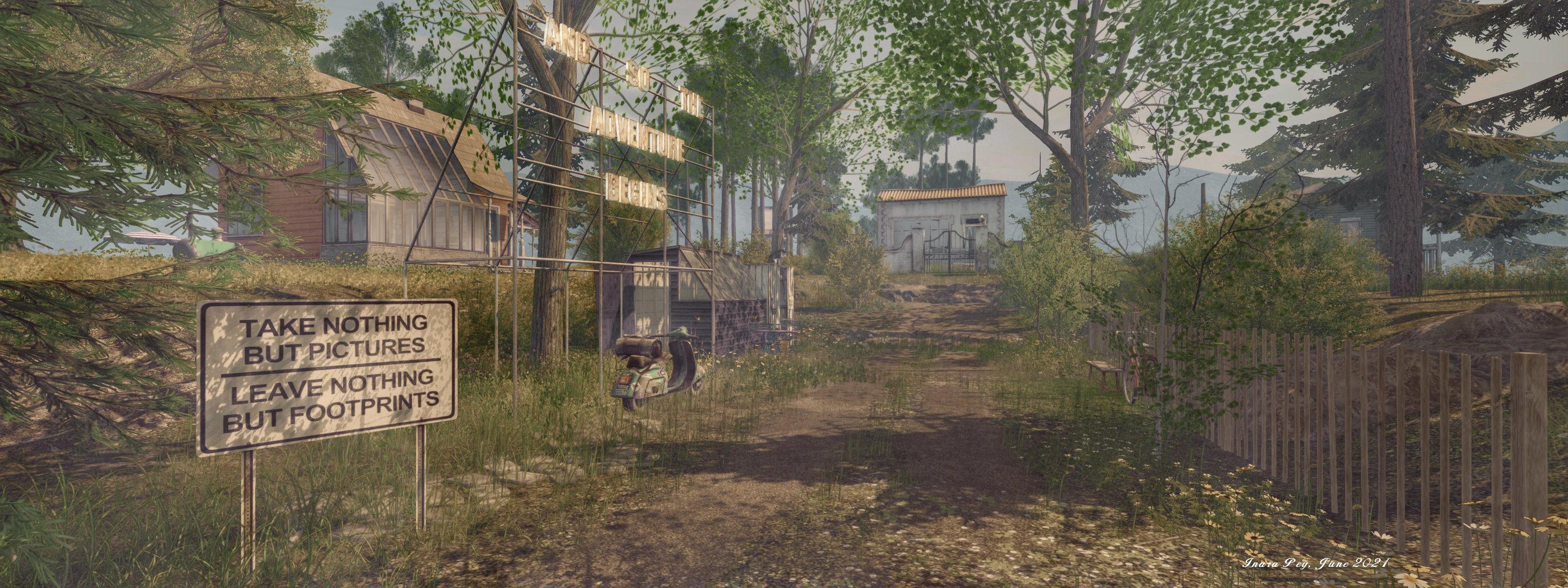
Close by is a sign that draws on motto of the Baltimore Grotto: Take nothing but pictures. Leave nothing but footprints (the motto itself continuing Kill nothing but time), itself a variation of a phrase from the “Leave No Trace” philosophy of naturalist all over the world. It’s a perfect sentiment by which to start an exploration of the region.
Bella’s Lullaby, June 2021
From the landing point, a rough track runs north between several of the island’s little buildings to the Tuscan style house. It’s a natural way to start explorations, although the cabins either side of the path are liable to tempt feet away from it.
Not that this is a bad thing – there really is much to discover here without the region feeling an any way overcrowded. As such, roaming freely (if under the watchful eyes of the local cats!) is the best way to proceed.
Bella’s Lullaby, June 2021
From landing point to old ranger’s tower, and from water tower to east side patio, Bella’s Lullaby has been beautifully crafted to offer a place to explore or to sit and enjoy company and comes rich in opportunities for photography.
Grauland Falls Art Park, June 2021 – click any image for full size
I first visited Grauland, the Homestead region held by by JimGarand and home (in the sky) to his M-1 Art Pose business in March 2019. At the time, I was immediately struck by its genuine uniqueness, offering an environment that expresses art as a landscape.
Since that time, Jim has continually revised the region on a regular cycle of iterations, some of which have continued that idea of art-as-landscape, others of which might be regarded as more “natural” settings – tropical beaches, oriental gardens, deserts – all of which have been highly engaging and kept me returning to the region to write about many of them.
Grauland Falls Art Park, June 2021For the iteration I visited in June, Jim has returned the region to what, for me at least, is its roots – a setting in which art plays an important role in expressing the overall landscape.
Rapidly dropping from eastern highlands marked by a high peak and a curtain of cliffs backed by high mountains, the region is immediately visually engaging; the peak giving birth to falls that in turn feed the streams that break up the lowlands as they flow out to the surrounding waters.
Grauland Falls Art Park, June 2021
Rugged and attractive, with western and northern bays watched over by a ranger’s watchtower to the north-west, two tidy woodland areas and a scattering of buildings, the landscape is highly photogenic. However, it is what is to be found within it that captures the eye.
From obelisks through the familiar concrete blocks to statues, tiered gardens and totems, the art to be found throughout the region fits neatly and elegantly into the setting, bringing it naturally to life.
Grauland Falls Art Park, June 2021
As an art park, the setting is laid out as a place one travel to in order to visit: the landing point is presented as a cark park, the road running from it vanishing into a tunnel that appears to pass under the mountains to connect the part with the rest of the world. It sits bounded on two sides by the remnants of what might have once been a complete costal fortification built during the last world war, but which now stand with gaping windows and walls that have in part started to lean somewhat as their foundations have settled.
Forming the entrance to the park, the great blanks walls of this ruin also naturally lend themselves as a part of the park’s artistic statement, providing access to the tiered gardens that form the starting point for explorations.
Grauland Falls Art Park, June 2021
From the gardens with their cobbled paths, visitors can roam where they please – as indicated by the static characters already in the region that add a further sense of it being a a popular place to visit. A single path does offer a route from the landing point, one that passes over the region’s three bridges – which also very much form part of the art statement. These bridges lead the way to the largest complete building on the region, a boxy unit offered as something of a meeting / relaxing space.
Jim’s designs are always engaging and a pleasure to visit, but I admit to finding this iteration particularly engaging. There’s that sense of returning to the focus of early iterations of the region whilst retaining a completely unique look and feel.
Grauland Falls Art Park, June 2021
With photographic opportunities can be found throughout, and the 3D art elements bringing a richness to the environment that encourages the visitor to remain, explore and appreciate, Grauland Falls Art Park is not to be missed.
Mousehole, June 2021 – click any image for full size
Tolla Crisp contacted me recently to extend an invitation to visit her new region holding, Mousehole, located to the south of her famous Frogmore, a place I’ve covered numerous times in these pages due to it’s sheer beauty. The two are connected to it via footbridge, with Mousehole expanding on the Cornish theme folded into the current iteration of Frogmore (which you can read about here), making both regions ideal for a joint visit, as well as each one standing on its own.
A Full region using the standard 20K land impact, Mousehole takes its name from the Cornish fishing hamlet of Mousehole (pronounced maʊzəl, orPorthenys in Cornish), located in the far south-west of the English county, on the shore of Mount’s Bay. Like Frogmore, the overall design is the work of Dandy Warhlol (terry Fotherington), whose hand and eye helps to give that flow of continuity between the two regions.
Mousehole, June 2021
With a population of around 700, Mousehole has a long history as a fishing village that dates back to the 1200s. However, in modern times it is noted more as a visitor / tourist destination and for its many festivals and community events that are held throughout the year.
Whilst taking its name and a lot of its inspiration from the hamlet and Cornwall’s rugged coastline, the design also offers and inland setting that offers a mix of hints of Mousehole village and the wilder aspects of the county. Combined, these give the region a unique look and feel whilst also giving a hint why almost a third of Cornwall’s coast and some of its inland areas are designated Areas of Outstanding Natural Beauty (ANOB) – giving them the same status as a national park.
Mousehole, June 2021
The main part of the region is open to the public, encircled by a broad beach broken by rocky outcrops to form smaller coves typical of the kind that might be found along the Cornish coast. Along these sands are places to sit, bars to by found, opportunities for swimming or simply floating on the water.
Sitting within this are two upland areas which might be seen along the upper reaches of Cornwall’s rugged coast around Mount’s Bay, but which equally bring to mind the wilds of Bodmin Moor. Separated by a sandy divide that offers a shortcut between the north and south sides of the island, these two uplands are rich in greenery and home to individual scenes.
Mousehole, June 2021
The larger of the two offers a setting that might have been lifted from the village itself – most notably the famous Mousehole Pub, which shares the hilltop with a stone-built house and a country church. No roads are visible here, however; instead, the buildings stand surrounded by moorland grass grazed upon by donkeys (Cornwall and neighbouring Devon are also noted for their donkeys), with visitors free to wander across the hilltop and perhaps cross the bridge spanning the shallow gorge to touch the second upland.
This smaller hill is home to an abandoned house (I admittedly found the motel sign outside to look and feel out-of-place), its garden overgrown and nature starting to reclaim its interior. Forlorn and decaying, it has the feel of a place that one might come across deep in the Cornish moorlands, once home to a farm or the retreat of a wealthy tin mine owner and his family, now long abandoned and forgotten.
Mousehole, June 2021
Further touches of Mousehole and its surrounds can be found within the region. Just off the southern coast, for example, is an islet that is mindful of the small island of St. Clements sitting just off the entrance to the village’s harbour. Be mindful that the in-world island is actually a private residence, however, so do be wary of trespass.
Also, just off on of the beaches lies the entrance to a cavern. Find your way inside and you’ll discover a little homage to the tale of a hermit who was said to once lived along the coast at Mousehole.
Mousehole, June 2021
Rich in detail and touches – off to the west is a smaller island, home to another little bar and also what might be an abandoned military facility of a kind that can be stumbled across around the English coast – Tolla’s Mousehole is another delight to explore and photograph – and a delight to explore.
Hazelnut’s Kingdom, June 2021 – click any image for full size
Hazelnut’s Kingdom is a 5-region estate held by Noubeil (noubeil Alpha) and landscaped by Dandy Warhlol (terry Fotherington) I was invited to tour some time ago – so my apologies to Noubeil for only now getting to write about it.
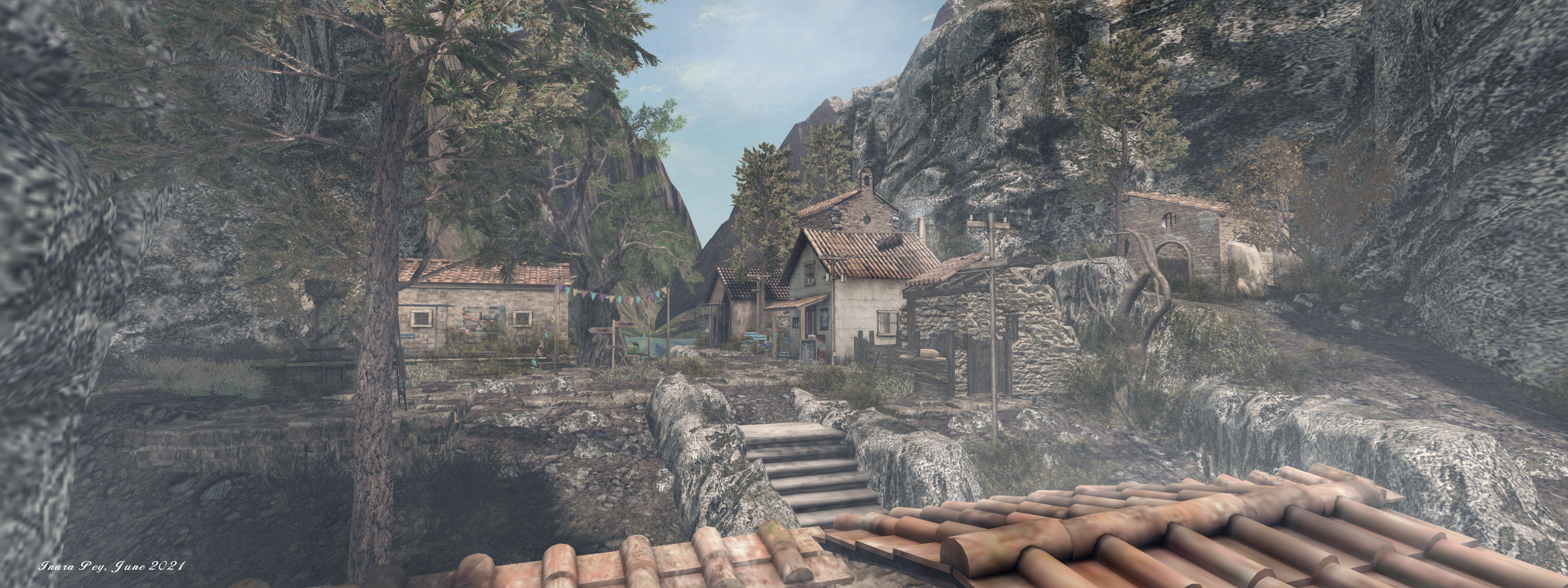
Drawing its name from Noubeillane – “Hazelnut” in Occitan – the estate presents a highly immersive interpretation of the Ariège Pyrenees, together with the coast of southern France, that is utterly breath-taking.
Hazelnut’s Kingdom, June 2021
Offered as a public / private estate, the estate can be enjoyed by anyone with a love of nature and natural settings, but those wish to avail themselves of all of its facilities: rezzing rights; the ability to set home within the the estate’s public spaces; the use of group-owned items in the estate (including horses and boats), should consider a visit to the group membership area and pay L$500 to join the estate group.
Some 12 locations are available for rent across the estate, featuring houses that are in keeping with the overall theme. Most are located either on the small islands to the east of the estate, or in the western uplands. They vary in rental price, and at the time of my last visit, all but four were occupied.
Hazelnut’s Kingdom, June 2021
The preferred landing point lies to the south-east, in a corner of the estate’s coastline alongside a small harbour. A greeter will supply various links to places such as the estate’s website and rentals page, etc., while a teleport board offers a quick way of reaching the two major public venues as well as some of the rentals (please be careful with the latter as the properties are likely occupied).
A pair of gates provide access to north running path that passes behind the local stables to come by way of river, wharves, and trail to the local town, fronted by a golden sanded beach and watched over by a medieval church with a commanding view across the estate’s northern lowlands from its perch up on a headland.
Hazelnut’s Kingdom, June 2021
Here there is much to see, with multiple trails offering routes around the headland and its church or that climb the slopes on which the town has been built and then roll into the lands beyond, with their mix of rocky foothills, sloping fields tumbling stream and waterfront and hillside villages. Backed by high mountains to the west that represent the Pyrenees, this northern aspect of the estate is quintessentially southern France with just a touch of northern Italy – something again totally in keeping with its Occitania roots.
More public spaces are to be found here, including a stage for open-air music performances – music is very much a part of Hazelnut’s Kingdom – and off to the western foothill, the high stone walls and stern towers of a high castle – one of the best integrations of the Fanatik design I’ve seen in a while; so good in fact, that I wouldn’t be surprised if it turned up in one of the many scenic aerial shots that grace television coverage of the Tour de France each year!
Hazelnut’s Kingdom, June 2021
The western highlands also offer a lot to explore, as the trails running to and from the castle and through the woodland below it are only too eager to reveal. Some of the large rental properties are to be found in these uplands, together with high lakes, tumbling streams, a cable ride up to to a high plateau, and even a walk up to snowy uplands – so take a coat and suitable walking gear!
The two most notable public spaces in the estate lie to the south, occupying another flat table of rock, one that rises from the landing point mentioned earlier, and connected to it by a winding path that connects to the great chateau that crowns the rock. This is home to grand rooms and a stables on the lower level and, on the upper, The Queen’s Bar.
Hazelnut’s Kingdom, June 2021
Sitting quite literally below the chateau, and reached via a path that hugs the foot of the plateau and which starts a little set back from the landing point, is The Owl Club, a venue hewn from the living rock, a little Tuscan-style setting located just outside to add some further atmosphere. Also, keep an eye out for the other caverns nearby!
Immersive and photogenic, Hazelnut’s Kingdom is an engaging visit, although time is required to do the estate proper justice. Also, even the depth of detail involved, some adjustment to the viewer will likely be required for those on mid-ot-lower-spec systems.
Elvion, the homestead region design by Bo Zano (BoZanoNL) has always been a place to which I’m drawn. Since its inception and through several iterations, it has presented a haven of natural peace and beauty in Second Life that can smooth both troubled mind and upset heart, and which never fails to offer the eye and camera much to see and appreciate.
As far as I can recall, Bo has tended to keep his designs to the ground level, but with the iteration I visited at the start of June, he’s made use of the space available overhead as well and the ground level environment. The result is a setting of three distinct parts, each complete unto itself whilst also joining naturally with its companions to offer visitors much to see and appreciate – and even more space to reflect.
Elvion, June 2021
The ground level of the region presents a setting that in part echoes past Elvion designs in terms of general landscape and the mix of land and water, but which is nevertheless unique in its presentation, sitting as a small, low-lying island, the partial region surround suggesting it might be part of an small archipelago.
This island, rich in summer greens and the bright colours of wild flowers, is home to the main landing point that sits to the the south-east, watched over by a mature pelican and young goat. Two large buoys are stranded on the shore here, rusting and fading under the Sun. Their position raises the question of whether they might have been deposited by some past storm that tore them from their anchor chains or if they were simply abandoned by human hands, their work out in the channels beyond the island long since finished.
Elvion, June 2021
A path leads the way up from the landing point to where an A-frame house sits as a quiet retreat, places to sit and appreciate the view both on its raised deck and among the flowers growing around it. This house is, together with a small gazebo / pergola sitting closer to the landing point and overlooking the rocky shoreline, pretty much the only sign of human habitation to be found on the island, allowing its rugged beauty to be fully appreciated.
The path from landing point to house will lead visitors past one of the region’s little pug dogs that have in the past been named after either the Three Stooges or members of the Rat Pack (along with other animals found in past Elvion iterations), but who sits unnamed here, keeping an eye on the region’s information givers and pointing the way to the teleport signs.
Elvion, June 2021
Set as a group of wooden signs, these provide access to the two sky settings within the region at the time of my visit.
Touching Forest will carry you to – unsurprisingly – a woodland setting. It’s a place in the blooms of spring and colours of summer that could so easily be pictured as a further part of the island, the A-frame house waiting to rise back into view if you just wandered far enough in the right direction through the surround mist.
Elvion, June 2021
At the same time, however, those surrounding mists, the ruins and the trails winding over the the grass and rocks to a domed stone gazebo and the falls and water that lie beyond it, present the feeling that its is genuinely an altogether different place to the island; somewhere altogether more mystical.
Walking the path from the landing point and its ruins to – and beyond – the waterfalls and their streams, I felt I was wandering into some corner of Westeros or perhaps a forgotten outlier of Imladris, such is the deep sense of place bound within the setting that encourages the imagination to take flight.
Elvion, June 2021
Dreamland, the highest of the settings in terms of general elevation offers a similar connection to both forest and the island through its landing point, which sits within a ruined abbey, and the surround rich foliage of trees.
But step beyond the confines of the old walls, and you find you have been transported somewhere entirely different: a place where desert and grasslands intertwine – but whether it is a place where prairie meets dustlands or veldt meets desert’s edge, is entirely up to you.
Elvion, June 2021
A thatched cottage and nearby windmill give a slight European lean to the setting, but at the same time, were a herd of cattle to come through the scrubby grass, driven by weather-beaten cowpokes, they would be at all out of place.
And certainly, for those with wearable horses, this is a location with more than enough room for riding, whilst those seeking places to sit and reflect, cogitate or enjoy the company of another, there is also plenty here to be found.
Elvion, June 2021
Beautifully conceived and executed, Elvion remains a joy to visit and behold.