Still and In Stillness sit as a pair of Second Life regions (one a Full private region leveraging the available Land Capacity bonus, and the other an adjoining Homestead region) held and designed by Matchbook Monday. Together, they more than live up to their About Land description – a place to still the mind and relax.
The two regions are presented as a temperate archipelago sitting – going by the region surrounds – just off the coast. In terms of which coast, I’d guess that by the lie of the land and Matchbook’s own origins together with the abundance of Canadian flags, either the east or west coast of that nation; say, somewhere along the British Columbia coastline or maybe somewhere within the gulf of St. Lawrence.
Still, April 2024
Although that said, it could just as easily be imaginatively set within somewhere like Lake Winnipeg (and even then, a boathouse in the setting displays a map of America’s Cape Cod, further making the setting a fascinating mix of potential influences!).
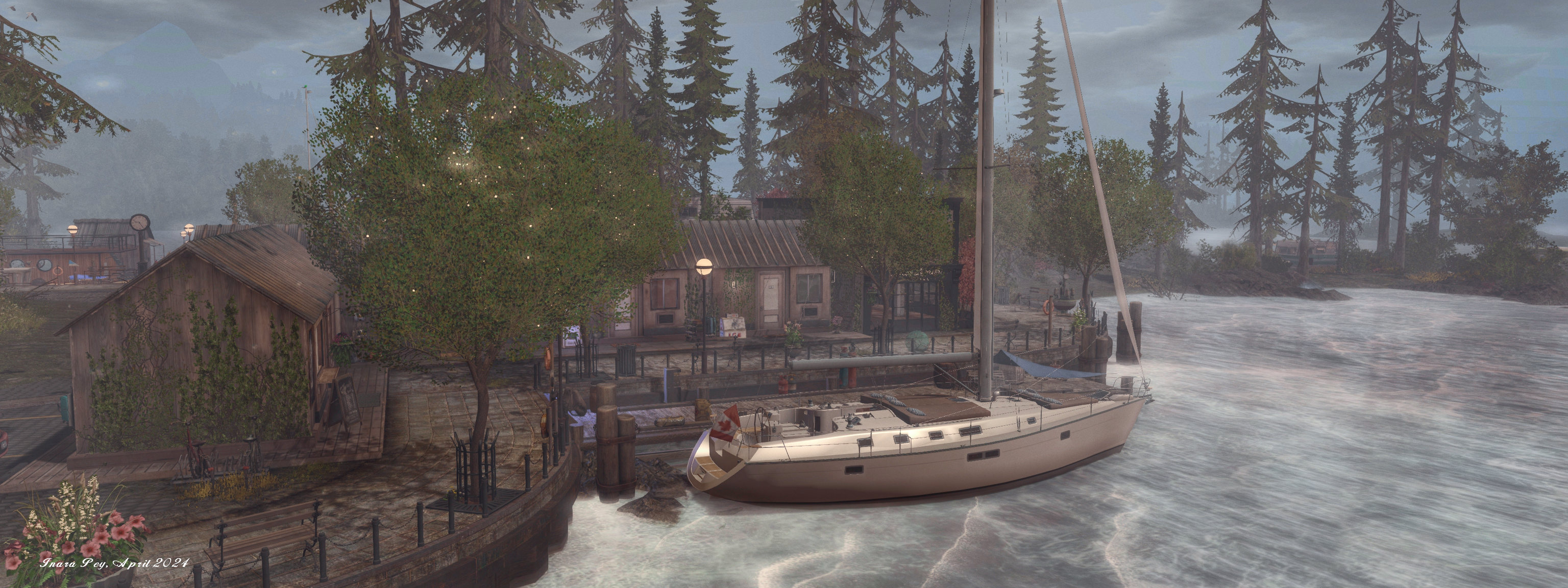
But wherever it might be placed, if one were inclined to try to pin it down as a place of the imagination with a physical world foundation, there is no doubting the natural beauty of the setting. The Full region comprises three islands, two of which are quite large, the northernmost of which is home to the main landing point. heavily wooded, the island sports a small cluster of waterfront businesses at its western end.
Still, April 2024
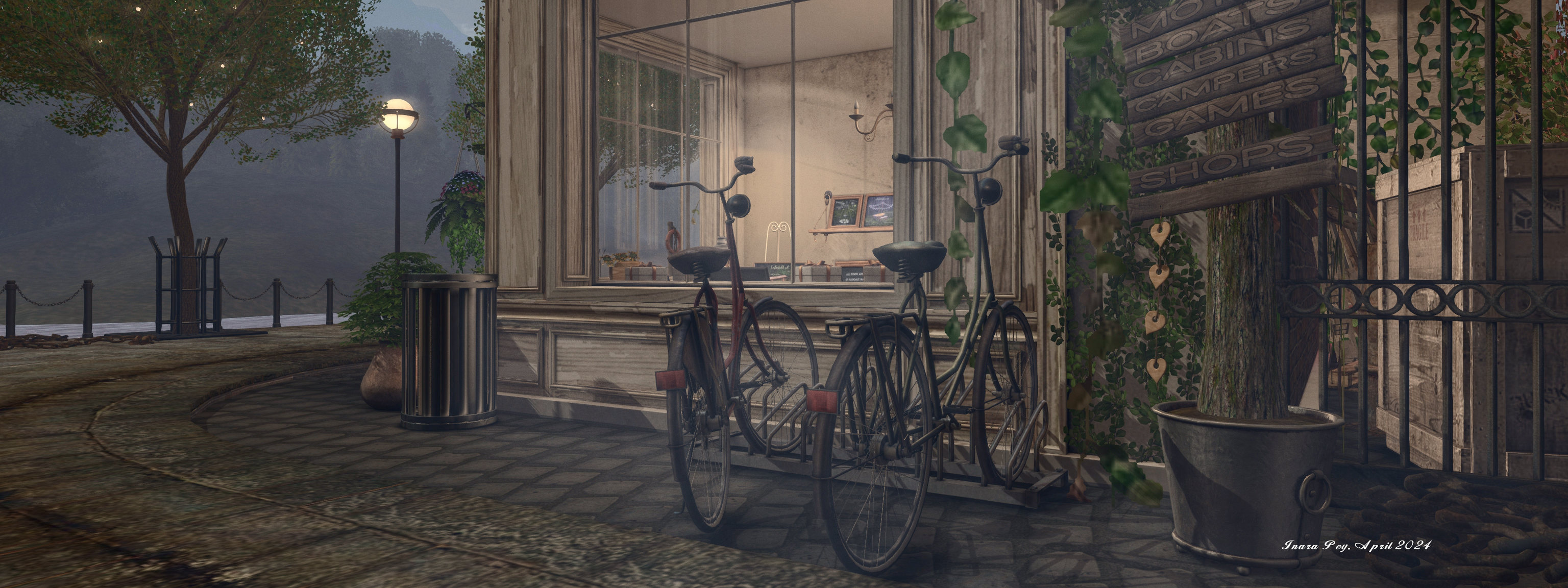
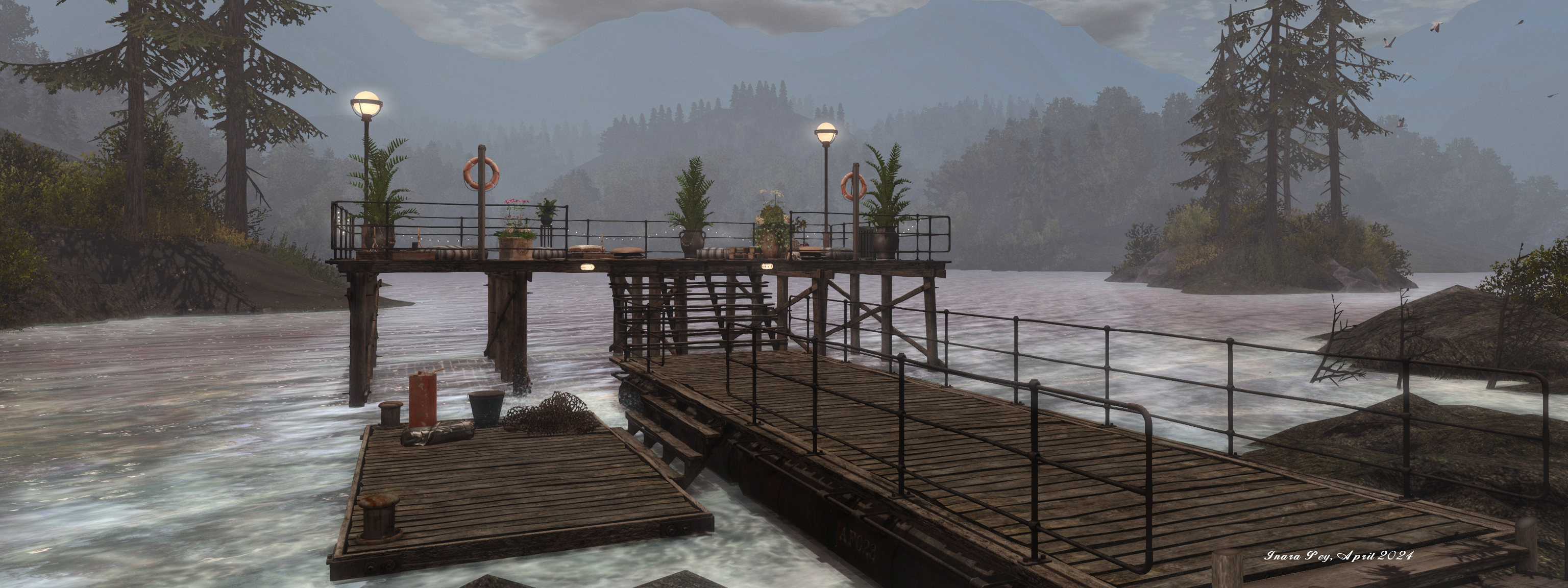
A broad walk passes around the northern side of the island to reach a small marina, sitting almost opposite a motel sitting alongside a quay on the island’s southern side. To one side of the motel, and rather incongruously given the wild nature of the landscape and setting as a whole, there is a parking lot hosting a couple of saloon cars – not that they really have anywhere to drive easily. It is perhaps the one eccentricity within the entire estate, and offers something of a little visual twist.
The eastern end of the island is home to a campsite dotted with caravans which appear to be available for rent. This end of the island also offers views across a narrow strait of water to its southern neighbour, which almost matches it for size. However, the easiest way to reach this island is via the bridges which connect all three islands. Both the second large island as the smaller isle making up the trio are similar inasmuch as they both share the same landscaping as the first – unsurprisingly, given this is an archipelago – and they are both home to small collections of rental cabins.
Still, April 2024
This latter point does not mean either island is off-limits to exploration; there are paths and trails running through both which are open to wandering. Rather, it simply means that visitors should be aware that the cabins, like the caravans mentioned above may be occupied and deserving of privacy.
That both islands might be explored can be seen in the provision of the two jet ski rezzers available – one per island. Open to public use, these allow visitors to scoot around all of the islands in the group – particularly those scattered across the Homestead region, viewing them from the water.
Still, April 2024
Throughout all of the main islands are multiple places to sit and pass the time – camp sites, decks, outdoor eating and drinking places. Those with keen eye might also spot places to fish and also bicycle rezzers for a little fun in exploring the main islands. These all give the setting an increased since of space, joining with the selected EEP settings and landscaping to add to the ambience of the regions – something further enhanced by the moody set of the misty waters around the islands.
Rounded-out by an ambient soundscape and with birds wheeling overhead, the two regions of Still and In Stillness (which have been given the names In Stillness and Still the Mind by Matchbook), are beautiful designed and implemented, offering a lot to appreciate and explore, and plenty to do. And needless to say, the setting is highly photogenic.
Hotel Del Salto, April 2024 – click any image for full size
In May 2020 I visited a region design by Jade Koltai which – as with her work with the much-missed Serene Footman – was based on a real world location: the Hotel De Salto, Columbia. It was a fascinating visualisation of a place with an equally fascinating history, some of which I touched upon when writing about my 2020 visit.
Well, Jade’s Hotel De Salto is once again open to tourists to visit in Second Life, and as with the original, again sits above the gorge of the Salto del Tequendama, or Tequendama Falls. With the return of the build come some new elements I don’t recall from the first iteration – although they could be things I simply missed back in May 2020; either way, they provided an added bonus in re-visiting this eye-catching build.
Hotel Del Salto, April 2024
As I noted back in my original piece, the Hotel Del Salto is located some 30 km south-west of Bogotá, Columbia’s capital city, and within an area steeped in legend. The waterfall, for example, is believed by the indigenous Muisca people (also known as the Chibcha, also the name of their language) of the Andean plateau to have been created by Bochica, the founding hero of their civilisation, who (amongst other feats of leadership) used his staff to break the rocks of the high savannah plateaus to release the waters covering them, providing the Musica with rich and fertile lands for settlement. In fact, Tequendama, an ancient settlement close to the falls, is regarded as one of Colombia’s earliest permanent settlements.
Measuring 132 metres in their main height, the actual falls are an impressive sight, and the location of another Musica / Chibcha people’s legend, being the place where it is said that in order to escape the Spanish conquest and its violently enforced evangelization of the Americas, the indigenous people of the area would leap from the falls, becoming eagles able to fly to their freedom.
Hotel Del Salto, April 2024
The story of the hotel commenced in 1923, and became wrapped in its own semi-tragic legend. Designed and built by Carlos Arturo Tapias at the behest of the 11th President of the present-day Republic of Columbia, Pedro Nel Ospina Vázquez, the building reflected French architectural lines. Its original purpose was to be a private mansion where the elite of Bogotá could gather and celebrate their wealth and elegance in a setting of supreme beauty and breath-taking views – the building built against the very lip of the gorge carved by the nearby waterfall.
By 1928, the building had become a more formalised hotel, opening its doors to visitors from around the world, a role it was to perform for around 50 years. With its spectacular views of the falls, available from both the rooms and suites on the gorge side of the hotel and – especially – from the broad dining and tea terrace extending from the rear of the hotel to the edge of the gorge, the hotel did attract many. However, not all of them were happy visitors, with the hotel gaining a reputation for attracting the broken-hearted who would – perhaps as a result of the ancient Chibcha legend of people throwing themselves from the nearby falls to escape the terror of the conquistadors – throw themselves to their deaths from the nearby cliffs. These tragedies further enhanced the Hotel’s reputation, as it was said the cries of those taking their own lives could be heard from within the hotel, leading to claims that it was also haunted.
An interior view of Hotel Del Salto taken as work to restore the building was underway in 2011. Credit: National University of Colombia
However, in the 1970s, the Hotel’s fortunes entered a decline. Bogotá has undergone expansion at a pace that far outstripped its supporting infrastructure. As a result, the river serving the Tequendama Falls and following through the gorge below the hotel has become the city’s primary sewer. This became so bad that the falls gained the dubious distinction of becoming “the largest wastewater falls in the world”, and the river regarded as one of the most contaminated in the world, with its stench rising to the level of the hotel. A dam built across the river above Bogotá further restricted the flow of water reaching the falls whilst conversely increasing the among of raw sewerage it contained, and by the 1990s, Hotel Del Salto had closed its doors and was simply left to nature and to rot.
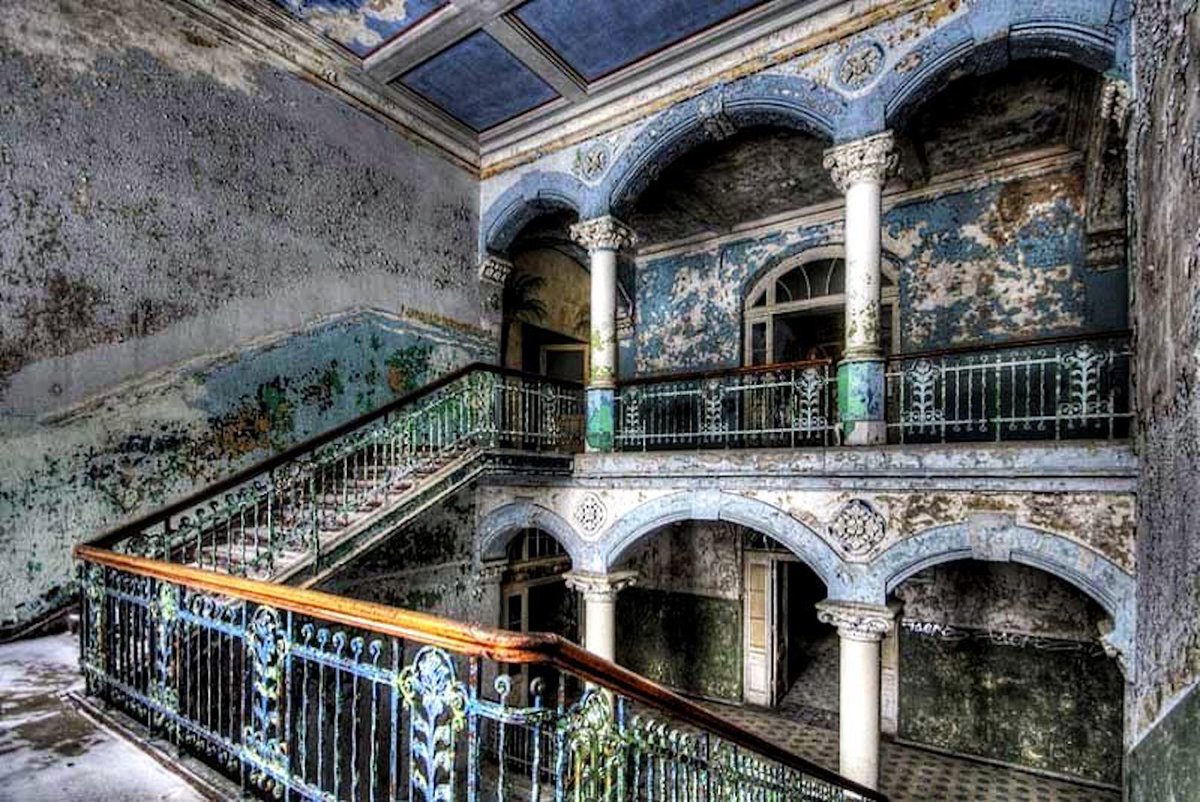
It is in this state that Jade has again chosen to represent the Hotel: an empty, mouldering shell. Rooms lay deserted, vines and creepers scale walls and hang from rafters, the branches of bushes and trees intrude through windows that have long since lost their glazing; paint fades on walls and doorways gape slack-jawed onto balconies, their doors also long-since vanished.
However, within its empty bulk, there are still reminders of the hotel’s glorious past, together with echoes of the ancient history of the Tequendama area and of the Musica / Chibcha.
Hotel Del Salto, April 2024
For example, one of the broad terraces offers a parasol-shaded lounger from which to appreciate the full glory of Salto del Tequendama, here depicted long before any upriver dam stemmed the full spate of the the river. Directly behind the Hotel, another terrace presents an ornate cast-iron table and chairs set for tea offering, again offering a view of the falls and one down the lush gash of the gorge, humming birds and a parakeet adding to the exotic sense of indulgence.
Meanwhile, a balcony serving one of the long-since deserted suites of the hotel offers both a comfortable bed for use as a latter-day chaise lounge, a gramophone on the floor for those requiring music perhaps reflective of the hotel’s early years. Watched over by a cockatoo, this balcony carries some of the echoes of the ancient past in the form of painted skulls displayed on the parapet guarding its edge.
Hotel Del Salto, April 2024
A further suggestion of the region’s ancient heritage might be found by descending the stairs which cling to the stone walls of Jade’s built as they support the Hotel from the rocks below, offering a route down to the water’s edge facing the foot of the falls. Here Jade has taken a little artistic liberty, turning the river into an enclosed body of water, allowing her to present evidence of ancient structures which help acknowledge the rich history of Tequendama, as well as providing a further retreat for those who wish to tarry for a while within the region.
Another place in which to pass the time can be found on the steps of the north face of the gorge. This takes the form of a sturdy, if rusting tower topped by plants and places for couples and individuals to sit. Reaching it, however, does require a sense of adventure and a trip along one of Cube Republic’s excellent rope climbs!
Hotel Del Salto, April 2024
For the last 14 years, the original Hotel Del Salto has been undergoing restoration, initially as project undertaken by the National University of Colombia’s Institute of Natural Sciences. This was part of a broader (and on-going) effort “to recover the region and make it free, clean, and surrounded by a healthy ecosystem.” Initial exhibitions at the Hotel under the Institute’s umbrella commenced in 2013, with the museum officially opening to the public in 2016.
However, according to several reviews of the restored building, much of this work involved a complete abandonment of its original interior décor, settling instead for a modern, clinical white plaster finish, leaving the building’s interior a faint shadow of its former self. Similarly, much of the exterior of the building has been whitewashed, possibly in an effort to protect the stone and brickwork against the ravages of the local climate, although visitors have again critiqued this as eliminating much of the building’s splendour.
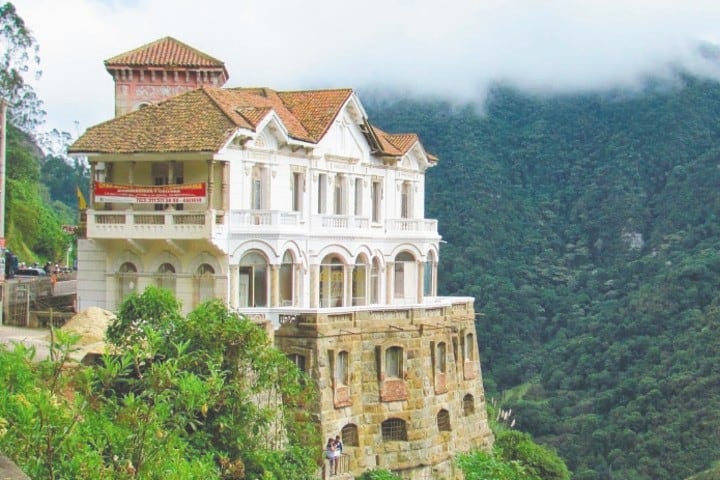
The Hotel Del Salto in 2023 with its whitewashed frontage overlooking the Tequendama Falls. Credit: El Espectador
But however one might find the original Hotel Del Salto – should one opt to visit Columbia! – there can be little doubt that Jade’s interpretation is a welcome returnee to Second Life, and represents a vision of what might actually be the most evocative era of the real Hotel’s history, and does so in a manner that both pays homage to the broader historical context of the Tequendama area whilst perfectly fitting the constraints of a Second Life region.
Grauland – Last Trees, April 2024 – click any image for full size
Jim Garand never fails to intrigue / please with his periodic re-designs of Grauland, his Homestead region. Since 2019 he has consistently offered environments for people to visit which have mixed themes and ideas in multiple ways – landscapes, art, architecture, history, mystery, science fiction, and so on.
As such, it is always a pleasure to drop in and witness what he has most recently created for people to enjoy. And for me, this is particularly true of the April 2024 edition of the region, which he has called Grauland – Last Trees, as it reminds me of one of my favourite – and potentially one of the most underrated classics of of the genre – science-fiction film, Silent Running.
Grauland – Last Trees, April 2024
The region does this in two ways. The first is that – like the film – it appears to offer a commentary on the environment and the damage being done to it by the human species. In this, the setting also perhaps echoes Waterworld, given it appears to be a lone outpost rising from an unending sea; but I’m sticking with Silent Running simply because of the two great biodomes sitting to the north and south of the outpost. If you’re familiar with the film, then it’s hard not to see these two massive geodesic structures of glass and steel and not think of Valley Forge and the precious cargo she and her sister ships carried in the home of one day replanting Earth.
Here, however, the domes do not protect woodlands or the fields of plants and all the insects and smaller animals vital to a healthy biosphere as seen in the film. Instead, each dome is home to a single giant oak rising from a sea of grass and spreading their boughs in defiance of the glowering sky outside of the gentle lights (and warmth, perhaps?) of the domes. But as with Silent Running, it would appear that this outpost, anchored to the bed of the shallow surrounding sea, is dedicated to the preservation of these two great trees and also to the renewal of plant-life to some degree, given the hydroponics farm located in the lower level of one of the great domes.
Grauland – Last Trees, April 2024
Whilst not out in the void of space near Saturn, Grauland’s outpost is crewed by people clearly trying to make the best of things – as were the crew of the Valley Forge. Part of the station is devoted to living quarters offering creature comforts and sitting over floating docks where jet skis and RHIBs are available for recreational enjoyment on the water (and yes, you can ride the jet skis), while lidos and floats bob on the water, suggesting swimming is also to be had. In this, the jet skis – for me – offered a further indirect link to the film, standing-in for the four-wheeled buggies Freeman Lowell and his colleagues used to let off steam as they raced around their cargo ship.
Sadly, Huey, Dewey and Louie are absent from Jim’s design – probably because the similarity to Silent Running is entirely of my own making -, but there are three android-like heads and upper bodies awaiting discovery instead. Quite what their purpose might be is for anyone visiting to guess. Perhaps, within their I, Robot-ish looks, they are the brains monitoring the station. You decide.
Grauland – Last Trees, April 2024
A series of landing pads, four of them occupied by hopper shuttles, suggest that flight is required to get to the station from elsewhere (wherever that might be), with two of the craft apparently for rescue / evacuation use. However, given a wheeled amphibious truck is hauling itself out of the water onto an elevator platform, there is also the suggestion that land of some kind might not actually be too far away.
If land is relatively close by, then the question must be asked what has happened to require a station such as this, dedicated as it seems to be, to the preservation of the two great oak trees and the growing of new plants (or trees)? Indeed, is this base actually on Earth at all – or are we perhaps somewhere else in the cosmos, a place sufficiently like Earth so as to support Earth-based animal (i.e. human) and plant life? In all of this Jim offers no clues, instead leaving the door of the imagination wide open to allow us to formulate our own ideas and stories about this place.
Grauland – Last Trees, April 2024
What is clear is that while the waters here might be shallow, they would appear to be wracked at times by storms of a sufficient enough violence to warrant sitting the majority of the base atop massive girder-like legs, presumably to lift the buildings, landing pads and so out wall out of the reach of ravaging waves and spray. It’s also clear that there is much to explore here as well – stairwells climb between levels, catwalks, ramps and gantries connect different areas, elevators offer ease of access to the water up to higher sections of the outpost for those who don’t fancy counting steps, and the crew quarters offer their own curiosities.
All told, another expressive and imaginative build by Jim, and one well worth visiting and exploring.
Morrigan’s Roadhouse, April 2024 – click any image for full size
It had not been my intention to write about two locations designed by Yxes (Yxes Evergreen) practically back-to-back; however serendipity played a hand when, after writing about Memories of Dreams (see here for more), I was bimbling around south-western Heterocera (specifically along Mock Heather Road and trying to work out if it was part of the atoll continent’s Route 2 or not) when I stumbled across a place called Morrigan’s Roadhouse.
Or rather, I initially came across the unmistakable form of the TLG Ruined Gate by Marcus Inkpen, standing alongside one of Elicio Ember’s marvellous plants and with the . a i s l i n g . Old Fountain sitting under it. Given all three are creators / brands I tend to use myself, I was immediately intrigued, and with the large house sitting above the ruined gate teasing me further, I decided to poke my nose at what I had found, and only after flycaming and discovering more of interest – notably in more of Marcus’s architecture and Elicio’s plants – did I take a look to see who was responsible for this most enchanted of settings, and thus discovered it to be the work of Yxes.
Morrigan’s Roadhouse, April 2024
Sitting to the north side of Mock Heather Road and within just under 20,000 square metres of land, Morrigan’s Roadhouse is a place of gentle contradictions natural delights, touches of fantasy and (to me at least) spirituality (in a pagan sense), and infinite charm. The About Land description suggests the setting may have been influenced by what might be the most instantly recognisable (and misinterpreted) of all of the recordings by the Eagles: Hotel California, quoting as it does the sixth verse of the song.
It’s a verse that is somewhat reflected in the mysterious lean of the setting – the big house sitting as they crown of the landscape (inasmuch as it rises above everything else) might be seen as a place every bit as strange and mysterious as the hotel of the son, whilst the roadhouse of the setting’s title might bring to mind the idea of an edge-of town inn or coaching house where accommodation, alcohol and perhaps dancing might be had; again somewhat in keeping with elements of the song.
Morrigan’s Roadhouse, April 2024
Similarly, there is much within the song – and the quoted verse that might be applied to Second Life and those of us who have been engaged with the platform for a long time – do we ever really leave? Whilst the platform itself might be said to be programmed to receive.
But then there is the name of the setting itself, which carries one away from the poetry of (relatively) modern song and lyrical juxtapositions of meanings real and imagined, and into the realm of Irish / Celtic mythology in the form of The Morrigan, the Phantom Queen, most often associated with war and fate, and said to be able to take the form of a crow. Indeed, within the setting, the ruins of a chapel (again the work of Marcus Inkpen) offer a shrine and prayers to the Morrigan, further strengthening this connection.
Morrigan’s Roadhouse, April 2024
Nor are these two thematic elements in opposition to one another; just as there has been much debate and speculations about the meaning behind the lyrics of Hotel California, so the Morrigan can be interpreted in different ways. she is seen as both an individual in the form of the Red or Phantom Queen, and also a triumvirate, as both a threefold goddess and also as the Morrigu, three sisters of united heritage cause. Thus, both the reference to the song and to the pagan figure, lend an air of mysticism combined with fantasy and dream to the setting, well in keeping with its unique and engaging presentation.
Which is undeniable about Morrigan’s Roadhouse is the sense of enchantment and the fantastical found throughout, be it in the will-o’-the-wisp-like blankets of mist drifting here and there between the trees and over the waters, or the exotic plants and giant mushrooms awaiting discovery, or the unicorn and albino stag watching over the landscape, or the simple presence of boats floating serenely in the air. There is a charm and sense of magic to be found within the buildings (and under them in the case of the main house), whilst the motifs of familiars (cats and ravens) might be found in multiple places throughout.
Morrigan’s Roadhouse, April 2024
That said, this is a place where flycamming is perhaps more advantageous in seeing all that is on offer when compared to walking around. There are elements of the setting not entirely conducive to wandering on foot, and while this may make finding them a little harder, the fact that the landscape does hold somewhat inaccessible corners is entirely in keeping with Nature herself in rarely offering us a simple footpath or trail to follow.
Engaging, photogenic, peaceful and definitely with more than enough in possible motifs, themes and meanings to get the brain cogitating on all of its cylinders (a mere four in my case, admittedly!), Morrigan’s Roadhouse makes for a very worthwhile place to visit.
Elvion, April 2024 – click any image for full size
Update: Elvion closed in June 2024.
It is always a pleasure to visit Elvion, the ever-popular work of Bo Zano (BoZanoNL) and his SL/RL partner, Una Zano (UnaMayLi). From its earliest beginnings and throughout all its iterations, Elvion has always been a place of eye-catching and photogenic beauty, often ensconced within a Homestead region and occasionally within a Full region.
With its latest iteration, which I was able to drop into at the start of April 2024, Elvion retains its reputation as a place of beauty and relaxation, although it has once more switched to being founded on a Full private region, one leveraging the Land Capacity bonus available to such regions. And whilst I’ve always enjoyed Bo and Una’s designs, I have to say this one is particularly gorgeous.
Elvion, April 2024
Referenced as the Blackbird Edition, this version of Elvion offers everything which has over the years made Bo and Una’s work so highly regarded amongst Second Life explorers, photographers and bloggers – natural beauty, a sense of life imbued by the presence of wildlife and hints of human presence, together with far more of a sense of location and of a rich tapestry of life down through the generations.
Indulge yourself in this green land full of history and natural beauty. From stunning water views and forest trails, to the cosy harbour and city.
– Elvion Blackbird Edition, About Land
Elvion, April 2024
With the landing point to the south west and sitting on a rugged upland overlooking the local natural harbour and coastal walk, those arriving within the setting have the choice of either following the old cart tracks of the Mountain Trail for their explorations or of using the local teleport board to hop to one of the listed locales within the region. Of these two choices, I would obviously recommend the former, lest some of the the details present within the region.
Depending on which way you go in following the Mountain Trail, the first of the locations, as listed on the teleport board you’re likely to reach will be either the old gatehouse standing guard on one side of the local town, or the ruins of the abbey that once occupied the north-western extent of the region, flanked on two sides by open water and on the third by a deep gorge of a water channel which cuts through the setting north-to-south, fed by waterfalls and streams and crossed in several places by stone and wooden bridges.
Elvion, April 2024
The ruins of the abbey – an absolutely perfect use of elements from The Looking Glass Ruined Chapel, a long-standing favourite of mine – give a sense that this is a place long inhabited, even if once only as a religious retreat. The ruins look out across the waters to a rugged coastline which gives the impression that this iteration of Elvion sits as a small island which may have once been joined to that rugged coast, before the surrounding waters had forever sundered the two.
Across the gorge, and reached by the single stone bridge spanning it, the gatehouse leading to the town demonstrates a similar sense of age, together with a certain French turn in its architecture as it sits with its portcullises open to welcome visitors into the town.
Elvion, April 2024
The latter is a pleasing mix of buildings and styles, neatly suggesting it has grown organically over time, its two cobbled footpaths are split between elevations, offering a please walk through the town and down to the harbour. This sits within a natural bay into which the region’s water channel flows. Such is the nature of the this little port of call that it sensibly requires both a lighthouse and large marker buoys to help guide small vessels into the harbour’s arms and a safe mooring.
The lighthouse sits on a small isle which forms one side of the harbour and presents a pleasing walk in its own right, offering as it does a loop back to the town or a means to reach another of the region’s locales, the local windmill. The latter sits towards the north-eastern corner of the region, and which also sits at one end of the Mountain Trail.
Elvion, April 2024
But it is the natural look and feel to the setting, together with Una and Bo’s inevitable attention to detail that really bring this iteration of Elvion so memorable as a place. The ruggedness of the island perfectly matches the mountains off-region surround, giving the setting that sense of the two being properly related geologically, rather than the surround simply being a backdrop for the region’s landscape.
The detail extends to the rich mix of wild and domesticated animals found throughout the region, with the former coming in a variety which makes it hard to pin down where in the world this edition of Elvion might represent – if any at all -, further adding to its magic and attractiveness. Further attractiveness is given through the provision, again as is common and always welcome within Elvion, of multiple places to sit and pass the time.
Memories of Dreams, April 2024 – click any image for full size
Susann Decuir is responsible for drawing me to Memories of Dreams, a marvellously Japanese-themed Homestead region design by Yxes (Yxes Evergreen). she did so when I caught her write-up on the setting in her blog whilst I was largely outworld of SL during March 2024. As regulars to these pages know, almost anything with an Oriental theme will pique my interest, so I noted the SLurl and at the first opportunity on getting back in-world, off I toddled (or rather, my alt toddled!) so I could poke my nose in and have a look.
Spring in a Japanese styled sim….a place to sit and reflect once you’ve explored all the small nooks and crannies. Be sure to notice the Orcas migrating along the coast.
– Memories of Dreams, About Land Description
Memories of Dreams, April 2024
The setting is one of those which amply demonstrates the adage “Less is more”. Yxes has used a little of 50% of the region’s Land Capacity to produce a wonderfully evocative setting that does not need to be filled to the brim with objects in order to achieve its stated goal.
At least partially surrounded by off-region mountains (I’m actually not sure if it is supposed to be entirely surrounded, because for some reason the 3070 GPU on my current PC has a devil of a time rendering region surrounds where my old 970 rarely worked up a sweat in doing so), the setting is suggestive of a quiet retreat located on a (little-visited?) islet within the Japanese archipelago. The summer retreat, perhaps of a once-powerful Shogun.
Memories of Dreams, April 2024
The island’s rugged form is dominated by a large pagoda-like building. Perhaps once a home perhaps once a temple, it surrounded by a variety of trees – Japanese maple, Sakura, plum trees and more – which give colour and vitality to the knobbly and uneven mass of the island’s central knoll in a manner flowers and shrubs would not be able to manage. In addition, the trees obviously provide shade and a sense of coolness for those wandering this wildling garden as it sits around the main building.
Below the main structure, to the north-west and north and both sitting withing the island’s shallows, are two further structures. The each sit at the end (or start, depending on your point of view!) of a stone stairway set into the island’s slopes.
Memories of Dreams, April 2024
Located at the end of the potentially grander stairway – it being quite broad at its lower extent and semi-defensively boxed-in by walls on three sides – is a single-roomed building set upon stone slabs set above the coastal waters. Now a place to enjoy a quiet meal, it’s general design suggests that it may have once been where boats bringing people to the island came alongside.
The second building is also single-roomed, but sits slightly off-shore within the walls of what might be a man-made island. Torii gates and stepping stones over the shallow waters provide access to its gates, and the structure itself, located in a formal sand garden crossed by further stepping stones, has the feel of perhaps once having been a walled temple or shrine, but which is now given over the the art of the tattooist.
Memories of Dreams, April 2024
Close by this walled setting, and sitting on a low-lying headland, is a Japanese Zen garden offering a walk around its gravel paths and a way down to the island’s eastern beach, where visitors might to watch passing Orca as they frolic off the coast. A second arc of sand lies on the south side of the island. Located within a shallow cove, it is reached by walking down the grassy slopes from the main building.
Throughout all of this, subtle depth is added through the placement of small artistic touches – umbrellas apparently caught on a mysterious updraft so they hover above the entrance to the main building; a broken Torii gate with payer papers still pinned to it; Toro and other lamps scattered around to help hold the night at bay from the paths and steps; sculptures giving further voice to the presence of human hearts and minds on this little isle; and the gentle, watchful eyes of Buddha observing all who come and go, and the dance of Japanese Crane.
Memories of Dreams, April 2024
All told, a beautifully idyllic and beautifully relaxing (not to mention utterly photogenic) location, and once well worth visiting and appreciating.