[ Dispersion ], June 2021 – click any image for full sizeDesigned by Syna Kiyori / Sônge (SongeFireflies), [ Dispersion ] is an atmospheric Homestead region that offers a lot to take in and appreciate, as I recently discovered courtesy of another pointer from Shawn Shakespeare.
Syna/Sônge describes the region as a meeting place for lovers of sensuality, inviting them to dance and explore and allow their creativity free reign as they enjoy opportunities for photography. And the truth is, the region offers all of this and more.
[ Dispersion ], June 2021Sitting under a twilight sky where the Sun is dipping towards the horizon, and the heaviness of sky and cloud give a sense that we’re already in the last light of day, the region is intriguing in its mix of setting and home for art.
From the landing point in the north-east, the region immediately suggests something of a post-apocalyptic / disaster setting: the main bridge leading away from the landing zone is broken and partially collapsed – as is the road beyond. What appears to be a decontamination crew is warning people away from the far side of the broken bridge.
[ Dispersion ], June 2021Nevertheless, the bridge can be crossed; and despite looking cold, the waters washing over the old road are not deep, allowing the road to be followed to a pair of blocky structures linked by a glass and wood gazebo. This is the home of the La Boite Noir (The Black Box), a gallery space that at the time of my visit was featuring the art photographer Hilaire Beaumont, whilst outside are places to sit and enjoy the view back over the region.
But to return to the landing point a moment. This offers something of an event space, what appears to be disused parking lot (despite the warning it is a tow away zone ) now partially overgrown, a tree having long since taken over the centre of the tarmac. Old televisions hang from the branches of the trees and from another to one side of the the tarmac. Together with the wrecks of old cars and the carcass of an old low-loader for a stage, they present place where the promises dancing can be enjoyed.
[ Dispersion ], June 2021A gap in the fencing on the west side of the landing access a path leads the way between an old wall and tall trees, passing a long-abandoned swimming pool complete with Cyrillic writing on the roof. Here, and along the path itself, are further displays of art: the old pool house contains images by Syna, and the path is home to sculptures.
Further west, the land opens out a little, home to a domed pantheon. Despite the fact that nature is taking control inside, this is home to a strangely cosy and engaging club-like setting. Chandeliers hang from the branches of the old tree, armchairs and couches scattered beneath its branches and lit by spheres of light.
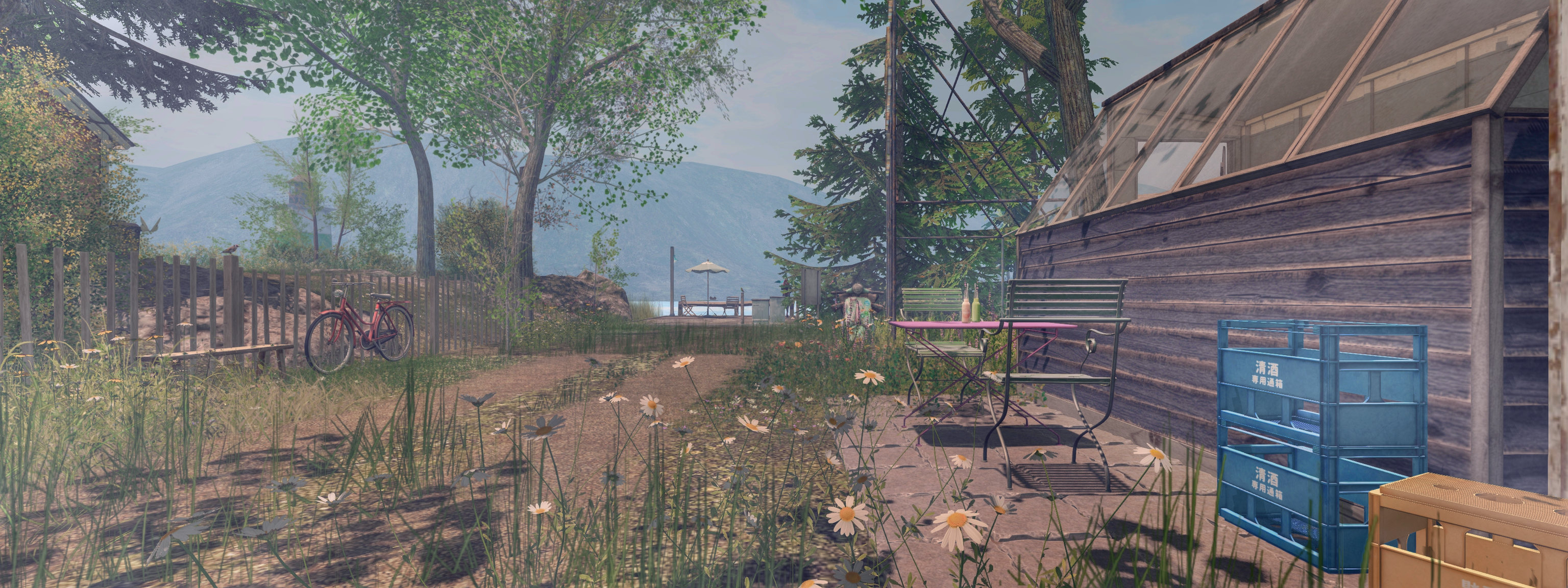
[ Dispersion ], June 2021To the south sits an island connected to the rest of the region by two wooden bridges. Rugged and home to fir trees, an old barn sits just across the bridge, but the island’s delight lies in the orangery standing amidst the trees to the south-west. Again partially reclaimed by nature, it also offers something of a romantic setting, one framed by the westering Sun and with places indoors and out to sit and appreciate the many views to be had.
The eastern end of this island looks back towards the art gallery, close to where another wooden bridge offers a route back to the landing point. A tractor sits on this bridge which, when added to the presence of the barn and the goats, gives the suggestion that a farm once existed here.
[ Dispersion ], June 2021What may have happened to flood the land and leave it partially broken and with sunken containers washed against the shore, or why a team in hazmats is needed is open to the imagination. However, what cannot be denied is the fact that [ Dispersion ] is a picturesque and captivating setting and one thoroughly deserving on a visit.
Adored – For Bambi, June 2021 – click any image for full size
A perusal of the Destination Guide recently brought me to an entry for another region design by Valarie (Zalindah) and dedicated to Bambi (NorahBrent), whose hand can also be seen in a couple of places within the region, and with whom Val has worked with in the past to create virtual spaces.
Adored – For Bambi is another enchanting setting, described as a “Japanese inspired Zen garden”, but which is so much more: a landscape that mixes garden and wilder spaces, water with land, the natural and the fanciful in a marvellous mix of ideas and settings that flow together perfectly and achieve Val’s stated desire to boost spirits, inspire the mind and relax the heart.
Adored – For Bambi, June 2021
The landing point sits within a Japanese pergola located on a short finger of land that extends out into the bay that cuts into the island to form the focal point of the zen garden. A path from the pergola leads to a pair of Torii gates standing guard on either side of the garden’s path as it set out to follow the curve of the bay’s edge and to a small koi house on the shore.
This house offers a charming / romantic retreat, a place to be enjoyed at the end of a visit, especially if accompanied by a loved one. But before turning to it, there is much more to see, as a second path extends beyond the two Torii gates of the garden, pointing the way to northern grasslands. Here the land is in sharp contrast to the woodlands around the garden and bay: the trees are few, the grass long and turned to gold under the Sun.
Adored – For Bambi, June 2021
The remains of a single, once massive and elm-like tree rises from one side of these grasslands, its few remaining branches still sprouting leaves, the top of its truncated form smoothed and levelled into an elevated platform, tree bark acting as a natural wind break on one side and a set of wooden steps spiralling around the broad trunk to reach it. The nominal shade of this tree and the sea of grass around it has been claimed as the home of a small herd of fallow deer, complete with offspring, that wanders and grazes peacefully.
Across a narrow channel of water cutting into the grasslands, stands the remnants of a stone building, now little more than a pair of incomplete walls. Paired lines of trees close by give the impression the land here may once have been an orchard. but if this were once the case, the denuded and withering state of the trees and the tumbledown nature of the building would suggest that time was long in the past, and building and trees have been left to fade; even the little greenhouse that someone had built into the ruined building has been deserted, the area now home to a frolicking Kitsune.
Adored – For Bambi, June 2021
And this is just scratching the surface of the region’s secrets. Off to the north is a little island with a shelter of its own, whilst back in the woodlands there await more discoveries along the lanterned path that sweeps around the land under the trees to return to the koi house on the shore.
Along this path lie woven arches, Torri gates, places to sit and, hovering in greeting, three little flying monkeys. Such creatures are often not found to be friendly in literature and tale, but visitors have nothing to fear from these three, as they watch the comings and goings quietly and present a small taste of the more fanciful elements of Adored – For Bambi.
Adored – For Bambi, June 2021
The latter is more keenly to be seen just beyond the landing point, where a rocky hill forms a small promontory to one side of the bay, balancing the koi house on the other side. A carpet of fluffy grass offers a way up to the crown of the hill, passing between tall growths of bamboo to reach a bridge that stretches out into the air to where clouds await those seeking a place to sit and watch the orca playing below.
With domesticated dogs, stags and wolves helping to round-out the animal population, and with lanterns floating on the water and through the air, Adored – For Bambi makes for an engaging and restorative visit for the weary of eye or soul.
About a week ago, I bumped into Hera (zee9), creator of the ever-popular Drune series of region designs and during the course of our conversation, she mentioned that while the last (at that time) iteration of the city – Drune Diesel (see: Drune’s diesel-deco delight in Second Life) – had now gone, she was nevertheless working on a smaller-scale redux of the more dystopian versions of the city.
The result is Drune Sleazy Street, and at the weekend, Hera extended an invitation to visit and explore.
Drune Sleazy Street, June 2021
As the name might suggest, the new build only replicates the main street of the dystopian Drune. Given the design is sitting within a Homestead, it’s a little hard to reproduce all of the city; but what Hera has produced is nonetheless engaging and rich in detail, both echoing the older Drune builds and offering some touches of its own.
Drune Sleazy Street, June 2021
Awash with the neon that always gives Drune a pulse of life, the street is home to the passage of hover vehicles along the main carriageways, the adult-themed emporiums and the eateries, all overseen by hovering bots, quietly parked police spinners, and elevated walkways.
Among the buildings that line the street are two clubs, one with the familiar Alien-esque theme, the other offering a more grunge feel (and called appropriately enough, Biohazard). Also awaiting discovery is opulent delight of the Shanghai Dragon. While for those who seek it, an elevator will lift them up to the Exotic lounge.
Drune Sleazy Street, June 2021
But rather than being written about, Drune Sleazy Street – like the various iterations of the full-scale Drune – is a place that should be seen and savoured while it lasts and which will appeal to anyone with a love of sci-fi (the Blade Runner references are clear in the design, and really don’t need mentioning alongside those of the Alien franchise). As such, I’ll just leave images here as encouragement (I hope!) for you to hop over and take a look for yourself.
Bella’s Lullaby, June 2021 – click any image for full size
Bella’s Lullaby is the name Bella (BellaSwan Blackheart) has given to her Homestead region design I had occasion to visit in June, courtesy of another pointer from Shawn Shakespeare.
A quiet, natural setting of two main islands surrounded by off-region hills and embellished with a subtle and fitting sound scape, this is a delightfully tranquil setting that sits easy on the eye and most likely will soothe troubled nerves.
Bella’s Lullaby, June 2021
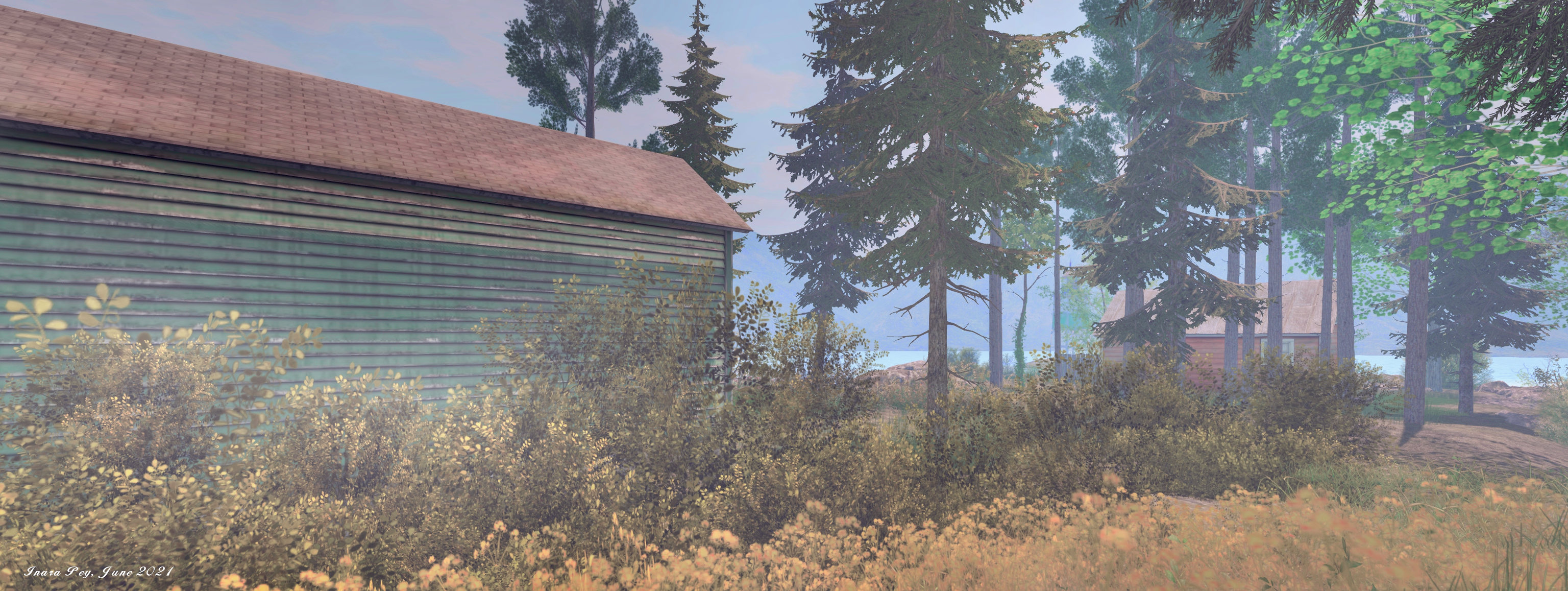
The larger of the two islands is home to a variety of trees scattered across its low form – Scots pine, fir, oak, linden, and so on, giving it a temperate feel. Between the trees, and occasionally shaded by them, is a smattering of small buildings – cabins, sheds, Tuscan style house – that give the suggestion this may once have been a farm smallholding, but which has now become a retreat of some kind.
Nor do the trees or buildings dominate the island; there is plenty of open grass where the young shoots of the rapeseed plant (which tend to be called by their Japanese name nanohana) freely grow, giving a sense of open space and room to wander and breathe.
Bella’s Lullaby, June 2021
The smaller of the two islands sits to the west, separated by a shallow channel marked by rocks that rise above the water, and by snakeweed and water moss. Devoid of trees, it is home to more nanohana and grass, curtains of shrubs partially lining the low hump of its pate like hair on an old man’s head.
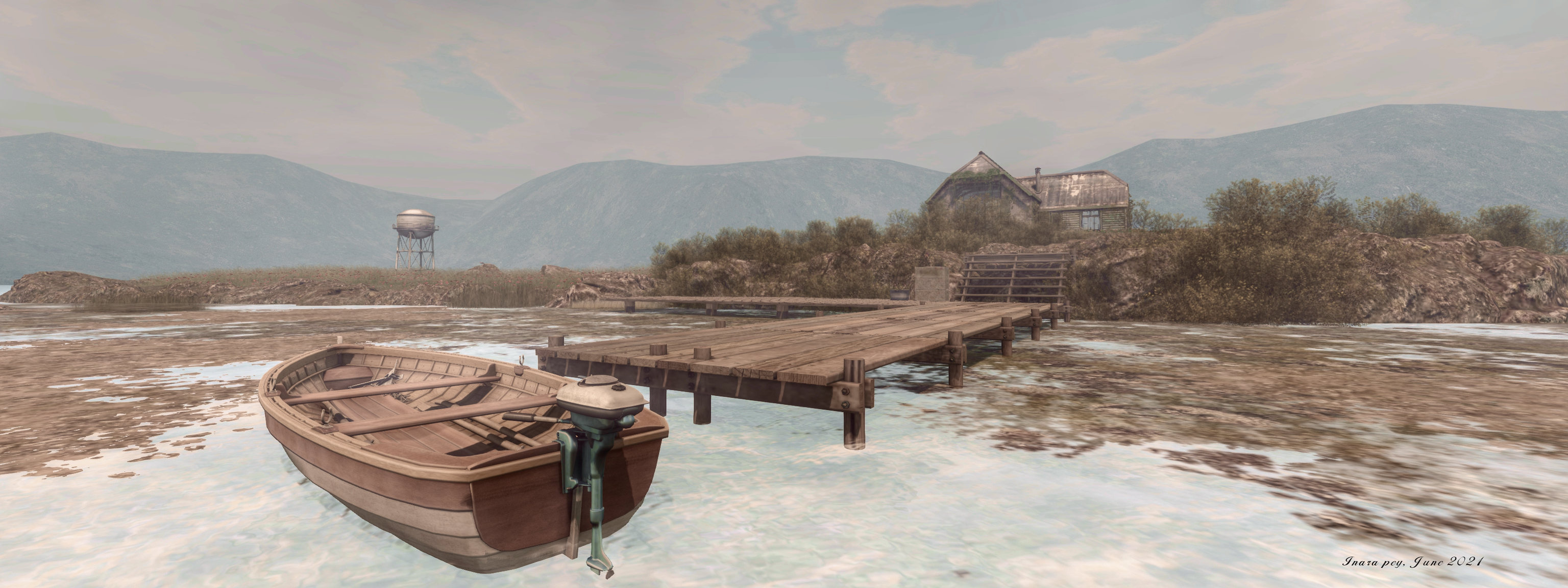
This smaller island is dominated by an old warehouse unit – what role it might once have served now lost, although the passing trawler suggests that perhaps, once upon a time, it may have had something to do with local fishing. Now it sits as another isolated retreat, partially furnished, a little (static) boat with outboard motor sitting at the dock apparently the means to travel back and forth to the large island.
Bella’s Lullaby, June 2021
The southern end of this smaller island forms a slender finger, edged by rock, a place where the nanohana gives way to poppies and daisies and other meadow flowers that offer a splash of colour to the island and which wash around the feet of the oblate water tank atop its sturdy tower.
There are a couple of tiny islets that also make up the setting. One is a flat-backed slab of rock, is home to a small lighthouse; the second is a little more robust, a rocky table with its own sandy-shale beach. In difference to the rest of the region, this little corner sports palm trees that grow alongside what appears to be an old rail carriage long ago separated from its bogies and converted into a cosy two-roomed shack.
Bella’s Lullaby, June 2021
These two southern islets are overlooked by the region’s main landing point (although this is not enforced), sitting on a square deck built out over the shallows surrounding the main island.
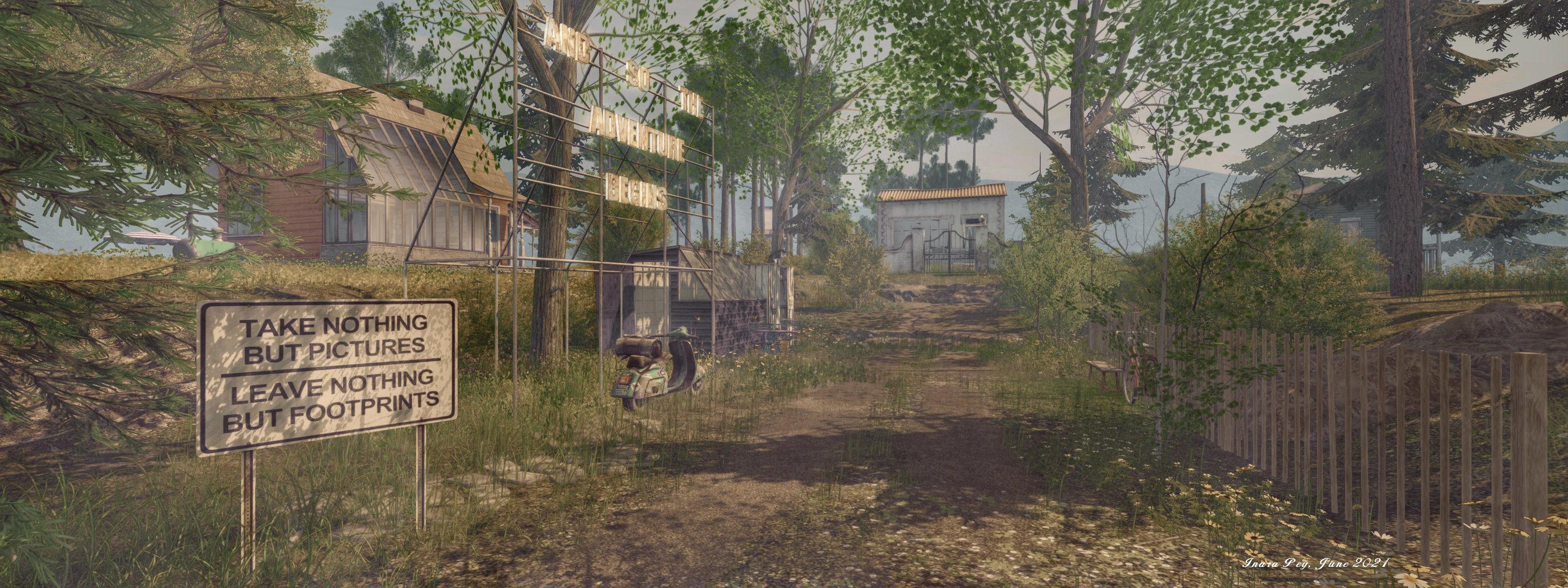
Close by is a sign that draws on motto of the Baltimore Grotto: Take nothing but pictures. Leave nothing but footprints (the motto itself continuing Kill nothing but time), itself a variation of a phrase from the “Leave No Trace” philosophy of naturalist all over the world. It’s a perfect sentiment by which to start an exploration of the region.
Bella’s Lullaby, June 2021
From the landing point, a rough track runs north between several of the island’s little buildings to the Tuscan style house. It’s a natural way to start explorations, although the cabins either side of the path are liable to tempt feet away from it.
Not that this is a bad thing – there really is much to discover here without the region feeling an any way overcrowded. As such, roaming freely (if under the watchful eyes of the local cats!) is the best way to proceed.
Bella’s Lullaby, June 2021
From landing point to old ranger’s tower, and from water tower to east side patio, Bella’s Lullaby has been beautifully crafted to offer a place to explore or to sit and enjoy company and comes rich in opportunities for photography.
Grauland Falls Art Park, June 2021 – click any image for full size
I first visited Grauland, the Homestead region held by by JimGarand and home (in the sky) to his M-1 Art Pose business in March 2019. At the time, I was immediately struck by its genuine uniqueness, offering an environment that expresses art as a landscape.
Since that time, Jim has continually revised the region on a regular cycle of iterations, some of which have continued that idea of art-as-landscape, others of which might be regarded as more “natural” settings – tropical beaches, oriental gardens, deserts – all of which have been highly engaging and kept me returning to the region to write about many of them.
Grauland Falls Art Park, June 2021For the iteration I visited in June, Jim has returned the region to what, for me at least, is its roots – a setting in which art plays an important role in expressing the overall landscape.
Rapidly dropping from eastern highlands marked by a high peak and a curtain of cliffs backed by high mountains, the region is immediately visually engaging; the peak giving birth to falls that in turn feed the streams that break up the lowlands as they flow out to the surrounding waters.
Grauland Falls Art Park, June 2021
Rugged and attractive, with western and northern bays watched over by a ranger’s watchtower to the north-west, two tidy woodland areas and a scattering of buildings, the landscape is highly photogenic. However, it is what is to be found within it that captures the eye.
From obelisks through the familiar concrete blocks to statues, tiered gardens and totems, the art to be found throughout the region fits neatly and elegantly into the setting, bringing it naturally to life.
Grauland Falls Art Park, June 2021
As an art park, the setting is laid out as a place one travel to in order to visit: the landing point is presented as a cark park, the road running from it vanishing into a tunnel that appears to pass under the mountains to connect the part with the rest of the world. It sits bounded on two sides by the remnants of what might have once been a complete costal fortification built during the last world war, but which now stand with gaping windows and walls that have in part started to lean somewhat as their foundations have settled.
Forming the entrance to the park, the great blanks walls of this ruin also naturally lend themselves as a part of the park’s artistic statement, providing access to the tiered gardens that form the starting point for explorations.
Grauland Falls Art Park, June 2021
From the gardens with their cobbled paths, visitors can roam where they please – as indicated by the static characters already in the region that add a further sense of it being a a popular place to visit. A single path does offer a route from the landing point, one that passes over the region’s three bridges – which also very much form part of the art statement. These bridges lead the way to the largest complete building on the region, a boxy unit offered as something of a meeting / relaxing space.
Jim’s designs are always engaging and a pleasure to visit, but I admit to finding this iteration particularly engaging. There’s that sense of returning to the focus of early iterations of the region whilst retaining a completely unique look and feel.
Grauland Falls Art Park, June 2021
With photographic opportunities can be found throughout, and the 3D art elements bringing a richness to the environment that encourages the visitor to remain, explore and appreciate, Grauland Falls Art Park is not to be missed.
Mousehole, June 2021 – click any image for full size
Tolla Crisp contacted me recently to extend an invitation to visit her new region holding, Mousehole, located to the south of her famous Frogmore, a place I’ve covered numerous times in these pages due to it’s sheer beauty. The two are connected to it via footbridge, with Mousehole expanding on the Cornish theme folded into the current iteration of Frogmore (which you can read about here), making both regions ideal for a joint visit, as well as each one standing on its own.
A Full region using the standard 20K land impact, Mousehole takes its name from the Cornish fishing hamlet of Mousehole (pronounced maʊzəl, orPorthenys in Cornish), located in the far south-west of the English county, on the shore of Mount’s Bay. Like Frogmore, the overall design is the work of Dandy Warhlol (terry Fotherington), whose hand and eye helps to give that flow of continuity between the two regions.
Mousehole, June 2021
With a population of around 700, Mousehole has a long history as a fishing village that dates back to the 1200s. However, in modern times it is noted more as a visitor / tourist destination and for its many festivals and community events that are held throughout the year.
Whilst taking its name and a lot of its inspiration from the hamlet and Cornwall’s rugged coastline, the design also offers and inland setting that offers a mix of hints of Mousehole village and the wilder aspects of the county. Combined, these give the region a unique look and feel whilst also giving a hint why almost a third of Cornwall’s coast and some of its inland areas are designated Areas of Outstanding Natural Beauty (ANOB) – giving them the same status as a national park.
Mousehole, June 2021
The main part of the region is open to the public, encircled by a broad beach broken by rocky outcrops to form smaller coves typical of the kind that might be found along the Cornish coast. Along these sands are places to sit, bars to by found, opportunities for swimming or simply floating on the water.
Sitting within this are two upland areas which might be seen along the upper reaches of Cornwall’s rugged coast around Mount’s Bay, but which equally bring to mind the wilds of Bodmin Moor. Separated by a sandy divide that offers a shortcut between the north and south sides of the island, these two uplands are rich in greenery and home to individual scenes.
Mousehole, June 2021
The larger of the two offers a setting that might have been lifted from the village itself – most notably the famous Mousehole Pub, which shares the hilltop with a stone-built house and a country church. No roads are visible here, however; instead, the buildings stand surrounded by moorland grass grazed upon by donkeys (Cornwall and neighbouring Devon are also noted for their donkeys), with visitors free to wander across the hilltop and perhaps cross the bridge spanning the shallow gorge to touch the second upland.
This smaller hill is home to an abandoned house (I admittedly found the motel sign outside to look and feel out-of-place), its garden overgrown and nature starting to reclaim its interior. Forlorn and decaying, it has the feel of a place that one might come across deep in the Cornish moorlands, once home to a farm or the retreat of a wealthy tin mine owner and his family, now long abandoned and forgotten.
Mousehole, June 2021
Further touches of Mousehole and its surrounds can be found within the region. Just off the southern coast, for example, is an islet that is mindful of the small island of St. Clements sitting just off the entrance to the village’s harbour. Be mindful that the in-world island is actually a private residence, however, so do be wary of trespass.
Also, just off on of the beaches lies the entrance to a cavern. Find your way inside and you’ll discover a little homage to the tale of a hermit who was said to once lived along the coast at Mousehole.
Mousehole, June 2021
Rich in detail and touches – off to the west is a smaller island, home to another little bar and also what might be an abandoned military facility of a kind that can be stumbled across around the English coast – Tolla’s Mousehole is another delight to explore and photograph – and a delight to explore.






 Inara Pey: Living in a Modemworld