The closing of a Storybook in Second Life

Storybook Forest, March 2020

If you want your children to be intelligent, read them fairy tales. If you want them to be very intelligent, read them more fairy tales.

– Albert Einstein

I opened my 2018 travelogue for Nessa Zamora’s (Noralie78) Storybook Forest back in September 2018 following our visits to the Lost Unicorn regions (read more in Opening a Storybook in Second Life). Part of this quote is also used as an introduction to the region, so given news has come that the the Forest is shortly to close to make way for a new design, it seemed a fitting piece with which to open this piece.

Storybook Forest, March 2020

Designed by Noralie78, Storybook Forest is an utterly bewitching place that, if you’ve not visited before, you really, really, should before the end of day on March 3rd, 2020 (I’d have given more warning, but only got word myself following the Lost Unicorn post giving notice of the closure being published on March 1st). The design stands as a marvellous homage to fairy stories and a delight to all who still love the fables and tales they may have heard in childhood days or have enjoyed reading to their own children – or who simply like reading; while for photographers and explorers, it offers something to smile at around every corner.

This is a place where ornate, rounded castle towers rise from the surrounding trees while paths wind between tree trunks and under a canopy of wide-spread boughs; where exotic plants grow and sunlight dapples the glades and falls across the waters of a small lake. From the outset, it’s clear the is is a place where the imagination can be set free and the magic of books and tales has been given leave to run as they will – and we can run with them.

Storybook Forest

So it is through this winding path, passing from castle to castle, from glade to tower, that visitors may find Peter Pan pointing the way forward, Mary Darling standing below, even as Captain Hook, Mr. Smee and Tiger Lily row past on the nearby waters, a certain crocodile inevitably in tow. Deeper still are opportunities to gather with a group of dwarves, as Snow White lies under glass, the victim of the Wicked Queen’s apple, or to sit with Alice, a white rabbit and chap with an affinity for hats to partake of afternoon tea, while a lost boy wades the shallow waters of the little lake, gazing in wonder at the pile of books that rise from is midst.

Nor is this all; every turn in the path awaits the opportunity to offer a new childhood memory: Bambi and his mother, Cinderella, Snow White… the list goes on, and I’m not going to spoil things by mentioning all who are given a role within this forest.  And as well as these glimpses of childhood tales, Storybook Forest offers many places where visitors can sit and allow memories wash over them or have their imagination take flight – or rest their avatars while their camera roams through the woods, seeking out details that might otherwise be missed.

Storybook Forest, March 2020

And details there are indeed, from dedications to read through quotes from stories to places where a little interaction can be enjoyed, such as at the harpsichord sitting atop Cinderella’s tower. Even some of the characters have some unique aspects too them – take a look at the seven dwarves gathered around Snow White’s glass casket, for example! All of this is offered with a special dedication from Noralie, offered to all that wander Storybook Forest’s enchanted paths:

To the boy or girl who reads by flashlight
Who sees dragons in the clouds
Who feels most alive in worlds that never were
Who knows magic is real
Who dreams.

This is for you.

Storybook Forest, March 2020

As noted, Storybook Forest will be around until the end of of March 3rd, so make sure you capture any memories you wish to have of it before then. I confess, I will miss it once it is gone; it is a magical place. However, while it may soon pass into memory, so too are we given the promise of something new to follow – and so I look forward to returning and seen what new fruit has come forth to replace it.

SLurl Details

An abandoned vacation spot in Second Life

Dya’s Abandoned Vacation Spot, February 2020 – click any image for full size

An Abandoned Vacation Spot in the 30s. Sometimes you can still see the glamour of the past….

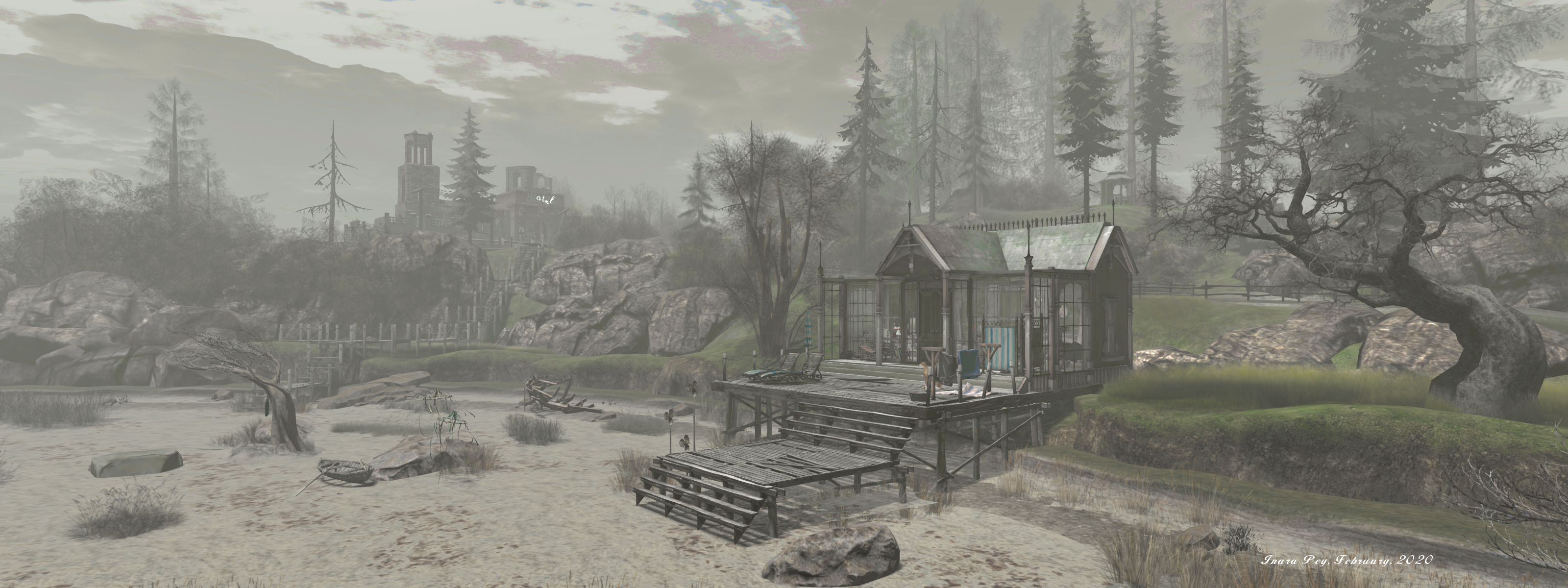
So reads a part of the description for Dya’s Abandoned Vacation Spot, a location we were drawn to courtesy of Maddy Gynoid. Designed by Dya OHare, this Homestead region presents a fabulous setting, an island sitting somewhere – possibly just off the coast or within the estuary of a broad river – that was once a place for holidays and fishing, but which has now faded well past its prime, the holiday makers long since departed, the water front now little more than moorings for fishing boats, but not a base of operations.

To say this is a beautiful setting would, frankly, be an understatement. The island has obviously been carefully considered and designed to present a setting that really could exist as much in the physical world as in the virtual. It’s made all the more natural through its single-track road which, just as might be expected of a vacation setting, neatly loops its way around the landscape, linking all the points of interest, and thus providing a natural means of exploration.

Dya’s Abandoned Vacation Spot – February 2020

The landing point sits in one of these aged waterfront buildings, one that is in slightly better overall condition than the rest, and home to Dya’s Gacha resale store.  From here, visitors have a choice: proceed on foot, take a bicycle from the rezzer a little further along the waterfront, or take the the steps down to the the piers where a motor boat rezzer awaits anyone who fancies pootling around the island by water.

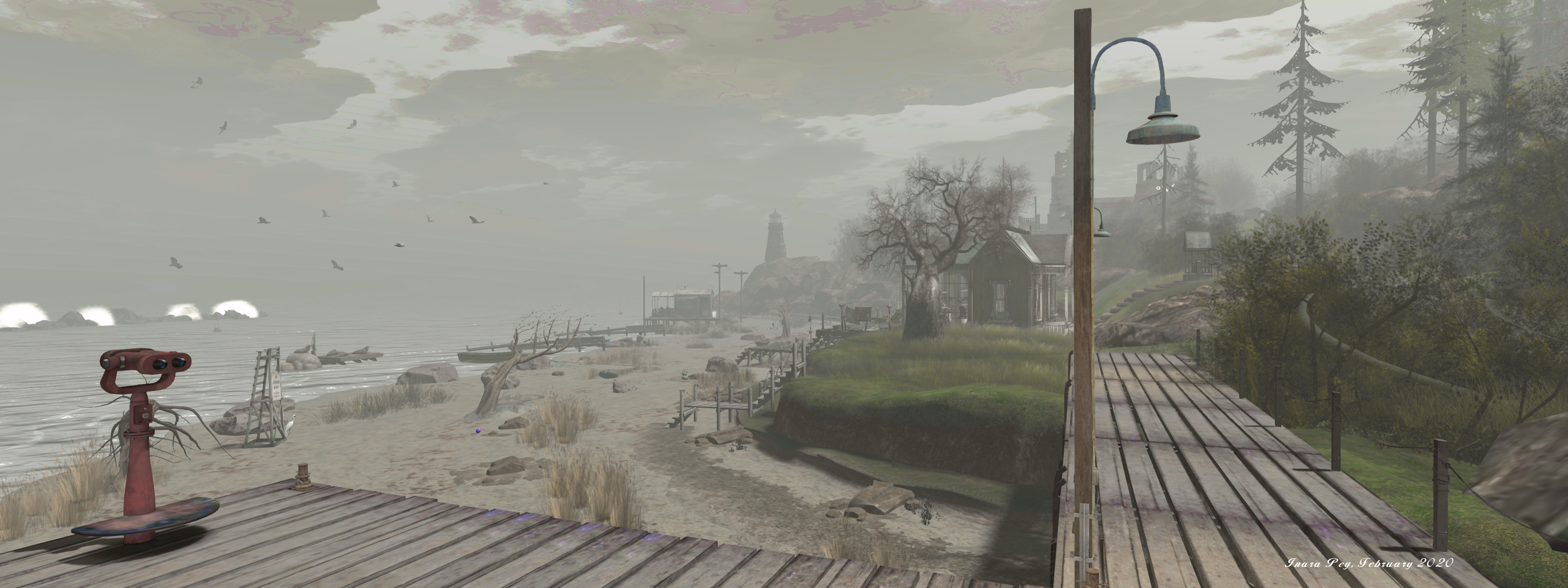
The road runs both north along the the shore, and east. The former route fully brings home the faded nature of the island’s heritage, passing between water to the one side and buildings that are falling apart on the other, their signs and façades harking back to when the the paved street was alive with visitors – although a couple of folk appear not to have realised the bar is no longer serving customers!

Dya’s Abandoned Vacation Spot, – February 2020

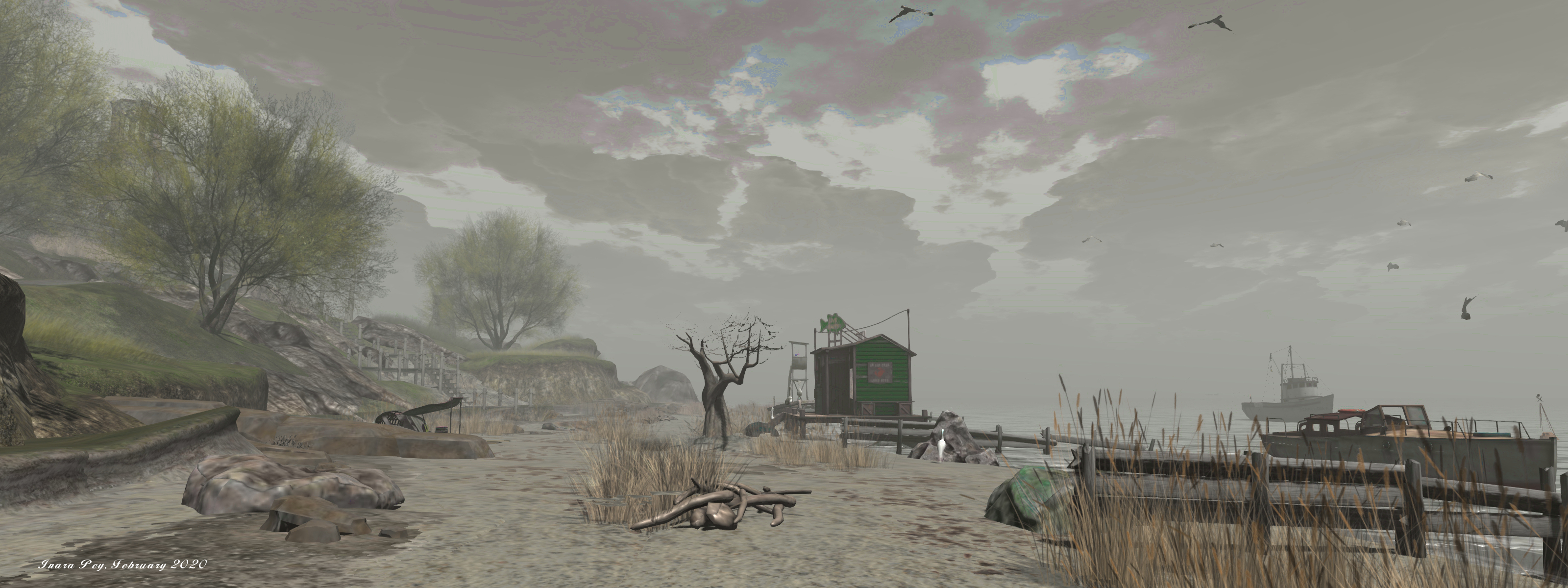
To the north, through a local rain shower, sits a more business-like wharf and buildings, where also sits the carved hull of a submarine whose shape looks born more of the Cold War era than from the 1930s. It sits as a single incongruity in the region’s overall design – and yet it still fits the setting, suggesting that while this was a holiday centre in the 1930s, time has indeed moved on, and the island has seen other uses.

Two beaches mark the south and east side of the the island, separated from one another by a rocky headland dominated by an old wooden lighthouse.  Both of the beaches reflect the island’s long-passed heyday; flotsam is scattered along sands that have a tired feel to them under the overcast sky, the trees along them apparently dead, marker buoys just offshore warning passing fishing boats not to get too close to the shore where they might run aground (and also mark the region’s boundary for those using the local motor boats to get around).

Dya’s Abandoned Vacation Spot, February 2020

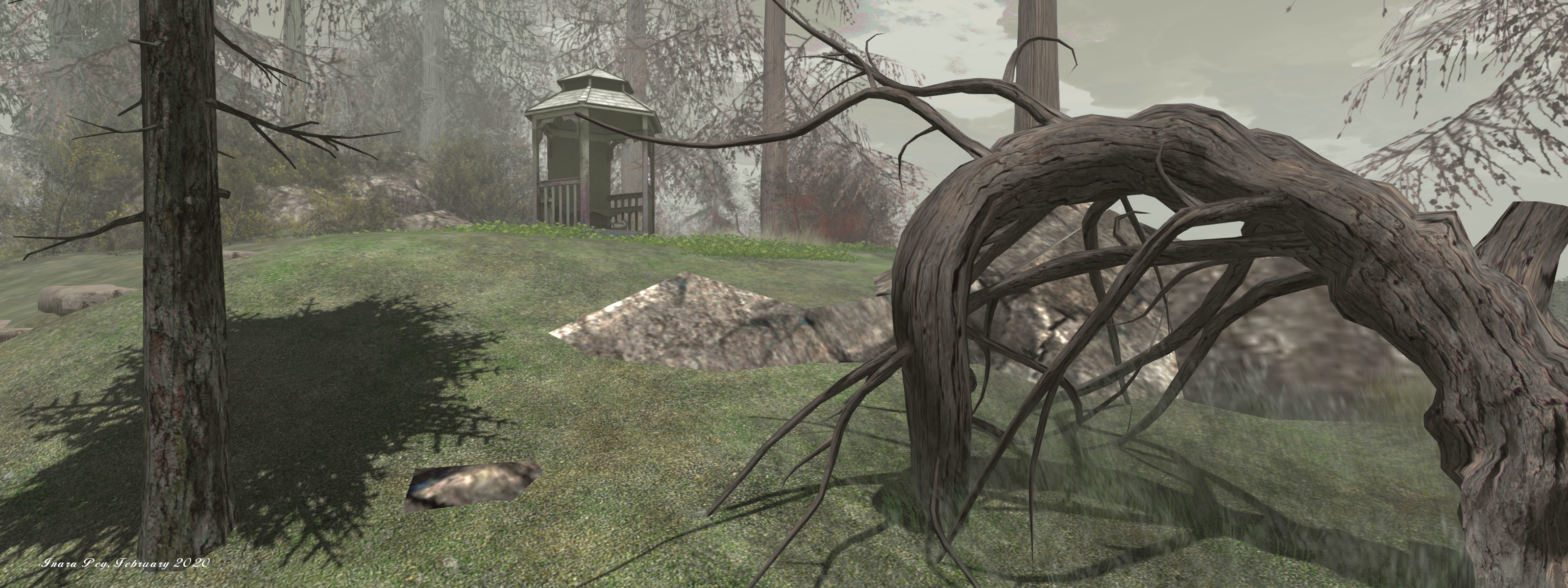
Both of the beaches are also overlooked by a ruins of an ancient church, a place that looks older than than the rest of the island’s structures. Neon signs hand from one end of this old building, advertising it as a hotel, but whether it ever served this purpose or not is open to question; there’s barely the space for individual rooms, so perhaps the signs – still flickering, and so under power, are meant as a joke by whomever still uses the island.

This ruin can be reached by following the loop of the islands-road, which also provides access to the beaches by means of board walks and steps. The road also runs past what is perhaps the last standing holiday home overlooking the sands and sea. It’s a modest place, the deck bigger than the house, but it is still in use, simply furnished and offering a sense of life within a place mostly given to the past.

Dya’s Abandoned Vacation Spot, February 2020

While it has no obvious connection other than the period in which the island had its heyday being close to that of the book, where exploring, I couldn’t help but feel it sits as some kind of seaward Valley of Ashes from The Great Gatsby, albeit with strong differences; a place that, rather than being a place of run-down businesses, secrets and eventual tragedy, through which the rich of East Egg and West Egg pass under sufferance, the island sits as a place to be passed by and occasionally used by fishing as they travel to and from richer ports of call whilst plying their trade.

Why my mind should jump to such a connection, I’ve no idea; but it just seems to fit. What I can say is that with its wildlife and horses, sound scape and cloud-heavy skies, Dya’s Abandoned Vacation Spot is a captivating place to visit, rich in its own romance and utterly photogenic.

Dya’s Abandoned Vacation Spot, Februay 2020

SLurl Details

A Little World with a touch of Voodoo Land in Second Life

Little World, February 2020 – click any image for full size

Back in September 2018 we visited Little Havana and its neighbour, Voodoo In My Blood. The former was a joint design led by Sofie Janic, the latter largely the work of Megan Prumier. You can read more about that trip here).  Given the length of time that has passed, together with catching an image taken by Cecilia Nansen whilst she visited the region set me to thinking a return might be in order.

Little Havana has now gone – possibly for a while, given the amount of time since our last visit – and it has been replaced by Little World, a design again led by Sofie, together with Abaracdabra, and that is apparently still under construction. It’s a place very different to Little Havana but it retains the same photogenic attractiveness that has already brought it to the attention of SL photographers.

Little World, February 2020

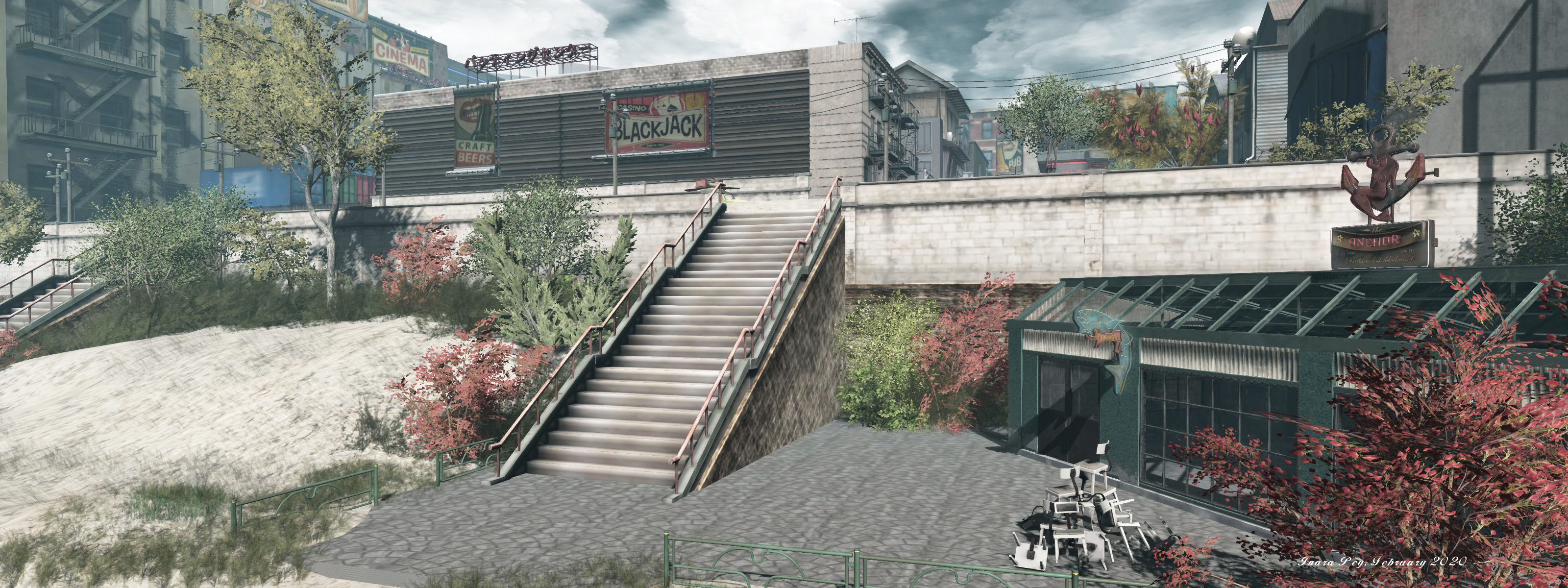
The landing point sits on the south side of the region on the bridge linking it to Voodoo Land (which was called Voodoo In My Blood back in 2018, and of which more anon). From here, a road climbs to the east behind tall buildings with their backs to the water, steps point the way north and up to where an urban scene sits under a default sunset sky.

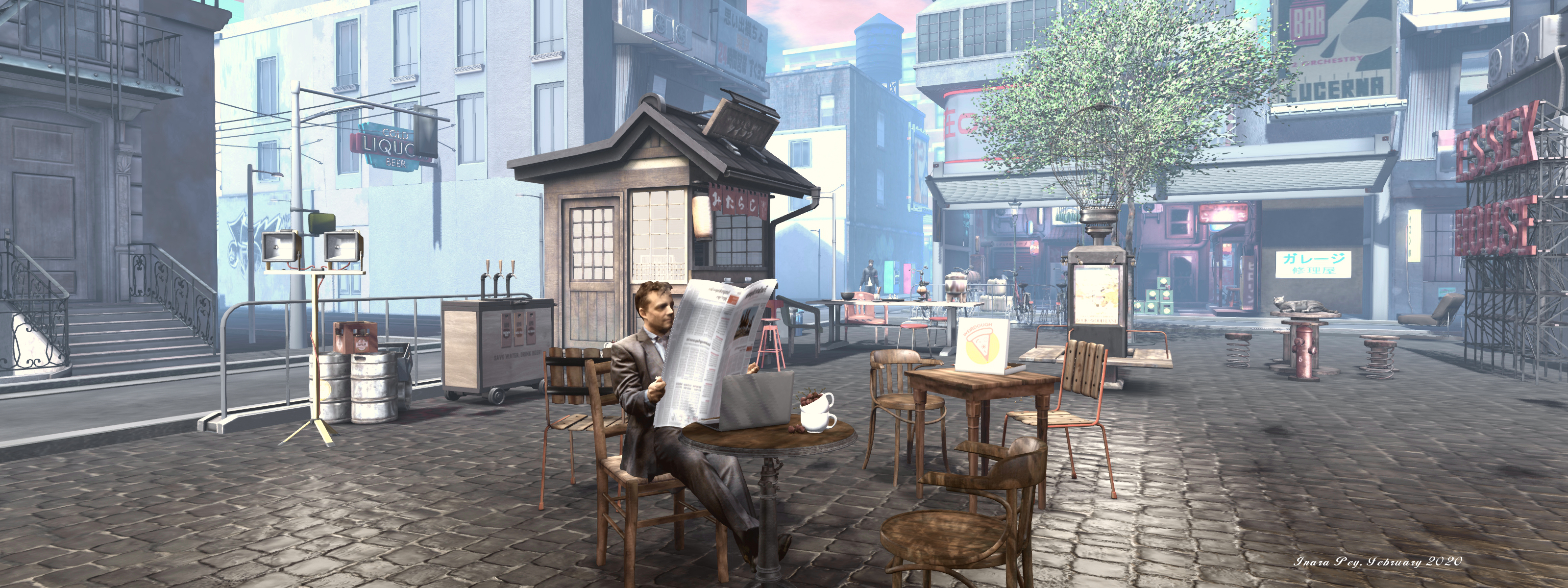
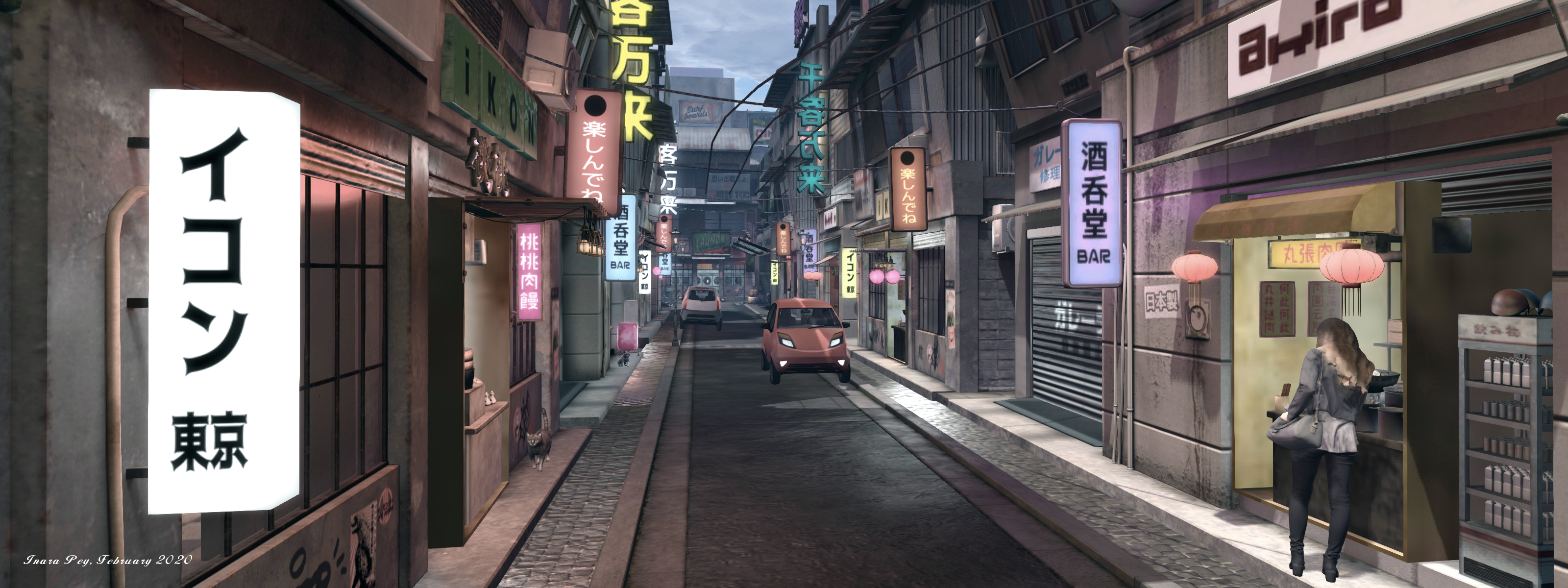
Neon is very much the order of things here, bright signs thrusting out into a narrow street that is in places made narrower by parked vehicles. Street-side eateries fill the air with steam from cooking foods, while steel shutters denote places of business that have closed for the night. Overall, the sense that this is a little corner of Japan is strong along this street – but that’s not to say the build as a whole is meant to represent a location in Japan.

Little World, February 2020

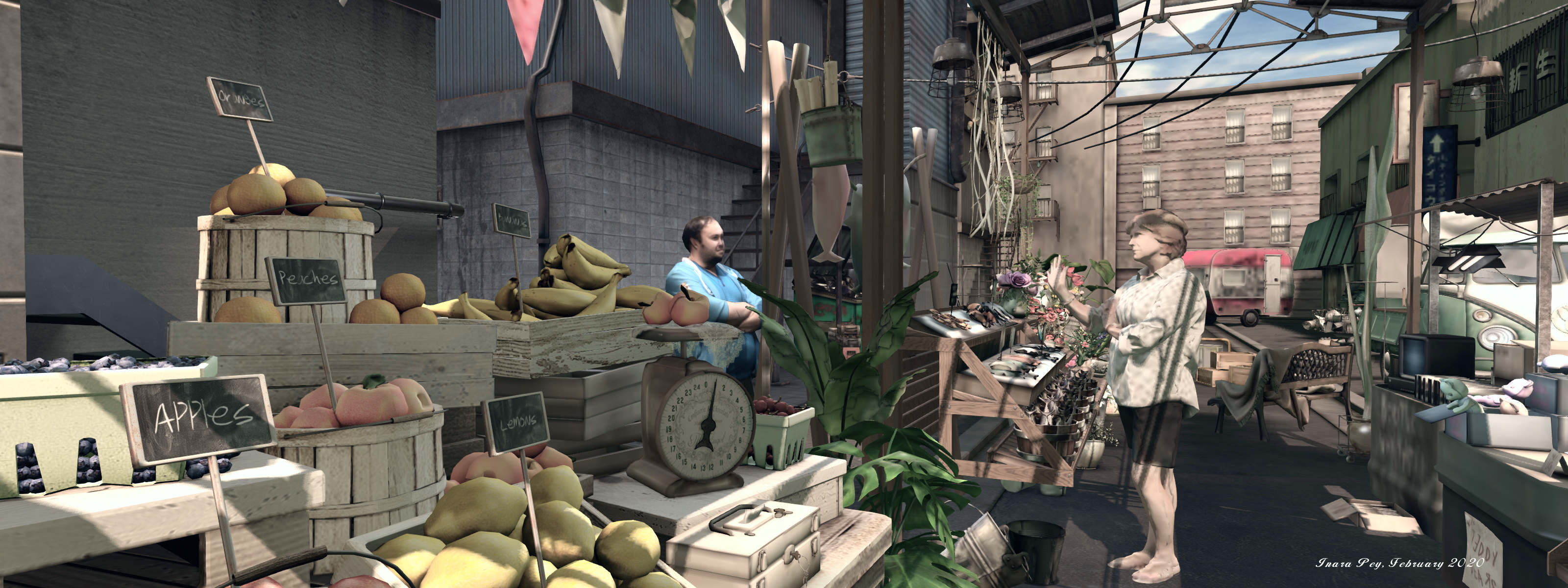
A second north-south street is home to an open market, rich with fruit, vegetables, fish, flowers and, in a throwback to times past, VHS tapes. While the signage on the buildings either side might be Japanese, the price tags and signs in the market are distinctly western. Thus, the sense that Little World is a melting pot of influences in the way of so many urban centres around the globe so often are.

Connecting the two streets at their northern ends is a cobbled square offering an open air café and a space for music. West of this sits an echo of Little Havana in the form of a narrow ribbon of beach. Little fishing boats that look to be more for decoration then for fishing sit moored against a deck sitting over the waves.

Little World, February 2020

While the buildings are shells, Little World offers many opportunities for photography, with locations further brought to life thanks to the local “residents” – human and feline! Photos are welcome at the region’s Flickr group.

Across the bridge, Megan Prumier’s Voodoo Land remains much as we remembered it from 2018. There’s a “new” store area on the west side, with Voodoo still sitting on the east side of the region overlooking the bay. South of this, the region retains its run-down Americana look, complete with ageing buildings and its tired, open beach front that is packed with detail and extends around to a fun fair in the south-west corner.

Little World, February 2020

There are other subtle changes here as well – the high pier and boat moorings have gone, but a new English-style pub appears to have been plonked down on the hedgerows and paved paths on the west side of the region. I’m assuming this is a temporary location for the pub, and that it may yet be moved.  There’s also an underground section I don’t remember from 2018 – but that could have simply been missed during that visit.

Like Little World, Voodoo Land presents multiple opportunities for photography and exploration, with both making for an ideal joint visit.

Voodoo Land, February 2020

SLurl Details

A return to Khodovarikha’s desolate beauty in Second Life

Khodovarikha, February 2020

In late 2017, Serene Footman, bringer of some of the more captivating and unusual locations from around the globe, opened Khodovarikha, a Homeland region  design inspired by a spit of land extending into the shallow waters of the Pechora Sea, now regarded as the south-eastern extent of what we call the Barents Sea off of Russia’s north coast, although it bore its name as far back as when the Barents was simply called the Murmanskoye Morye  (“Sea of Murmansk”).

.

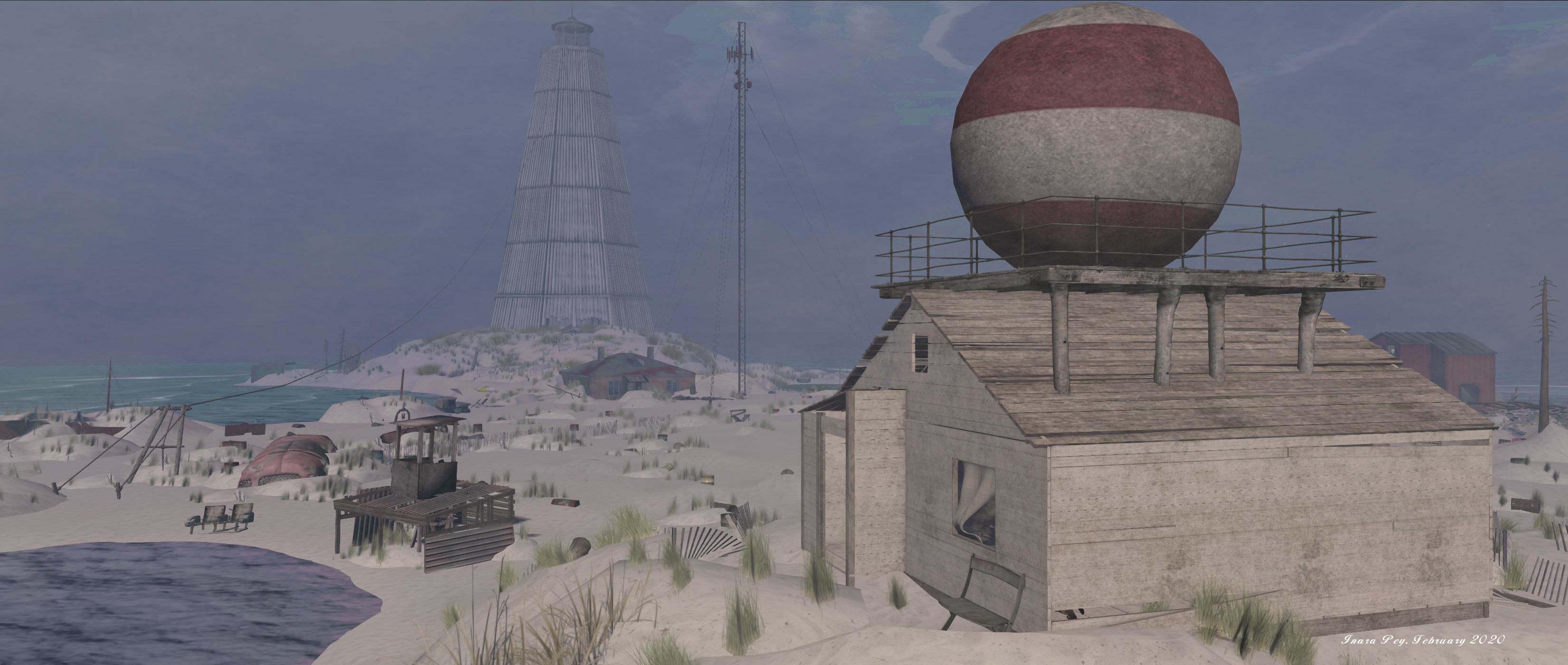
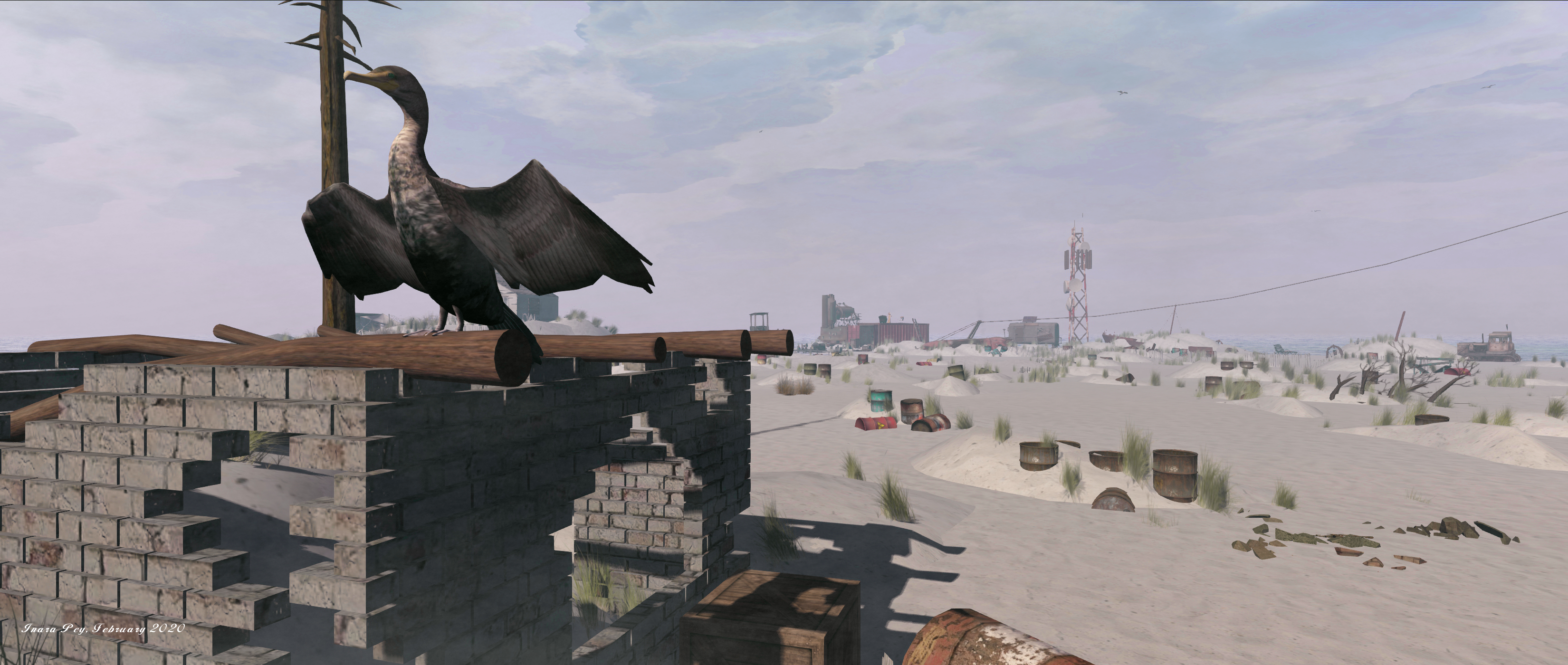
It’s a desolate, lonely place, marked by the wood-framed octagon of a lighthouse that once marked the Yugorsky Strait linking the Pechora and Kara Seas, once an important trade route and, during World War 2, the route taken by allied convoys bringing supplies and materiel to aid Stalin and his armies. Today, Khodovarikha is a largely forgotten place, most of its building falling into decline, a single, lonely weather station the only working centre. Its a place so remote, it isn’t even connected by road or rail to the rest of Russia.

Khodovarikha, February 2020

I mention this because Serene’s interpretation of Khodovarikha is once again open in Second Life for a limited period, and brings with it a new blog post on the location and his inspiration for creating it. However, this is not a mere re-establishing of a past build; rather, Serene has taken the spirit of his original build, together with some of the notable elements – the lighthouse, the weather station, etc., – to offer a new interpretation of Khodovarikha and the life of its one permanent resident – Vyacheslav Korotki, or Slava as he is known.

As Serene notes in his 2017 blog post on the original build, it was Slava’s story that first drew him to wanting to represent Khodovarikha in Second Life. Now, in this iteration of the build, we see more of that life brought into focus: the distinctive lighthouse no longer functional (as it was in the original build), reflecting the fact its namesake ceased operations in 1996. Similarly, the damaged side panels apparent in the model and perhaps seen as storm or other damage with the original build, are now explained by Serene as being the result of Slava’s assaults on the wooden frame in order to provide him with the warmth of firewood during the harsh winters. A zipline also now extends down from the lighthouse, a tribute, Serene informs us, to the sports hall that once stood at the base of the structure.

Khodovarikha, February 2020

Originally set within the cold harshness of winter, the region is this time offered in the summer months. This iteration brings new life to Khodovarikha: birds are very much in evidence, while with a few tweaks with the viewer’s windlight settings, it’s possible to render the setting under bluer skies as might be seen in the summer months, and which may well life Slava’s mood and thoughts. Certainly, a drop of sunshine adds warmth and light to Slava’s lonely, red-planked home.

The discovery of more photographs of the area have allows Serene to commission structures reflecting those to be seen in Khodovarikha – such as the brick-built but dilapidated bungalow sitting in the lee of the great lighthouse. This is reproduced within the region courtesy of Impossibleisnotfrench, who also produced the bothy in Serene’s last region design (see: Serene Footman’s Scottish vision in Second Life, December 2019).

Khodovarikha, February 2020

As Serene notes, Khodovarikha does not have any natural beauty to it what would make it a subject for postcards, but in its deteriorating, lonely position, now all but bereft of human presence save for one man and the annual visits of the Mikhail Somov, it has a desolate, captivating beauty of its own. In bringing his vision of the location back to Second Life, Serene is allowing us to experience that isolated, decrepit beauty for ourselves, making a visit to the region – and a reading of both of Serene’s blog posts on it – an absolute must of Second Life travellers and explorers.

SLurl and Links

A revisit to Otter Lake in Second Life

Otter Lake, February 2020

Update, November 2022: Otter Lake has relocated.

Otter Lake is one of the most alluring homestead regions we have recently visited. The work of Sharon Hinterland, this is a truly remarkable region in terms of the amount of space the region exudes, the beauty of the design, and the richness of detail. So much so that it is actually hard to believe it is only an Homestead region and thus capped with a land capacity of 5K.

I wrote those words back in June 2019 following our first visit to Otter Lake. We recently made a return to the region after receiving an invitation to do so from Sharon, who noted she’d made a number of changes to her design, and hoped we’d be able to take a look.

Otter Lake, February 2020 – click any image for full size

Now, to be honest, given the region really did captivate and offer a stunningly realistic design, hearing that it may have changed did cause something of a surge of anxiety: would the charm be retained? Would there still be the same sense of of depth, the same natural beauty?  Might something have changed to cause the magic of the region to evaporate, even if only in part?

Well, the answer to all of these concerns proved to be an emphatic “no”: Otter Lake remains as captivating and enticing as ever, the additional elements offering further depth and opportunities for photography and for simply appreciating Sharon’s work as a landscape artist.

Otter Lake, February 2020

Retaining the lake and home that gave the region its name, fed from on high by waterfalls dropping from a hilltop pool, the region offers a pleasing mix of the familiar and the new that combine into a further natural setting ready for exploration.

Perhaps the most obvious new element in the region is the fishing wharf that now forms the landing point. It’s an interesting focal point on its own: while this retains the warehouses of old and has a salmon trawler tied up alongside, fishing no longer gives the wharf’s purpose. The tallest of the warehouses has been converted into a home, the smaller into a cosy café, while what might have once have been fishmonger’s stores are now boutique shops.

Otter Lake, February 2020

Across the region from the wharf, a lighthouse raises its light over the trees, perhaps causing those who have visited the region in the past to recall another lighthouse that once stood there, albeit one without a tower. Other touches of the former design also await discovery: the humpbacked bridge, the broken delivery truck and much more besides.

As a firm fan of Alex Bader’s landscaping kits, I admit to particularly like the use of his stream building kits and specifically Sharon’s clever integration of elements from the Studio Skye Zen Garden Building Set. The later are to be found throughout the region and offer subtle accents throughout the landscaping.

Otter Lake, February 2020

Also among the newer elements are further buildings snuggled among the trees and paths, as well as some of the paths and trails themselves. Between them, the latter of take visitors on a marvellous trek through the region, one that again gives the feeling of walking through a space much, much bigger that the usual 65,535 square metres supplied by a region, without ever giving the impression that the space is in any way limited or feeling of walking in circles.

Sharon confessed to me that she wishes she has the land capacity to use “better trees”. However, while they my be low LI, the rich mix of trees that are provided across Otter Lake make for a rich – and quite natural – mix that varies by altitude, adding further depth to the region.

Otter Lake, February 2020

Filled with colour and natural sounds that change throughout the day – a day, by the way, enriched with a custom windlight -, with numerous places to sit in the open under boughs of trees, along river banks and paths and with much to see that doesn’t unduly impact viewer performance, Otter Lake remains one of the most alluring an natural settings it has been our pleasure to visit.

SLurl Details

The serpentine beauty of Lake NumB in Second Life

Lake NumB, February 2020 – click and image for full size

Surrounded by tall green mountains and with fir trees in places lining its shore, Lake NumB sits hidden from the rest of the world, its waters a colour suggestive of great depth. It lies within with the hills uninterrupted save for a single, sinuous island that appears to be swimming through the blue waters from east to west, the narrow stripe of a stream running through it from end-to-end along its green back.

Designed by Num Bing, this homestead setting is stunning in its simplicity and beauty, and offered to visitors because – to use Num’s words:

I wanted to create a little spot… a stream banked with nature… with photo & relaxation spots… so here we are… wander & enjoy…

Lake NumB, February 2020

The landing point is on a wooden bridge spanning the stream towards its western end. To the south of this, a carpet of grass sits between water’s edge and stream to provide a access to two greenhouses. The first, and nearer of these, is a near-pristine structure tucked into a grove of fir trees and offering a quiet retreat – one of several throughout this meandering isle.

The second greenhouse sits further east, where the land rises very slightly between curtains of rock. It is older than the first, its frame now without glass but with net curtains hanging on one side. It offers a large tub of water as an escape for one our two people, the water warmed by copper coils absorbing the heat from a naked fire sitting alongside it. Nearby, grassy steps lead down to a deck sitting over the waters of the north shore, while to the south a second bridge offers way back to the path that runs between it and the landing point.

Lake NumB, February 2020

Beyond this, the island continues east, the land lined with trees, shrubs and flowers and grass paths encourage explorers forward to discover all the hidden delights to be found. And these delights are many: places to sit, decks over the water, little glades, and an out-thrust of land that offers a formal garden with checker board pebbles, trimmed hedgerows and topiary.

Extending out into the lake, the garden looks to have been artificially added to the island, and is home to another frame – for either a greenhouse or shed – that sits unfinished and provides home for an setting ready for afternoon tea complete. Entertainment is waiting to be provided by the most charming clavicytherium that came as a particular delight to me, as I had no idea one was available in SL (so kudos to Jake Vordun, its creator!).

Lake NumB, February 2020

Beautifully designed and presented, Lake NumB does precisely what Num Bing intended of it: presents a natural setting rich in places to relax and opportunities for photography (images can be submitted to the region’s Flickr group, if desired); it’s a place that works under multiple windlight options and encourages visitor to stay a while and that shouldn’t be missed.

Our thanks to Annie Brightstar for the tip.

Lake NumB, February 2020

SLurl Details