A notebook for Aspen Fell in Second Life

Aspen Fell – The Notebook, July 2020 – click any image for full size

It’s been several years since we last visited Aspen Fell in Second Life. A homestead region managed by Jessica Marabana, it’s a place that periodically undergoes transformation by designer Aspen Fell to offer visitors something new to appreciate whilst exploring, in taking photographs of and in writing about. However, I have to admit my curiosity was particularly piqued in reading the latest description provided with the region’s entry in the Destination Guide:

The Notebook is inspired by the movie ‘The Notebook.’ Stroll through the streets of Seabrook, South Carolina, have a seat in the movie theatre, and feel the love Noah and Allie, through all the ups and downs, had for each other.

– from the Aspen Fell Destination Guide description, July 2020

Aspen Fell – The Notebook, July 2020

I have to confess that The Notebook is not a film with which I was familiar prior to reading those words, so I made a call to a friend (aka Netflix and a couple of hours in front of the telly) to learn more – although as I found out on making my return trip to take the photos seen here, the landing point does offer a note card with a fair synopsis of the film to incoming visitors, which I may have accidentally discarded on arriving for our exploratory wanderings.

In short, the film – itself based on the 1996 début novel by Nicholas Sparks – is a decades-spanning love story about a young man of humble origins who lives and works in Seabrook Island, South Carolina. During a night at the local carnival, he becomes smitten with a young socialite who is vacating in the town with her family. His persistence eventually wins her over – although her family doesn’t precisely approve. In part due to their objections and the interference of the woman’s mother, and in part due to America’s entry into to World War Two, the two separate and remain apart for several years until a chance sighting whilst Noah is visiting post-war Charleston brings the two indirectly back into one another orbits, and eventually leading them to renew their relationship.

Aspen Fell – The Notebook, July 2020

As simple as it sounds, the film – like the novel – is nuanced it the way it presents its story. We see the unfolding relationship of two main characters – Noah Calhoun and Allison “Allie” Hamilton – in flashback, as an elderly patient in a nursing home, referred to as “Duke”, reads their story from a journal to an elderly female patient. Through the intertwining of the modern-day storytelling and the flashbacks we discover that not only did Noah and Allie’s love eventually endure, but the the elderly man and woman are Noah and Allie, and his reading of their journals is itself a poignant act of love for her, stricken as she is with dementia.

I know you feel lost right now; but don’t worry, nothing is ever lost, nor can be lost. The body sluggish, aged, cold; the embers left from earlier fires shall duly flame again.

“Duke” / Noah Calhoun, quoting in part lines from Walt Whitman’s Continuities

Aspen Fell – The Notebook, July 2020

Within Aspen Fell, notable elements in the film in which the story of younger Allie and Noah’s relationship are played out are presented as vignettes. There is the main street of Seabrook Island itself; the carnival where they first meet; the lumber mill where Noah works; the abandoned house he shows her, which she describes once it his been restored to its former glory and which he eventually renovates in accordance with her vision in the belief it will bring her back to him.

And there is more: in the town you can dance in the rain or watch the changing traffic lights in reflection of Allie and Noah; in the carnival you can try the rides, at the house you can explore Noah’s renovations and make yourself at home, or close by, you can visit the boathouse and take a canoe out on to the water and get caught in the rain, just as they do.  Thus, as a homage, the region’s vignettes are all nicely framed and gently linked by a winding path.

Aspen Fell – The Notebook, July 2020

Just how much love for the film has been put into Aspen Fell can additionally be seen in the smaller details. For example, the movie theatre is promoting Albert S. Rogell’s 1940 version of Li’l Abner, starring Buster Keaton just as it does in the film. Elsewhere, the dilapidated house contains the old piano Allie sits at and plays (and in respect of this and the piano solos featured as a part of the film’s soundtrack, the region’s audio streams features piano solos). Look hard enough and you may even spot a copy of Allie’s journal the elder Noah reads to her to frame the story.

The introductory note card states the region is open for rezzing to allow for props, etc., but during our visits, I found this not to be the case, even with membership of the local land group. However, this isn’t really an issue; there is more than enough to see within the region, and a fair number of poses available as well.

A labour of love, a photogenic setting and – for those not familiar with the film (or the novel) – and education, Aspen Fell – The Notebook makes for yet another engaging visit.

Aspen Fell – The Notebook, July 2020

SLurl Details

Carolina’s new summer look in Second Life


Caolina, July 2020 – click and image for full size

It’s been a year since we lasted visited Arol Lightfoot’s Homestead region design of Carolina, so given it is back in a summertime look, we hoped over recently to see what was new and found the answer to be, “Everything!”

In the summer of 2019, Carolina was very much tropical in nature with lowlands, beaches and bays all combining into a setting ripe for wildlife and opportunities to wander (see: The beaches of Carolina in Second Life). For summer 2020, the lowland feel to the region is largely retained – with two very obvious exceptions – but the setting is very much more temperate in style.

Carolina, July 2020

Those exceptions are two tables of the rock that rise in the south-east corner of the region, separated one of the other by a narrow gorge but maintaining contact by means of the rope bridge that has been slung between them. The larger of the two sits bare-headed save for a single wooden frame. Its south side drops straight and true to a lip of rocky land that sits above the region’s one major stretch of sand; to the north it in part falls to a set of low-lying steps that then descend onwards to the region’s inland grasslands.

The second plateau reverses this arrangement: its north side drops sheer to the lowlands, whilst its south face steps down towards the sea in a series of rocky shelves over which water tumbles to form three streams that spread out to the surrounding waters like splayed toes.

Carolina, July 2020

The landing point sit on the larger table mountain, the wooden frame forming the upper end of a zip line (Cube Republic’s excellent design) that presents the only way down other than stepping off the edge of the cliffs and trying to avoid hitting the ground below too hard. The line stretches out over the southern lands, crossing above grass, sand and sea as it descends to reach a small, crooked headland, where sits a small lighthouse and an accompanying modest bonfire.

Where you go from here is up to you: scramble down the rocks and you can follow the beach as it points eastwards until it arrives at the splayed toes of the mountain steams. Or you can turn slightly inland and follow the gravel path that runs in the same direction as the beach, but along the lip of rock that sits above the sand. This route has the advantage of offering a bridge over one of the streams and the opportunity to strike off inland through the gorge between the high hills. Or, you can leave the beach and path along the south side of the region until later, and head immediately inland from the lighthouse and headland.

Carolina, July 2020

It is this last route that will open the rest of the region to you, revealing it as a land rich in oak and willow and ash and birch, the trees scattered across the grasslands and around the small bays that sculpt the coastline. Three buildings sit upon the land, all ranged to the north and varying in style from a cosy waterfront cabin that looks east over the little curve of  sand, gravel and rock that might pass as the region’s second beach, through a summer house sitting within its own wild garden whilst offering more creature comforts within, to a solid rectangle of a house that sits on a rounded north-west headland as if awaiting occupancy.

There are multiple ways to reach all three, and all of them are set far enough part such that walking between them will reveal more of the island’s secrets. But as cosy (at least with two of them) and attractive as they are, and deserving they may be of being seen, they are not the focal points for the region. That honour goes to the large pond sitting close the the centre of the land and from which a great weeping willow rises, offering shade and coolness beneath its drooping arms.

Carolina, July 2020

With mist curling around the base of the tree and the water topped by reeds, lilies, marsh plants and waterlogged grass, the pond is home to all manner of birds and waterfowl that make it a haven for photography, while the piers and open-sided boat offer places for romance and sitting within its arms.

It is in wandering the island and finding it wildlife – birds, frogs, otters, bears – and the accompanying animals – dogs, cats, horses – that gives Carolina a depth of life. While the many ways to explore it give plenty of opportunities to find the little surprises (I presume the telephone box sits among the firs and birch of the gorge is there just in case someone want to make a  … trunk call!) and touches that lie throughout.

Rezzing in the region is open – but visitors are asked to kindly restrict this to poses and props for photos and to please clean up when they’ve done. For those seeking a place to sit and cuddle / chat / pass the time, Carolina offers numerous places where all three can be enjoyed, once again making it another engaging and charming build from Arol.

Carolina, July 2020

SLurl Details

Randelsham Forest in Second Life

Randelsham Forest

Shortly after Linden Lab launched the Log (or lodge, as I tend to prefer) Homes for Premium members on Bellisseria (see Second Life: Log Theme Linden Homes released), they started to add – as they had with other Linden Homes themes – a number of public spaces. Some are on the main run of land, others sit on islands within the lakes and rivers. All offer places of escape and relaxation. Chief among them its is Randelsham Forest, intended to act as a community hub, open to those who might wish to make use of it.

We actually visited Randelsham back at the end of April. It’s a rugged location, sitting between lowlands with house and a large, semi-sinuous body of inland water. At the time, I didn’t blog about it, as it appeared the regions around it were still very much a work in progress: whilst on a stretch of the Bellisseria railway passes by and has a local station, the line doesn’t as yet connect to anything.

Randelsham Forest

This is still the case, but it’s clear that now that SL17B no longer requires the input, the Moles are returning to work on Bellisseria, so I’ve little doubt things will be properly connected up.

The focal point for the setting is a large “tree house”, in part sitting up on wooden legs from the shore of the lake to level itself with the railway station, to which it is linked by a wooden board walk. Split into two, the tree house offers a large lounge area with wooden walls with a long balcony to one side with a bubble rezzer at the far end for those who fancy taking to the air. A bridge on the other side runs down to an open-sided platform ranged around the trunk of one of the area’s great redwoods.

Randelsham Forest

Like other community areas before it, the tree house is able to be reserved as a community use space to gather with the community, your friends. socialize, hold events, and enjoy the beautiful scenery.

– Patch Linden, April 27th, 2020

Lamp-lit paths await discovery, offering opportunities for people to the means to descend down to the banks of the lake, where trails further give opportunities for exploration and to find places to sit.

Randelsham Forest

The paths also offer routes up into the hills rising either side of the rail lines, to peaks where people have the opportunity to take to the air in a different way – via zip line;  although when we tried it, the ride was a little rough! The line out to the lake’s island also (at the time of our visit) leaves folk without an option to get back to shore without flapping their arms to take to the air; I assume this will be rectified as more work in the area is completed (a rowing-boat rezzer, perhaps, to connect to the little pier below the tree house?

With a path down to the houses on the inland side of the hills, Randelsham offer a perfect setting for the locals to use and hold their own events, planned or spur-of-the-moment. On a broader front, it, and the social spaces large and small that can be found throughout Bellisseria offer the means to help break-up the land and present places for explorers and visitors to discover. For my part, I’m looking forward returning and using it for a start of some more horseback explorations of Bellisseria.

Randelsham Forest

SLurl Details

Coalition Island: looking at the US military’s use of Second Life

Coalition Island – June 2020

In late 2008, the US Army made the headlines in a number of on-line periodicals such as Wired, when it announced the Army Training and Doctrine Command (TRADOC) was opening a “recruitment island” in Second Life, hoping to tap into the “4 million” users of the platform (yes, this was the era of hype about SL) into signing-up through a mixture of promotion and tchotchkes.

While that announcement was met with sniggers by some of the press reporting on it, it actually masked the fact that the US military had been engaged in evaluating Second Life as a platform for modelling, simulation and training (MS&T) activities for more than a year.

This work was centred on a group of regions called MiLands – Military Lands – which at their height (2009-2010) were made up of around 30 regions, split between the four major branches of the US military: Air Force, Navy, Army and Marine Corps. Such was the US military presence, Linden Lab assigned Scott Linden to manage the regions and liaise with the US Department of Defense in its use of SL.

The MiLand Meeting Room, home of the MiLand Charter

Within those regions, Coalition Island, established (2009), was created to offer a public point of access to the US Military’s use of second Life. Today, it remains as a piece of Second Life’s early history – although it could in all honestly do with a little TLC as parts of it have not weathered the passage of time too well.

At its heart is a large pentagonal area – the symbolism here fairly obvious! On four of its sides, this presents photographs of each of the four military branches mentioned above Brownstone paths radiate each to lead to informational displays on how each branches was using SL – although both the Army and Air Force displays look more recruitment oriented, and the US Marine Corps is now conspicuous in its absence. The US Coastguard also gets a passing nod, with a small inshore patrol RHIB moored to one side of the island.

The fifth side of the pentagon comprises a broad set of steps once used for presentations (and now somewhat disconcertingly inhabited by three disembodied heads). At the top of these is the island’s former greeting / conference / meeting centre, the upper floor of which contains the Second Life US Military Coalition Charter, covering the aims and use of the former MiLands regions.

Coalition Island: the Team Orlando information display

Close to main conference centre is a display by Team Orlando, a collaborative alliance of U.S. military organisations working in modelling, simulation and training using a number of platforms including – back in 2009-2010 – Second Life.

While I was unaware of Team Orlando’s use of Second Life, thanks to Dr. Douglas Maxwell (Maccus McCullough in SL, and also the founder of he in-world group RL United States Military in SL), I had originally become aware of attempts by the US military to use Second Life as an MS&T platform, back in 2011.

As a civilian contractor, Dr. Maxwell was employed at the Navy’s Virtual Reality laboratories in Washington DC, and in 2008 he was asked to head-up the work in establishing a 12-region campus in Second Life to be used by the Navy Undersea Warfare Centre (NUWC) for training and simulations.

It is a computationally steerable persistent simulation. The capabilities in here are tremendous: in-situ scripting, terrain deformation in real-time, every object is composable, not static. We got the idea that if we could increase the fidelity of the physics in here, it could actually be very useful.

Dr. Douglas Maxwell discussing NUWC’s use of SL in 2008

Coalition Island: US Navy NAVSEA display for the Virtual Navy Undersea Warfare Centre (vNUWC)

Maxwell’s involvement with the military use of Second Life expanded in 2009 when he became the Science and Technology Manager at the US Army’s Simulations Training and Technology Centre (STTC), also looking to make use of Second Life. This came at a time when Linden Lab was engaged in the (ultimately ill-fated for a variety of reasons) development of the “standalone” (or perhaps more accurately, the “behind your firewall”) Second life Enterprise (SLE) product, and Maxwell and his team were steered towards SLE as a potential solution to their needs.

In fact, Maxwell’s team found SLE to be highly conducive to their work thanks to a greater freedom of control over the simulator software and capabilities than could be achieved with the “public” SL product. This allowed them to develop a number of feature-rich training simulations to help train troops in advance of their deployment to Afghanistan.

Nor was the STTC alone in the use of SLE – the US Navy invested in it, at one point filing a US government FBO request for the purchase of up to 70 SLE support licences for the product, worth in the region of an initial US $3.5 million, had it been approved.

Coalition Island: the US Air Force information display

But before that came to pass, Linden Lab opted to discontinue the development of Second Life Enterprise, thus ending US military interest in the product. For Douglas Maxwell and the STTC, this meant taking the lessons they had learnt and applying them to building a simulation environment using OpenSimulator (see: MOSES: the US Army’s OpenSim exercise).

Whether or not the ending of SLE development was also the cause of other branches of the US military stepping back from experimenting with Second Life, I cannot in all honestly say. Today, as far as I’m aware, the US military has little or no official involvement in Second Life. However, Coalition Island today stands window on a time, as short-lived in the scheme of things though it might have been, when Second Life was being looked at seriously as a platform for training and simulation, and so it remains as an integral part of the platform’s history.

SLurl Details

A new Storybook in Second Life

“With a Smile and a Song”: Storybook, June 2020:  – click any image for full size

Caitlyn and I have long enjoyed visiting the Lost Unicorn regions held by Natalie Montagne and designed by Noralie78. The designs offered within them have been the most captivating of any within Second Life. Sadly, as I reported in The closing of a Storybook in Second Life in March 2020, one of the region designs – Storybook Forest  – went away, although in a kind-of compensation, Noralie78 went on to design Finian’s Dream, also held by Natalie (see A touch of Celtic magic in Second Life).

But, and as the saying goes, you just can’t put a good book down, so Storybook Forest is once again back; this time with a new name – a simple Storybook -, a slightly different approach and entirely the work of Natalie, who announced the new design in her blog on June 26th, 2020:

I have been working on and just recently completed my first attempt at building a region all on my own. I had a lot of fun and am pretty excited about it and am ready to share it with everyone 🙂 Remember Storybook Forest at Lost Unicorn? This is an all new version … now called Storybook. It is above the gallery region, Faerie Tale.

– Natalie Montagne, Lost Unicorn Gallery blog

Storybook, June 2020

As a sky build, Natalie has been able to combine the new design almost seamlessly with a mountainous region surround. This gives the real feeling that this is – to coin a phrase used in relation to fairy tales – a land far, far away, something which the ground-level Storybook Forest couldn’t achieve to the same degree. A further difference between this design and that past iteration is that this includes a number of rentals properties that present people with the chance to live within a fairytale setting, and of which more anon.

Visitors initially arrive at a landing point sitting on its own – a click of the storybook there will carry them onwards to the setting itself, delivering them to a small town setting that may at first look quite ordinary. But again, as a saying goes – looks can be deceptive. A mouse looking a little like Stuart Little awaiting a tour guide stands close to the landing point; down the street, another mouse is carrying a try of drinks and cakes in the café; the street, an antlered jackalope enjoys a cup of hot chocolate while another bunny is preparing to take a photograph – perhaps of the little robot trundling down the street or perhaps of Mary Poppins, who is dropping in via umbrella overhead (so much so that it’s hard not to hear the melody of A Spoonful of Sugar as she drifts in).

Storybook, June 2020

The little town marks the heart of the setting – and the detail that has been poured into it: as well as the characters on the streets, the little shops are all given furnishing and décor entirely within the contexts of a storybook setting; but it what lies beyond it that gives the land its soul. The T-shaped streets all end in tall wrought iron gates, neatly splitting the land into three area of exploration: south and east, north and west, and westwards, with the first two – south and east and north and west – having paths that loop through them to return to the little town fairly close to the landing point.

Which route you take is entirely a matter of choice: all three offer much to see, although the forest itself lies through the gates that sit to the west, within an archway of a great castle. Beyond them, steps descend into the forest, mist snaking among the trees, the paths between the tall trunks set out with paved slabs of stone, each with a name that reflects the theme to be found along them: Cinderella Way, Brave Boulevard and Snow White St.

Storybook, June 2020

Each of these gives a clue as to what lies along them by way of vignettes. Those familiar with the past iteration of Storybook Forest will be pleased to note that here – and elsewhere – familiar characters from that build can still be found, although some are now offered in a new aspect of their story, as is the case with Snow White. There are also some new characters to be found as well. Follow Brave Boulevard, for example to its twisting end you’ll discover the old woman who lived in a shoe sitting and reading, while her children are at play. Behind them, their shoe (or in this case boot) house rises – and a careful examination will reveal it is one of the units available for rent.

And therein lies the secret of seven rentals here: all of them are offered in a style entirely in keeping with the vignette they may be placed alongside, or the theme of the setting as a whole- shoe, forest cabin, pear house, watchtower and more, none of which interfere with people’s ability to explore.

Storybook, June 2020

Elsewhere are other reminders of the previous iterations of the design: Alice is still attending an unusual tea party; the little village of animal houses curves around one of the paths, while books and quotes on stories await discovery.

Within the castle – a new addition that forms a gallery space – the Wonderland theme continues on the lower floor with the Red Queen / Queen of Hearts waits. Through its halls, floors and towers can be found more of the Storybook Forest characters, offered in reflection of the art on display: interpretations of Peter Pan (while Captain Hook’s ship floats over the region), Cinderella, Snow White and Hansel and Gretel, making for a visit in its own right.

Storybook, June 2020

The new design offers a setting that captures much of the magic of the original whilst offering something new – a new chapter in Storybook’s tale.

SLurl Details

The maps (and more!) of Second Life

New Kadath Lighthouse Art Gallery: Second Life Maps

When listening to the SL17B Meet the Lindens Session with Patch Linden, I was given cause to recall Juliana Lethdetter’s outstanding Maps of Second Life, on display at her New Kadath Lighthouse Art Gallery.

It’s a place I last wrote about long ago in the dim and misty days of 2012 (see: Charting the growth of Second Life), and so has been long overdue for further coverage in these pages.

New Kadath Lighthouse Art Gallery: Second Life Maps

For those unfamiliar with this particular gallery, it is a labour of love that brings together just about every style of map of Second Life that has ever been produced – and provides a wealth of information besides.

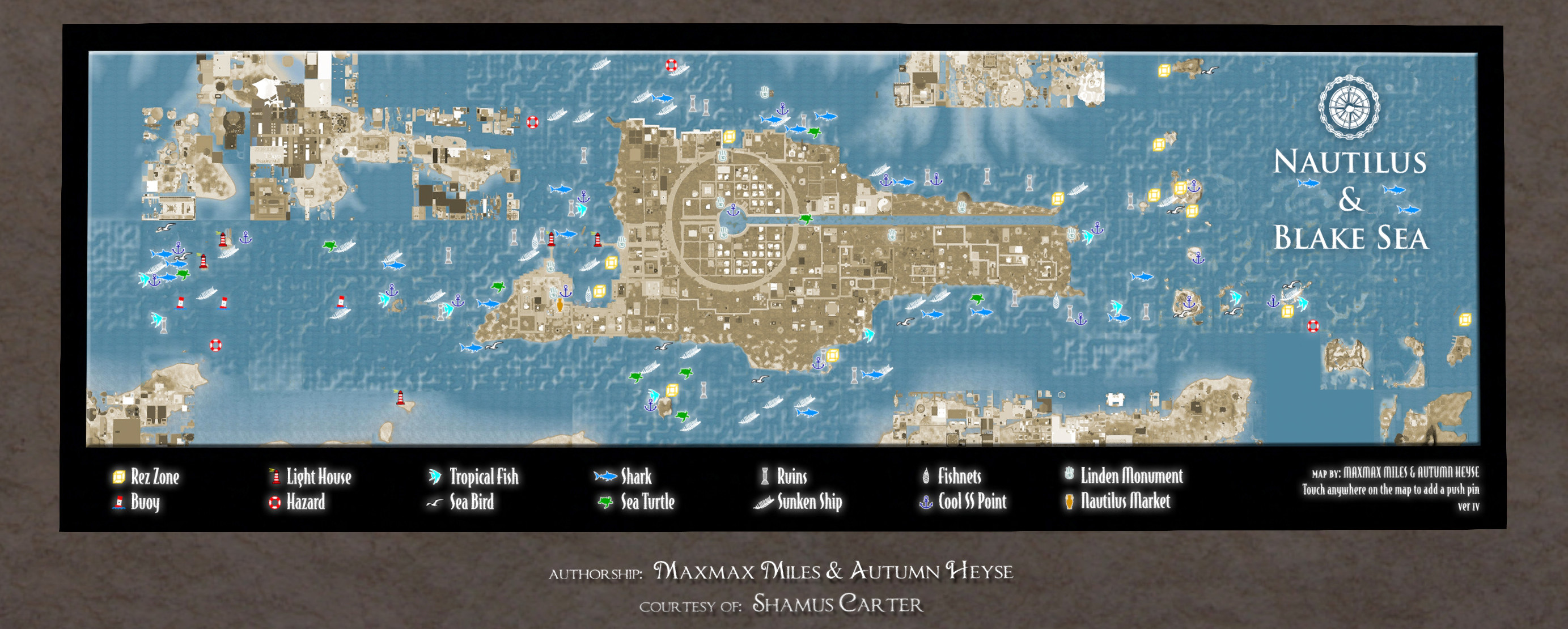
The maps start from the earliest days of Second Life – 2002 – and run through to almost the present. It encompasses “official” maps, those produced by SL cartographers depicting the Second Life Mainland continents, and specialist maps charting air routes, airports, the SL railways, specific estates. Not only are they informative, some stand as works of art in their own right, as with the map of Nautilus, below.

New Kadath Lighthouse Art Gallery: Second Life Maps

Alongside of the maps is a veritable treasure trove of information that any Second Life historian is liable to fine mouth-watering, as well as a certain amount of practical information poking at the technical intricacies of the platform. You can, for example, look back to 2007 and see why Anshe Chung became the first “SLebrity”, appearing on the cover of CNN’s Business week as her Dreamland “empire” as it stood at the time shown in all its glory. Or you can take a peek at Second Life as it stood in March of that year – a time when it had in total roughly the same number of private and Mainland regions as Mainland has on its own today.

Elsewhere, you can look back on Second life Birthday celebrations of the past, the gallery featuring SL12B, one of the celebratory events organised entirely by residents and referred to as the Second life Birthday Community Events (2012 through  2018), when Linden Lab completely stepped back from direct involvement in the event’s annual planning and execution. Or you can catch up on the very latest acquisitions for the gallery, such as Rydia Lacombe’s map of SL railways I recently wrote about (see: Mapping Second Life’s mainland railways).

New Kadath Lighthouse Art Gallery: Second Life Maps

The latter underscores the point that this is a living museum / exhibition. Since my original article on the gallery, Juliana has continued to curate and grow the exhibits on display, growing to incorporate further items of interest new locations in Second Life, as well as retaining those special items of SL history like the guide to the legend of Magellan Linden.

Thus, as well as the railway map noted above some of the elements that have been added since my last piece include a display of other map resources in Second Life, which includes information on David Rumsey’s excellent collection to physical world maps (see: If maps are your thing, Rumsey’s the king!), while maps and images of Bellisseria ensure the gallery is right up-to-date with the growth of Second Life continents.

New Kadath Lighthouse Art Gallery: Second Life Maps

What makes this exhibition especially worthwhile is the sheer depth of information presented. Individual maps / displays are presented around the walls of the gallery with large information panels alongside or under them, complete with citations, while gear icons provide further access to information – note cards, landmarks, links to external web pages, and so on. All of which makes this a first-class practical resource.

If you’ve never visited the New Kadath Lighthouse Art Gallery, then regardless of your level of interest in Second Life history or maps in general, I really cannot recommend it enough. It is guaranteed to captivate, and is a genuinely educational visit. And while there, please do use the books on the landing point to visit other points of interest in the region.

New Kadath Lighthouse Art Gallery: Second Life Maps

SLurl Details