In January, I relayed the news that Bryn Oh was one of 17 recipients of grants from the Ontario Arts Council. At the time she received news of the grant, Bryn indicated that some of it would be used in recreating and filming her outstanding The Singularity of Kumiko (which I wrote about here). On July 24th, and following a premier at Indie Teepee on July 21st, she formally released the finished machinima on YouTube.
In rebuilding the installation for the filming, Bryn has made a few changes, and as she notes in her post on the film (which I’m actually unable to link to directly, due to her post not having a title of its own, so I can only direct you to her home page), she’s also incorporated scenes in the film which are not present in the in-world installation. None of these changes in any way alter the narrative arc of the piece; rather they allow the film to further stand as a valid and independent artistic interpretation of the installation.
This is the third grant Bryn has received from the Ontario Arts Council with respect to her work in Second Life, noting, “I also would like to thank the Ontario Arts Council for their continued support over the years … It is very rewarding and encouraging for me to know that such an establishment sees the virtual space as a powerful and unique tool for creating art.”
The Singularity of Kumiko was, and remains an extraordinary demonstration of immersive art and storytelling in Second Life, and one fully deserving to be preserved within this film. The installation itself remains open on Bryn’s home region of Immersiva. Regardless as to whether you have visited it before, please do take this opportunity to visit it in person whilst it is available.
Bryn, whose work is known and appreciated by many in Second Life, is one of 17 recipients in the latest round of grants awarded by the Council, and this marks the third such time her work in the virtual medium has received funding via a Canadian government grant.
The funds will in part be used to re-assemble and film The Singularity of Kumiko, and to create a first life exhibit using the Oculus Rift and Stem system. In addition, Bryn also notes the grant will additionally be put towards various other projects and activities, including marketing, voice acting, music, and travel.
From the thrust of Bryn’s post, it seems she is hoping the film project will help further her work in seeing immersive virtual arts gain wider appreciation, understanding and acceptance within the arts community as a whole. In making her announcement she notes:
I have spent a long time working in this area now and have witnessed the resistance of some curators to see outside their comfort zone. Many curators have spent a life learning how to evaluate and understand painting, sculpture, film etc and to be honest, I think some of the resistance is from being intimidated by the prospect of having to learn something completely new and difficult for them.
The truth is that to understand an immersive artwork then one must become immersed, so the simplicity of pictures and text don’t apply to the Immersivist artwork and a curator just can’t hope to evaluate our artform by looking at pictures or even watching machinima. They have to experience it and it’s not easy to do so.
Using a VR HMD with 360-filming would certainly help those unfamiliar with immersive, virtual art better understand the creative potential without the added complication of them having to need to understand the use of avatars, the viewer, and so forth.
The opening scene of The Singularity of Kumiko
The Singularity of Kumiko, which I reviewed here, originally opened in February 2014, and takes the form of a an immersive narrative which takes the visitor on a journey of discovery, focus on the exchanges between Kumiko and Iktomi (the latter communicating by means of letters placed inside bottles the visitor must find, while Kumiko uses a mixture of bottled missives and the spoken word.).
The journey the visitor must take, as with the flow of conversation between Kumiko and Iktomi is not always linear, further drawing the visitor into the piece and making them a part of the unfolding story. If you didn’t managed to visit it the first time around, I hope Bryn will leave it standing for visitors to enjoy for a while after she has completed filming.
In the meantime,her current work at Immersiva, The Gathering (which you can read about here), will remain open, Bryn says, for another month, after which it will be packed away to make room for The Singularity of Kumiko. so if you’ve not yet witnessed The Gathering, now is the time to do so!
Many (and belated) congratulations to Bryn on receiving the award!
Bryn Oh’s latest installation on her home region of Immersiva opened on Sunday, March 29th. Entitled Lobby Cam, it is, in keeping with her previous works there, a full region installation; albeit one which, on the surface at least, seems a lot less complex than pieces such as Imogen and The Pigeons or the more recent The Singularity of Kumiko. But as we know with Bryn, all is not always as it may first appear to be.
Bryn has always embraced the so-called digital divide, and by doing so remove it somewhat from people’s view. Her virtual work has often incorporated elements of her physical world artistry, while her work in the physical world has frequently encapsulated her virtual art. Lobby Cam takes this a stage further, as it places a number of Bryn’s paintings front-and-centre within the installation, which itself appears to have its origins painting possibly inspired by a trip to Sasakatoon and the surrounding region of Saskatchewan in Bryn’s native Canada.
The artwork is on display in a lobby-like gallery to one side of the region – although this is not the lobby to which the title of the piece refers. Here visitors can obtain a HUD (free of charge) which presents the wearer with a journal forming the hub of an unfolding story. From here, the visitor can progress through the gallery space, reaching a wall on which is mounted a copy of the painting on which a good part of the installation is based. As this is approached, the wall breaks apart, allowing access to the rest of the region.
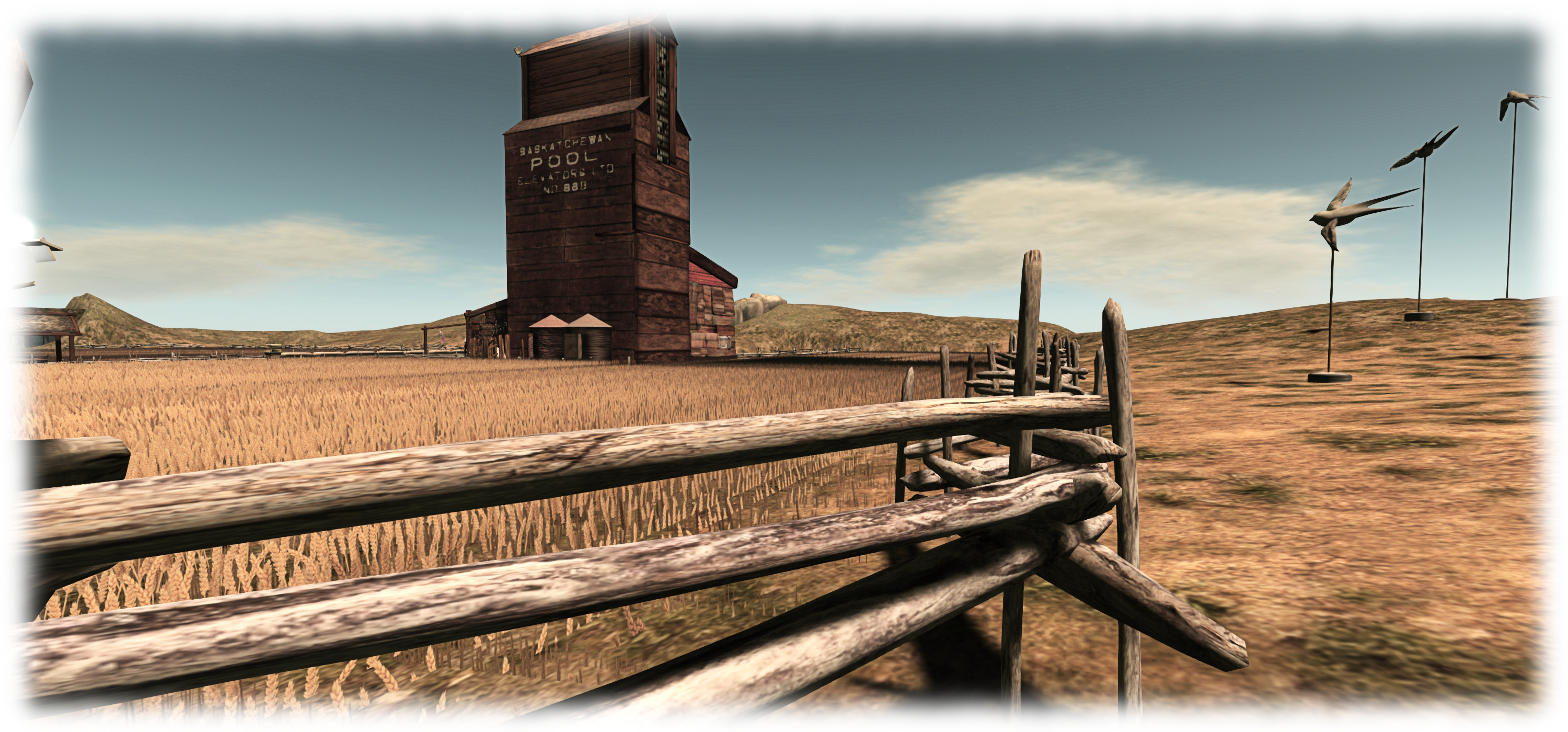
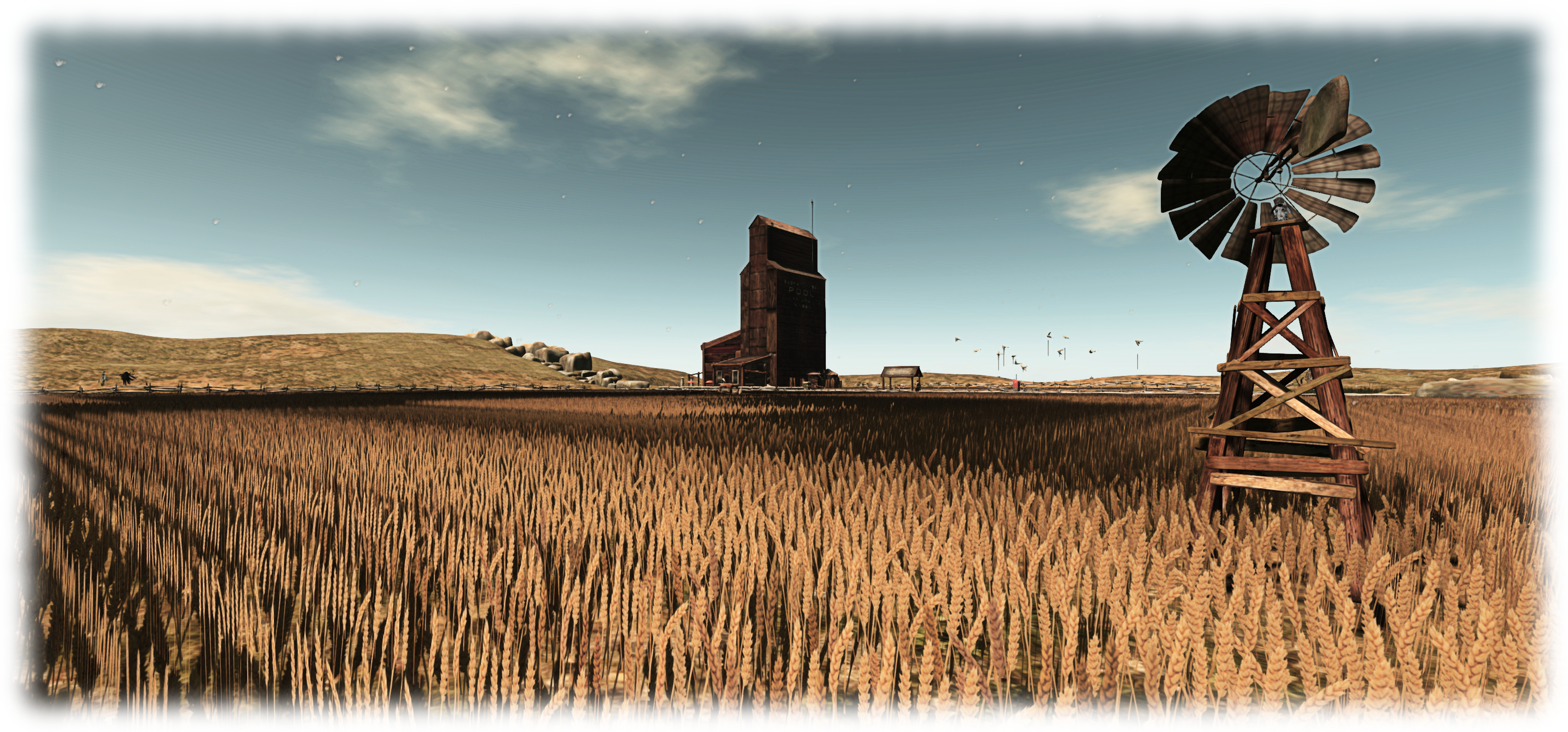
Most of this is given over to fields of wheat which stretch off to the horizon, and from the midst of which a huge wooden grain elevator rises bluntly into the sky. This is not just any grain elevator, however; it is No. 888, originally built in Keatley, Saskatchewan in the late 1920s as a part of the Saskatchewan Wheat Pool, but which was moved in the 1980s to North Battleford, some 137 kilometres (86.5 miles) north-west of Saskatoon, where it was restored as a museum.
Such grain elevators where once widespread across the prairies, and early photographs of Saskatoon itself show just such an elevator located alongside the railway tracks on the edge of the town, forming something of a focal point. Within Lobby Cam, the elevator sits as a focal point within a broad spread of wheat, like some tall ship riding the sea, the rippling wheat, which moves to the SL wind, the waves beneath its prow.
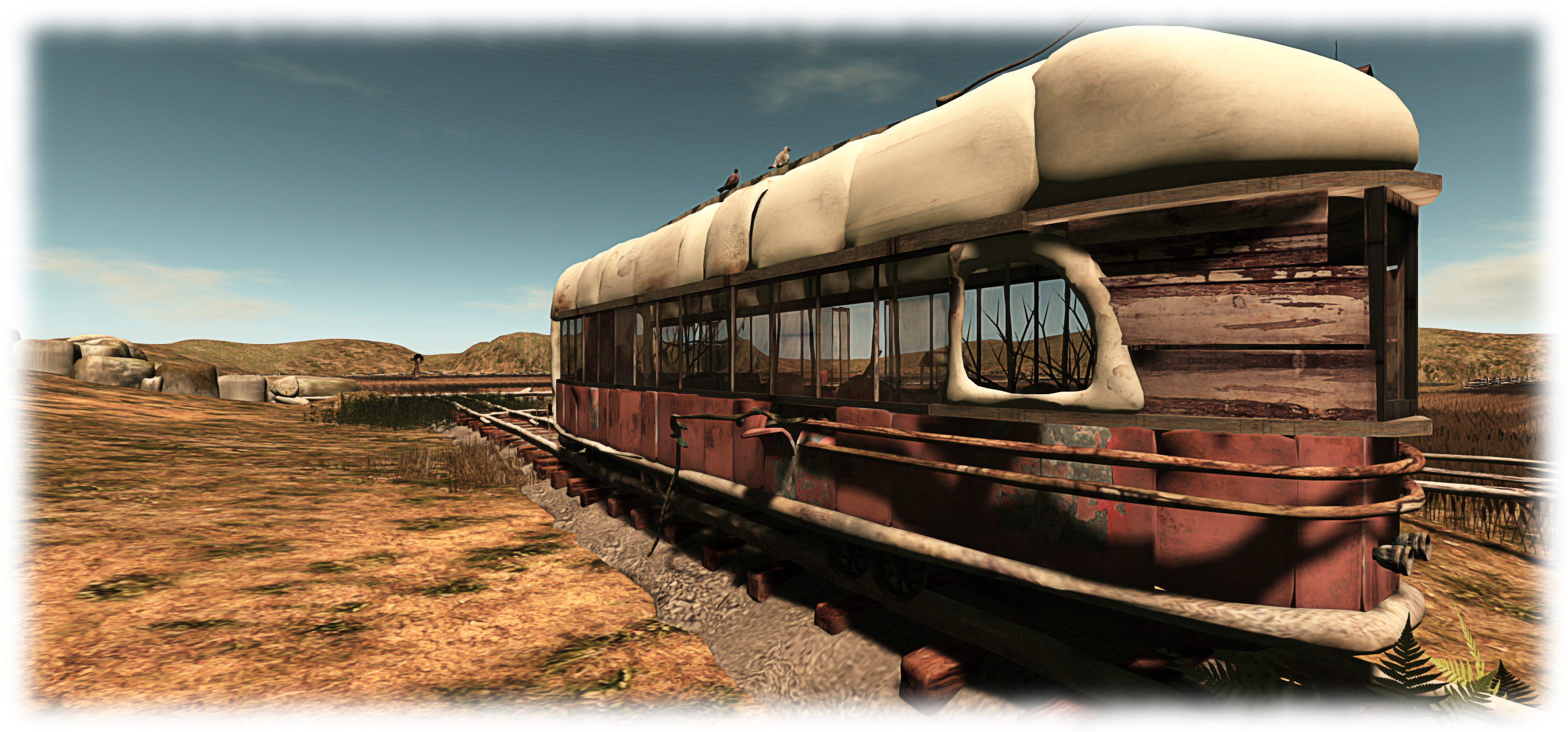
Given its size, the elevator is a natural destination, and there are several floors within it to be explored, including the upper floor which links back to the HUD-based story, which I’ll get to in a moment. Further across the fields, towards the south-east corner, sits the battered bulk of an old Toronto streetcar, doors and windows broken, a part of it boarded-up as vines wind their way through it. Elsewhere amidst the wheat visitors will also find the rusting hulk of a old pick-up truck, sitting like a raft in the middle of a yellow ocean.
All of these pieces are perhaps emblematic; a commentary on the passage of time and the changing of ways. They also help to attract one’s attention to elements of the unfolding story. As mentioned above, the HUD obtained at the start reveals a journal. Initially, only the first few pages can be read but, explore the region and you’ll come across more, which are automatically added to the journal as you do so, allowing more of it to be read. I’ll not say too much more on this, other than you should take a little time in your explorations, as there are pages and more to be found.
Lobby Cam
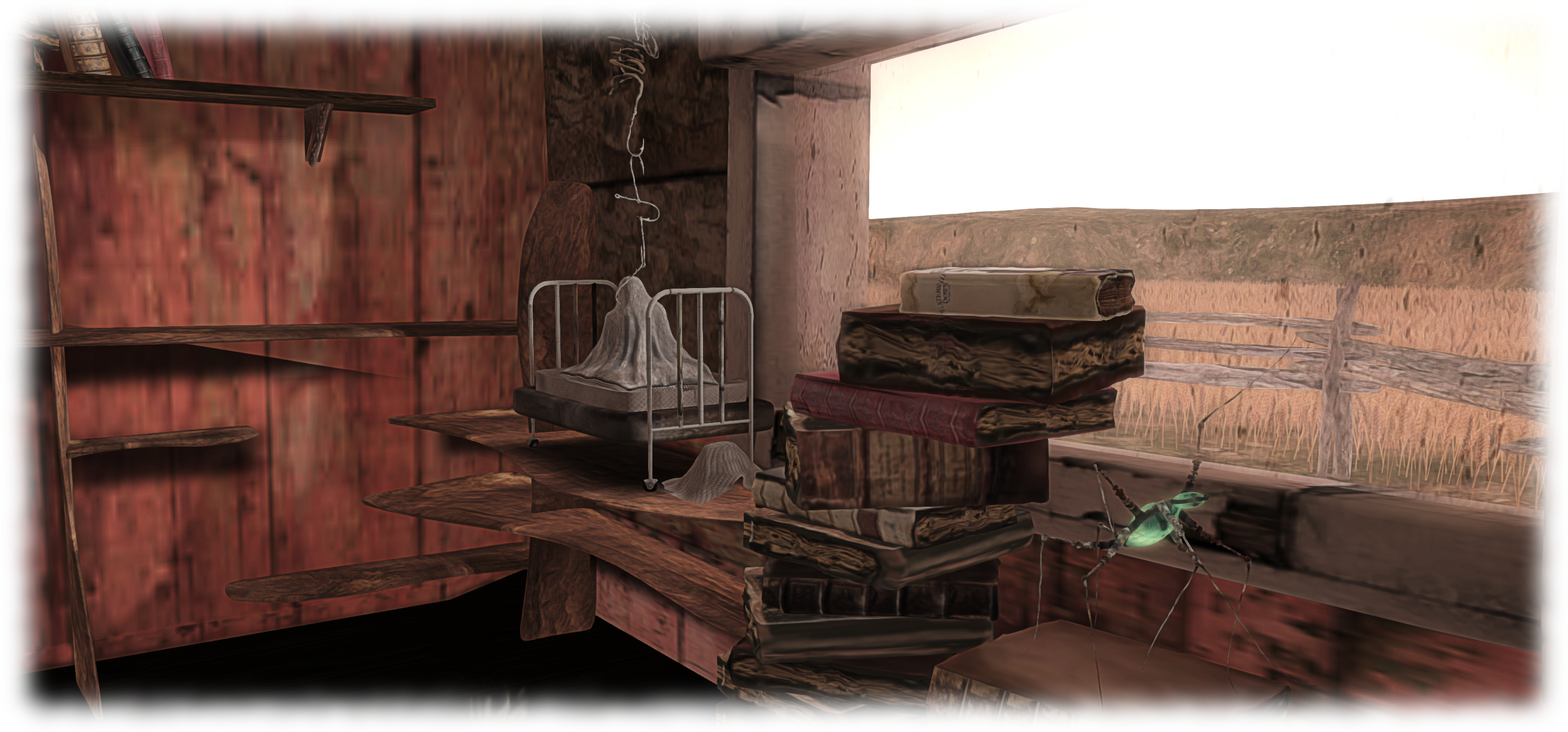
Throughout the build, there are many references to some of Bryn’s other works, some obvious, some perhaps less so. Such motifs are not uncommon to her work, and they add both depth and familiarity to her pieces.
In the default windlight (I’ve taken the liberty of using a different windlight in the images here), the entire installation has something of a “rough” look to it colours in places – such as on parts of the grain elevator – can look a tad odd to the eye, which the old Toronto streetcar might at first look like a badly-made model. However, this is entirely intentional.
As already noted, the entire installation is essentially the recreation of a painting; thus, the colours and rough uneven surfaces and (in places) blocky finish to various elements in the installation are all redolent of the colours and textures found in the original painting.
Bryn’s work can often be taxing for some computers, and Lobby Cam is no exception, although Bryn has once again put considerable effort into minimising any loss of performance that might be experienced. She also offers some notes on how to lessen the potential impact and improve your experience – including trying SL Go (Bryn has no affiliation with the service, but recognises it as a means by which those on lower-end systems can perhaps better enjoy the installation). These notes can be read directly in-world at the HUD dispenser, or obtained via note card by clicking the information board above the HUD dispenser, or via Bryn’s blog, which includes the introductory trailer video I recommend you watch, if you haven’t already.
Lobby Cam offers-up another intriguing piece from Bryn, which as noted at the top of this article may initially appear less complex than some of her other work, but which is actually beautifully layered.
Bryn Oh is perhaps one of Second Life’s most respected and well-known artists. Her work spans the last seven years of SL’s history, and her installations have been visited by many in that time, whilst also making frequent appearances in the Destination Guide. Over the years, her pieces have grown from static sculptures to region-wide art-focused experiences, rich in narrative and elements of gameplay. It also spans the virtual and physical divide, having appeared at exhibitions, shows and festivals around the globe, marking her as an internationally regarded digital artist – in every sense of the word “digital”.
Such is the extent of Bryn’s work, that and in-depth retrospective is perhaps long overdue. Chance Acoustic and Art Blue have offered a modest, but attractive means of celebrating Bryn’s work through A Room for Ferrisquito. However, Bryn’s catalogue is so vast, it cries out for something more extensive.
Until recently, Bryn has fought shy of offering such a retrospective herself. However, she was recently invited to participate in the Art & Algorithms digital festival in Titusville, Florida, where she is one of a number of digital artists exhibiting their work through the festival’s digital lounge, and thus Bryn Oh retrospective 2007-2014, has been born.
This is a comprehensive study of her work, which might be said to span two locations in SL. The primary focus for the retrospective is a region-wide installation at LEA9, where visitors can explore the development of her art over the years chronologically. The second element – primarily aimed towards to the Art and Algorithms event, is an invitation for them to experience The Singularity of Kumiko on her home region of Immersiva – where she states she has instructed Mr. Zippers not to slaughter anyone should they do so!
The LEA9 installation is an immersive, multi-faceted endeavour involving elements of her work in both 3D and 2D together with information boards and links to machinina pieces on YouTube. Interestingly, most of the pieces on display are not Bryn’s own choices; as far as possible they’ve been drawn from suggestions and requests provided by members of her Immersiva in-world group.
Putting some of this together wasn’t easy, as Bryn informed me on inviting me to take a look around LEA9. “I discovered that all my really old work from 2007 etc., are now all unlinked and the prims migrated in some cases!” she said. However, if any of the early pieces on display had to be put back together, I’d say the time spent doing so has been more than worth it, because LEA 9 presents the visitor with a fascinating voyage through Bryn’s work – and more.
Those familiar with Bryn’s art over the years will doubtless recognise many of the items on display and regard them with fond memories; they may even trigger reminiscences about art, SL and more. Each year is presented in it own space or spaces, combining individual pieces with sets from some of Bryn’s more immersive, region-wide designs. Large signs denote the years as you come to them – make sure yo take the welcoming note card on your arrival, and do take your time exploring; there is a lot to see and read – and not all of it in the exhibition spaces, as noted there are a number of opportunities to watch machinima of Bryn’s work, such as the one below for Condos in Heaven.
Bryn is known for giving insight into her creations through the pages of her blog, where she frequently allows us glimpse her creative thinking. In many ways, this retrospective is a deeper extension of that process. Exploring it, I felt I was not so much looking back over her work of the last seven years but had in fact entered her “Country of the Mind”.
I make no apologies for using a fictional construct, as given form by Greg Bear, to describe my response to viewing this installation; if anything I’d say it was actually appropriate. “Bryn Oh” came into being as a way of exploring whether a digital character unaligned with any physical identity could gain acceptance as an artist in her own right; given the world-wide renown Bryn’s work has attained, there is little doubt she has achieved this goal.
But creativity is rarely purely an outward expression; through the creative process, we often define or enhance or influence or own thinking and perhaps reflect facets of our personalities back to ourselves as much as display them outwardly. As such, wandering through these spaces within LEA9 gave me the sensation that I was witnessing not only the growth of Bryn’s artistry within SL, but was also seeing the growth of her persona as a distinct entity separate from the human mind behind her. It’s as if each of the pieces on display, from the small to the large, form aspects of her “big and little selves”, to use Bear’s terminology, each reflecting a facet of her creativity and drive, which blend together and with her Primary Self – the human mind behind her – adding to her growth as a distinct personality. I actually mentioned this idea to Bryn as I toured LEA9; I’m not entirely sure what she thought of my perspective – but she seemed intrigued.
My point here is that this installation is more than just a simple retrospective display of past works; there is something very tactile about it which speaks as a voyage through the developing of Bryn as a personality as much as to the creative beauty of her work. As such, it is a fascinating place to visit and in which to dwell.
Certainly, this is an installation – a country – worthy of careful exploration. There is a visual and written richness to it that is engaging and well deserving of the time one can spend immersed within it. I can honestly say I have spent more than two hours within the installation following Bryn’s invitation, and I will doubtless be returning to it again.
Ferrisquito (l) displays one of the pieces of Bryn’s art
Opening in Second Life at the Rift Horizon Gallery on Wednesday September 3rd at 08:00 SLT is an exhibit by Chance Acoustic entitled A Room for Ferrisquito, featuring elements of Bryn Oh’s work from the period 2008 through 2011, and which will be marked by a special presentation by Art Blue.
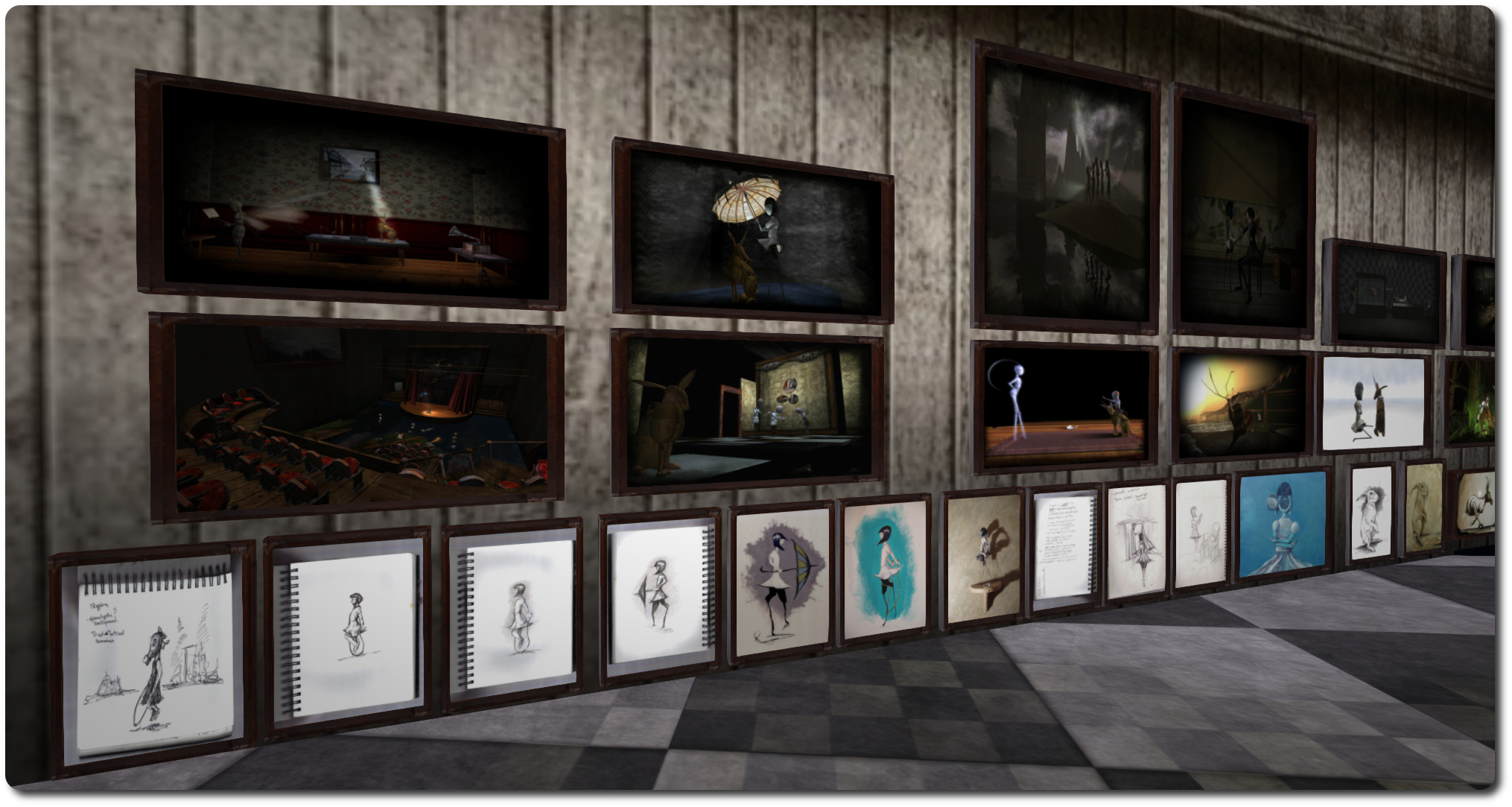
The room is situated over the gallery, so if you arrive at ground level, use the teleport sign to reach it. The oval room offers an intimate display space, with images of Bryn’s work, as photographed by Chance, framed around the curved walls, and The Consumerist Sherpa sitting on one side of the floor. Overhead, the Beetlebot presides from a high perch, watching everything.
However, the focal-point for the exhibit is Ferrisquito, an angelic-appearing character, who can be summoned via a wall panel close to the “door” into the room. When summoned, he’ll acknowledge in chat, then duly arrive and stand on a pose ball. Once there, he’ll rez elements of Bryn’s work, displaying them on the floor space around him and sometimes overhead in the upper gallery area which can be reached via the staircase, allowing them to be viewed and examined by visitors.
In all, there are 25 3D pieces of Bryn’s work to be seen, comprising: Under the Poumbrella [poembrella], Mayfly machinima, Downloading …, The Violinist, Run like a fawn, Run Rabbit Run, Mother, Feed me, Steamdragon, Wee little Steamclock, Standby, Carriage, Consume, Poumbrella, Pouncing Fox, Confused eyes, Bryn Oh´s bicycle, The Rabbicorn, 26 Tines, Cerulean, Willow, Angler Girl, The Violinist and Nightmare. Ferrisquito himself is a reference to the icon representing the robot theme park featured in Immersiva, while the room in which the pieces are displayed is seen by the Art Blue and Chance as a time capsule, designed to keep the pieces forever safe and available for display for as along as Second Life exists.
In keeping with this idea of time, the exhibit’s opening will feature a short play by Art Blue entitled Knowing. Lasting 20 minutes, it involves a story of time travel, an attempt to uncover the secrets of life, and the discovery of Bryn’s work; all of which is narrated by an owl, Nervual. Following this, visitors will be invited to enjoy Chance’s images of Bryn’s work, and witness the arrival of Ferrisquito, ready to reveal the 3D pieces he carries with him. Visitors will also be invited to collect a special book of images and text from the exhibition as a keepsake of their visit.
Following the opening of Ferrisquito in Second Life, Art Blue will also be hosting an exhibition on Metropolis grid featuring the room, together with two of Bryn’s 3D pieces – the Beetlebot and the The Consumerist Sherpa, – for which he has had special permission to transfer to Metropolis grid. The exhibit will form part of his Vulcanicus OpenSim art time capsule.
This opening on Metropolis grid will be marked by a special event in which Art Blue will call the room and its surroundings into existence before his audience, the artist giving form to a new “world”. Those wishing to attend the event should contact Thirza Ember via the HG Safari Facebook group, as sitting is limited for the performance.
Bryn Oh opened her latest immersive piece The Singularity of Kumiko on Friday February 14th – and believe me when I tell you, it is something you are really not going to want to miss.
It’s an amazing piece, demonstrating the visual and intellectual power evident in Second Life as a medium for expression, art, discussion on the nature of death and the potential to live beyond it, and for creating an immersive, involving narrative.
The essentials lie within in communications involving two people, Kumiko and Iktomi, who are an ocean apart. Some of these (from Iktomi) come solely in the form of messages in a bottle, while some of those from Kumiko take the form of the spoken word as well a bottled missives.
These have a strange dynamic which immediately draws one into the story, making one a part of it. The discussion revolves around loss (and being lost), the potential for immortality (of a kind) which Iktomi appears to have perhaps embraced and tried to have Kumiko to do likewise, perhaps almost desperately so, although how or why – or what has happened is something which must be pieced together.
I say “pieced together” because the narrative is entirely non-linear. The exchanges between the two are scattered across the region, and one must discover fragments through exploration and discovery of the bottles (and where present as well, the microphones), which are to be found in small vignettes and scenes through the region, some of which are almost connected by broken roads, while others are linked by narrow passageways or sit on open plains or within the house you’ll (eventually!) find.
This may sound easy; but trust me, it is not. Bryn has created an environment that is very, very dark, and visitors are reliant upon a headlamp and points of local light. The result is that you almost have to feel your way around the installation, distant points of light drawing you forward until a scene appears in front of you, like a sudden flash of memory in the darkness or a connection with … something … In this way, Bryn powerfully draws you into Kumiko’s world and her condition – although precisely what her condition is may not be apparent. This is also intentional; you are on a journey of discovery, one in which you very much become a part of the story itself.
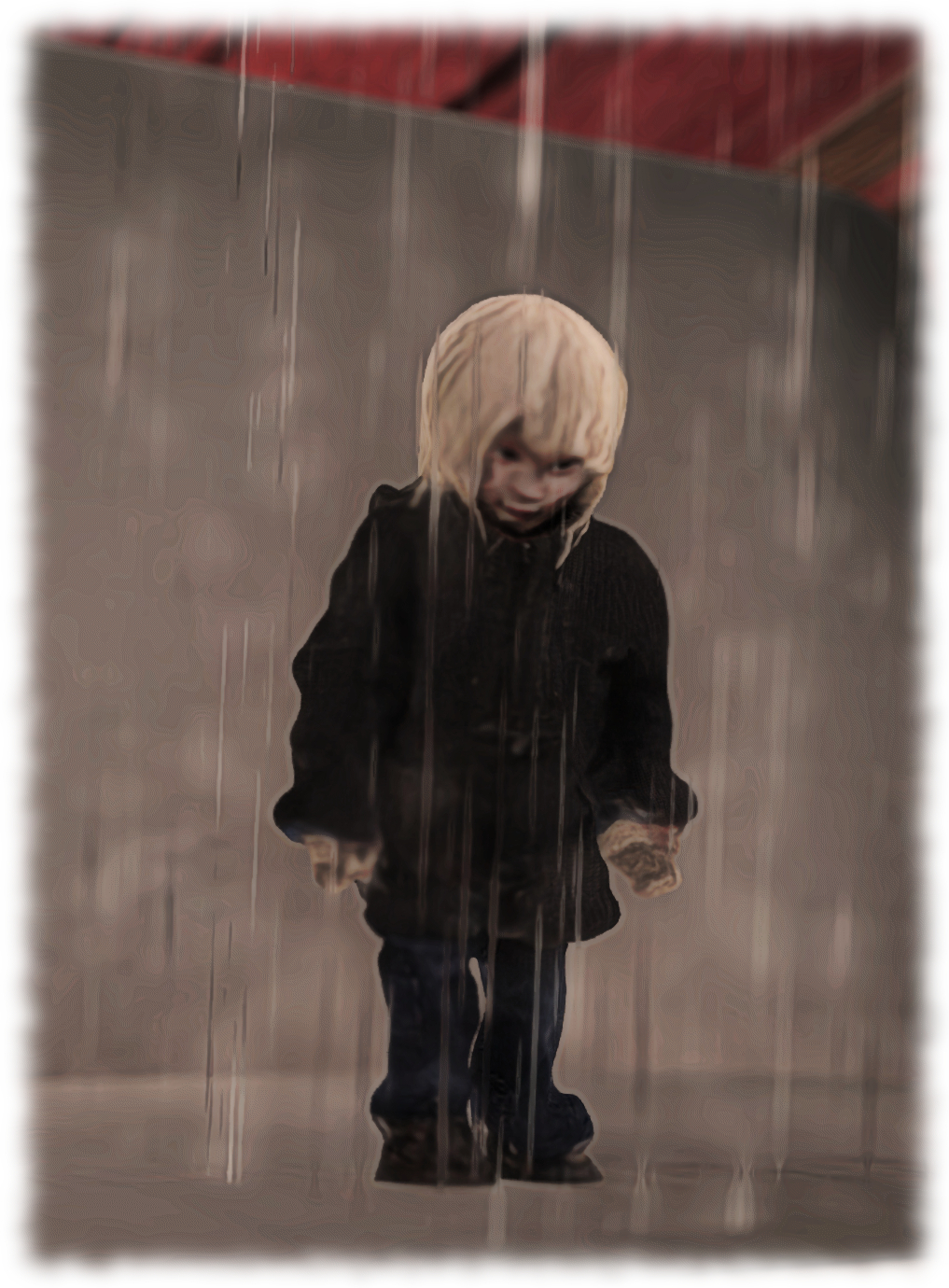
Be warned, however. This is also a dangerous place. Just as death, and survival beyond it, form a part of the exchanges between Kumiko and Iktomi, so to can you experience both in your travels. Damage is enabled, and “death” can be visited upon you by an aggressive rabbit called Mr. Zippers”. Once a much-loved toy from Kumiko’s past, offering her protection (comfort), Mr Zippers is here transformed into something far more physically protective of her. Listen-out for the squeaking wheel in the darkness and get ready to run …
Imagery throughout the installation is incredibly powerful and multi-faceted. Not only is it in the extraordinary exchanges between Kumiko and Iktomi (some of which are beautifully brought to life through the voice of Jenna Stillman (Akonia Resident) as well as through Bryn’s writing) and the vignettes one encounters while exploring, it is also in the soundscape one experiences whilst exploring; there is even reference to Bryn’s earlier work, Imogen and the Pigeons. Together these help give one a sense of familiarity with Kumiko (through exposure to Imogen), whilst also immersing us further into Kumiko’s world and situation. similarly, the title of the piece and the use of the term “singularity” suggests multiple approaches to the work, depending upon whether own looks at the word in terms of complex analysis, natural sciences, literary studies, technology or science-fiction.
To be enjoyed to the fullest, you’ll need to set-up your viewer in accordance with the instructions given at the arrival point. Note that having the Advanced Lighting Model option in Preferences > Graphics is preferred (although you don’t need to have shadows enabled as well). This may impact the performance of some low-end systems, but if you can manage it, your experience in seeing the various elements of the build will be greatly enhanced.
Bryn has done much to try to reduce lag within the region as much as possible, up to and including limiting the numbers allowed in at any given time to just 10-15, something which means you may not get a successful TP to the region at times, but which also further heightens the sense of immersion, as you’re less likely to bump into others.
Several people have helped Bryn bring this piece to life; they are listed in an acknowledgement posted in the arrival area. They should all feel justifiably proud of their input into this piece. Without wishing to overstate matters, it really is remarkable.






 Inara Pey: Living in a Modemworld