May 20/21 2012 saw an annular eclipse of the Sun. This is when the disk of the Moon comes between the Earth and the Sun, but the Moon is moving towards apogee in its orbit (the point at which it is furthest from the centre of the Earth), so that while the Sun, the Moon and the Earth are all aligned in syzygy, the disc of the moon is not large enough to cover that of the Sun to leave only the solar atmosphere visible (as with a total eclipse), but instead sits “inside” the disk of the Sun, creating what is called a “ring of fire”.
The eclipse was observable from China through Japan, Canada and much of the US from the west coast through to Texas. Images of the event were carried via a number of streams across the Internet, allowing thousands more to share in it.
I watched the event on-line (the sun having set in the UK a long time before the eclipse took place), along with a number of other SL friends who are also interested in astronomy, leading to a lively discussion about the eclipse itself and the possibility of hosting similar events in-world in the future. Our main stream for watching the event was provided by SLOOH Space Camera, which had cameras active in both California and New Mexico, although I was also keeping an eye on another feed from Reno, Nevada, which was transmitting via Ustream.
Annularity captured by the SLOOH camera in New Mexico, May 20/21 2012
SLOOH is a superb resource for people interested in astronomy and space exploration, regularly hosting events like observing the eclipse and their images are really excellent. I took the liberty of capturing screen shots of the event, as seen through both of the SLOOH cameras and have put them together in a Flickr slideshow (together with some initial images from the Reno feed and a brilliant photo obtained via the BBC) to try to capture the event.
A closer view through the SLOOH New Mexico camera. Note the sunspot close to the black disk of the Moon
The next major astronomical event SLOOH will be covering is the Transit of Venus next month, and if technology allows, there may be a chance people will be meeting-up in Second Life to witness the event, which will not occur again for another 105 years. If this can be arranged, I’ll be carrying information on the gathering on this blog nearer the dates of the transit (June 5/6).
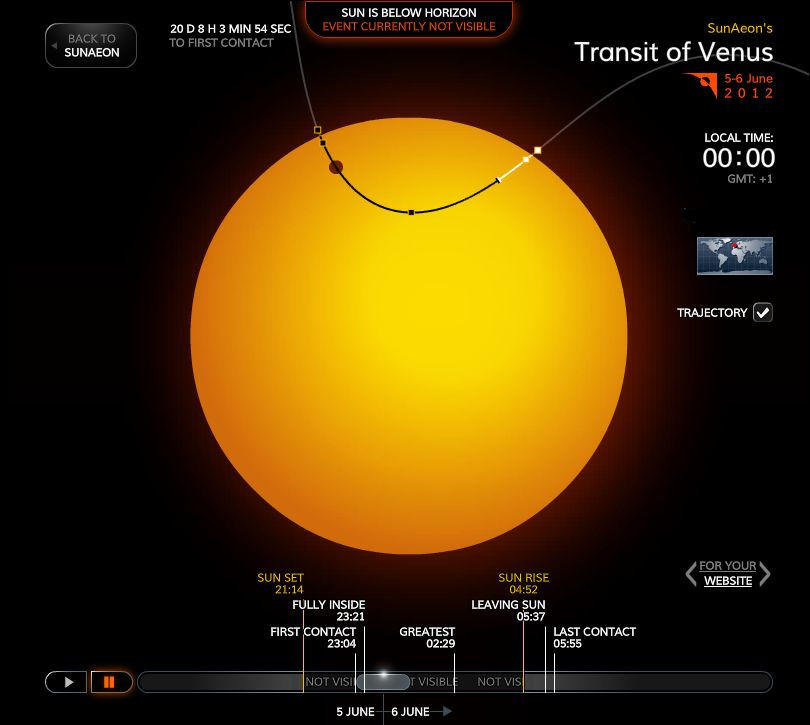
SunAeon has added a new model to their website: Transit of Venus. As the name suggests, it tracks the forthcoming transit of Venus across the disk of the sun which will occur on the 5th / 6th June 2012, and allows you to experience the transit, even if it is not visible from your location at the time the event occurs.
Transits of Venus across the disk of the Sun are among the rarest of planetary alignments. Only seven have occurred since the invention of the telescope (1631, 1639, 1761, 1769, 1874, 1882 and 2004). Such transits are only possible during early December and early June when Venus’s orbital nodes pass across the Sun, and have a pattern of recurrence at intervals of 8 and 121.5 years, then 8 and 105.5 years. This means that the next close pairing of transits will occur over a century from now in December 2117 (105 years from this year’s transit) and December 2125.
According to NASA, “The entire transit (all four contacts) is visible from northwestern North America, Hawaii, the western Pacific, northern Asia, Japan, Korea, eastern China, Philippines, eastern Australia, and New Zealand. The Sun sets while the transit is still in progress from most of North America, the Caribbean, and northwest South America. Similarly, the transit is already in progress at sunrise for observers in central Asia, the Middle East, Europe, and eastern Africa,. No portion of the transit will be visible from Portugal or southern Spain, western Africa, and the southeastern 2/3 of South America.”
The SunAeon Transit of Venus model
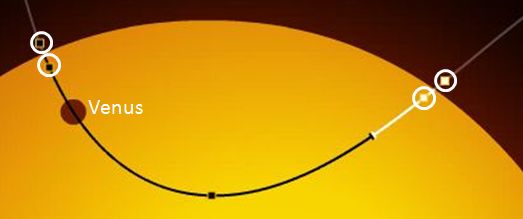
The SunAeon model is an animated representation of the transit, showing all four contacts together with a timeline of events at the bottom. Starting the model with advance the animation through the entire transit sequence, with annotations clearly showing if / when any portion of the transit is visible from your geographic location – making it a handy tool for determining if you want to observe the transit for yourself (and if you do, please observe safe methods of doing so).
For those running astronomy websites, the model also includes a tool for generating code which can be used to embed it in your site.
Venus in transit and the four contacts (circled) in the model
About SunAeon
SunAeon is an educational / immersive project being run by a small team based in Slovakia. It presents an interactive model of the solar system users can explore at leisure, visiting worlds examining data, etc. The team is planning to add further models to the main SunAeon portal, together with other features, including opportunities for social interaction.
Immersive, virtual environments come in many forms – and those developing them are seeking some novel approaches to developing such spaces that can be interactive on both an individual and a social footing.
Last year, I explored The Blu, which took this idea into the oceans of the world, allowing people to explore water, collect fish, interact with one another and create content with which to populate the various oceans.
Yesterday, I was pointed to another immersive environment which is still in what might be called a “beta” (or at least, start-up) phase, one which takes a far grander setting in which to immerse users: the cosmos around us.
SunAeon is an amazing educational / immersive project being run by a small team based in Slovakia, who have already cut their teeth producing a number of 3D interactive services including Sun / Moon Scope (which shows the current position of the sun and Moon (with the current phase of the latter) from your location, at either the current time or any given time of day) and Astrology Scope (which is an interactive guide to astrology).
The team’s latest project is the Solar System, a fabulous interactive model of the Solar System that is still under development, and which builds on much of the experience the team gained in building Solar System Scope, itself a unique and immersive study of the solar system and the stars around us.
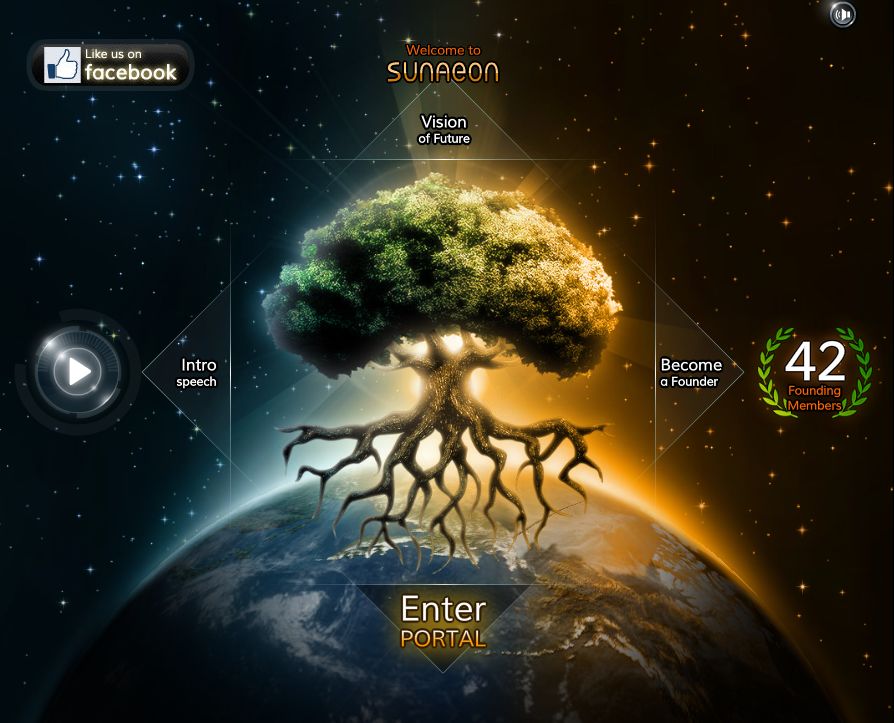
The SunAeon portal
Solar System is the first step in a new SunAeon portal site that will present various elements of astronomy and space exploration aimed at the astronomy / space enthusiast, the armchair hobbyist and at education. As well as providing a unique means of learning about our solar system and the cosmos as a whole, the overall aim of the portal is to eventually include a rich diversity of content, including multi-player games and a range of social engagement options. No special software is required and nothing needs to be downloaded or installed. Everything runs directly on your browser, making accessing the portal a simple matter of clicking on the URL.
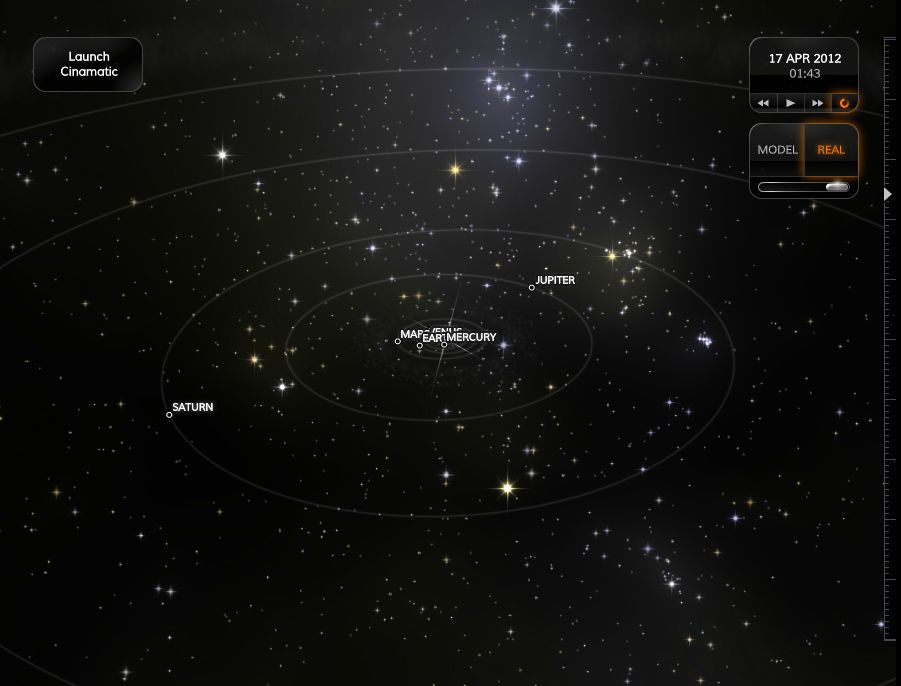
Solar System, as its name suggests, is a beautifully rendered 3D model of the solar system that provides users with an immersive means to discover and explore the worlds around us. The solar system itself is presented in two views: “model” and “real”, the key difference between the two being that of relative scale (see below). There is also a “cinematic” mode that takes you on a tour of the “model” view of the Solar system, the camera sweeping from planet to planet.
SunAeon “model” view (click to enlarge)SunAeon’s “real” view of the solar system (click to enlarge)
In either view, you can use the mouse to scroll around the solar system and view it from different angles. You can also zoom in/out using the vertical slider on the right of the display. To zoom in on a planet, hover the mouse pointer over it so it is outlined (easier in “model” view) and double-click.
Once zoomed-in on a planet, you can either orbit around it using the mouse, viewing it from the “day” or “night” sides or even across the terminator – or you can use a set of media controls to observe the planet as it rotates about its axis. Relative rotations are in “real time” comparative to one another, meaning that there is a marked difference between the observable rotation of say, Jupiter (which completes one rotation every 10 hours), and Venus (which completes one rotation every 243 days). Buttons on the media control panel allow you to speed-up planetary rotation if you wish.
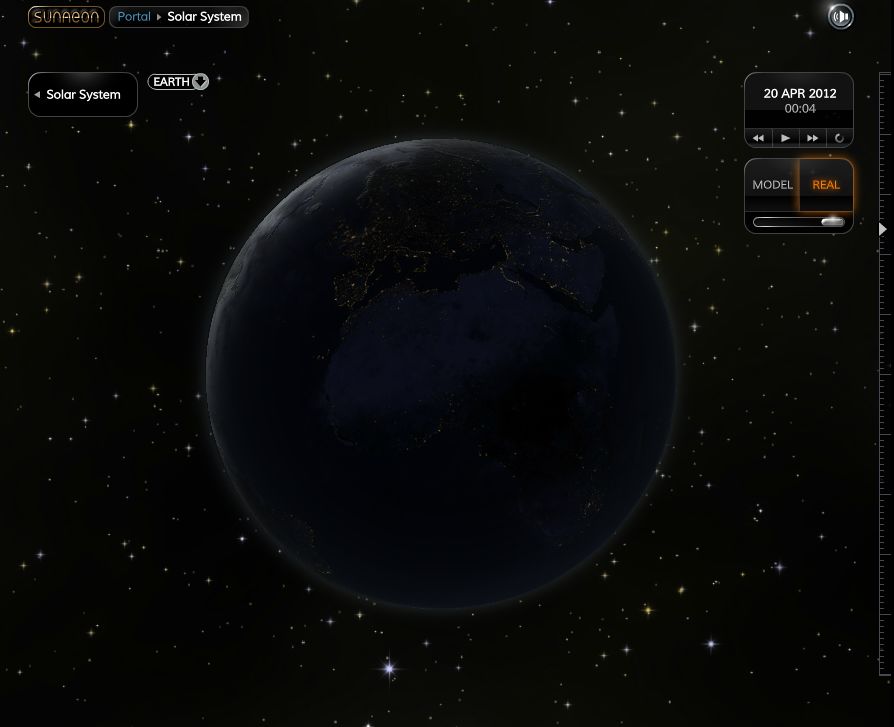
Earth by day … (click to enlarge)…and by night (click to enlarge)
The media controls are also available from the main Solar System page, where you can view all the planets currently modelled and set them rotating about their axes and travelling in their orbits around the sun. In the model view, and seen from overhead, this offers a very visual means of demonstrating “close approaches” between planets.
At the moment, Earth is the most animated of the planets: as you orbit it / allow it to rotate, you can see cloud swirling and moving through the atmosphere on the day side, and the myriad lights of population centres across the night side of the globe. Other planets are currently more static in nature, although the team are working to change this with a module called Planetary Explorer, which will present the planets more dynamically.
The first phase of this tool was rolled out as this article was in preparation: alongside each planet is a clickable drop-down window that displays basic data on the planet. Over time, the capabilities of the Explorer will be enhances, as SunAeon team member Mito Sadlon explained to me, “You’ll be able to use it to observe the surface and atmosphere of each planet. We’ll have a more extended version of the Explorer available in the coming weeks.”
Phase one of the Planetary Explorer – launched while this article was being prepared
Also missing, as the keen-eyed will observe, are key elements of the solar system – such as Pluto and our own Moon. The team are working on adding these, and also the two captured Moons of Mars: Deimos and Phobos and the four Galilean moons of Jupiter: Callisto, Ganymede, Europa and Io.





 Inara Pey: Living in a Modemworld