Studies in light and shadow, and Photopoetry in Second Life

Gallery Asaki Yume Mishi, Jan / Feb 2024: Noa Cloud – Photopoetry

I recently had the opportunity to visit two small and very different art exhibitions presented by two diverse creative talents in Second Life; and while they are entirely unrelated in terms of their visual composition and content, both appealed to me in such a way that writing about both within a single article struck me as not unreasonable.

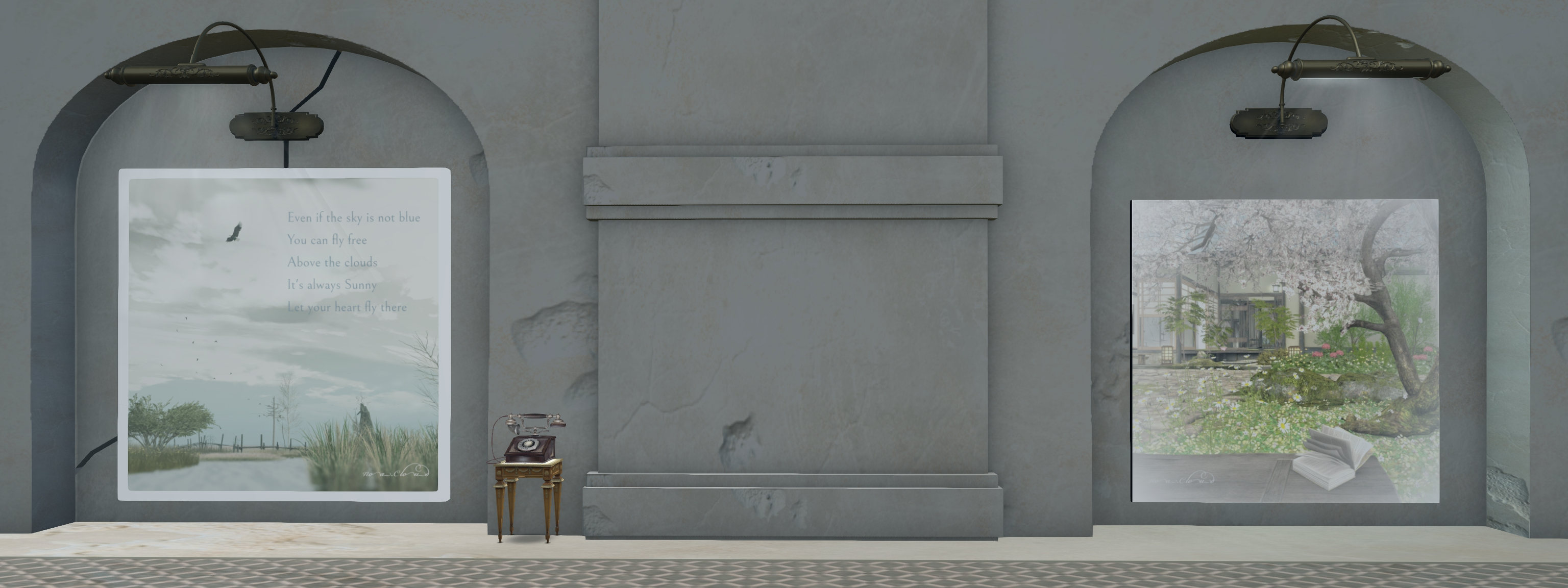
The first is a very modest – I wish it were more extensive! – exhibition by Noa Cloud, presented at the Gallery Asaki Yume Mishi, which has a novel underwater setting. Noa is perhaps best known amongst SL explorers as the holder and creator of [REN], with its seasonal designs and opportunities for photography (and which is also the home of his own gallery); however, he is also a gifted writer, a musician and actor, and an explorer of Second Life as well as an expressive photographer of both avatars and Second Life landscapes.

Gallery Asaki Yume Mishi, Jan / Feb 2024: Noa Cloud – Photopoetry

Within Photopoetry, Noa combines both his writing and his photography both directly and indirectly. Directly, because within the selection of pieces is a slideshow featuring all six of the presented pieces taken from around Second Life, each with its own single-stanza poem presented in both Japanese and English. As I don’t speak Japanese myself, I cannot say of they all form traditional Haiku, but the flow of their English metre suggests they are free-form Haiku (which do not necessary follow the 5-7-5 on), and each certainly has an implied kigo.

Indirectly, because while the combination of each image with a poem leans the observer into a line of thought suggested by the poet-artist, Noa also includes the six pieces individually around the gallery space (and within the slideshow prior to its accompanying poem gently fading-in), allowing visitors to view them free from any suggestion of rhyme and meaning. Thus, each piece is able to speak to us in its own right – and there is much each has to say; Noa’s photography carries within it a mix of homage to Nature’s beauty – often combined with a sense of spiritual reflection or uplift – together with a hint of mystery or social commentary, all of which makes for a thoroughly engaging visit.

Nitroglobus Roof Galley Annex: Frank Atisso – Shadows and Strength

Frank Atisso is also well-known within Second Life. He was the founder of the Art Kornersl blog which later morphed into the Art Korner Exhibits HUD and the Art & Photography Calendar. He also founded the Art Korner Gallery and currently co-runs the Artsville Hub, exhibitions at both of which have been, and continue to be, featured within this blog. And if that weren’t enough, Frank also keeps himself busy as a DJ in-world! However, his work as a photographer is something which may be less well known, and so his exhibition at the Annex of Dido Haas’ Nitroglobus Roof Gallery offers an excellent opportunity for those who have not done so to acquaint themselves with it.

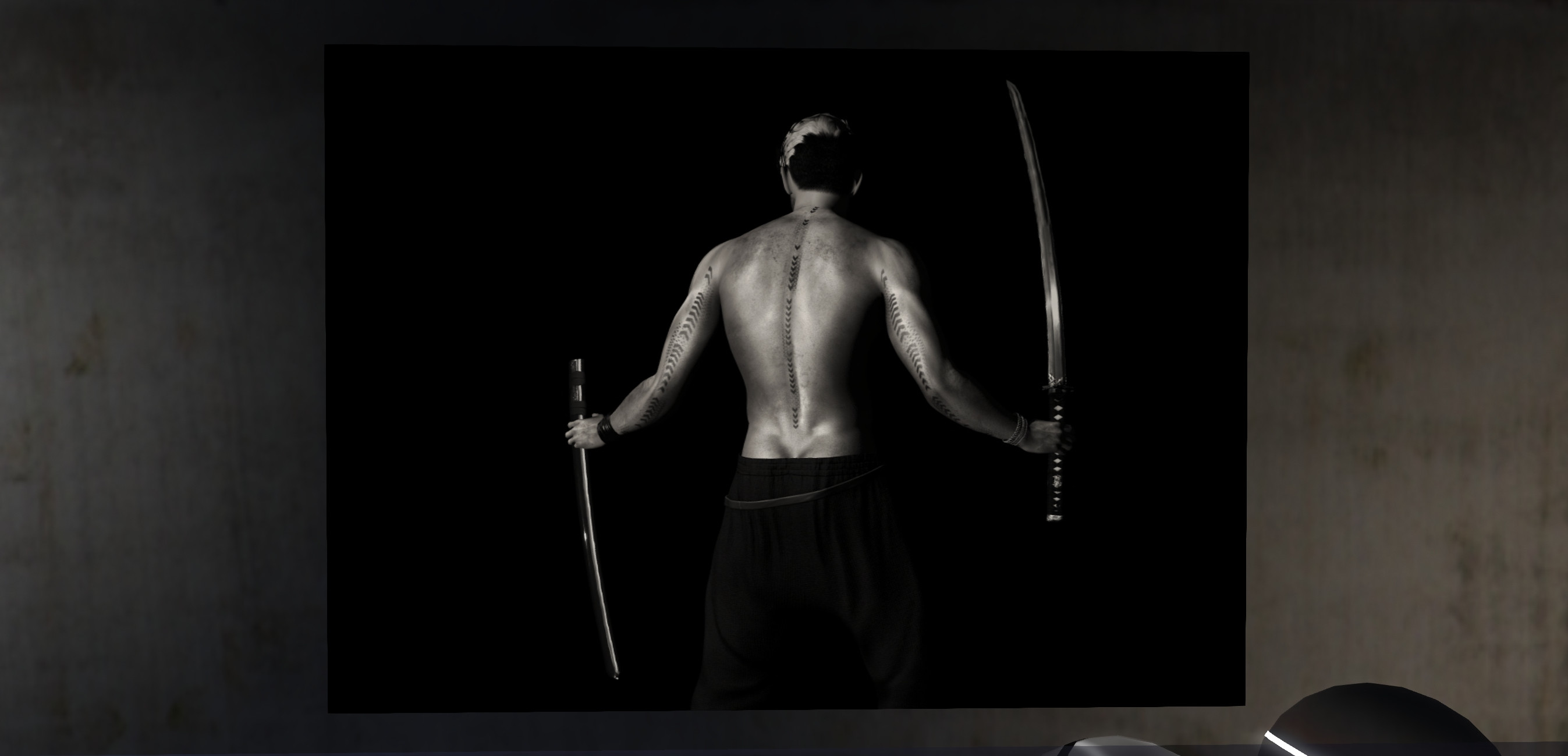
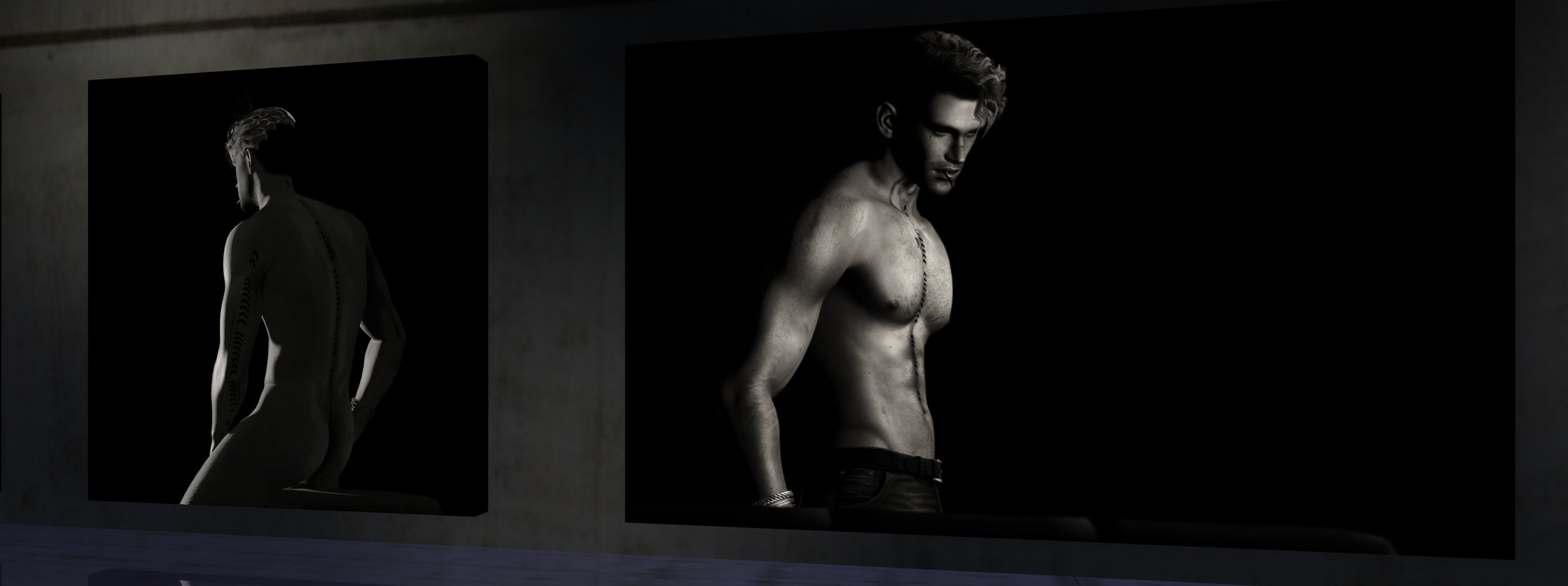
Entitled Shadows of Strength, this is an exhibition of male semi-nudes (something of a rare subject in SL!) which are specifically designed to explore the complex interplay of light and shadow within photography. Presented as chiaroscuro greyscale pieces, the nine images comprising Shadows of Strength are on a technical level a perfect embodiment of the technique: using bold contrasts (light / dark) to frame the entire composition and achieve a sense of volume and depth in modelling three-dimensional objects and figures within a two-dimensional canvas.
Nitroglobus Roof Galley Annex: Frank Atisso – Shadows and Strength

However, these are pieces that achieve for more than a technical embodiment of a technique. Such is the subtle interplay of contrasting light and dark in all their varying volumes and as determined by the subject’s pose and the positioning of the (off-camera) illumination, the eyes is naturally drawn to the manner in which both light and shadow ebb and flow across the subject, both of them giving subtle emphasis in their own way to changing skin and muscles tone which also highlighting features and hiding others to give an intrinsic and life-giving depth to each piece.

Thus, within each of these pieces we have not only a single-frame study of the human form and the use of light and shadow, but also an exploration of mood, thought, emotion, even vulnerability (particularly in those images where the subject is not looking at or towards the camera), conveyed as narrative threads to further engage the eye and mind.
Nitroglobus Roof Galley Annex: Frank Atisso – Shadows and Strength

Both Photopoetry and Shadows of Strength will remain open through February 2024, and I recommend both to fellow patrons of the arts in Second Life.

SLurl Details

A Kitten in The Wastelands of Second Life

Artsville Galleries, December 2023 – Kitten: Tales from the Wastelands

Update, January 15th, 2025: Artsville has relocated.

It shames me to think that despite us both having been active in Second Life for over a decade and a half, and given the fact I have visited on a number of occasions, I’ve yet to actually write about The Wastelands.

I have no excuse to offer on this, nor would I insult NeoBokrug Elytis, the community’s founder and curator, in trying to do so; the most I can offer is an apology to him and the community as a whole for not as yet having made the effort to blog about their work, and to offer here views of The Wastelands as seen through the eyes of another traveller (and more particularly – artist), whose meanderings through the 12 regions that make up this post-apocalyptic setting form an end-of-2023 exhibition at Frank Atisso’s Artsville Galleries.

Kitten (Joaannna Resident) is a Second Life artist-photographer whose landscape work I first encountered in 2022, although it wasn’t until later in that year that I blogged about it after catching Noir, a series of avatar-centric studies in celebration of the film noir genre both in terms of her approach to the pieces and the tone in which they were presented, and the fact that they offered an unfolding tale much in keeping with the genre (see A Kitten’s Noir World in Second Life).

Artsville Galleries, December 2023 – Kitten: Tales from the Wastelands

Within Tales from the Wastelands (presented in Gallery 3 at Artsville) Kitten once again takes this approach; starting with an introduction in her own words to both the exhibition and the setting (complete with a landmark giver for those wishing to make their own foray through The Wastelands), this is a series of 10 images which carry us through various aspects of the regions in a manner of a non-linear story.

Which is not to say this selection is in any way derivative of Kitten’s earlier work; it is not; within Noir the story was ever-present within each image, if open to interpretation as to what it might be. Tales, by contrast offers moments from a traveller’s story; scenes which are not quite vignettes, but which offer enough within themselves for our imaginations to paint a unique story around each one. As such, they can be shuffled together howsoever we prefer when viewing them, each scene / story standing in its own right as a complete piece – but at the same time, as freely shuffled as they might be, the 10 scenes remain joined through a subtle sense of narrative in that each represents a chapter in a broader story.

Artsville Galleries, December 2023 – Kitten: Tales from the Wastelands

Predominantly presented in Kitten’s trademark panoramic style, the 10 images are a tour de force not only in her ability to capture a story-in-a-frame, but also in her skill as a compositional artist; the framing of each piece is both natural and cropped to perfection; the use of both colour and black and white images demonstrating a measured and skilled ability to evoke feelings and emotions. The use of angle, depth of field and focus both masterfully drawing us into the scenes and stories as if we are in fact part of them whilst we remain separated by the fourth wall of the camera lens; thus a further sensation is invoked within us: the desire to follow in her footsteps and see this world of anarchy and danger, beauty and hope, for ourselves.

We Orange the World 2023 in Second Life

We Orange The World, November 2023

Opening on Saturday, November 25th at Artsville is We Orange The World, a 16-day arts event intended to coincide with the The United Nations Women’s 16 Days of Activism Against Gender-Based Violence, and which runs from November 25th, 2023 through to December 10th inclusive.

The physical world campaign started in 1991 at the inauguration of the Women’s Global Leadership Institute, which continues to coordinate each year’s campaign. It is used as a nexus strategy by individuals and organisations around the world to call for the prevention and elimination of violence against women and girls. Initially a civil society initiative, the campaign has – since 2008 – been supported by the UNiTE campaign,  which runs parallel events with the aim of ending violence against women by 2030.

We Orange The World, November 2023

Within We Orange the World, now in its third year, artists have been invited to submit 2D and / or 3D art to be displayed within the exhibition, related to the general theme of the beauty and empowerment of women around the world. Entrants were asked to keep pieces positive, uplifting and empowering rather than negative in nature, otherwise subject matter and presentation were left up to the artists.

Participating artists for 2023 include: Raven Arcana, Ceakay Ballyhoo, Bamboo Barnes, Bijoux, Abi Brewer, Carelyna, Mirabelle Biedermann, Melissandre Blade, Ilyra Chardi, Xia Chieng, Mareea Farrasco,  Dido Haas, Margo Hollak, Jeanie, Jessamine2108, Lizzy, Diney Mccallen, Maghda, Marvayu, Selen Minotaur, Raisa Reimse, Rhiana Rhiano, Sina, Souza, AmandaT Tamatzui, and Dakota Wind, with Artemis Greece providing 3D sculptures.

The event includes entertainment throughout the 16 days, with the schedule at the time of writing as follows (all times SLT):

Saturday, November 25

  • 12:00 Noon: DJ Pru
  • 13:00: Susie Star Twilighton
  • 14:00: Tay Tayana
Monday, December 4

  • 14:00: Maximillion Kleene
  • 15:00: Amberle Janniah
Monday, November 27

  • 13:00: Wytchwhisper Sadofsky
  • 14:00: Katia Portugal
Tuesday, December 5

  • 13:00: Open microphone poetry with Sabre and Jolie Carter
Tuesday, November 28

  • 13:00: Open microphone poetry with Sabre and Jolie Carter
Thursday, December 7

  • WOW event at the Spartan Empire (no time given)
Thursday, November 30

  • 11:30: DJ Lizzy and Tom
  • 13:00: DJ Noir Tater
Friday, December 8

  • 14:00: DJ Velvet (Women in SL)
Sunday, December 3

  • 12:00: WOW event at Arbors
Sunday, December 10

  • 11:00: Tillen Avers
  • 12:00 noon: Bsukmet
  • 13:00: DJ Carelyna
  • 14:00: DJ Streuner
  • 15:00: A-R-R-A
We Orange The World, November 2023

SLurl Details

Catherine’s black and white photography in Second Life

Catherine Nikolaidis: The Body I Was Born With, Artsville Gallery 2, August 2023

It is two exhibitions for the price on one with this article – in part because both exhibitions have been open a while, and one at least is liable to be closing in the next few weeks; and in part because they both offer opportunities to appreciate the sheer artistry of Catherine Nikolaidis.

Catherine is a Second Life photographer whose work I’ve touched upon a few times in these pages, as she has participated in a number of ensemble exhibitions I’ve attended, but it is not often I’ve seen her work individually exhibited – some again, these two exhibitions are a dual treat for me.

Those familiar with Catherine’s Flickr photostream will know she has a penchant for black-and-white photography – something bound to attract me – and a focus on avatar studies, often using her own avatar, and this certainly the case with both of these exhibitions. More than this, however, is Catherine’s use of tone, pose, contrast, and overall composition. These come together with her innate sense of detail to create pieces which have a depth of life which genuinely suggests her avatar inhabits the physical world as much as she does the virtual, crossing easily and naturally between the two.

Catherine Nikolaidis: The Body I Was Born With, Artsville Gallery 2, August 2023

This is particularly true within The Body I Was Born With, which has been open at Artville’s Gallery 2 since at least the start of July 2023. Within it, Catherine presents 10 self studies which are both deeply personal in content and presentation but which all carry that sense of having actually been taken at a studio in the physical world. This is achieved first and foremost through an expressive and skilled use of chiaroscuro, the play of framed lights and darkened background, together with the play of shadow, used across the entire composition of each piece.

Then there is the choice of pose and position of camera; rather than presenting her avatar in full, Catherine offers glimpses, giving the pieces an more intimate presentation – yes, with nudity, but not the kind intended to titillate; rather it further enhances the sense of intimate revelation, presenting each piece as a part of a story.

Catherine Nikolaidis: The Body I Was Born With, Artsville Gallery 2, August 2023

There is much that could be said about this exhibition in terms of identity and identification – certainly the title of the exhibit prods the thought processes it that direction. However, I’ll refrain from jumping down that rabbit hole here; the vignettes contained within these ten pieces are more than sufficient to engage the eye artistically and the imagination narratively. What I will say is that this sense of personal expression and potential for narrative also winds through August Noir, which opened within the main gallery complex at the Kondor Art Centre in late July (and so is likely to be coming to an end sooner rather than later).

Here, again, Catherine uses black and white to present s series of images which offer both an invitation to enter into stories of summer and vacational escape. Again, they these are all pieces that are highly personal and where light and dark – more subtle than outright chiaroscuro – are a vital part of the composition and appeal of each piece.

Catherine Nikolaidis: Autumn Noir, Kondor Art Centre, August 2023

This is particularly noticeable in that out of the ten images within Autumn Noir where the subject’s face might be seen, in only one is it actually revealed; for the rest, shadow and angle play a role in obscuring her features. Thus we are somewhat cast into the role of voyeur in witnessing these pieces, far more so than with The Body I Was Born With; possibly because of the naturalness of the actions being performed: sitting, walking, swimming, enjoying the sun… 

Within both of these exhibitions there is a musical fluidity; with The Body I Was Born With this might be defined as a sonata, whilst Autumn Noir might be seen as a rhapsody, further enhancing their appeal.

Catherine Nikolaidis: Autumn Noir, Kondor Art Centre, August 2023

All told, these are two highly engaging exhibitions featuring the work of one of SL’s most engaging avatar photographers and which really do deserve to be seen before their respective time in-world expires.

SLurl Details

Invisible Cities: The Future in the Present Overflows in Second Life

Artsville Galleries and Community – Debora Kaz:  Invisible Cities: the Future in the Present Overflows

Friday, May 26th saw the opening of Invisible Cities: the Future in the Present Overflows at the Artsville Galleries and Community, operated and curated by Frank Atisso. The work of Debora Kaz, the exhibition is a further instalment of her Invisible Cities series, which I first encountered in August 2022 when  Dido Haas hosted Invisible Cities: Fighting Women at her Nitroglobus Roof Gallery (and which is reviewed here).

With Invisible Cities: The Future in the Present Overflows, Debora once again tackles a societal issue and the lasting effect it can have on the lives of those subjected to it: violence, in all its forms, visible and invisible; physical and mental / moral.

In this exhibition, the idea is to suggest parallels between past, present and future of lived stories where violence is present since childhood. To bring out the need to talk about these stories, to heal, survive and protect. Violence as an instrument of power … brings with it disorders and dependencies, fragilities that need support, affection and respect. [This is] An exhibition to put you in a place less critical and more solidarity.

– Debora Kaz, introducing Invisible Cities: The Future in the Present Overflows

Artsville Galleries and Community – Debora Kaz:  Invisible Cities: the Future in the Present Overflows

However, before getting into things, there are a couple of points to note up front. The first is that it should be viewed using both the local environment settings (World → Environment → Use Shared Environment) and with Advanced Lighting Model (ALM) enabled (Preferences  → Graphics → make sure Advanced Lighting Model is checked); Shadows do not need to be enabled as well, so flipping ALM on (if you usually have it disabled) should not impact viewer performance.

The second is that the installation is multi-level, the three levels linked by a teleport system. This takes the form of an atom-like structure. Right-clicking on it will sit you and display a list of numbered destination options. While it is not implied by the ordering or within the introduction, I would perhaps suggest that in starting a tour, you first use the teleport to visit the elements labelled Past 1 through Past 6. These will deliver you to the uppermost elements of the installation, representing childhood and the past. Within each is a father / daughter combination, each with what appears to be a duality of purpose. At first, they might seem to simply represent a parent / child relationship – out walking, holding hands, a loving pat on the head, the gestures of nurturing care.

But look again, particularly at the likes Past 2, Past 6 and Past 1; note the body language of the child, the way the adult’s arm grips wrist or upper arm:  these suggest something less than loving and closer to restraint, control, subjugation. Now take the hand resting on the child’s shoulder and the apparent head-pat; are these actually gentle gestures of love, or might they also be further suggestions of restraint and subjugation aimed at the child?

Artsville Galleries and Community – Debora Kaz:  Invisible Cities: the Future in the Present Overflows

Thus, within these six dioramas is manifested the idea of violence present in childhood, the lances extending from these bubbles to the lower levels representing the way such violence can literally spear every aspects of a life exposed to it from that point on.

Between them, the mid and lower levels of the installation offer reflections (so to speak) of the present and future of a life spent in the receipt / fear of violence, with the lower level offering a series of rooms in a house which can either be reached via the teleport system or simply explored on foot once within them.

The house and its contents is a poignant tour-de-force of a life riven by fear – rational or otherwise – resulting from the persistent pressure of both physical and mental violence. It is a metaphor for both solitary comfort a home can offer  those so afflicted – and the prison it can be become, where fears can still haunt and the world beyond the windows seem full of threats.

Within it, the images reflect the fear – the flight reaction – under which those affected by prolonged violence of deed and word find themselves almost constantly feeling; the figures reflect the confusion, the sense of self-blame and guilt they feel for allowing the violence  they suffered and the fear they are now living with and their self-perceived weakness in being unable to cope within a world which too often tells them much the same.

Artsville Galleries and Community – Debora Kaz:  Invisible Cities: the Future in the Present Overflows
The victim is trapped within a cycle of violence that is almost impossible to get out of. The mental damage, the fragility, the feelings of impotence cause paralysis, guilt and frustration. And [while] while all the help in the world might be useless, [by] letting the victim know that she can count on someone may be the only hope for life. All together we can care and protect – and most of all, love.

– Debora Kaz, introducing Invisible Cities: The Future in the Present Overflows

Invisible Cities: The Future in the Present Overflows might not be the easiest installation to grasp or feel comfortable with; but that’s the point. This is a challenge to all of us living in a world increasingly riven by attitudes, outlooks and beliefs that are increasingly polarising and driven by the need to “other” those who refused to adhere to ideals and morals that are – frankly – immoral, and to foster violence upon them in the process, that perhaps we all should endeavour to rise above such actions and reach out, love and nurture our children and those around us because they are different, and that pain, ostracization and brutality of action and word should have no place in a civilised society.

SLurl Details

The Book of Caligula in Second Life

Artsville Gallery: Chuck Clip – The Book of Caligula

Gaius Julius Caesar Augustus Germanicus was born in 12 CE into the Julio-Claudian dynasty. The son of beloved Roman general and hero Germanicus, he became popular with his father’s troops when, at just three years of age, he accompanied them on a campaign in Germania wearing a full miniature soldier’s uniform, right down to little versions of their hardy footwear. It was from these little boots that he would gain a nickname from the troops which would follow hi throughout his life: Caligula.

Caligula succeeded Tiberius – with whom he had a strange relationship as the second emperor’s “ward”-come-prisoner – in 37 CE to become the third emperor of Rome. His rule started as a time of get popularity: he seemingly put a stop to the terror of Tiberius’ treason trials with their executions and exiles; he recalled those exiled back to the freedom of Rome; he decreased the overwhelming burden of tax on those the most affected; he re-established elections to public service positions, and spent treasury money on lavish games and entertainments for the citizens.

Artsville Gallery: Chuck Clip – The Book of Caligula

Almost all of that largesse vanished barely eight months into his rule. Struck down by a sudden and potentially life-threatening illness, his recovery left him with a far darker, crueller demeanour, one which saw the return of executions and exile, a lust for money and power, the ruthless extermination of real or perceived threats, and a growing belief in his own righteousness. It is claimed that the latter reached a point where he allegedly demanded he be regarded as Neos Helios, the “New Sun”, and in 40 CE announced his intention to relocate his seat of power from Rome to Alexandria, Egypt, where he believed he would be worshipped as a living deity. Whether or not this is true is subject to debate; however it was later recorded as the primary reason for his assassination in early 41 CE, allegedly because such a move to Alexandria would result in Rome – and the Senate – losing its power and prestige as the seat of the empire.

History tends to regard Caligula as insane; but is this true? Certainly in the generations that followed, Suetonius and his contemporaries looked back on Caligula as such. But they based their views on the contemporaneous writings of Seneca and Cluvius Rufus – neither of whom may have had an unbiased view of the emperor; Caligula almost executed Seneca out of malice in 39 CE whilst Rufus was a conspirator in Caligula’s assassination – and of Philo of Alexandria. They also potentially took Seneca’s and Philo’s references to insanity out-of-context, as both couched the word in terms of Caligula being corrupted over time in his role as emperor, rather than being genuinely mentally unstable.

Artsville Gallery: Chuck Clip – The Book of Caligula

So what is the truth behind Caligula? Was he born a sociopath who would inevitably cave in to his own blackness of heart and be regarded as a madman? Or was he born of good heart and intent, only to be corrupted by the absolute power bestowed upon him as emperor? Or did the legacy of his upbringing – the imagined ancestral weight of the dynasty into which he was born, coupled with all he witnessed first-hand as the prisoner / ward of Tiberius – ultimately combine to drive him to excess? Or did all three combine within him over time?

Which of these might be true is lost to the passage of history. But while time may well have moved on, and the structures of family, society and power have changed, are we, as individuals and a society, really that far removed from Caligula and the Rome over which he held sway? These are the questions swirling through The Book of Caligula, an exhibition by Chuck Clip and hosted within a suitable Roman villa-like setting at Frank Atisso’s Artsville Galleries and Community.

Comprising 40 individual pieces (including three positioned to suggest a triptych), these are fantastical and not a little disturbing works offered almost as etchings, rich in detail. Each offers a window into Caligula’s life and times: the elevation of bloody gladiatorial games; the corruption born of power (be it emperor or the Senate); the mercurial swings between generosity and and brilliance and bloody, murderous intent, and more. Some, such as Incitātus, offer a very direct reference to the legend (if not necessarily the reality) of Caligula’s life. Others, like Mockery, offer a more subtle hint as to the foundations of the darkness in his heart (his young adult view that the nickname bestowed upon him by his father’s troops was intended as form of derision).

Artsville Gallery: Chuck Clip – The Book of Caligula

But within each of the intricate nightmarish twisting of form and content – almost Boschian in extent – each offers lies something deeper. Note only might they be seen as windows opening onto Caligula’s time, but also mirrors reflecting the realities of the human condition.

Yes, times have changed, as have the strictures of society such that murder, assassination and blood games are no longer considered openly acceptable and apart of the natural order of things; but are we not all still as potentially fallible as Caligula, whether through a failure of mental health or through the corruptions of society and (particularly) political power? Are we not equally vulnerable to excesses which can so easily swing our moods erratically from kindness and generosity to cruelty of word and viciousness of action? Does not power still corrupt, and do we still not, when perceiving ourselves as victims, all too often lash out viciously and blindly? In short, when all is said and done, are we really any more immune to the underpinning weaknesses and failings evident in Caligula’s rule?

Thus, as Chuck notes in the introduction to the exhibition, The Book of Caligula is not merely about the life and times of a fallible Roman emperor ages dead, it is about all of us, and the continued complexities and failings of the human condition.

SLurl Details