Subcutan – art and exploration in Second Life

Subcutan Art Gallery, November 2023 – Welcome Area; click any image for full size

Subcutan has relocated to here – see:

I have been watching the redevelopment of Subcutan Art Gallery, home of the work of Sophie de Saint Phalle (Perpetua1010) since around early August 2023, following the gallery’s move from its form home to region-straddling parcels on the tip of Satori. As such, and with things now appearing largely complete, I thought it high time to write about a setting which is far more than just a gallery space, offering as it does opportunities for exploration, photography, relaxing and having a little fun.

My first encounter with Sophie’s work was in 2021 when she was exhibiting at Mareea Farrasco’s IMAGOLand Gallery. Featuring a collection of her physical world watercolours reproduced for display in Second Life, The Art of Water and Colours immediately led me to visit her original Subcutan gallery and immerse myself in her work (see: The art of Sophie de Saint Phalle in Second Life). As an artist, Sophie considers herself an experimentalist, and her work reflects this covering as it does multiple genres and styles, from watercolours through abstract and digital art to caricatures and skilled studies of the human form, and encompassing etching and 3D sculptures. Her work is both engaging and exquisite, never failing to capture the eye – and often the heart.

Subcutan Art Gallery: Japanese Garden (upper area) and Atramentum Gallery

With the new Subcutan Art Gallery, Sophie has combined her artist’s eye with that of companion Dex (Dexter Kharg) to create an environment which both celebrates her art – including being able to re-visit installations such as Infinite, a marvellous celebration of indigenous Australian art (which I reviewed in February 2022), Cyborgs, a visual essay on a possible future for humanity (of which I wrote about here) and witness more of her studies of the human form – and to also immerse yourself in an setting which offers something of an east-meets-west fusion to offer a engaging opportunity for exploration and photography, as noted above. In this, a visit is not so much a visit to an art space so much as it is a delightful immersion into Sophie’s and Dex’s creative vision.

The campus – if I might refer to it that way – encompasses parts of two mainland coastal regions whilst just edging into a third. The first of these, Terric is home to Subcutan’s main landing point and welcome area. This presents a distinctly modern looks and feel and offers extensive public facilities: the welcome centre itself, occupying a purpose built structure by Dex and containing an office space and a large seating area of sofas supported by a self-service refreshments area whilst also presenting a mixed genre display of Sophie’s art, all of which is offered for sale. Outside of this is the landing point itself and the primary (Experience-driven, so be sure to accept any request it offers) teleport board.

Subcutan Art Gallery: welcome area lounge

Whilst the teleport board and its siblings around the location offer a quick way to hop around, with the exception of the board outside the main gallery, and which offers the only means to access all the gallery spaces, I’d recommend eschewing the teleports and let your feet do the walking when initially exploring, as there are elements of the location which might otherwise be missed – such as the Man Cave, a short walk between palm trees from the landing point. Occupying another custom build by Dex, this offers a games room and lounging area, complete with playable arcade games and table-top games, the latter including chess, backgammon and Mah-jong (the latter two being particular favourites of mine in the physical world, together with Carrom, despite the beating my nails have taken when getting a trifle over-enthusiastic when taking a shot!).

Above the welcome area and reached by three sets of stairs, is an outdoor events area with glass-floored dance area extending over the welcome area, swimming pool and open-air bar, the seating to which offers a view of the large aquarium below. This area also sits before what appears to be the private home of Sophie and Dex – so trespass is perhaps best avoided unless invited. Looking out to the north, this events area looks out of the Subcutan harbour area, the main wharf of which can be accessing from the landing point and leads by way of a wooden walkway at its western end (and passing by the stairway leading up to the main gallery) to the Japanese and Guest Harbours.

Subcutan Aret Gallery: Japanese Harbour by night

The Japanese waterfront area is an eclectic mix of false-front “businesses”, some of which have an adult lean to them (but only in appearance, not in content), whilst there is also a certain amount of humour on display (such as the “Safe Area” sign encouraging people to go swimming – as a shark circles the waters below, or the appropriately called “Small Shop”). Rich in neon lighting and lanterns, this is a little corner best seen at night; the waterfront can be a place for photography and offers the chance to try your hand at Japanese calligraphy.

Set above and back from the Japanese Harbour are the main gallery space and the Japanese Garden, again as noted above). The former comprises the Atramentum Gallery – a very neat play on words, given it is home to a richly engaging display of Sophie’s studies of the human form which are presenting in greyscale and on black mounts (complete with a black tiled footpath leading into the gallery). This entranceway is also home to a more extensive teleport board which allows visitors to partake of Sophie’s sky galleries, where as mentioned, her Infinite and Cyborgs installations can once again be appreciated, together with Red Impressions (an exhibition I witnessed on my very first visit to Subcutan, again as referenced above) and Yellow Expressions.

Subcutan Art Gallery: Japanese Garden (lower area)

The Japanese Garden, meanwhile, offers an extensive opportunity to wandering and sitting, taking photos and / or simply relaxing. Split over two levels linked by a stone stairway curling down from one corner of the upper level, the gardens have been built using Alex Bader’s superb Zen Garden Building set (another personal favourite!) whilst folding into it a number of elements not found in the kit – such as Buddha in his pavilion (and to whom respects can be presented in a traditional style). With its waterfall, ponds and placement of trees and cliffs, the lower level of the garden presents a quiet, contemplative retreat calmed by the gentle chimes of a heavy temple bell.

What is particularly engaging about the Subcutan campus / environment is the manner in which everything flows; there are no sharp juxtapositions which might present a sense of sharp edge as one explores; there is a compositional crafting which is both subtle and intrinsic to the setting.

Subcutan Art Gallery: Atramentum Gallery, November 2023

Take the welcome area and landing point for example. The manner in which Dex has crafted the buildings here such that they combine architectural elements (e.g. the use of angles and glass skylights / roof areas) so that they combine seamlessly with the third-party elements seen within the glass dance floor (a nice kitbash from one of Loz Hoyle’s Meshworx designs) and the house (by Ballack (Rodrigo Aubin) to present a modern / futurist feeling which the likes of Frank Lloyd Wright would probably appreciate. Similarly, the joining of a traditionally-joined Japanese garden with the sharp glass-and-concrete bulk of the gallery building is managed in such a way as to avoid any sense of sharp-edged divide; instead the former – through the use of ground cover from the Zen Garden set – appears to gently lap against the hard tile of the latter, like waves gently lapping the shore, allowing the two to flow together.

Then there is the use of elevation and elements from Colpo Wrexler’s designs. The latter help to both bring together the waterfront areas allowing for a natural transition from the landing area through the moorings at the harbour to the sense of jostling city life of the Japanese waterfront without the move from one through the others feeling in any way jarring, while the former ensures the more peaceful elements of the setting such as the gardens can be set apart from the hustle and lights and general “busy-ness” of the waterfront without any sense of the divide between them being artificially enforced.

Subcutan Art Gallery: Man Cave

All of which makes for a richly engaging visit, with the gallery standing as a superb means to immerse yourself in Sophie’s talent as an artist (I just hope we also get to see some / more or her caricature work as well, as it is brilliantly engaging!).

 SLurl Details

Judilynn India: fractured abstracts in Second Life

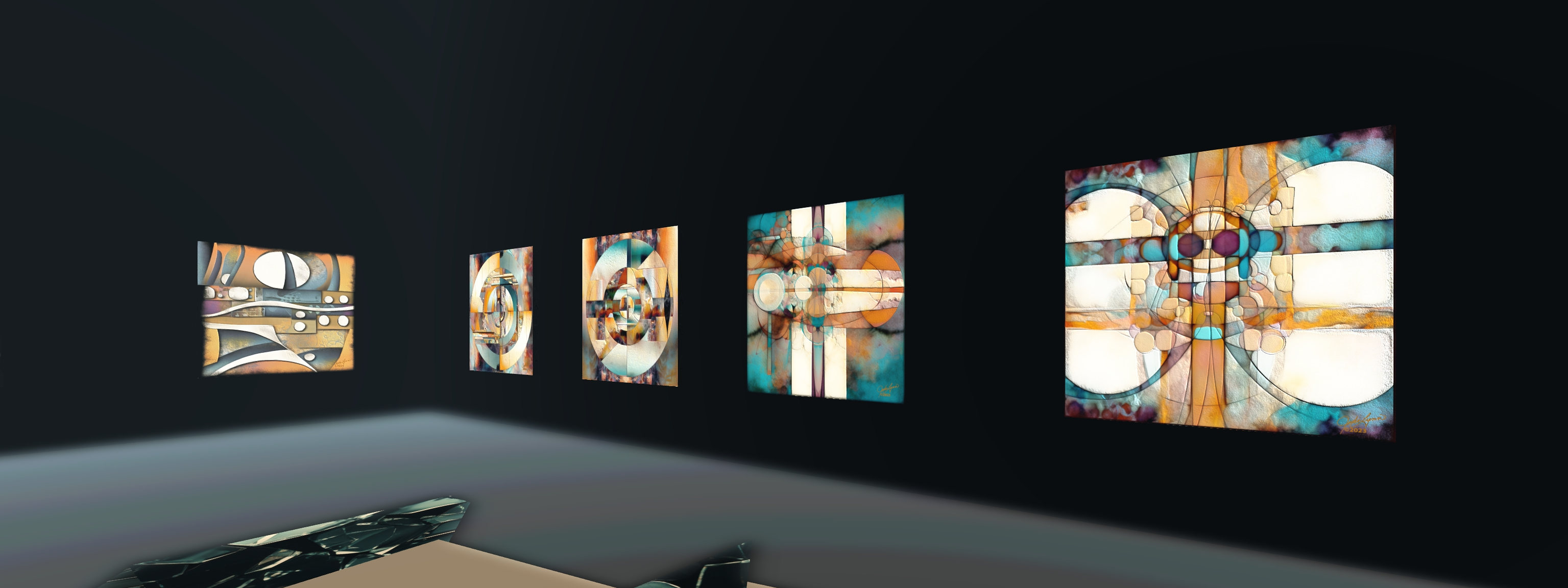
Third Eye Gallery, November 2023: JudiLynn India – Fractured

Currently open at the Third Eye Gallery, operated and curated by Jaz (Jessamine2108), is an exhibition of new works by JudiLynn India, entitled Fractured.

An abstract painter in the physical world, having studied graphics design at the Tyler School of Art, Temple University, Philadelphia, JudiLynn has been a part of Second Life since 2010 as both an artist and an engaged member of the broader Second Life community of users.

I’ve been drawing since I could hold a crayon. After the turn of the century, I decided to focus my creativity on acrylic and digital painting and have totally enjoyed the journey. My work embodies my spirit and personality. My goal is to allow you to experience the image with your own mind’s eye. My work is entirely intuitive. I get lost in the layering of texture and colour. Occasionally, I will include figurative work if my spirit is so presented with the composition.

– Judilynn, discussing her work

Third Eye Gallery, November 2023: JudiLynn India – Fractured

Working in a variety of mediums – digital, acrylic, wet paint, and so on, JudiLynn is perhaps most widely known as an abstract artist, although her overall portfolio is much broader than this – as can be witnessed by a visit to her on-line gallery and shop. With Fractured,  she presents 18 pieces with are predominantly abstract in nature, but which also fold within them hints, perhaps, of surrealism, pop/psychedelia, and touches of futurism/suprematism (in the use in some of geometrical forms and lines). Thus there is a richness of style and content to be found within Fractured, both in terms of individual pieces and as a collection of works as a whole.

Exactly how the pieces are perceived is entirely up to the individual viewing them; JudiLynn has refrained from offering an artist’s by-line to the collection, preferring people to experience the exhibition with an unbiased eye. As such, I am somewhat loathe to say too much in terms of my own perspective beyond very broad brushstrokes (no pun intended) such as those above.

Third Eye Gallery, November 2023: JudiLynn India – Fractured

What I will say however, is that the pieces within the collection might also been seen in terms of compositional / thematic groups. This is somewhat obvious through the manner in which they have been arranged (like by like), but it also helps to more readily discern those hints of style and approach found within specific pieces – such as with the quartet of Fractured 17 through Fracture 20, which present abstractions strongly suggestive of nature whilst folding within themselves hints of the pop/psychedelia genres thanks to their use of colour and mural-like flow.

However, and as noted, this is an collection very much about personal perceptions on viewing the art, so I’ll leave the rest to you to pay a visit to Fractured.

SLurl Details

Artistic digital fusions in motion in Second Life

Kondor Arts Centre, November 2023: Monique Beebe – On the Move

I confess that I find myself caught in a dichotomy of viewpoints when it comes to AI art; on the one hand, there is a huge potential for using AI tools to enhance the creative process and allow the artist to produce some truly stunning and innovative art. Countering this are the twin concerns of the potential for AI tools to be terribly degenerative towards genuine artistic skills under the guise of “democratising art for all”, and the fact that very often – as with Midjourney, the current darling of art AI proponents – those behind such tools are content to raise a large middle finger towards concerns of copyright & artists’ rights as they pull “source” material from wherever they deem fit.

As a result, I’ve tended to exercise caution in reviewing exhibitions of AI art in Second Life. Not that I deem it unworthy or have doubt towards the artists concerned; rather, it is the fact that it is not always easy to identify the broader provenance for such art in terms of a potential for it to incorporate elements which might be regarded as violating the copyright of others. Fortunately, there are artists and exhibitions with SL utilising AI where the provenance for the pieces lays so clearly with the artist’s imagination and skill, they can be seen and enjoyed entirely in their own right and without the broader questions surrounding the use of AI intruding.

Kondor Arts Centre, November 2023: Monique Beebe – On the Move

Such is the case – once again – with the work of Monique Beebe, who recently opened On the Move at the recently relocated Kondor Art Centre, operated and curated by Hermes Kondor.

On the Move is not just an exhibition; it’s a leap into a new era of artistic expression. Whether you’re a connoisseur of art and technology, a futurist, or simply an admirer of the creative process, this exhibition promises to leave you spellbound and questioning the limits of human and AI collaboration. … An exhibition that pushes the boundaries of creativity through the fusion of MidJourney AI, cutting-edge Gen2 MP4 technology.

This might sound a grandiose statement as the official introduction to On the Move, but I guarantee you it is not. I’ll also guarantee that the still images provided here do not come close to the beauty and creativity found within each of the collection’s images, every one of which is imbued with a richness of motion and life founded on Monique’s own creative eye and ability to capture thought, emotion and humanity.

Kondor Arts Centre, November 2023: Monique Beebe – On the Move

As I’ve frequently noted in covering her work, Monique – or Moni to her friends – is one of the most gifted individuals to enter the Second Life art world; an artist whose expressiveness is utterly captivating and who is herself wholly captivated with the creative process. She had been active in Second Life for nigh-on a decade prior to her first public exhibition in February 2017 – an exhibition which came about thanks to the gentle and considered encouragement from Dido Haas, taking place at her Nitroglobus Roof Gallery. Avatar-centric, it was an exhibition which immediately captivated me (see: Hidden Faces in Second Life), and led me to becoming a keen follower of Moni’s work over the intervening years.

Indeed, following Moni’s evolving expressiveness, her ability to challenge herself by constantly evolving her technique and style, the manner in which she has driven headlong into a variety of creative processes – photography, art, digital recording – all the while refining her abilities and extending her craft, has for me been an utter delight. Her desire to learn, to grow her art and cultivate new skills towards that end has led to a series of exhibitions startling in their beauty and emotional content, and which just under a year ago saw her present her first exhibition utilising AI tools, also at the Kondor Art Centre (see: Monsters, Demons and Chess in Second Life).

Kondor Arts Centre, November 2023: Monique Beebe – On the Move

As per its own introduction, On the Move once again utilises AI (MidJourney), with Moni combining its algorithmic power with still images, video and animations to produce 14 looping images-in-motion; a veritable tour de force in a mastery of digital techniques and incredible expressions of beauty and artistry which transports us instantly into the worlds of Moni’s imagination and creative expressiveness.

From the simple turn of a (Tilda Swinton-esque) head and slow blink of eyes (Eyes are mirror of the soul) to the utterly enthralling Where the magic begins, these are pieces which honestly sit well above the ability of mere words to encompass. Each is a visual essay in its own right – but more to the point, it is in their motion that their emotional depth resides, each one pulling us towards its narrative and passional core; as such, they really should be seen first-hand. Further, they collectively stand as a triumphal validation of the multiple hours of learning, trial, error and perfection of technique that have enabled Moni to offer art which is both truly representative of the positive potential of AI and digital capabilities as the tools (rather than the subsummation) of genuine artistic expression and creativity.

SLurl Details

Abstracts & Artifacts – challenging perceptions in Second Life

Virtual Peale, Second Life

It’s been a goodly while since I’ve written about the The Peale Museum in Second Life; however, an invite from Eme Capalini offered an intriguing invitation to hop along and take a look at their latest exhibition, featuring a very unique artist by the name of Lee Boot.

ICYMI, September 2020 saw the opening of a new public experience in Second Life entitled Virtual Peale, a collaborative effort between Virtual Ability Inc., Linden Lab and – most importantly, The Peale Centre for Baltimore History and Architecture, located in the first purpose-built museum building in the United States (and today a US National Historic Landmark) the Peale Centre. This has, since 1814, been a centre for art, history, community and learning, and within Second Life, the Virtual Peale has continued this long tradition, offering exhibitions of art and learning, centred on an in-world reproduction of the physical World Peale Centre in Baltimore, USA. However, rather than wibble on about it here, please feel free to read more about the project within Baltimore’s Peale Centre in Second Life, a piece written to mark the opening of the centre in SL, and which I was graciously allowed to preview ahead of time.

The new exhibition – Abstracts & Artifacts – is fascinating on a number of levels. Encompassing both the physical world Peale Centre and virtual Peale, it marks the first major gallery-oriented exhibition of Lee Boot’s work for about two decades. It is deeply rooted in Boot’s background as an artist and a researcher – he is the Director of the Imaging Research Centre (IRC) within the University of Maryland, Baltimore County (UMBC) – and is also innately (if tangentially) linked to The Peale’s unique history as a place of learning and education, something he touches upon in an introductory video to the exhibition and which I’ve taken the liberty of embedding here†.

Within Virtual Peale – and as is usual for the Centre – Abstracts and Artifacts is located in the “upper floor” gallery space. To reach it, either use the TP board close to the landing point or enter the Peale Building and take the stairs up to the upper floor and walk through the “doorway” to the exhibition area – you’ll be automatically teleported up to the exhibition space (where a door on the wall behind you on arrival will take you back down to the main building).

On arrival you will have the opportunity to view the introductory video, whilst a sign under it notes that there is a sequence to the exhibit visitors are asked as to follow, using the arrows on the floor. The first of these directs visitors back to an opening statement, framed as a question:

What if it were normal for artists to have careers working side-by-side, on equal footing, with other researchers and policymakers who determine how we improve education, or public health, or how we catalyse economic development in our communities?

– Abstracts & Artifacts, Virtual Peale, October 2023

This is a question of immediate intrigue in its scope and context – and one which might well have some throwing up their hands in horror at the idea of the “trendies” and “lefties” (or whatever) stirring the mix and exerting influence on matters of health and education. However, as the introduction goes on to note, there is a strong justification for considering the idea it represents:

It’s hard not to talk about culture and think about the arts. and artists make media which now, more than ever, are the central systems and currencies of our lives.

– Abstracts & Artifacts, Virtual Peale, October 2023

Virtual Peale, October 2023: Lee Boot – Abstracts and Artifacts

There are truths within the above statement that may have about them a certain dichotomy. All too often, we are used to considering the cultural and societal of art in a historical context: what it says about the generations who came before us, their outlook on life, the nature of their culture; how it might aid us in similarly understanding the nature and structure of civilisations which came well before our own, and to whom their surviving art is the one expression we can physically grasp in terms of offering a window into their times.

However, in looking back in time, it is important to note that throughout much of humanity’s history, both art and science were closely intertwined; it is only relatively recently that they have branched away from one another – and then largely as a result of artificial constructs modern society has opted – possibly to our detriment – to enforce (e.g. those  in education being required to choice between the study paths of “the arts” and “the sciences”, with often limited opportunities to combine the two beyond a certain point). Further, art is ever-evolving, harnessing new means to present itself – to utilise the very capabilities wrought through “the sciences” to communicate, to enhance and enrich, to inform.

Virtual Peale, October 2023: Lee Boot – Abstracts and Artifacts

This is the trust of Lee Boot’s work;  he has combined his Master of Fine Arts (painting) with the disciplined approach of research, evaluation and data interpretation / analysis, to develop and direct science-driven research enterprises. This has allowed him and his fellow researchers and students at URC to prototype and develop novel media and visualisation technologies specifically aimed at promoting awareness / understanding of a broad range of social issues: the aforementioned health/wellbeing, education and economics development through to the likes of social justice, democracy and climate change.

Twenty-five years ago, media artist Lee Boot stepped away from a promising artworld career to join scientists and others doing research to find ways to meet some of our most significant public challenges. For more than twenty-five years he has brought artist’s thinking into rooms where it is seldom seen. Literally and figuratively, he has coloured outside the lines, spilled paint on his colleagues, flipped the script and reframed conventional thinking to reimagine how we meet the challenges of our time and better ground our efforts in the cultures, experiences, and lives of the people they are intended to serve.

– Lee Boot biography

Within Abstracts & Artifacts the artist offers (in keeping with the title of the exhibition) pieces of abstract art, together with text elements which frame ideas as questions. The individual pieces of art partnered with the text elements might at first appear to be entirely random but each has a form and substance within it when studied, serving to illustrate and amplify the ideas posed within the written interrogative.

That the clarity of meaning may not spring forth at once should not be taken as a negative; the art is as much about altering perception as it is about illustrating an idea; ergo, it should engage the grey matter sitting between the ears, and may do so is so subtle a manner that repeated study of individual piece might well be required. In this, and as Boot notes in his video introduction, each section of the exhibition should not be considered as text + images, but as a visual interpretation of ideas drawn from a sketchbook used to formulate concepts and thinking.

Virtual Peale, October 2023: Lee Boot – Abstracts and Artifacts

Within the centre of the exhibition space is an area devoted to previous projects formulated by Lee and the URC, and it is worth taking the time to view these. Those elements taking the form of video screens (like the TVs within the main exhibition) can be touched to receive an introductory note card on each exhibition and a link to watch the video through a browser on Vimeo†.

All told, a genuinely engaging exhibition revealing the rarely-seen work of an artist-researcher at the forefront of disassembling the artificial barriers between art and science / research – my thanks to Eme for the invitation, and apologies for not making the opening. While visiting, do be sure to take in the ground level Peale Centre’s displays, both indoor and in the grounds.

SLurl Details

† Please note the videos presented in the exhibition may require you to log-in to Vimeo.

Phantoms of moods in Second Life

IMAGOLand Art Galleries: Carelyna – Phantasmagoria

Having opened at the start of October and occupying a skybox gallery at Mareea Farrasco’s IMAGOLand galleries, Phantasmagoria is the latest exhibition by Carelyna.

Whilst the title might well evoke thoughts of ghosts and spectres, this is a collection which takes the term in a different direction to ideas of ghosts and demons, being far more subtle in intent – as I’ll get to in a moment.

The term phantasmagoria is said to have originated in the last decade of the 18th Century as a French concatenation of the Ancient Greek phántasma (“ghost”) with either agorá, (“assembly” or “gathering”) or (agoreúō, “to speak publicly”).  Exactly who coined it is subject to debate, but Paul Philidor, a magician and showman, is perhaps most widely recognised as having popularised it in the late 1790s and early 1800s, using the terms to promote his shows featuring ghostly apparitions and the shades of departed famous people – although such shows, utilising everything from concave mirrors to magic lanterns and camera obscura to create / project such ghostly phantoms, reach back into at least the 17th century. Others who started using the term around the same time as Philidor include French dramatist and proto-science fiction writer Louis-Sébastien Mercier, and Belgian showman Étienne-Gaspard Robert – who is also credited with coining the term fantascope to describe the equipment he, Philidor and others used to create their spectres.

IMAGOLand Art Galleries: Carelyna – Phantasmagoria

For her show, Carelyna has created a collection of sepia-rich, ghost-like images of individuals. It overall tone, they are suggestive of the flickering images witnessed by those sitting through one of Philidor’s shows. Some are clearer than others, presenting an well-defined study; others are caught in a halo of light and brightness which both adds to the suggestion they have perhaps caught the spirit of a person who may not have been there – or that the image was taken a long time ago, and time and light have not been kind to it.

However, while they have that faded, ghostly sense about them, as noted above, these images are not intended to portray the spirits of the departed or suggest we’re within a magic lantern show; rather they and intended to evoke ideas of mood and emotion. From celebrations of life and expressions of love, to studies of strength and introspection and of potential loss or aloneness, the emotional depth found within these 12 pieces is both intense and also entirely open to interpretation: while Carelyna offers a suggestion or theme within the title of each. it is very much down to how we individually respond to each of them in its own right.

IMAGOLand Art Galleries: Carelyna – Phantasmagoria

An engaging and expressive exhibition.

SLurl Details

Louvre’s Power of Water in Second Life

NovaOwl Sky Gallery, October 2023: Louvre – Agua

Open through October at the NovaOwl Sky Gallery is an exhibition of art by Louvre (Iamlouvre), a physical world artist who is now making her mark in Second Life, having joined (I believe) in 2021. This is the first time I have witnessed at exhibition of her work, and found it to be richly expressive.

Entitled Agua (the Spanish for “water”), this is an exhibition which fully embraces the space in which it displayed, Louvre demonstrating that as well as being a skilled artist, she has an innate sense of space and design, offering an environment that neatly folds itself around the exhibition’s theme, with the art split between the two levels of the gallery.

Water symbolises much more than an infinite space where we lose ourselves
when we look to sea. Water symbolises transformation, Life. All of us are water.  

– Louvre (Iamlouvre)

NovaOwl Sky Gallery, October 2023: Louvre – Agua

On the upper level, prints of her work are mounted on easels and walls, some of the latter backed by curtains of water tumbling to the floor below. On the lower level, this water spreads across a floor decorated with squares, some just below the surface other rising above it. All offer a sense of being stepping stones, encouraging visitors to make their way across them. These squares and mirrored by cubes and blocks climbing up the walls, the shimmering curtains of water visible in the gaps between them.

Close to the gallery entrance, sixteen cubes present sixteen paintings by Louvre, each painting repeated on all six faces of the cubes. Further back sit two larger cubes, each with an image of one of her paintings projected within it whilst further pieces are mounted on easels in an intentionally understated display, the entire level dominated by a single piece entitled Submarine.

Almost all of the paintings might be seen as portraits of a most unique kind. Few present a complete individual; rather they present images wherein the subjects are blurred or obscured, as if seen through a sheen of water, or with their subjects incomplete of cracked and fractured. In amongst them are paintings of a more abstract nature, but even these contain a sense of water-like fluidity and motion.

NovaOwl Sky Gallery, October 2023: Louvre – Agua

All of this is heavily suggestive of the opening lines of Louvre’s description for Agua, of water giving, being and transforming life. But there is more here as well, as Louvre goes on to note:

Water is also the tears produced by pain and sorrow. It is the force of the DANA flood that just hit my city. Washing away the homes of many neighbours and friends, taking within it their daily objects and their homes. Never in all my life have I been able to contemplate a greater disaster so closely. 
Water is the effort of my hands helping them, to the point of exhaustion, with water and more water.

– Louvre (Iamlouvre)

Storm Dana lashed Spain with torrential rain in early September, causing widespread flooding, particularly in the region of Castilla La-Mancha, home to the cities of Madrid and Toledo, with water levels rising such that streets, major transport arteries  – and most particularly, homes were overwhelmed. Such was the force of the water in places that cars were overturned or smashed together and evacuations were ordered. At least two deaths occurred, and several more people were reported missing.

NovaOwl Sky Gallery, October 2023: Louvre – Agua

It is this devastation, this sense of loss Louvre conveys through her paintings through their blurred / missing / incomplete elements. This reflection of Dana’s destruction is – as Louvre notes – very personal. She has witnessed the loss and hurt it has caused, and sought to help alleviate it through practical support for those around her hit by the storm’s ferocity. That this has also triggered her creativity through her art additionally completes the circle represented by Agua: that as a force of nature, water has the power to both positively and negatively bring about transformative experiences in life.

SLurl Details