A Rusted Farm in Second Life

Rusted Farm

Rusted Farm, the latest installation by Terrygold, open on July 6th, 2018. With it, Terrygold leans towards an ecological theme.

Visitors arrive in a tunnel  – actually a drain which might otherwise act as a run off for rain water – where a series of information boards provide notes on preferred viewer settings and provide background notes framing the piece, all of which should be read: just touch the flags below the images to have the notes delivered in text in either English or Italian.

Oil pollution: it’s a contamination of the environment (soil, air and above all water) caused by all kinds of liquid hydrocarbons, i.e. from crude oil or its derivatives. Oil pollution can be systematic or accidental … Systematic or chronic pollution is often much more serious than accidental one. The lumps of tar deposited on the beaches in the seaside resorts derive mostly from the residues contained in the ballast water discharged into the sea.

– Extract from the Rusted Farm introductory notes
Rusted Farm

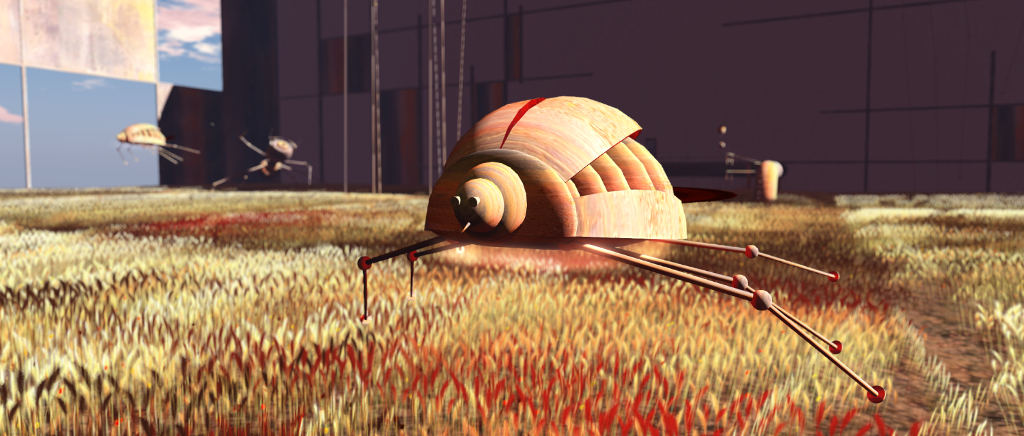
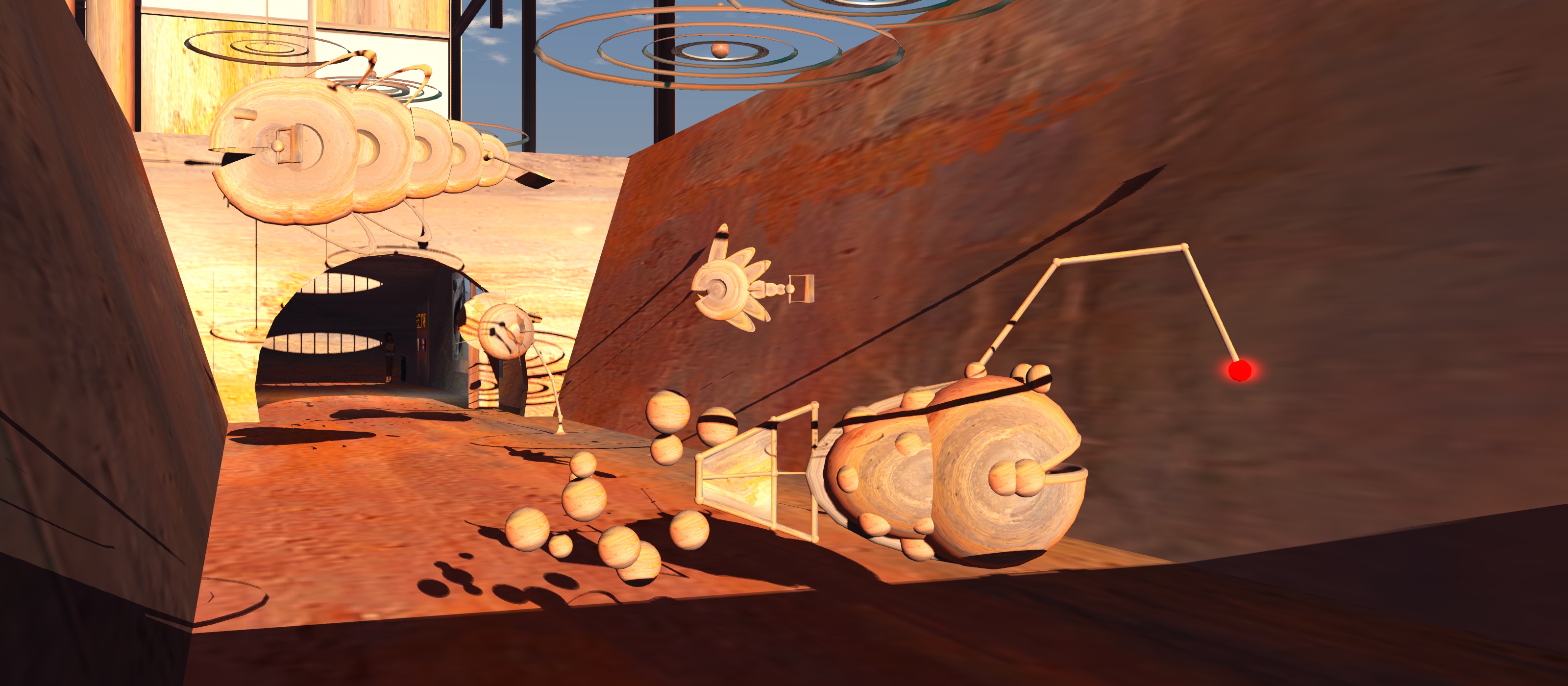
At the end of this tunnel is a ladder offering the way up out of the drain. To reach it, visitors gain the first hints of the direction in which Terrygold is taking the piece: strange-looking fish circle, watched over by equally curious bugs hovering overhead. At first appearing to be mechanical in nature, it takes a while to realise they might actually  be made up of waste material – rusting metal, discarded bulbs, with dorsal fins looking like deformed plastic six-pack rings, and so on. Beyond these, barrels leak oil into the drain.

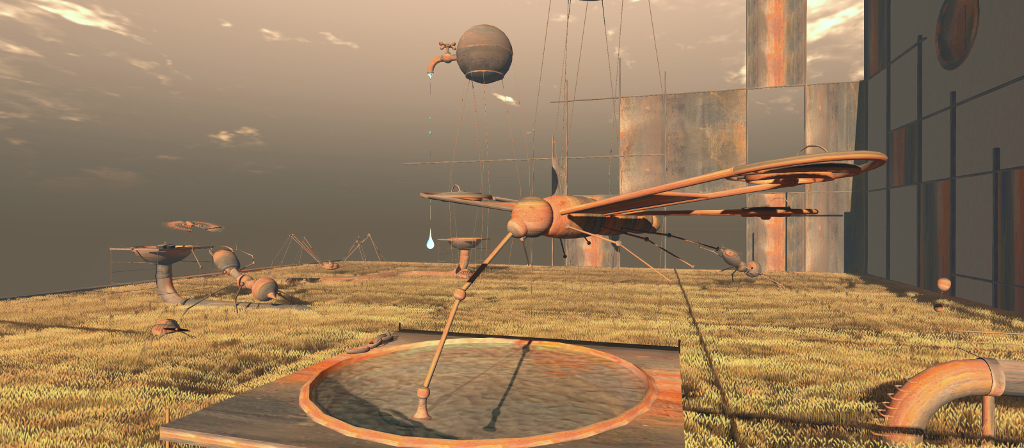
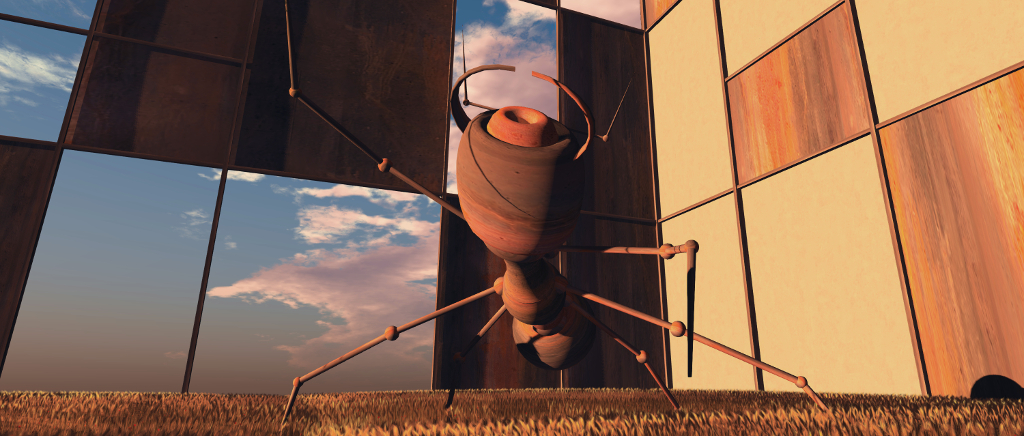
The “ground” level, reached via a ladder placed beyond the fish and barrels, is a large field of sun-ripened wheat over which more bizarre creatures stand or fly. Birds look more like drones; ants and spiders again looking as if they are made up of waste and rubbish. Great spherical tanks with spigots are raised on spindly legs or set into the great wall of a building, apparently dripping water onto the field of wheat, giving it life.

The Great Pacific Garbage Patch, also described as the Pacific Trash Vortex, is a gyre of marine debris particles (mostly plastic) in the central North Pacific Ocean. It’s located roughly between 135°W to 155°W and 35°N to 42°N.

Extract from the Rusted Farm introductory notes (from wikipedia)
Rusted Farm

It is a bizarre scene, the field also crossed by pipes and other drains, raised above the crop as if ready to receive liquids. Nevertheless it is one, with the backdrop of a setting sun, seems innocuous outside of the initial framing of the information boards. Looking at the strange ants, birds and spider, it’s easy to put it all down to artistic licence.

However, dominating all of this is the flank of that huge building, in which a tiny door sits, reached by climbing one of the pipes and then walking along it. Opening this door and touching the blank wall beyond it to activate a teleport, reveals the truth of matters. Giant pipes sit within the walls of this building, rusted, ugly and dripping huge gobs of brown liquid – oil waste, contaminated water, take your pick as to what it might be; the key point is at least some of it is being delivered to collection drains which then carry it away and into the soil being used to grow the wheat.

Thus it is that we have the complete picture: fish, birds, insects a metaphor for the waste products we’re dumping into the world’s oceans, burying in landfills, and so on; the pipes and liquid waste a reminder of the waste products we let contaminate the land and which, ultimately, enter our food chain (as represented by the wheat). And it is apt that among the bizarre creatures we find in Rusted Farm Terrygold has included a deep ocean angler fish, highlighting the fact that while we tend to point to things like the Great Pacific Garbage Patch (estimated to possibly range between  700,000 sq km / 270,000 sq mi and 15,000,000 sq km / 5,800,000 sq mi in area – that’s between Texas and Russia in size), the impact of plastic pollution on the sea floor / deep ocean is still largely unknown.
Rusted Farm

A possibly dark installation in theme, but one intended to prick the conscience, Rusted Farm is also a curious mix. Despite the underpinning message, when taken on its own, the wheat field with its strangely crafted insects and birds is from some angles almost a garden of sculptures ready to be appreciated in their own right.

SLurl Details

A visit to Another Planet in Second Life

Cica Ghost: Another Planet

Cica Ghost opened her latest region-sized installation on Wednesday, July 4th, 2018, offering visitor the chance to visit Another Planet, a place where aliens roam free under the arches of strange landforms (are they mineral? Are they vegetable?), and where rocks – perhaps asteroids that were once falling from space – float serenely above various points in the scene, held aloft by invisible forces.

It is a strange landscape, in places pockmarked by tiny impact craters in the sand; in others the rock is covered in a an irregular pattern of indentations that from a distance almost look like they are indented scales on a skin. The strange “growths” rising from this gently rolling land also in places show signs of weathering by meteor strikes, suggesting they were once a part of the ground from which they rise. Here and there, odd circular protrusions rise and fall, as if breathing in a steady rhythm.

Cica Ghost: Another Planet

The aliens here come – if you discount human avatars (and who are perhaps more correctly the aliens within this environment) – two forms. There are strange, slug-like creatures with large, black eyes set either side of a small hooked proboscis, their bodies expanding an contracting along their length, even though they don’t move. Then there are the smaller creatures, who stand upright on ribbed conical bodies. They also have large eyes set into their round heads – perhaps indicative of the low lighting common to this world.

Despite seemingly without arms, these smaller aliens appear to have a degree of technological mastery; there are hover bikes and flying barges moving around the landscape, perfectly suited to transporting one or two them around (or indeed, one or two human avatars should you opt to sit on them – and if they don’t take your fancy, there is also a floating platform drifting around the sky). And as flying around may not appeal to all of them, some have apparently developed a form of television, and have gathered around it eagerly, some giving vent to very human frowns directed at others, possibly because their view was temporarily blocked.

Or… perhaps the television and the flying machines are the remnants of another time and civilisation? Who can say?

Cica Ghost: Another Planet

Visitors to the region are presented with a choice: to explore in their default form / look, or grab a free alien disguise from the vendor at the landing point. For those seriously interested in exobiology studies, the alien disguise is a must, helping you to blend in. And by “exobiology studies”, I mean having a little fun.

Another Planet is  a further marvellous, whimsical installation by Cica; one which comes – as do most of her designs – with a quote. It’s from English author, humorist and musician, Benny Bellamacina:

Find out if you’re still human, observe yourself from another planet

Cica Ghost: Another Planet

It’s an interesting quote, intended to give us pause and remember who we are. At a time when so much discomfort and hurt is being caused to so many around the world – the displaced, those seeking refuge, the lost – both in their own countries and those where they had hoped to find rest, help, and support, it’s perhaps a fitting little poke at our individual and collective consciousness; a reminder of what we should be to our fellow human beings.

Whether you opt to think on deeper things or to simply sit back and enjoy, Another Planet once again illustrates the magic of Cica’s imagination – which should be enough in itself to encourage a visit.

SLurl Details

Dimmie at Caledon National Museum

National Museum of Caledon

The National Museum of Caledon is a venue for art featuring monthly exhibitions and a chance to wander and relax in the neighbouring gardens.

Curated by Star (astarynite), the museum is a grand building in a neo-classical style, well suited to the Caledon environs, sitting with its back to the water, a trellised patio to one side where patrons can relax and enjoy the view over the gardens and appreciate the grand folly topped by a slowly revolving globe of the Earth. Or, should visitors be inclined, there is a short climb to a raised garden where the mind can wander whilst playing the harp.

National Museum of Caledon: Darlingmonster Ember

To my shame, I arrived at the museum towards the end of the current exhibition – I believe each runs through the months from start to close the end – because the current display, entitled What Would Dimmie Do? featurs the photograph of fellow Second Life grid traveller, Darlingmonster Ember, who also happens to be a resident of Caledon.

Thanks for taking the time to drop by and see what I’ve been working on. So many folks in Caledon in their avatars and the places we find on the SL grid. That’s what you’ll find in this showing … So there isn’t a theme here, except perhaps the SL experience of my 10 years …

Darlingmonster Ember on What Would Dimmie Do?

National Museum of Caledon: Darlingmonster Ember

Offered for our enjoyment across both floors of the museum is a selection of pictures by Dimmie, many charting her travels, others focused self-studies, all presented here as something of a historical record. From dark, almost portending studies to a richness of colour and gaiety, this is a selection which evokes a broad range of emotional responses as well as offering both a glimpse into Dimmie’s life and travels and upon some famous places that have appeared in Second Life over the span of time.

Many of the images appear to forego the common practice of post-processing to present almost “raw” studies and views. In an era where capturing scenes from within Second Life seems to be less about using the viewer’s available tools and more about demonstrating a mastery of PhotoShop, this really is a refreshing and natural exhibition – hence again my apologies for arriving so late in the exhibit’s run.

National Museum of Caledon: Darlingmonster Ember

Should you have the time before June fades away, do make the effort and drop in to What Would Dimmie Do?; I think you’ll likely be as entranced at I was in visiting – and keep an eye on Dimmie’s Flickr photostream if you’re so minded as well.  Plus, if you enjoy her exhibition, do leave a comment in the guest book; while an offering towards the continued upkeep of the museum would also doubtless be appreciated by Star.

SLurl Details

Barbara Borromeo at Serena Arts

Serena Imagine Arts Centre: Barbara Borromeo

I admit that until I received I received an invitation to visit her exhibition at Serena Imagine Arts Centre, I was unfamiliar with the art of Barbara Borromeo. As such, visiting the exhibition – called simply Barbara – produced to be a delightful revelation: Barbara Borromeo is an exceptionally talented artist, who produces art that is stunning in its depth.

Reached via the teleport disk near to the art centre’s landing point, Barbara’s work is presented in an overhead gallery space, offering a total of twelve pieces of her work (13 if you count the furniture laden carpet, which is also of her design). These present the visitor with scenes that are by turn, beautiful, strange, haunting, nuanced, and rich in potential narrative.

Serena Imagine Arts Centre: Barbara Borromeo

Such is the diversity of styles on offer, it is clear that Barbara is not someone defined by one or two stylistic approaches; rather, she immerses herself in whatever genre best suits the story she wishes to convey. Thus is that some of the pieces here sit in what might be regarded as the genre of fantasy, others are perhaps based on and more abstracted approach to their subject matter; others are rooted in a form of avatar expressionism, while some embrace the use of a broad colour palette, while others are confined to more primary shades.

To offer interpretations on these pieces would in a sense be wasted; while each clearly stands apart from its neighbour, so too they are united in the depth of narrative each contains – although it is up to each of us to interpret the individual stories, whether it is relative “simplicity” of Vintage Car, or falling into the haunting depths of Prison or Dark and Gold or the captivating beauty of Princess.

Serena Imagine Arts Centre: Barbara Borromeo

That said, I found myself particularly drawn to Princess and Avatar (both seen above). These both contrast with one another, and yet are joined through their construction. Within Princess, there is a wonderful fusion of images from Second Life and the physical world, caught within an almost surreal fantasy montage that is simply captivating in its use of darker monochrome tones. Similarly, Avatar offers a somewhat fanciful, surreal image, but one that in a reverse of Princess, using white and grey, rather than darker tones, together with a delicacy contained in the pencil-like strokes of the background image, to form that strong but complimentary contrast to Princess, making them ideal partners in this exhibition.

It is this layering of ideas within the offered works that is perhaps most captivating: when looking at some of them, the subtle construction may not be immediately apparent, but reveals itself slowly. Take Boudoir as an example. The eye tends to be immediately dawn through the “hole” in the wall and to the woman dressing herself, and the ghostly face observing us. Through these were are perhaps drawn into the role of voyeur caught in the act. Both figures can easily dominate the focus of attention, and it is only after re-appraising the image as a whole that the true nature of the darker elements of the “wall” might become apparent, adding a shift in the narrative the image contains.

Serena Imagine Arts Centre: Barbara Borromeo

A captivating, entrancing display of art, Barbara remain open through until July 22nd, 2018.

SLurl Details

Salt: an immersive arts degustation in Second Life

Salt

Salt is an immersive arts degustation. I’ve quite deliberately misappropriated the term ‘degustation’ [the careful, appreciative tasting of various foods, generally taken in good company] as this imparted itself as an ideal transition, because each segment-course is a unique work of its own volition.

Eliza Weirwight, discussing Salt

Salt is the title of the immersive installation by Eliza Weirwight, which formally opened over the weekend of June 16th and 17th, 2018. In terms of her non-commercial work, Eliza is perhaps best known for developing installations that reflect issues that concern her. This was certainly the case when I first encountered her work through her 2013 piece 35 Elephants, which you can read about in my article here.

This embodiment of matters that concern and / or have influenced Eliza are very much at the heart of Salt which, as Eliza notes in her introduction (quoted above), stands not as a single installation per se, but as a collection of scenes or elements or vignettes – call them what you will – which stand as pieces in and of themselves, but which all are drawn together via subtle threads of thought and outlook.

I will say from the top that this is not an easy installation to interpret. There is a deep layering of themes, whether they are in support of LGBTQ rights or statements speaking out against violence or inequality. In particular, there is a strong commentary on matter such as the objectification of women, gender-based violence, sexual predation, discrimination, hatred and on the state of “western” society as a whole which some may well find discomfiting. But so too is the installation richly emotive and evocative.

Salt

To define Salt, it is necessary to provide a little background information: while it is itself a new installation in and of itself, Salt has been a work gestating in thought and ideas for some time, as Eliza explains:

I was asked to produce a piece for One Billion Rising [Fourth Position]. It was eight little segments addressing things that were concerning to me … Some of the topics had such gravity, I refused to see them as disposable, and I had this idea bouncing around my head for a few years that I want to do this big thing, so I’ve woven a lot of that original work into Salt, because just about everything in this work matters to me. Some of it is my stories, and some of it is other people’s stories

Eliza Weirwight, discussing the origins of Salt

The “other people’s” stories Eliza references encompasses all those who have faced prejudice and / or hatred of any kind, be it based on gender, race, colour, sexual orientation or sexual predation. Within some of these issues she has drawn directly on the lives of others – notably Marilyn Monroe and  Phan Thi Kim Phuc; within others, she has drawn upon the work of artist of all genres – painters, writers, poets, musicians, to add flavour (depth) to the framing of the subjects represented by them. These influencers include – but are not limited to – David Bowie, Andy Warhol, M.C. Escher, Edgar Degas, William Blake, Maya Angelou, Pablo Neruda, and Norman Rockwell.

Salt: A take on Jane Elliott’s Blue Eyes–Brown Eyes. Sit on the chairs, and also note the comment on the wall from Jane Elliott in relation to the exhibit

The way these influencers are used is both intricate and subtle. For example, the very design of the structure housing Salt is mathematically precise in it use of shapes, whilst also offering something a challenge to the eye. Thus through it, we catch a glimpse of Eliza’s own appreciation for Escher’s work and the way in which it has captivated her thinking over the years. Elsewhere within the installation, Blake’s masterpiece The Tyger sits with a section related to violence, and thus its complex questioning on the nature of the creative force behind a creature as deadly as tiger becomes transformed into troubling questions on the subject of violence and those who would so willingly visit it upon others, becoming a further provocative motif within the section in which it sits.

Some of these references are delicately nuanced. The row of soup tins in Campbell’s Soup brand colours might initially appear to be “just” a homage to Andy Warhol. However the labels on these cans offer a statement on the ease with which bigotry and vitriol can be espoused on the basis of other people’s sexuality. Given Warhol’s own sexual orientation and attitudes prevalent in “respectable” society towards male homosexuality throughout most of his life, there is a deeper poignancy contained within this piece than might first be apparent.

Salt: Marilyn Monroe – objectification and self-harm

While the vignettes and scenes within Salt do, as noted, stand individually, so too can they complement each other, adding a further richness of narrative to taste and consider. Take, as another example, the exceptionally poignant section on Marilyn Monroe. Framed around an excerpt of six-page letter she wrote to the psychiatrist who would find her dead a year later, it cannot fail to evoke sympathy at the depth of personal suffering individuals can experience as we reflect of Monroe’s own life and suffering and the price that can be paid as a result of societal expectations.

But there is also a broader narrative here as well. Within the section, there are two images – Monroe examining a small sculpture of Petite Danseuse de Quatorze Ans by Edgar Degas – a man famous for his paintings of ballet dancers, and second of Monroe practising ballet. Both images offer a visual link back to the preceding section (in which a representation of Petite Danseuse de Quatorze can be found), although there is more at work thematically between the two sections.

As the quotes from likes of Vanity Fair and The Guardian accompanying the representation of Petite Danseuse de Quatorze Ans note, the manner in which Degas presented ballet dancers can often contain an almost misogynistic delight in portraying the pain and suffering inherent in their craft, somewhat objectifying them. Elsewhere in his art there can be a sense of male sexual predation. Thus, given that a lot of Monroe’s own suffering was a direct result of the objectification she faced, together sexual predation, the placing these two elements together within Salt intertwines the two, presenting visitors with a much more intense sense of narrative shared by both.

Continue reading “Salt: an immersive arts degustation in Second Life”

3D surrealism in Second Life

Classical and Surreal Sculpture

Quite by chance I stumbled across Classical and Surreal Sculpture, an open-air exhibition of works of surrealism taken from famous exponents of the genre and rendered as 3D models by MADD (maddomxc Umino). It’s a small place, and the setting a simple parcel field covering just 3072 square metres.

Within this space, MADD has reproduced surrealist works of art by some of the more famous exponents of the genre, including Constantin Brâncuși (1876-1957), Umberto Boccioni (1882-1916), Max Ernst (1891-1976), René Magritte (1898-1967), Walter Mac Mazzieri (1947-),  and Masaru Shichinohe (1959-), together with assorted reproductions of a number of sculptures,- most notably perhaps Prométhée (Prometheus) by Nicolas-Sébastien Adam (1705-1778).

Classical and Surreal Sculpture

Some of the more famous pieces by these artists are offered: Magritte’s The Lovers, for example, or Ernst’s L’Ange du Foyer (Angel of the Hearth) and Surrealism and Painting. Despite the small space, all of the pieces on display are set out such that the field doesn’t feel at all crowded, and a couple are presented with copies of the original 2D art on which they have been based. In the case of Surrealism and Painting, this has been done quite humorously – the sculpture is painting the image upon which it is based (rather than the piece the original is painting).

All of the pieces on display are offered for sale – a point that did admittedly leave me a little twitchy around issues of copyright, notably – but not exclusively – around the pieces based on Mazzieri and Shichicohe’s work.  However, and particularly in the case of the reproductions of the 2D art pieces, these are very well executed pieces, and while I’m not exactly a huge lover of surrealism (although I do admire Magritte’s work), this little corner of Second Life makes for an interesting visit.

Classical and Surreal Sculpture

SLurl Details