The Alpha and Omega of SL

Update: Alpha and Omega Points have both closed.

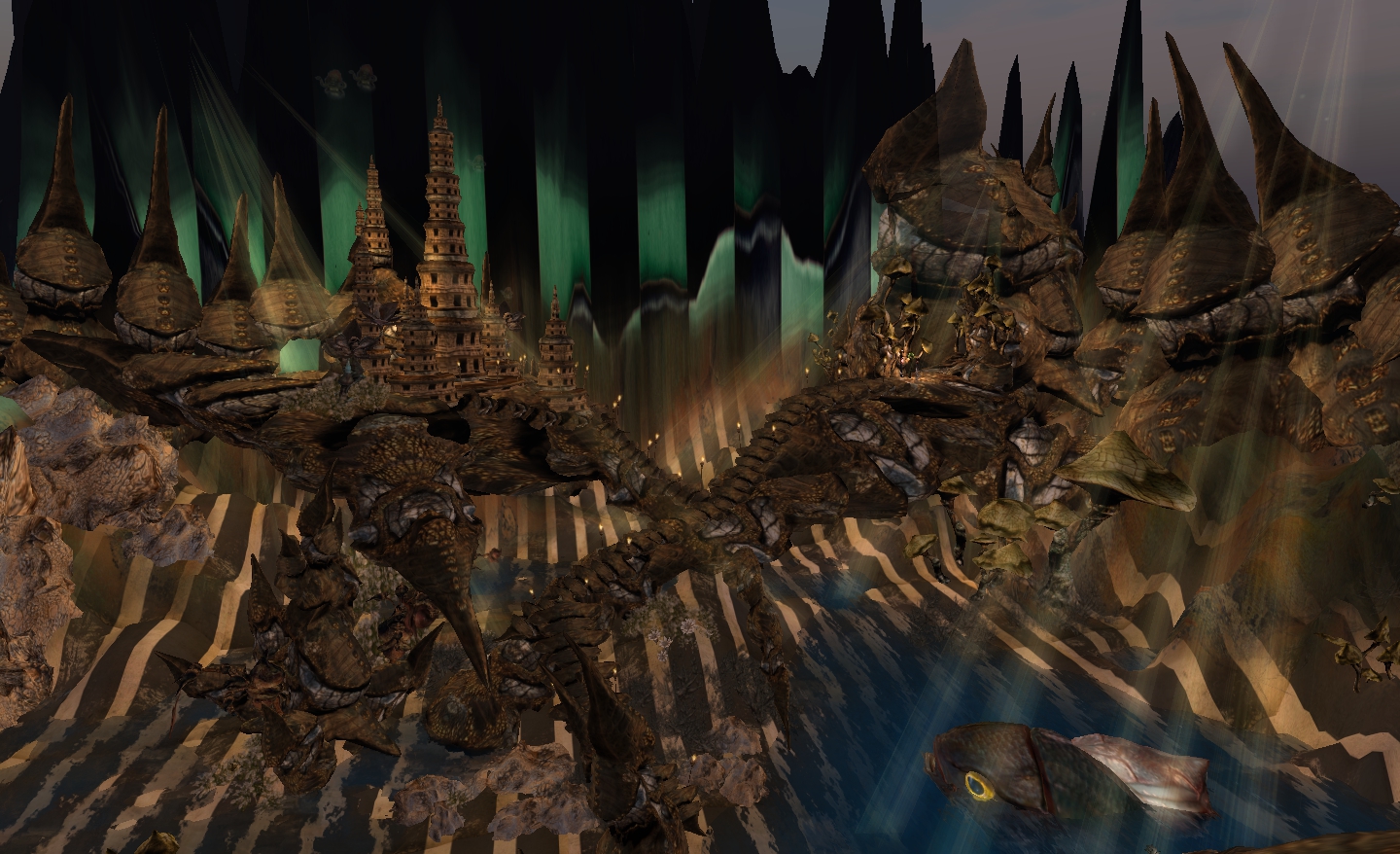
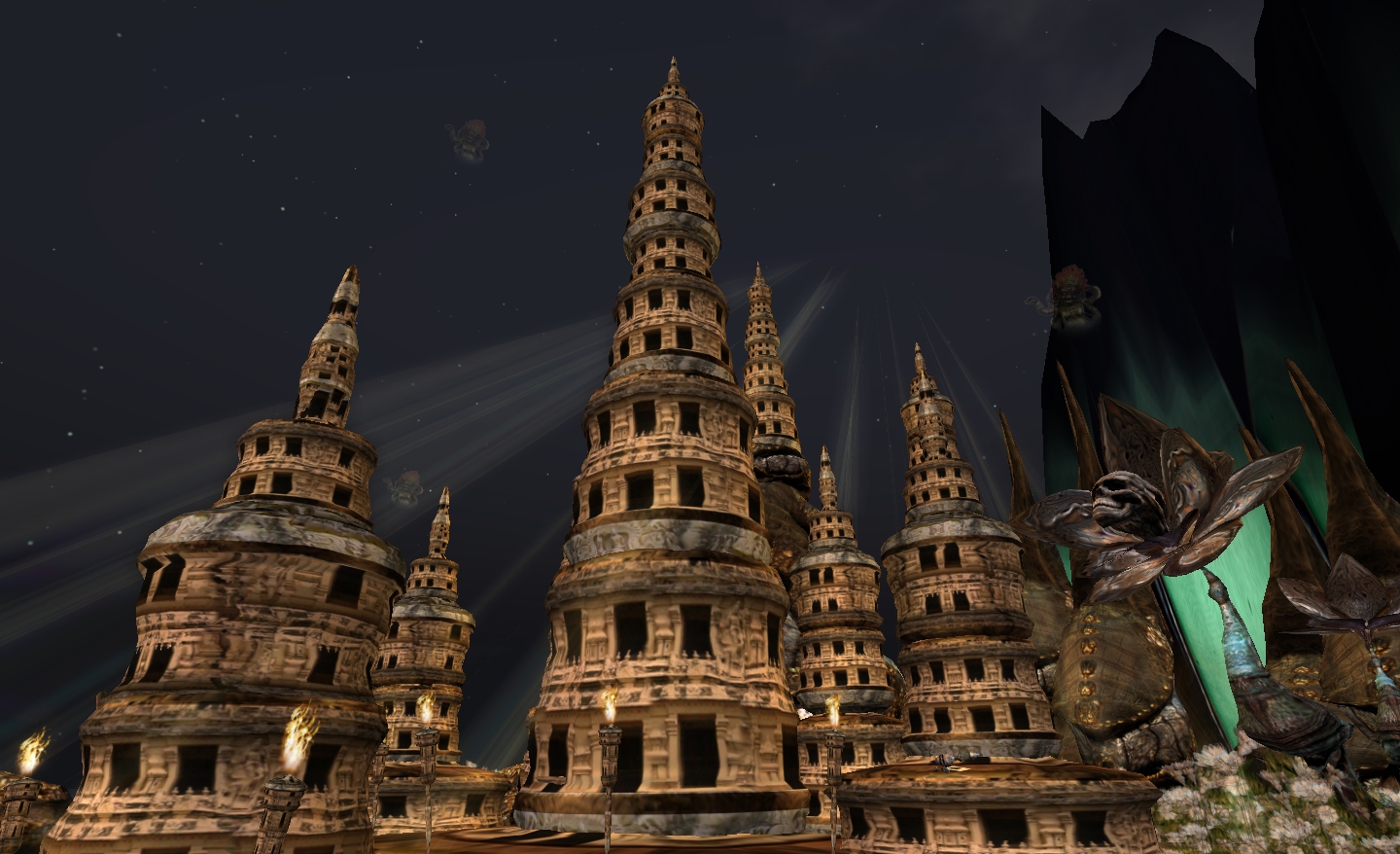
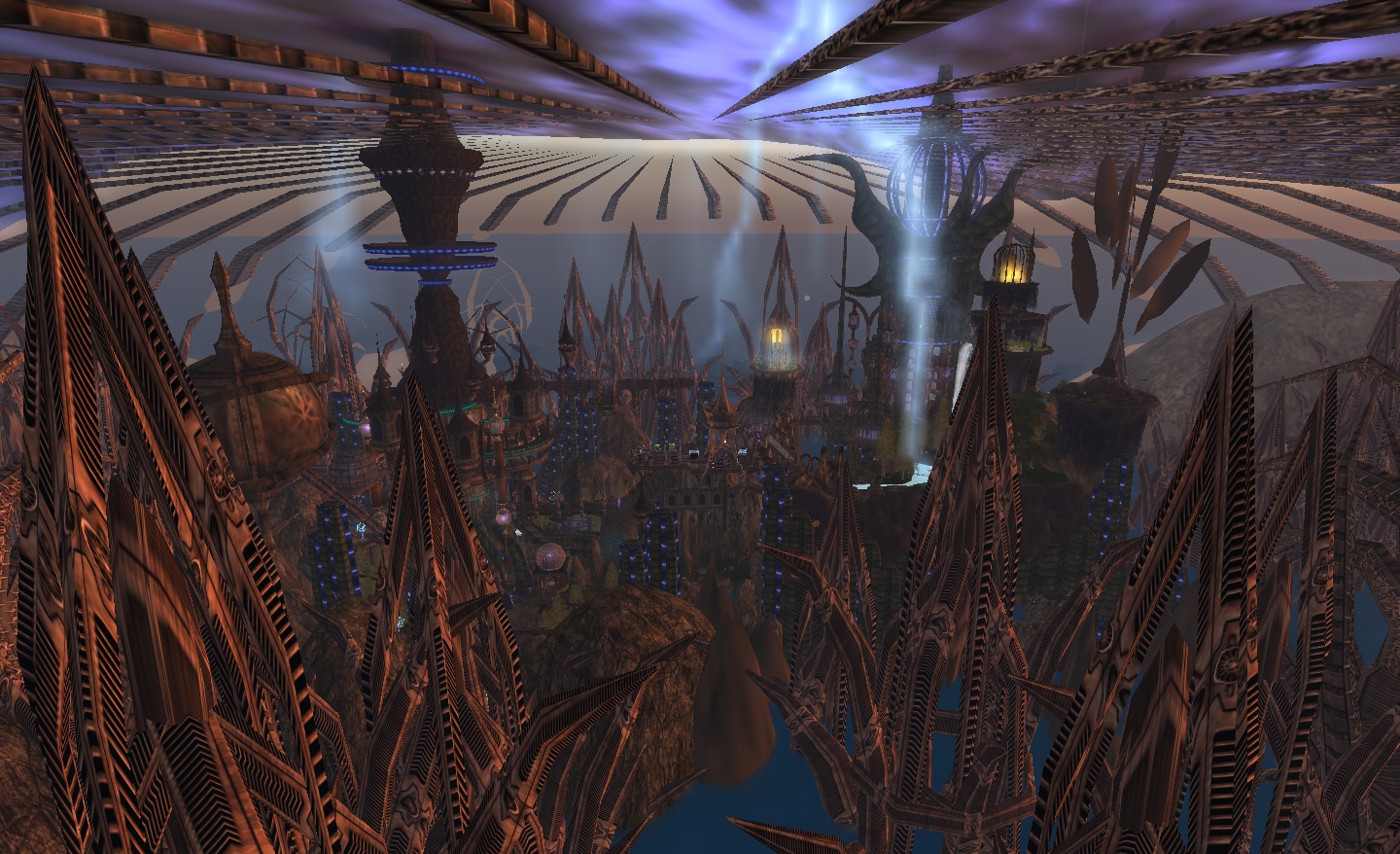
Alpha Point and Omega Point are two stunning builds in Second Life created by Masoon Ringo and Sweetlemon Jewell. Occupying a full sim and a Homestead sim, they form a marvellous build that combines fantasy and science-fiction in a way that simply demands exploration. Just make sure you give yourself plenty of time to do so; there is much to see – and much that can be so easily missed if you rush things.

I was introduced to the regions by Himitu Twine, who spends a good deal of time at both, wandering and exploring – and after the first time I joined her at them, I could well understand why. The combined build is simply glorious. Nor is it entirely static; Omega Point has altered over time, and I’ve no idea as to how permanent the current layout is. So, if you’re reading this piece six months after it is written, don’t be surprised if you follow the SLurls and find things have changed; it simply means you have a new experience to enjoy and will still have much to see and discover.
Alpha and Omega Points

Before you do pay a visit, make sure you turn your draw distance up as far as you comfortably can in order to get the fullest impact of the build; I recommend a setting of around 300m. Also, like a lot of regions nowadays, both Alpha Point and Omega Point have their own Windlight presets, and I recommend you keep to them after you’ve arrived.

The current teleport co-ordinates are such that whether you travel to Alpha Point or Omega point, you arrive at more-or-less the same place: an arrivals area that spans the boundary between the sims, high up and central to the build as a whole. While a marker clearly defines the sim boundary itself, I suggest you wait until things rez before moving around too much, least you find yourself bouncing off the boundary itself (although crossing between the sims, providing you do so at walking pace, is generally very smooth).

Once rezzed, cam out a little and orbit around your position. What appears to be a spired city, with trees and waterways below and a storm-laden sky above surrounds you, and you get the first indication of the complexity of the place. But don’t go camming too far out and peering into windows and doorways – you’ll simply spoil what is to come. This is a place that is best discovered through exploration.

The arrivals areas themselves have a series of teleport panels to get you to many of the points of interest and beauty in the build. At Alpha Point there are also a couple of flying options you can use to get around. However, I do suggest you ignore both flying and teleports to start with.
Teleport arrivals: Alpha (l) and Omega (r)

The arrival areas also have stairs and walkways leading from them, and if you really want to experience the build, then you should really start by using Shanks’ pony: take the stairs and start your explorations on foot.

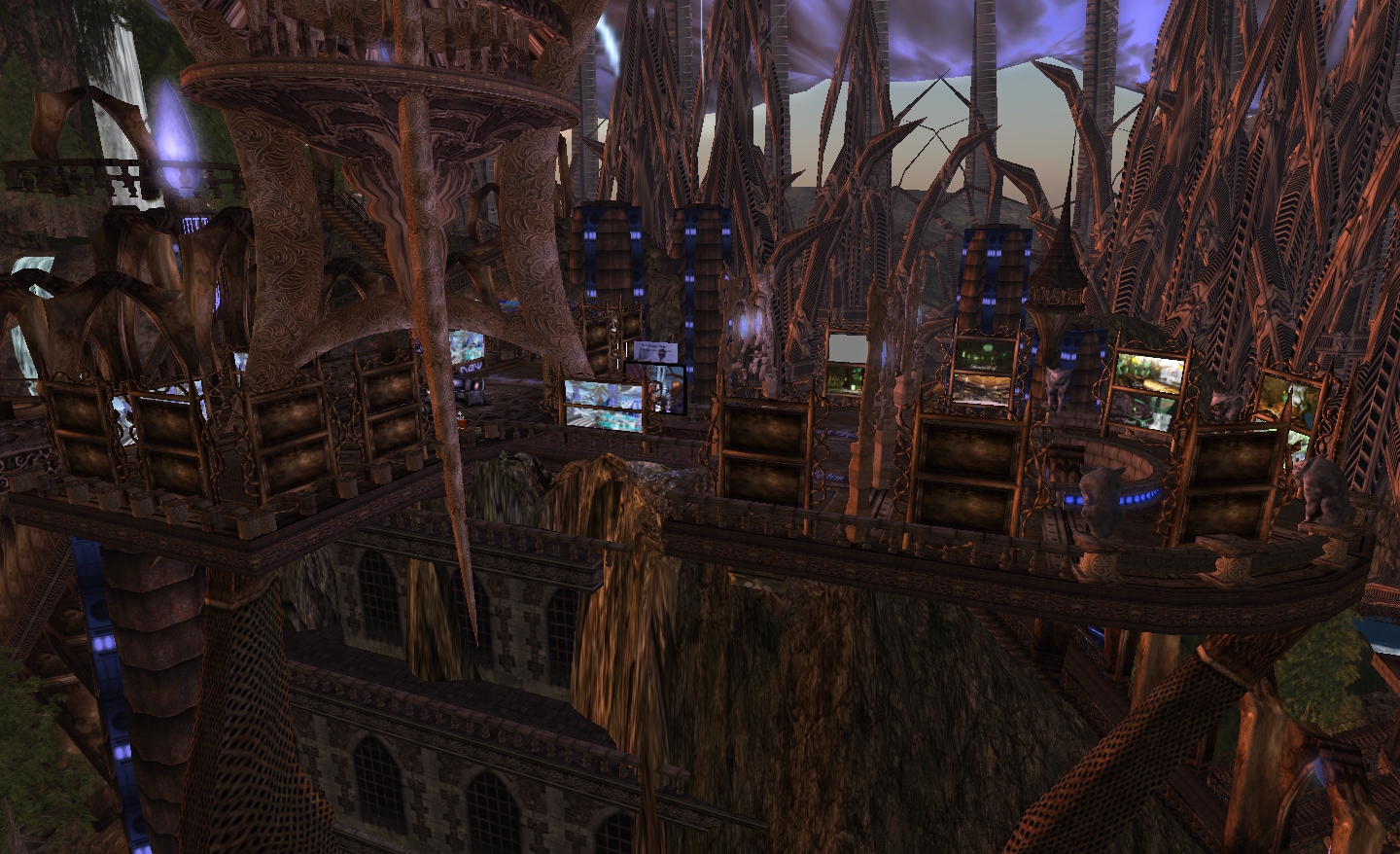
At the time this article was written, the stairs from the Omega Point arrival area lead down to a lower level from which you could make your way to the huge central tower, crossing a gargoyle-lined bridge, or you could carry on down even further to other walkways, landings and stairways until, eventually, you reach the ground. From here, it is possible to wander among trees and fallen sections of the build, long forgotten and half-buried that point to a story yet to be told about the passage of time in this place. There is much to be discovered while down among the trees, so don’t be afraid to wander wherever you will.
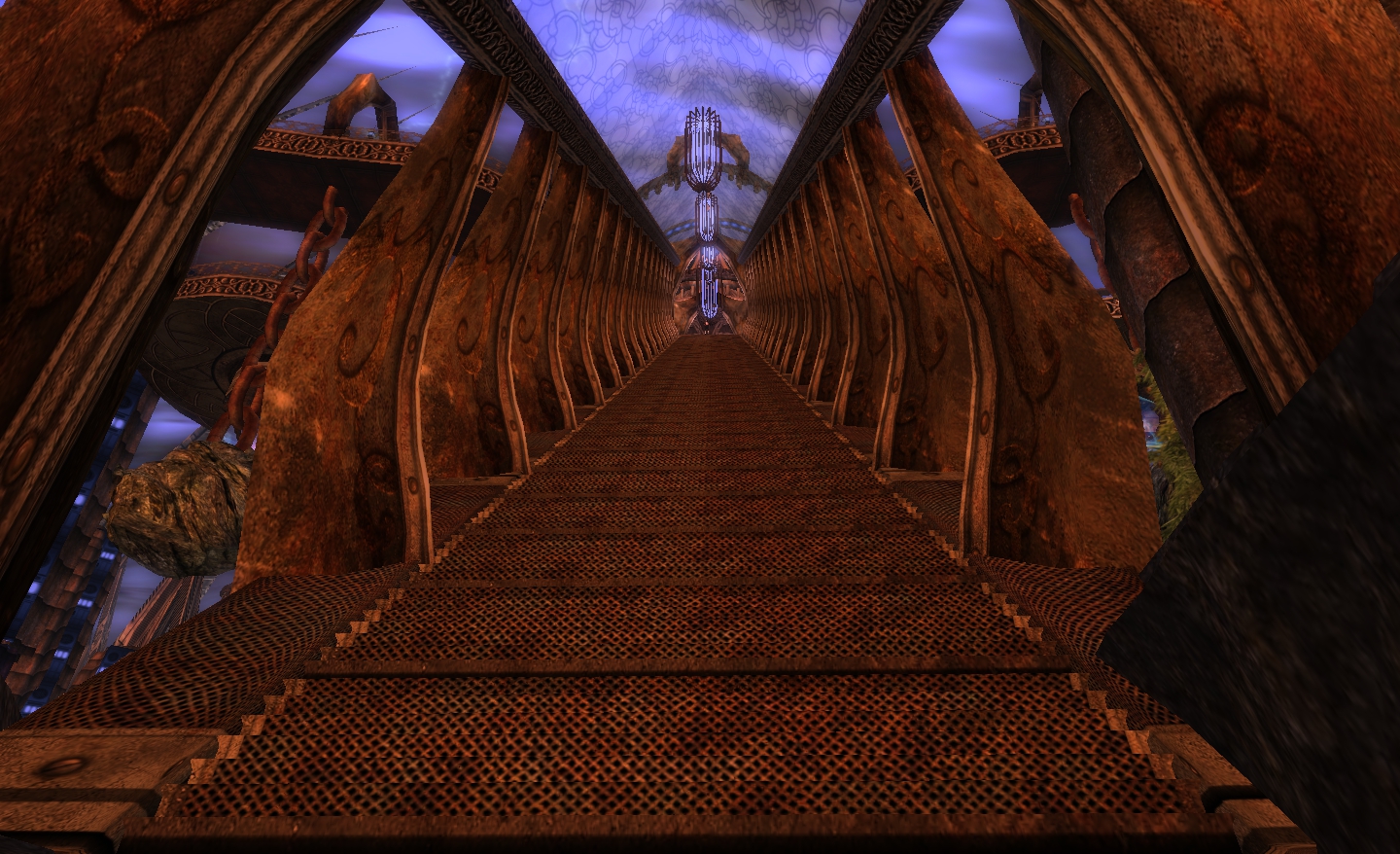
“Climb the stairs, Jim!” – yes, that’s me at the top!

Take the long staircase down from the Alpha Point arrivals area, and you’ll come to a walkway that leads the way around a stunning view of a waterfall. Follow the walkway further, and you’ll pass back under the waterfall, and so enter the labyrinthine lower levels of the build. Here hang paintings and images high up along tall walls, each with a story of its own. Here too, are stairways leading both up and down…
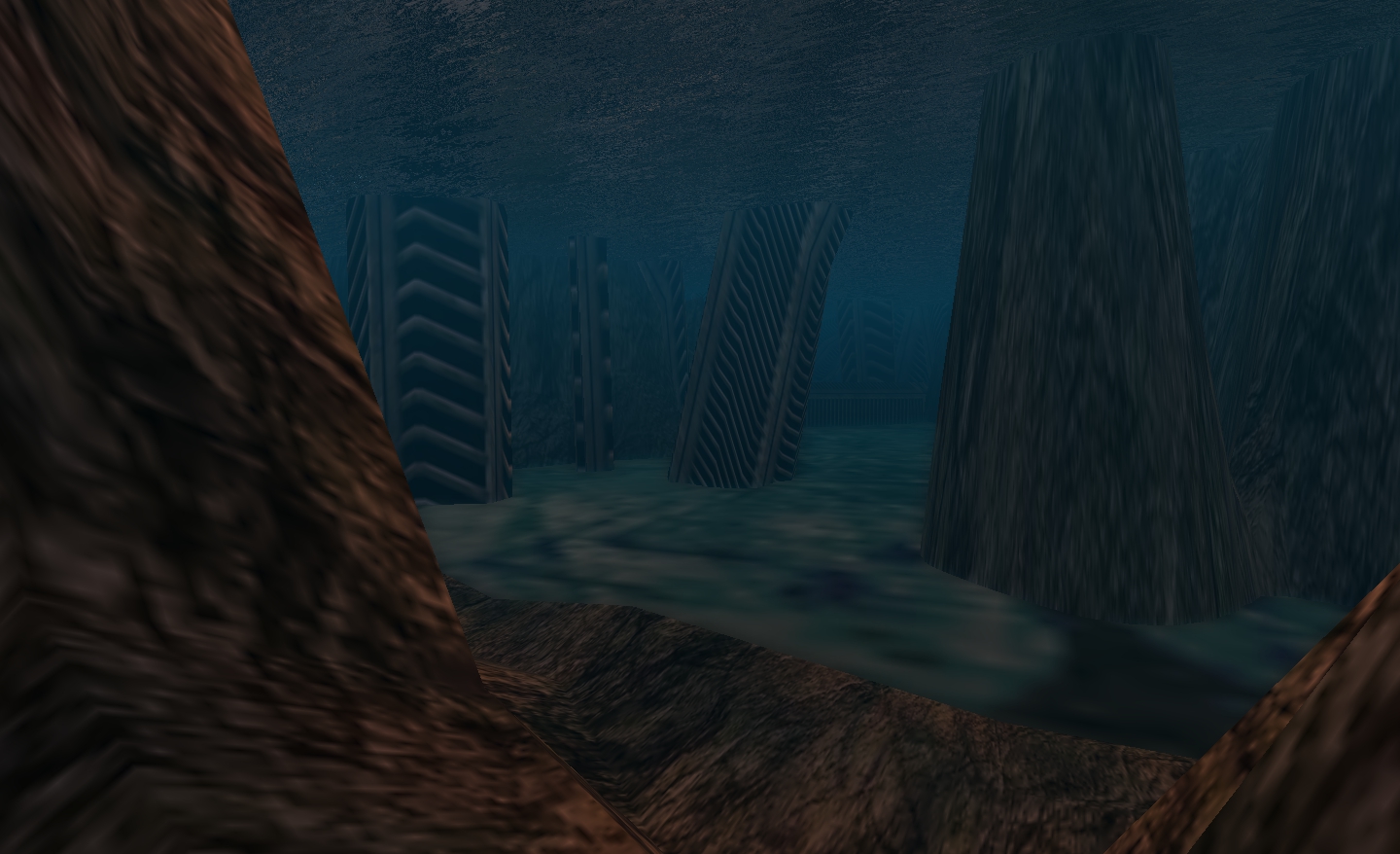
Sims extensions – cleverly used (click to enlarge)

One of the things I love about this build is the imaginative use of off-sim phantom prims to create an even more fantastical realm. In places, it’s as if the build never actually ends; it simply continues beyond our reach, down a hall, along a path or around a corner. It’s so tantalising; the effect engages the imagination and leaves one with a sense of “if only”; if only we could walk around that distant corner and slip under that shadowed archway, or reach those distant doors! What would we find, what wonders would await us – what stories would we have to tell? Lying beyond our reach, these parts of the build demand we fill their hidden promise with people, places – and creatures…

Never knowing quite where you are going to end up is another reason I like visiting; follow a route down into the bowls of the build, and it is quite possible that if you take enough stairs and turn enough corners, you’ll find that the way you thought lead back to where you came from has actually lead you somewhere else entirely. Just do be careful where you do walk, however, some of the walkways appear to lead you towards a destination, only to end abruptly, as if a section has fallen away; whether through age or other reason is up to you to decide.
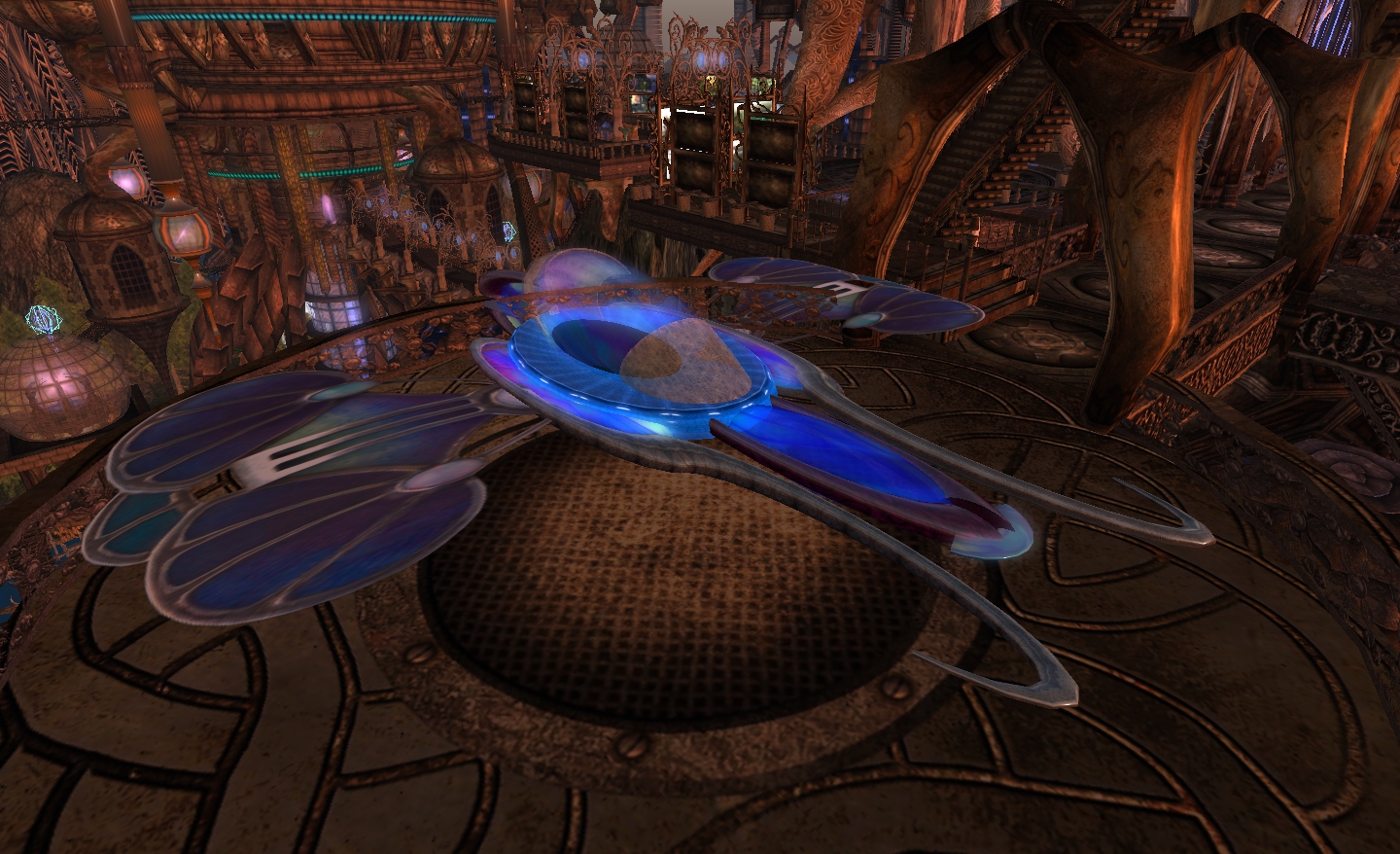
Flyers – a great way to get around

Should you tire of walking, but still have no wish to use the teleports, you can opt to take one of the flying options mentions earlier (so much more fun than free-flying on your own!). Find them back on either side of the Alpha Point arrivals area and teleports.

You can choose from a flying bubble or a craft that resembles a dragonfly for your aerial excursion. Each carries up to two people, allowing a friend to share the experience with you. Full instructions are provided via hovertext, and the usual keyboard controls can be used to control direction / height. Both craft are rez-on-demand from the master version, and will de-rez when you stand up from them. They are certainly a great way to see the build from above, and both perfectly match the theme and design of the place. While crossing  between the sims is very smooth for the most part, it’s worthwhile keeping an eye on your co-ordinates and taking things gently as you do reach the boundary between the two.
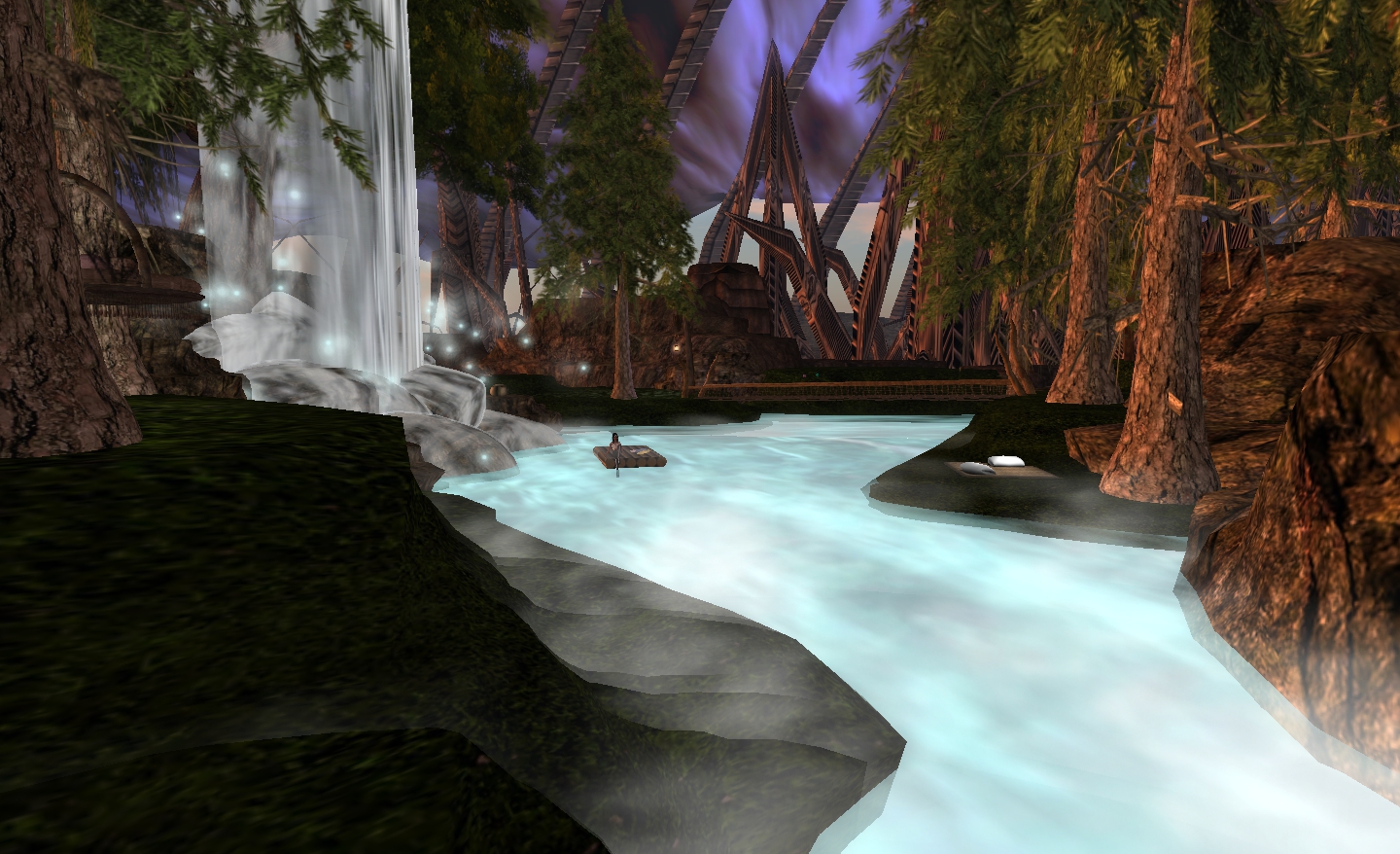
Romance or solitude also await those who seek them

Nor is the build short on romance. You can dance the time away in a ballroom or among the trees or beside the tumbling waters of a fall; you can cuddle quietly in one of many sofas and seats to be found throughout the build, or amidst the trees and grass of a floating garden; you can spend time admiring a waterfall, sitting on the banks of a river or sharing a raft as the water cascades down from high above…

There are also stories to be found as well, if you take the time to seek them – or at least, the hints of stories to be told – such as that of the storm and the shipwreck.
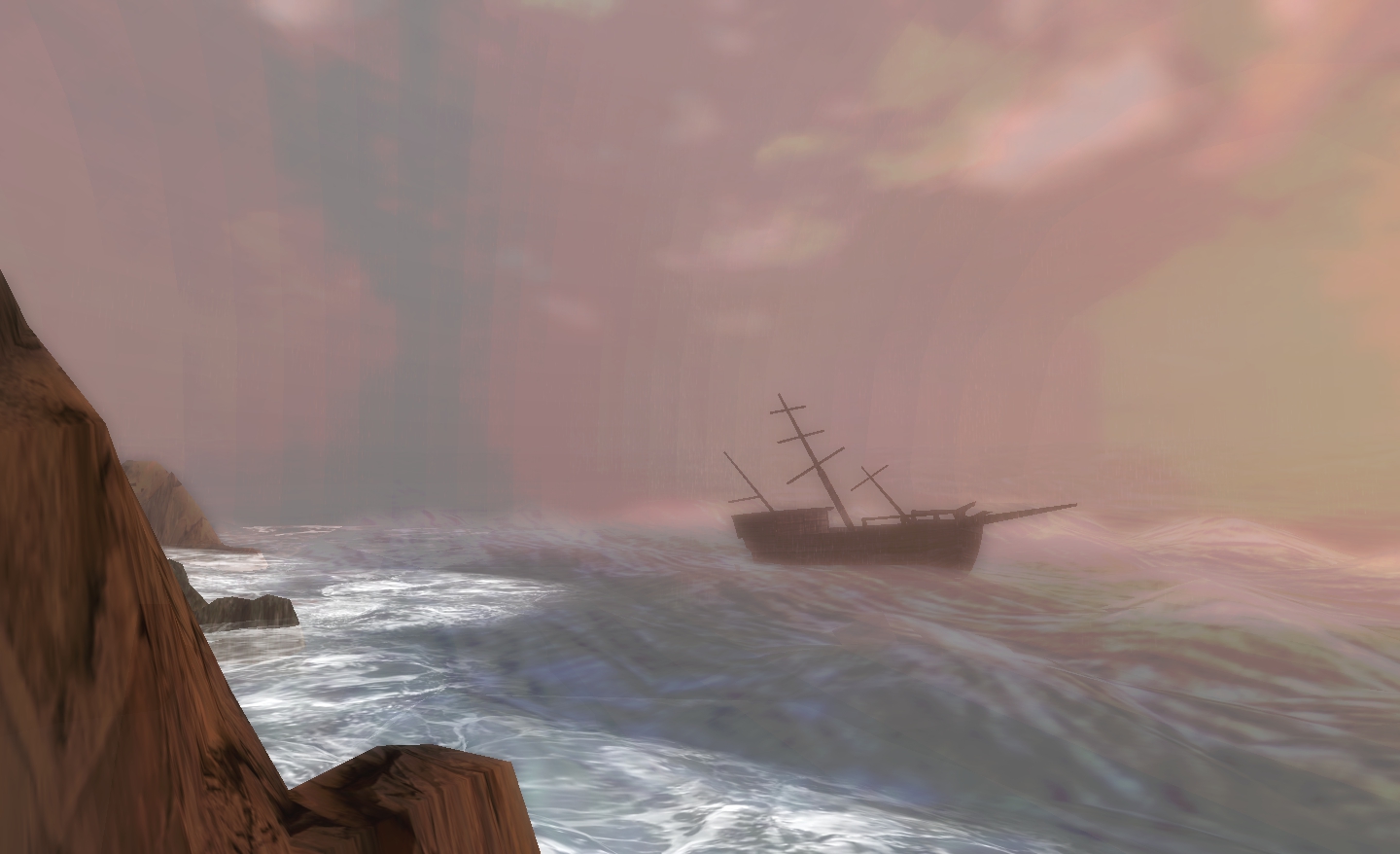
The wreck and the waves

Whither sailed the ship before the storm caught her and tossed her toward the rocks? What was her cargo? Did anyone from the shore witness her sad fate – and what of her crew? Did they live to tell of her loss, or did they perish in the unforgiving arms of the sea?

The start of the story is there for you to see – but how it should end is down to your imagination, and your imagination alone – but you’ll have to find it by exploring in order to settle on your own tale!

Even with the flyer options, however, there are some places here that are best reached via teleport. One of them is the fantastic “Village to Heaven”.

Set high in the sky and surrounded by perilous mountain peaks, this is another stunning build, rendered in ivory, marble and ice blue, with gleaming cloud-ships sailing by, and  lush woodlands below.
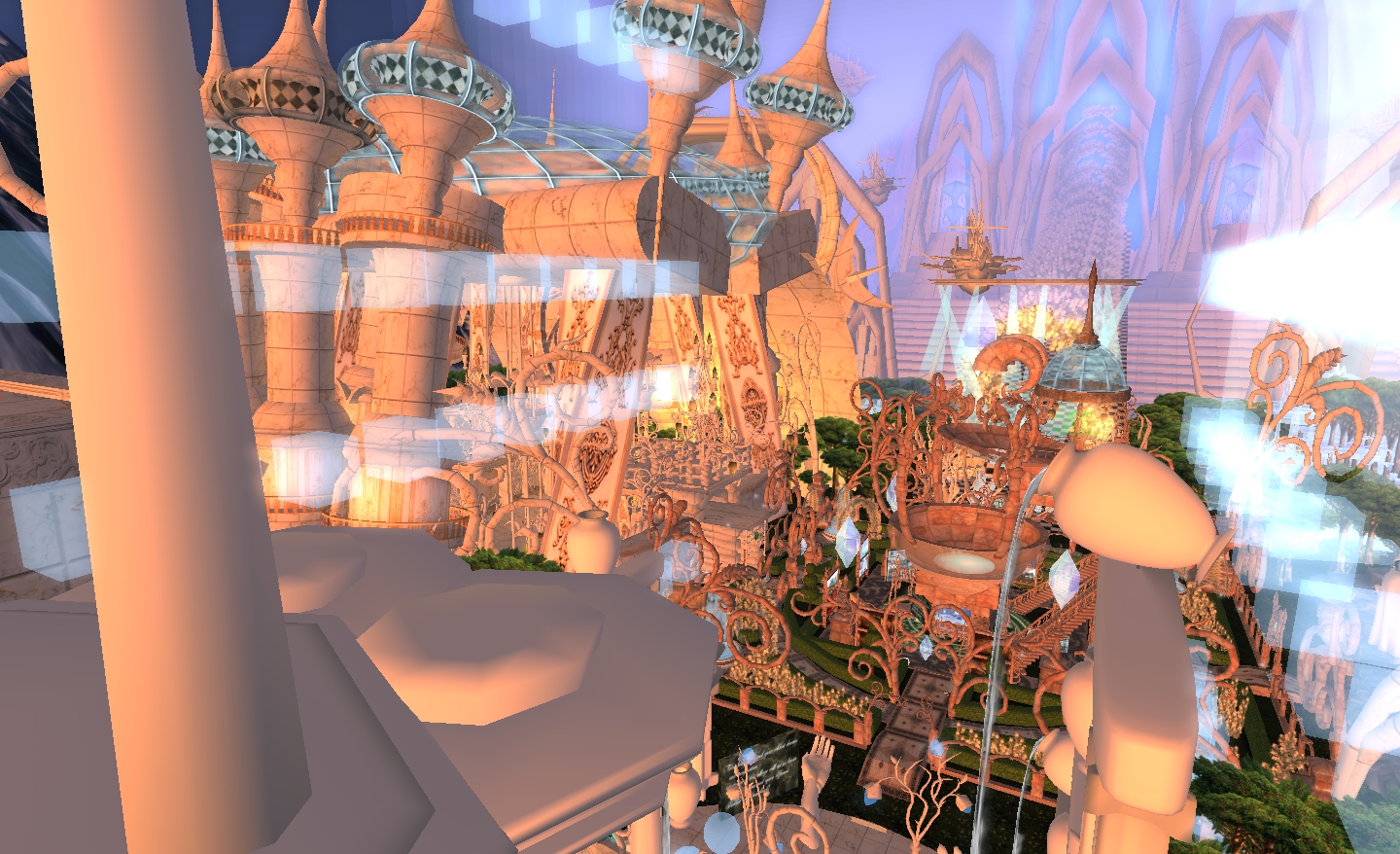
“Village to Heaven”

The scale and attention to detail here is equally as stunning as the build on the ground, including the use of phantom prims to extend the beautiful fantasy of the place beyond the limitations of the sim boundary, again giving the illusion of places we cannot visit and stories we cannot witness.

Take the path from the teleport, for example, and follow it through the doors leading into a huge amphitheatre – a feast for the eyes in itself – then cross to the other side and open the second set of doors. Just where does the path, sloping upwards and guarded by pairs of white-cloaked statues, lead? What lies beyond the gilded doors at the far end of the climb? You can never know for sure, as they lie beyond the edge of the sim – but as you walk as far as you can towards them, you can be sure your imagination will be asking questions as to what might be there, and who the robed statues really represent…

Another stunning use of a custom sim extension – where exactly does the sim end? Walk the path and find out…

Teleports are available here as well, but you should take the time to explore on foot, there is so much to see. The Village comprises parts representing the four elements: Air, Water, Earth and Fire – and I found that Air and Water in particular put me in mind of Tolkien’s Imladris – and I expected to hear the soft lament of elves if I turned on my sound.

Cloud ships

The key here is, again, to take your time with your explorations. When you have seen all you wish to see, look around once more. The chances are there is a path or stair or doorway you may otherwise miss.

When you are satisfied with all you’ve seen, return to the teleport point and climb the stone stairs. These lead up to the a Fall Pod platform. Here, every few seconds a ball will drop and roll towards a tunnel-like chute. Grab one quick with a right-click and SIT, and take a ride back down to the world below. It will reveal things that have so far escaped your attention as you return to the Alpha Point arrival area.

If there is one problem with this build, it is that when it comes to reviewing it, there is simply too much to see. This article is already around the 2000 word mark, and I’ve barely scratched the surface of the place. To try to capture everything in words and images would take a novella. But then, frankly, words and images alone do not do Alpha Point and Omega Point any justice. This is not something to be read about and looked at via static pictures; to do so would be like convincing yourself you’ve watched The Fellowship of the Ring on the basis of seeing and reading the film poster.

To really appreciate this build, it has to be visited; it is something that should be experienced, explored, enjoyed – and savoured – and I urge you to do just that. But be warned: once you have visited the Alpha and Omega of Second Life, you are likely to find yourself coming back time and again. The build is magnetic, inspiring…

…Addictive.

Omega Point

To further whet your appetite just a little more, here’s a machinina video JJCCC Coronet produced just over a year ago, showing how Omega Point looked back then.
Related Links

Original art debuts at Originalia

Travel to Originalia is the newest art exhibit on Amase Levasseur’s Originalia sim. It features three new works, Postcards Home by Callipygian Christensen, Adapt or Perish by Cherry Mangaand and Gateway to Hell by Fuschia Nightfire, together with a chance to once more enjoy Scottius Polke’s acclaimed The Docks.

The exhibit itself opens this coming weekend, but I was lucky enough to be invited to preview the installations ahead of the formal opening.

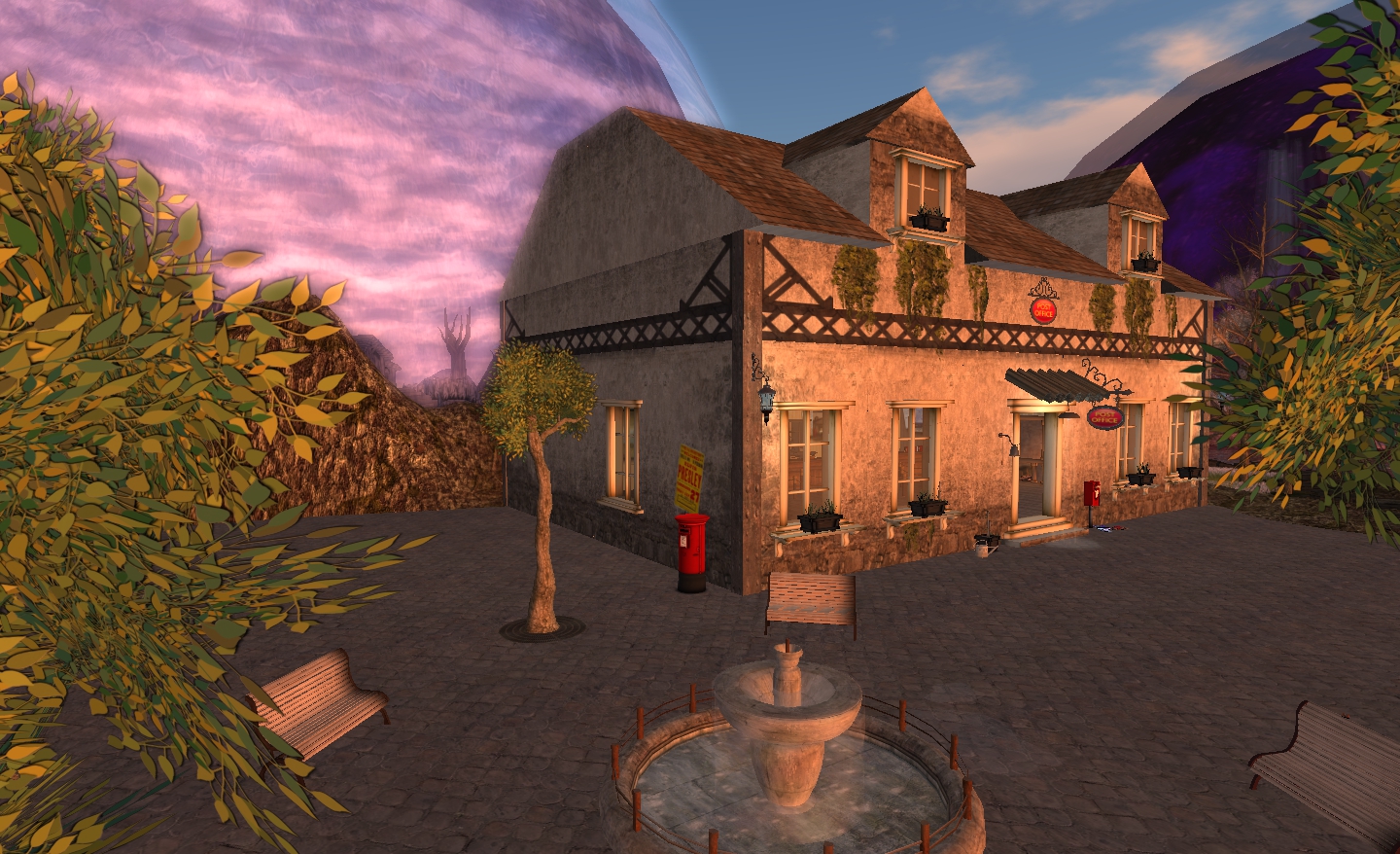
Teleporting to Originalia brings you to a small arrivals area, with the ominous title Adapt or Perish.From here lay a series of wooden or stone paths leading to the different exhibits in the installation, three of which are visible without excessive camera-panning, two under their own respective domes, while the third appears to be a quite rural English Post Office of yesteryear.

There is no specific order in which you should view the exhibits; however, as I am English, I naturally felt drawn towards the Post Office, which also seemed to have a small welcome area in front of it. So that is where this preview starts.

Postcards Home

If it wasn’t for the very obvious domes raising from behind and one side of it, one could almost imagine the Post Office is part of a set awaiting the arrival of Miss Marple and a BBC film crew. It’s a charming place, with a fountain out front and places to sit. There is also a poster for the exhibit, which provides an introductory notecard and a series of landmarks (which actually all resolve to the same arrivals point).

The Post Office

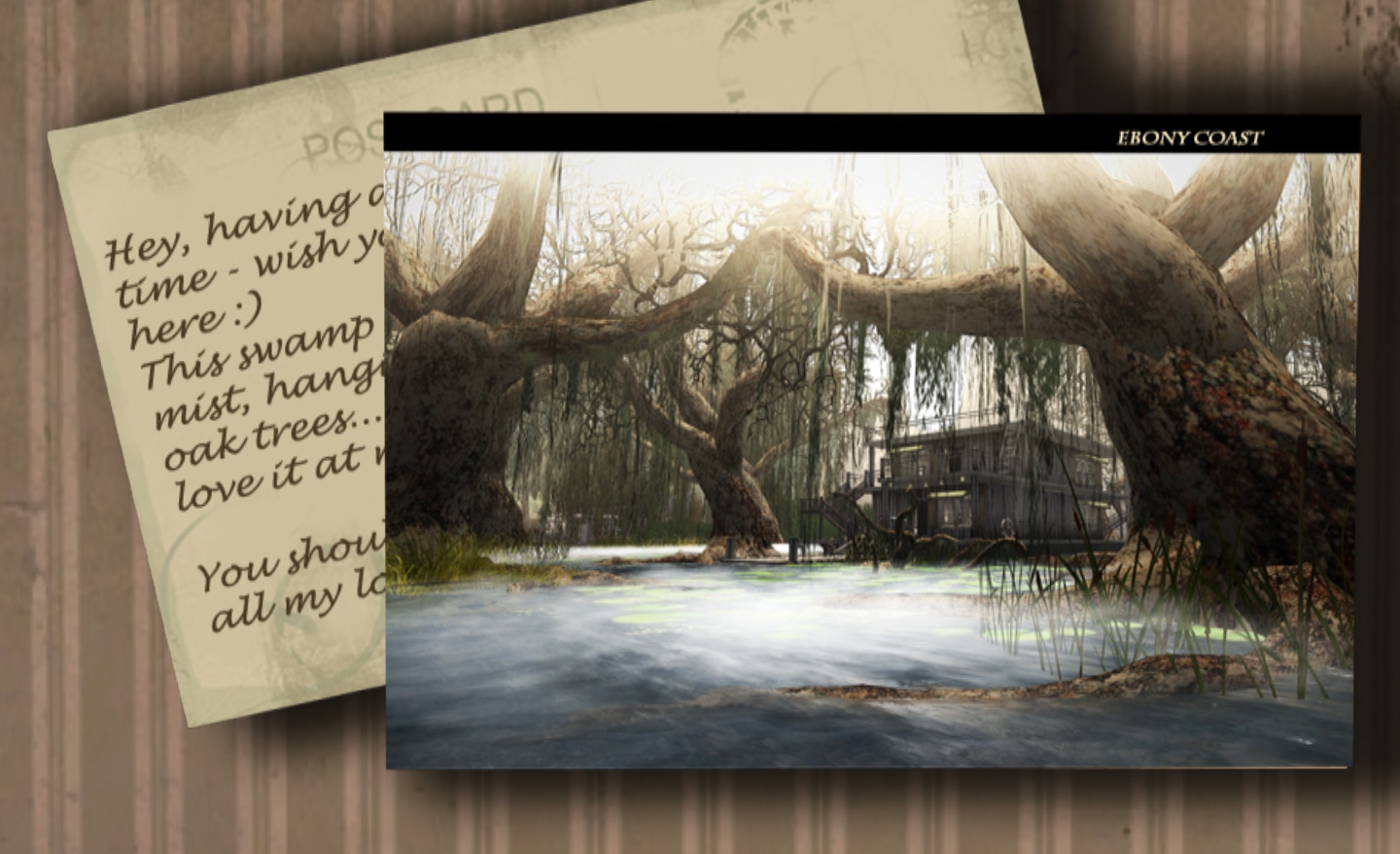
Inside are the orderly roped counter queue areas (we English so love our queues), a familiar counter and, on the walls, Callipygian Christensen’s images which form Postcards Home. Each, as the name of the exhibit suggests, features an image captured from somewhere within SL displayed as a postcard, complete with the “reverse” side tucked in behind it, some of the text just visible.

Callipygian Christensen’s “Postcards” – clever and evocative

It’s a clever approach; the images themselves can be evocative – there is one of AM Radio’s work which causes a slight pang given his sims are now sadly gone from SL. The partially viewed messages from the “backs”of the postcards give each one added depth, as we catch a small glimpse into the life and thoughts of the person who sent the cards.

Adapt or Perish

This is something of a cautionary tale about our need to remain in harmony with nature or risk destroying it – and ourselves.

Cheery Manga: Adapt or Perish

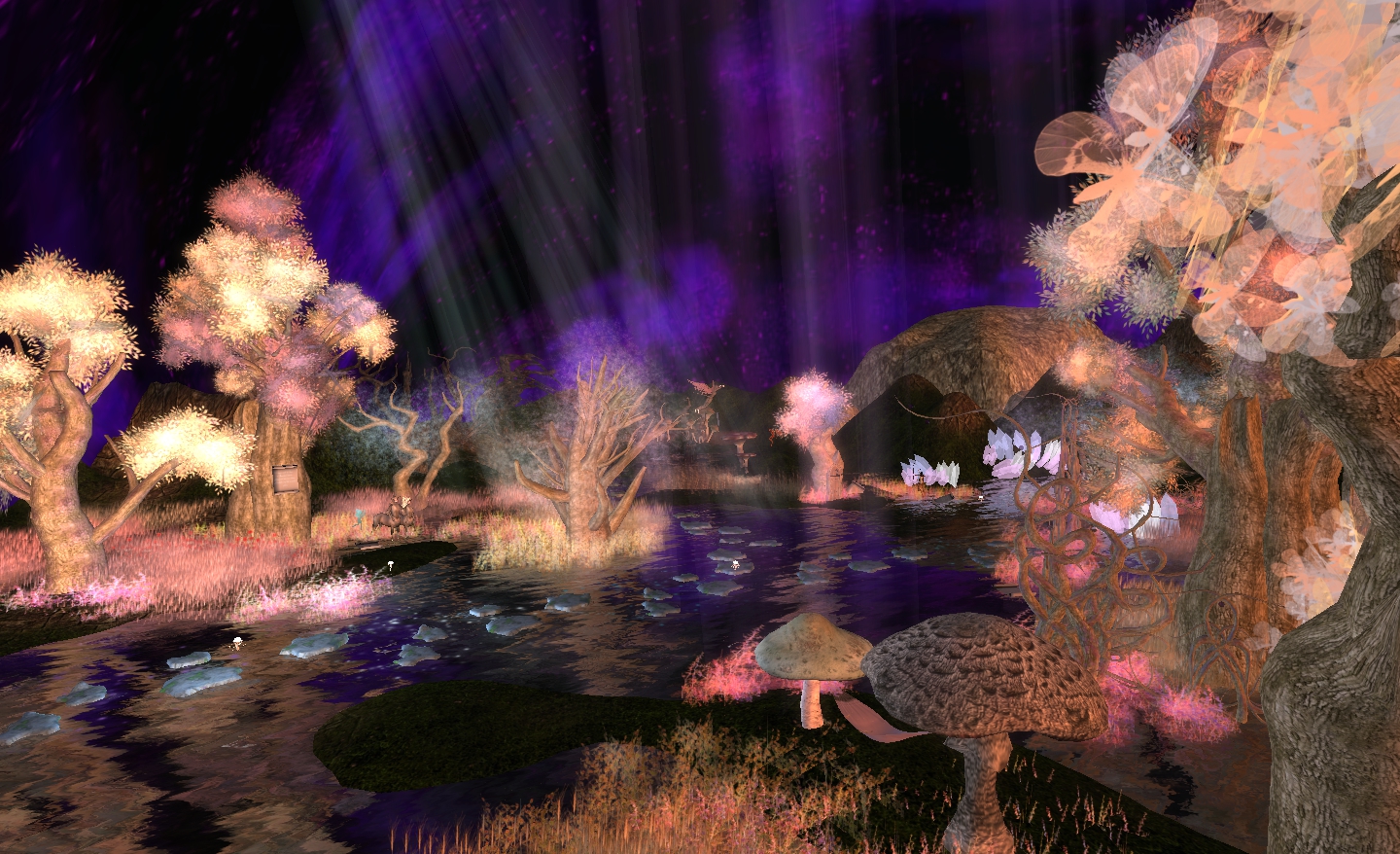
Entering the dome, you enter a fantastical landscape, rich with flora, with fairies, fawns, centaurs. This is not a single tableau, however. Rather, it is as series of visual vignettes, all of them interlinked and accompanied by a short verse, which all build together into the overall piece and the story it tells.

Stone paths over the water lead you deeper into the piece, past those who have learned to adapt and accept what Nature has to offer, taking no more than what is needed, sharing, making nature their home and giving thanks for all that they have.

But as one moves deeper, so things grow darker. The grass dies. The leaves wither from branches overhead. The trees themselves become bare-branched, misshapen grotesques. So to, does the music change, a haunting, deadly voice slowly filling the air the further one continues.

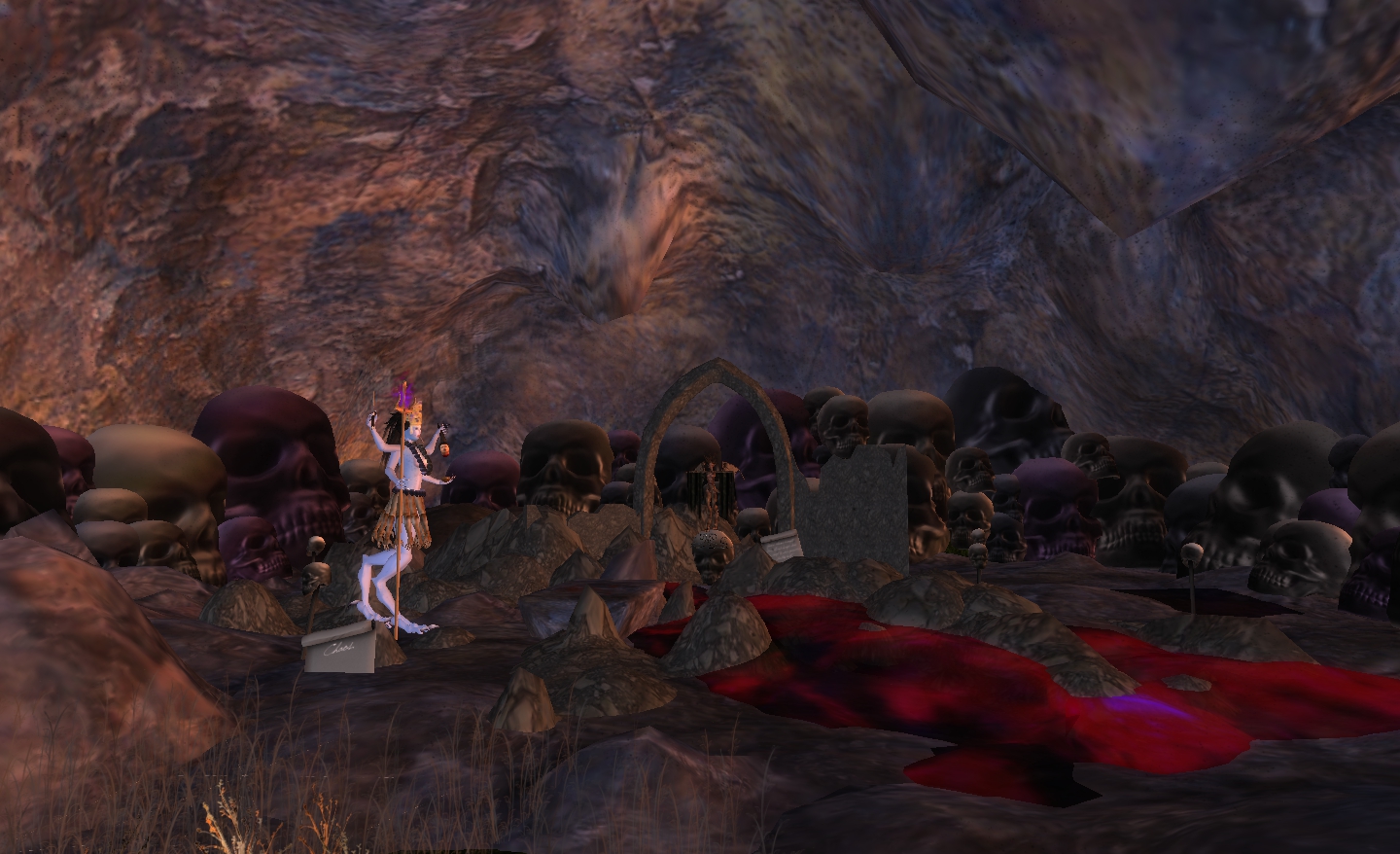
Here is the realm of those out of harmony with nature; those, we are warned, who steal and kill, who always want more. Their footprint is that of desolation where a dank mist covers the ground and nothing but fungi flourish. The air is filled with the sound of leaden, warning drums and a deathly chanting, and the path leads us inevitably to chaos and death.

It is a sobering message, one only too clear in its meaning – and it is also one beautifully rendered, although I must admit that I wish something other than a refrain from the soundtrack of Kubrick’s Eyes Wide Shut had been used for the more menacing element of the background music; this tended to allow images from the film slip into my mind, spoiling my focus on the piece in front of me.

Gateway to Hell

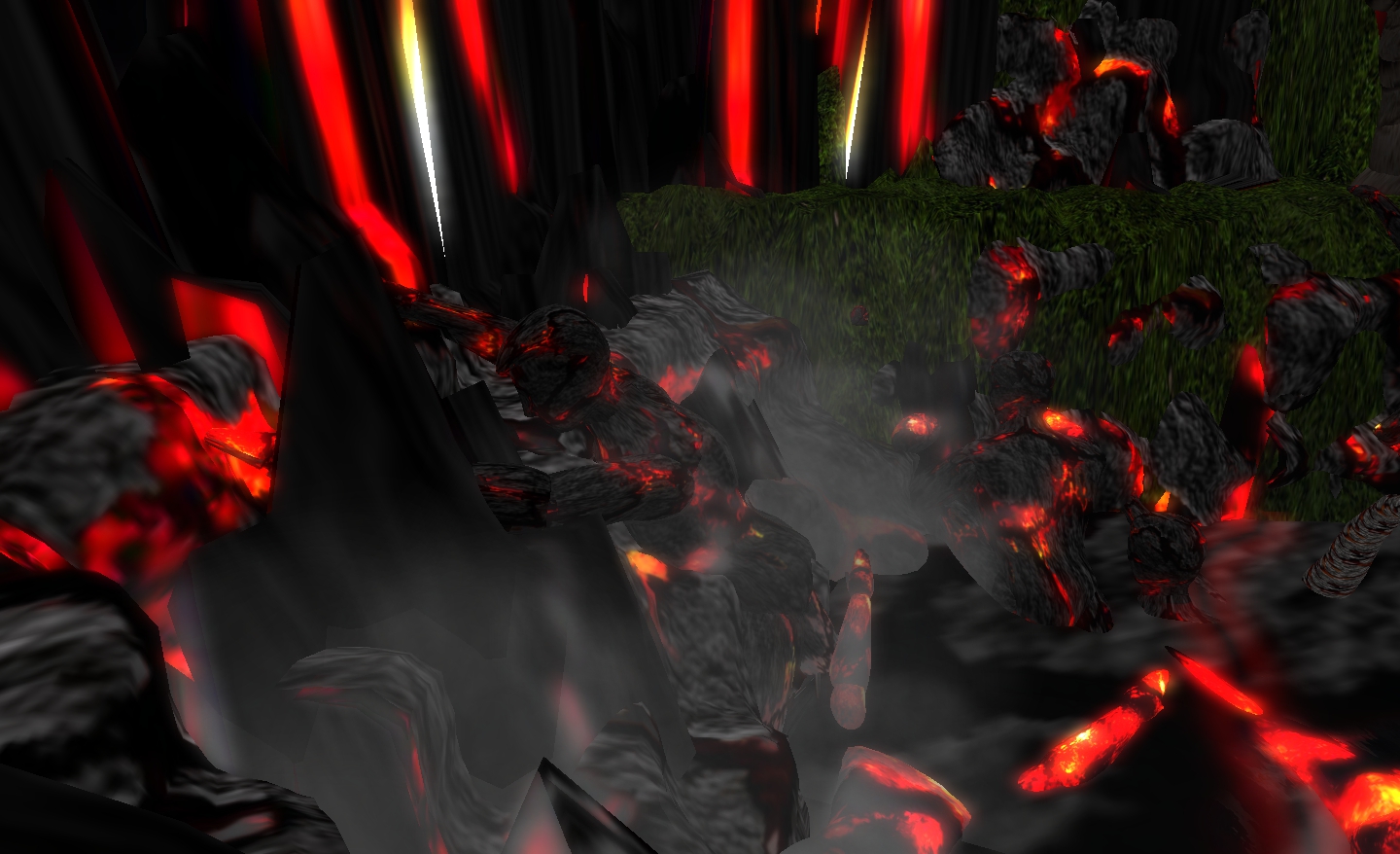
Gateway to Hell in some ways continues the theme of death and damnation as it presents us with burning image of the entrance to hell, the air heavy with ravens, a fire pit heaving and pulsating beneath, the tentacles of unknown creatures writhing up through the fiery rock. As lava flows down from the walls, so to become visible the spirits of the damned as they are pulled down through the pit into hell itself, few willing to go without a struggle.

The Docks

Scottious Polke’s The Docks won acclaim when first presented in SL, and became a popular subject for Machinima makers across the grid. Now it makes a welcome return to its original home. It is a haunting place to visit, one that is perhaps best summed up in What isn’t Underneath by Textcavation.

Opinion

Travel to Originalia is an interesting mix of exhibits, each with its own context and meaning, yet three of them  – The Docks, Gateway to Hell and Adapt or Perish carrying, for me at least, a common subtext. I enjoyed all four pieces – The Docks perhaps slightly more than the others, as I had missed it the first time around, and have only had machinima to allow me to see it; so having the opportunity to visit it in person gave me a sense of anticipation the other pieces, being original items, couldn’t match.

Which is not to say they are not worthwhile seeing. Rather then reverse, in fact. Whether see as a whole, and in a single visit, or as individual displays, each visited independently, they are well worth the trip. Should you visit all three together, I would recommend you do so in the order I used: start with the Post Office and Postcards Home, then go to Gateway to Hell via Adapt or Perish.

Travel to Originalia opens at 13:00SLT on Saturday October 22nd.

Login2life: a review

It has been almost four years in the making – growing from the seed of an idea planted some five years ago -, has a truly global reach in terms of those involved, and spans two rich virtual environments.

Login2Life, a documentary directed by Daniel Moshel,  follows a group of people from around the world, each of whom spends some of their time engaged in either Second Life or World of Warcraft – and in some cases, both. On the 17th October, the film received its premier in Germany, and is being streamed for this week only on the ZDF website.

At a touch under 85 minutes in length, the film doesn’t have a specific narrative flow – there is no narrator’s voice-over to guide us from a given starting-point vis-a-vis virtual worlds or lead us to a particular conclusion. Instead, we’re left to meet each of those the film involves, and follow them as they engage in their virtual lives and voice their views and feelings on their lives, what virtual worlds provide for them, about love and relationships and family living and much more. Obviously there is a degree directorial influence involved here – the selection of which part of people’s stories made it into the final cut, etc., but on the whole, the approach leaves the person watching the film free to consider all that they see and draw their own conclusions.

The film opens in real life, with the story of Corey Shea Franks, a young man from California who, in 2002, was left paralysed from the neck down following a car crash. From here we journey to Aurora, Colorado and Alice Krueger, perhaps better known in SL as Gentle Heron. She is watching a performance in Second Life by Jaynine Scarborough (real name: Juliane Gabriel), a singer and vocal music teacher from Berlin, Germany.

Alice has severe multiple sclerosis, which leaves her reliant upon both crutches, or more usually, a powered wheelchair, rarely able to venture out of her own home. Within Second Life, as Gentle Heron, she has been central in the creation of a Second Life community dedicated to those with disabilities – Virtual Ability, with its hub at Virtual Ability Island.

Inspirational: the creation of Virtual Ability and Virtual Ability Island seen through Login2Life

However, it was not her original intention to found and build a community; rather she arrived in SL together with two friends she met via the Internet looking for a community in which they could join. This grew out of feelings that, as disabled people in real life, they were not a part of the respective geographical communities in which they lived. When they failed to find what they were looking for, they decided to make it, and bring people to it.

It sounds so simple – and the machinima accompanying Alice’s description of those early days is touching without being overly sentimental. Yet it is here that we see one of the powers of Second Life revealed: that it is an environment where people can come together openly and, with the right impetus, create something that is truly marvellous and beneficial.

The laughing gnome: Philippe Fatoux and his WoW character

Elsewhere in the film we get to meet Philippe Fatoux, a machinina creator in World of Warcraft – in which he delights in being a cheeky little Gnome, getting up to various amounts of mischief, and Thomas Bengtsson, Guild leader for Ensidia, also within World of Warcraft. There is also Chinese family who play WoW together with the express aim of farming gold – which can be exchanged for real-world currency.

This part of the did leave me feeling rather discomfited; there was something unsettling about seeing almost an entire family almost desperately farming gold in WoW as a source of income while others engaging in the game gave the impression they looked down on those who do this with either pity or disdain.

We also once more meet up with Corey Shea, himself a skilled player in WoW, and his family; and we gain a candid look into the life Kevin Alderman, better known to many in SL as Stroker Serpentine in SL, owner of Eros LLC and the SexGen brand, although he originally started out in  Seducity.

What is striking about the film is the way it naturally blends people’s virtual lives with their real lives. There is no sense of delineation between the two as the film moves back and forth between the virtual and the real. Nor should there be – what happens within the virtual environs is as much a part of these people’s lives as anything they do in the real world. I think it fair to say anyone who invests themselves in a virtual world to a similar degree will readily identify with this lack of delineation as well.

For me, the stand-out elements of the film are with Alice and with Corey’s family – in particular, his mother. Both women are dealing with the massive impact a disability has had on their real lives – Alice in terms of the limiting factors MS has created for her, including her inability to easily socialise and meet people in her every day life; Margeau Janae Franks in dealing with Corey Shea’s condition and the impact it has had upon her family. Seeing both women working through Second Life to bring Margeau Janae’s book, The Length of a Breath to an audience and in the hope of helping others is particularly moving. I felt very privileged to be able to share a part of both of these women’s lives through the lens of Daniel’s camera.

Margeau Janae Franks (podium) and Alice Krueger (Gentle Heron) with her back towards us, work on Margeau Janae’s presentation in SL

Similarly, it is fascinating to follow Kevin Alderman and his family. Here is a man who clearly loves and values his family and who, with them, has demonstrated how very disparate real and second lives can be brought together relatively harmoniously, to the benefit of both. Several of my favourite moments in the film came from being allowed to witness Kevin’s interactions with his family. I also very much liked the scene showing Kevin / Stroker meeting with Alice /  Gentle – to discuss the creation of a couples dance animation that would enable someone in a wheelchair in-world to dance with someone more able-bodied.

Alice and Kevin meet via Gentle and Stroker to discuss dance animation (inserts my own)

Given the range of subject matter covered by the film – including sex – Daniel Moshel is to be congratulated on his overall handling of the subject matter. What we see in this film are not oddballs or people who are socially inept – which is all too often the way the media like to portray those engaged in virtual lives.

Instead, we have people who both directly and indirectly have found that through the virtual medium they have been able to hugely extend their and enrich their real lives. This makes Login2Life one of the few films out there that provides clear insight into why people are motivated to spend a good portion of their time engaged in virtual worlds without pandering to the need to titillate through overt sexual references. The sex is there, certainly, but there is none of the nudge-nudge, wink-wink that many in the media find hard to avoid when looking at virtual world environments. Instead, Login2Life simply introduces us to some amazing people who in turn invite us to share a little of their lives.

Some might critique Login2Life for the lack of narrative flow – or at least the lack of narration; it’s fair to say that at times the jumps in the film are a little disconcerting as we move from story to story, and one’s focus is broken in the mental gear-shifting that follows some of the jumps. If I’m honest, it also makes the film hard to review – I’ve really only scratched the surface in this article and focused on those elements that held the core of my attention. There is so much more going on within Login2Life that in some ways, had there been more of a narrative arc, it would have been easier to review and give feedback.

But the film has not been made simply to be reviewed. It has been made to be experienced, and in that regard, I think the lack of narration / narrative arc works and makes the film more engaging than might otherwise have been the case. Without an apparent central message, the film is far more a voyage of discovering for the audience, and thus that much more satisfying to watch and absorb, as we are free to be drawn into those elements that engage us and come to our own conclusions as the vignettes unfold.

Which is not to say the film does not lead up to something very special. The last fifteen minutes bring so much of what has gone before together in a series of very poignant moments which I’m not about to spoil by describing. You’ll have to watch and see for yourself.

Daniel and the production team are to be congratulated for putting in the years of hard work and effort that were required to make this film. Their effort has been more than worthwhile. Login2Life is a tremendous film, and all those who participated also deserve our thanks for allowing us into their lives.

Login2Life  – why not login and watch it yourself? You can do so all this week, and you won’t be disappointed.

A walk through an exquisite path

The exquisite corpse is the theme of a new full sim LEA exhibit called The Path, opening today in Second Life, which features the work of no fewer than eight of SL’s most talented artists.

Surrealists

The term “exquisite corpse” (also referred to as the exquisite cadaver) is a means by which a collection of words or images is assembled, with each collaborator in the piece adding to the composition in turn, either by keeping to a specified rule, or by being allowed to see the end of what the previous person contributed. If you think of it akin to the game of Consequences, in which each player contributes a line of a story then folding it to conceal part of the writing before passing the paper to the next player to continue, you’ll have the general idea.

As a form of art, the process was developed as a game by some of the leading Surrealist artists of the early 20th Century, including André Breton, Jacques Prévert, Marcel Duchamp, Yves Tanguy and Pierre Reverdy.

For The Path, the contributors of the piece are (in the order their work appears in the installation): Bryn Oh, Colin Fizgig, Marcus Inkpen, Desdemona Enfield / Douglas Story, Maya Paris, Claudia222 Jewell, Scottius Polke and Rose Borchovski. Bryn Oh explains how the order was decided upon:

” [The] Eight artists were invited to stand upon one of eight different coloured boxes I had set up.  Once all had chosen a box to stand on, a chart was rezzed which listed the order of colours which would dictate the sequence of artists to compose scenes for the narrative. So if red was first on the chart, then the artist standing on the red cube would begin the narrative.  If blue were next then the artist on the blue cube would continue the story.”

It’s an intriguing approach to building a collaborative piece of art – and one I’ve been itching to journey through since first learning about it while interviewing Claudia222 Jewell in September.

The Landmark / SLurl for The Path delivers you to a darkened room together with a request for the region to control your Windlight settings – for the best visual impact, you should allow it to do so.

To your left are eight plinths introducing the eight artists who participated in The Path – clicking on these will give you a short biographical notecard and (in some case) a Landmark where you can see more of their work. There are also two large stone-like tablets introducing you to the concept of The Path and which give you some advice on how to enjoy things – such as making sure you have sound available, as the installation is an aural, as well as visual, experience.

Getting A Head

It’s all in his head

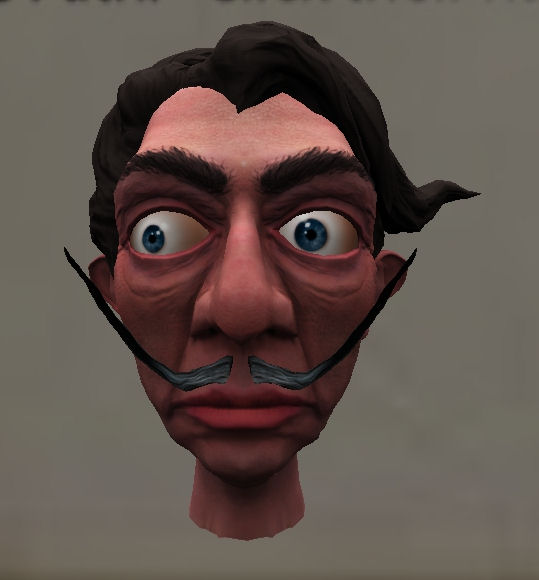
A head, resembling a young Salvador Dali, watches you from the bottom of one of these tablets – clicking on it will carry you to the start of The Path proper, and Bryn Oh’s work. Note, as well, that the head is your main clue as to how to proceed through the rest of the work.

Taking the teleport delivers you to a white room. A strange engine-like thrumming fills the air, together with soft piano music. On the floor lies a single, plaintive butterfly, while before you lies a black wall…a hole…beckoning you through.

Walking through the “hole” leads to another white room wherein the music and the thrumming are joined by a lonely wind and the sound of water drip-drip-dripping…another hole beckons. Passing through this brings you to a third room….

The lab – and the start of a journey

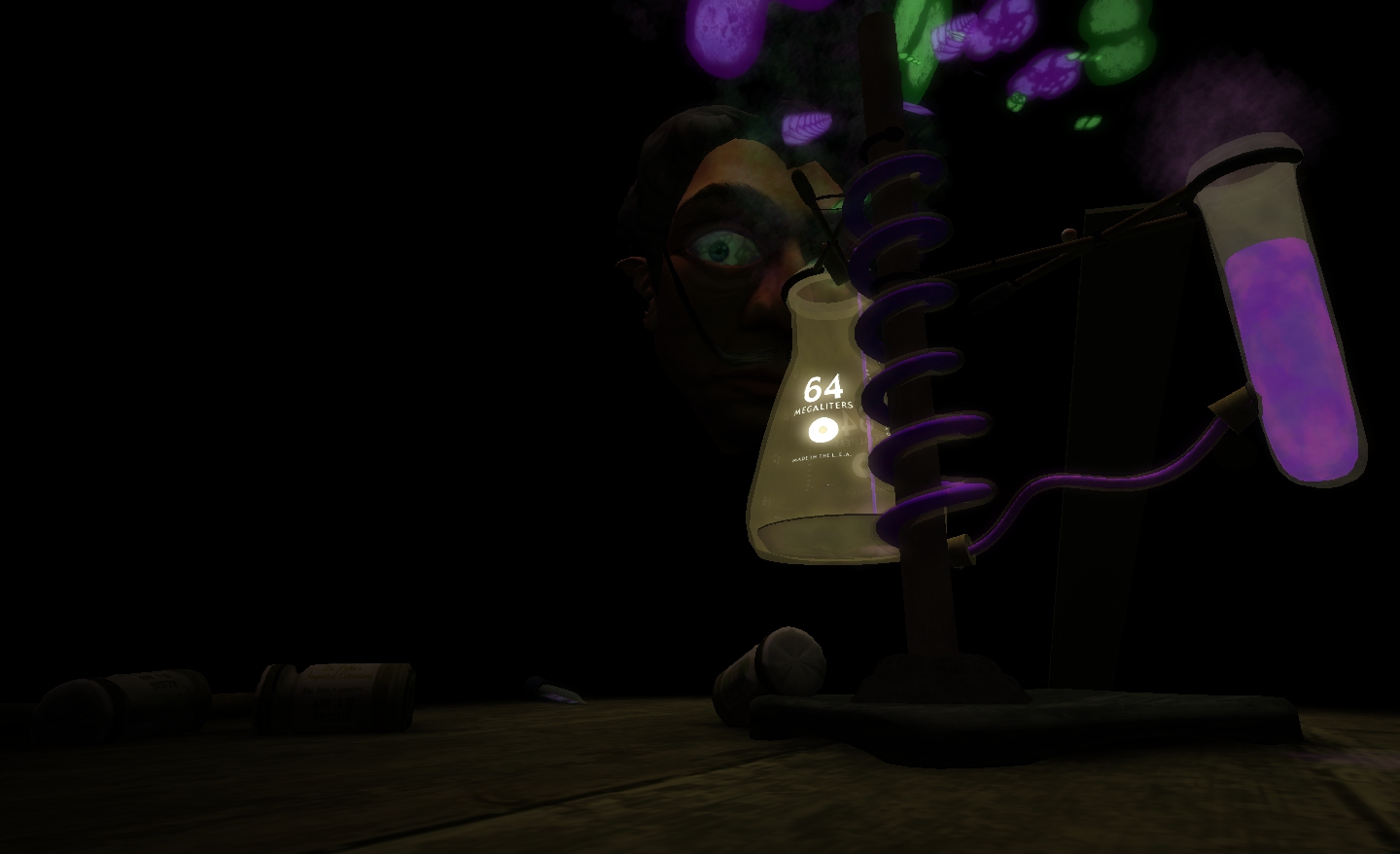
It’s a room of curios and oddities, partially flooded – hence the dripping previously heard, planks providing walkways over the water. This is the inventor’s lab. There is much to see here – and one or two things to touch; find them and you will be treated to  a side-story that accompanies the installation, told through YouTube – and which you might witness for yourself in part, should you find yourself in the field beyond the laboratory.

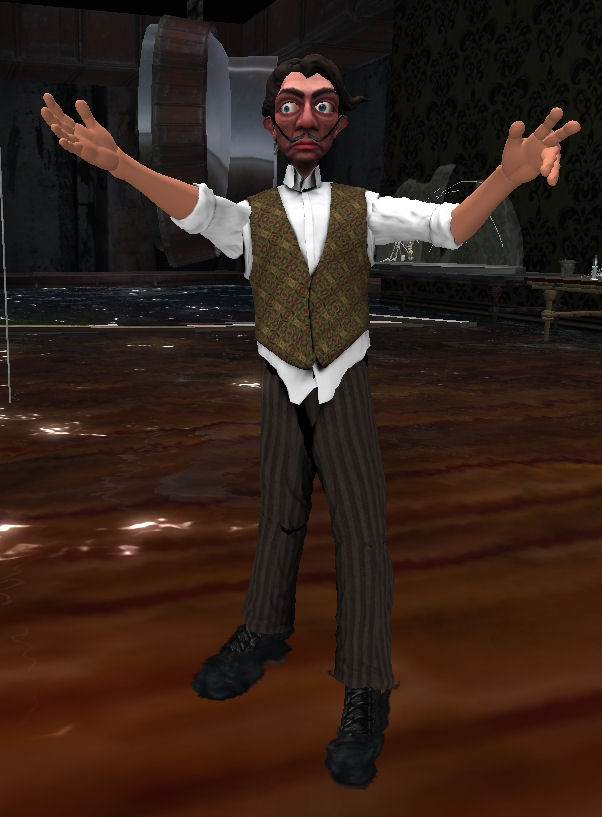
The inventor. Guide and … protagonist?

As you explore the lab, the inventor himself will materialise. You might recognise him – it was his head you clicked when commencing your journey, and thus you have a further clue as to how you must proceed. As he appears, a narrative beings, telling you about the inventor, his flooded lab and the portal he slipped through one day. Take it as your invitation to follow him.

Beyond the laboratory lies a misty, flooded field, water lapping around the trunks of trees. Here you can find the conclusion of Cerulean, the curio-accessed tale told via YouTube. Be warned, however, that if you step out into the field, you will not be able to return to the laboratory; instead you must find another way of continuing your journey along The Path. The only clue I’ll give you is not to wander too far from the walls of the laboratory itself…

Curiouser and Curiouser

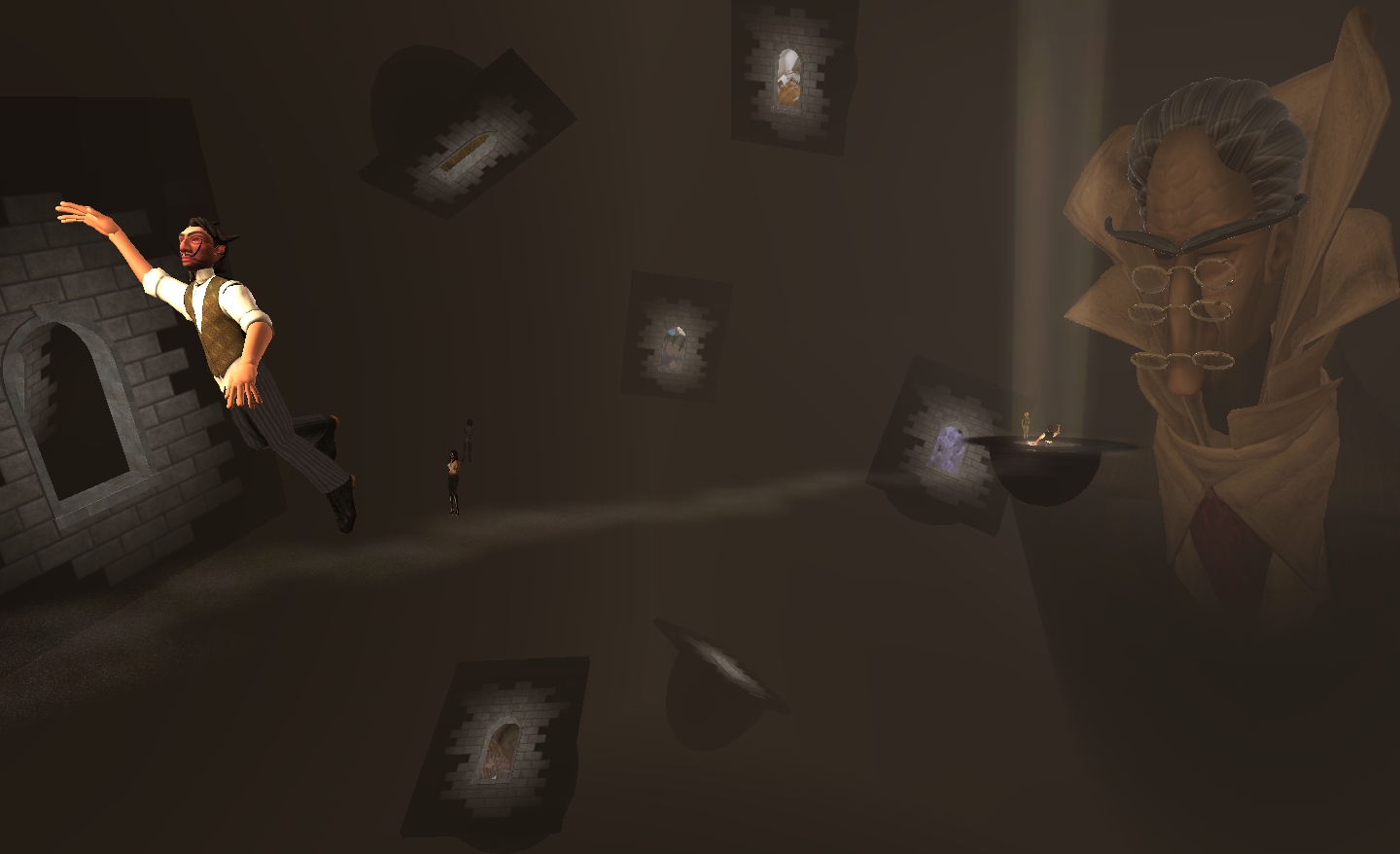
With the inventor as your guide you will arrive at the second part of the story, created by Colin Fizgig. This is a hole-y place, with windows looking out on different scenes, different places – with some looking inward at you from the other side. As the narration resumes, it is through one of these windows  – these holes – that the inventor flew, and you must follow him as he dives towards one…

Windows onto worlds – which one is yours?

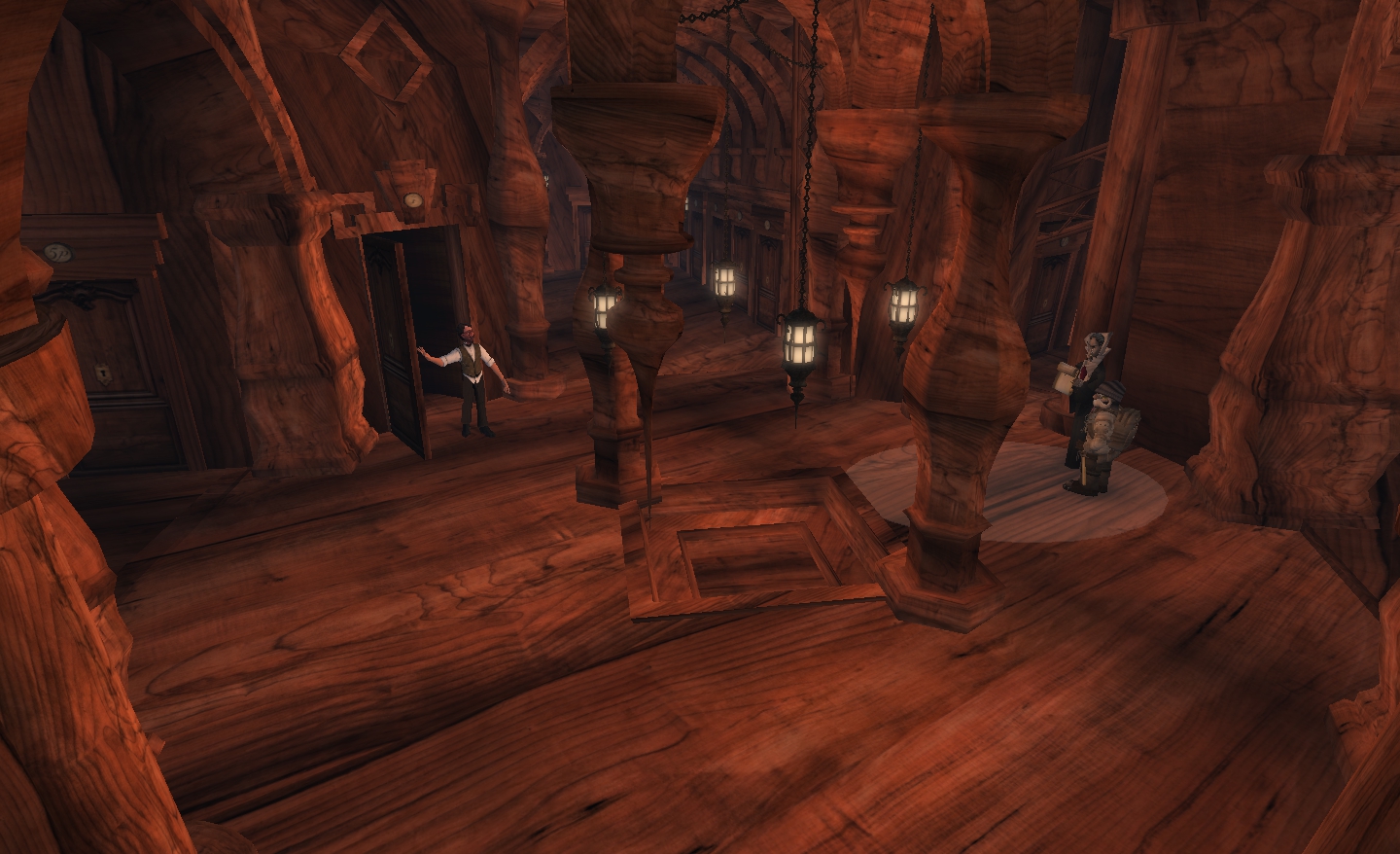
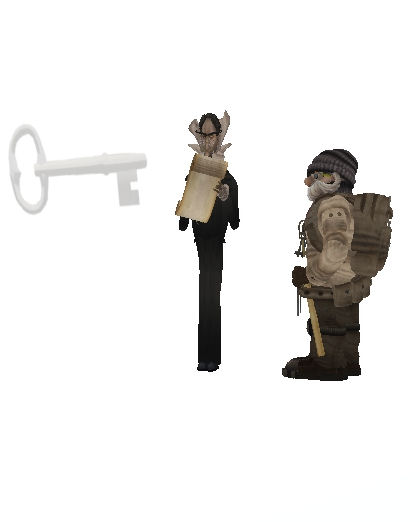
Marcus Inkpen provides the third part of the installation. Here stands the Overseer and his stout companion, conversing at the junction of several strange, door-lined hallways. Do you take one – and if so, which one? And what’s that about a key being in your pocket? Does it mean something… or…?

Your doorway awaits

Tonal sounds here give the place a brooding air, and if you wander the hallways, you’ll hear stranger sounds of life from the other sides of the many doors. But which door do you take…and what lies beyond?

Follow the key – carefully

Find the door, and you’ll discover the contribution from Desdemona Enfield and Douglas Story. It starts in a white room, just like the start of The Path itself. Here stand the Overseer and his companion once more, together with an apparently simple and innocent suggestion that you follow the key. But as with so many things, appearances can be deceptive, and following the key may lead to things not quite so simple and direct.

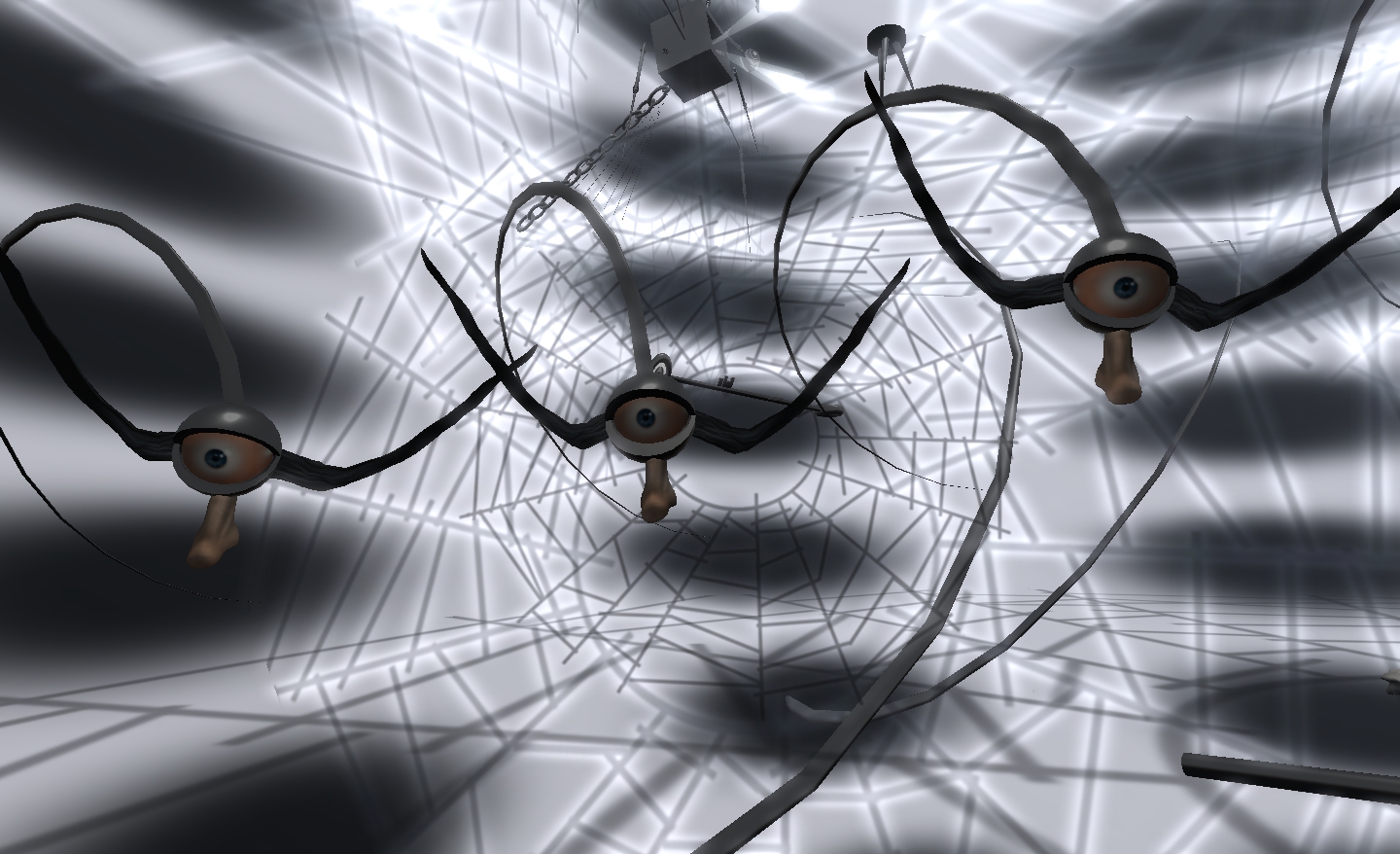
Maya Paris provides an altogether different landscape – are those the shadows of ladders, or the shadows cast by some bizarre web? Is something lurking in the apparent calmness of this place? Climb the ladder and find out; although I hope your eyesight is in good order – and not just for finding the inventor!

The eyes have it in Maya Paris’ piece

Feast

It is moving on to the sixth part of the installation that I confess to becoming a tad biased. This is because the sixth element features the vivid and beautiful imagination of one of my favourite artists in Second Life – that of Claudia222 Jewell.

Claudia222 Jewell on The Path – amazing

This is truly a visual feast and (as always with Claudia) a tour de force of what can be achieved in Second Life. Her City of Lost Souls is amazing in its complexity and beauty. Without detracting at all from the other works in The Path, one cannot help but feel this is another of her pieces that should be preserved and displayed for everyone to enjoy.

City of Lost Souls – will you be lost in Claudia’s contribution?

If I have one complaint here, it is simply this: Claudia’s work is too enticing. I wandered it for over 40 minutes drinking-in the detail and unwilling to leave. Perhaps that is why her city is inhabited by lost souls – many more may have visited and been unwilling to leave…

But leave one must – and this requires finding a head once more – but not necessarily the head of the inventor; although finding the right one will lead you to him.

Scottius Polke returns to the theme of the laboratory with his contribution to The Path, and on a grand scale. Here you must keep an eye out for the direction you should take, negotiating giant rulers, coiled pipes and other obstacles. This actually needs some care – the route you must take climbing some of the items is very narrow, and lag here and there can easily have you stepping off into thin air if you press a key for too long – as I found out.  And while you climb, be aware your every move is being watched from above, as the inventor himself gazes down upon you; but it is not his big head that will help you out of here.

It’s a big world

The final part of The Path is by Rose Borchovski, and you might say it is an eye-opener. It’s also slightly unsettling for ways not easy to discern; it’s not the eyes that stare and follow you; or those heaped pyramid-like, eternally watching. It is more the child’s voice whispering forlornly and the strange circle of beds, each one an echo of the places you have seen and visited while journeying The Path, the occupants (or parts of them in some cases) pinned to them like items in a collection. Be careful with the beds in particular; you might find yourself going on an unexpected trip into the past….

Rose Borchovski gives me an admirer

Overall, The Path is an amazing piece – one that requires a good deal of time to experience fully. Each element of the installation has been carefully considered, and the themes linking them are clear, een when the verbal narrative stops. Each of the sections of the installation is distinctive in both style and approach, while all come together to form a story that can be followed as you roam. Kudos to all those who participated in the installation, and to Bryn Oh for conceiving the idea.

You need to give the exhibit a fair amount of time; even with my joyful distractions in Claudia222 Jewell’s part of the installation, I still spent the better part of four hours roaming, poking, listening, prodding and generally losing myself (once quite literally) in walking The Path. But it was four hours I feel were well-spent. So why not take a walk along it for yourself?

The Path officially opens today for a 3-month period. My thanks to Bryn Oh for the preview opportunity.

MACHINIMUWA IV: Art of the Artists offers L$300K prize pool

The University of Western Australia in partnership with AviewTV, Cutting Edge Concerts, Open This End and the Summerland Estates announced MachinimUWA IV : Art of the Artists – a machinima competition offering a prize pool totalling L$300,000.

Submissions are open through to the 10th November, and the competition lists an impressive and distinguished list of judges:

  • Professor Ted Snell (RL) – Director, Cultural Precinct, The University of Western Australia
  • Rhett Linden (SL) – Vice President, Experience Design, Linden Labs
  • Jay  Jay Jegathesan (RL) / Jayjay Zifanwe (SL) – Manager School of Physics/ Lead of UWA Virtual World Projects
  • Yesikita Coppola (SL) – Official Machinimatographer for UWA 2011
  • FreeWee Ling (SL) – Curator, UWA 3D Open Art Challenge
  • Pia Klaar (SL) – Machinimatographer and Winner of MachinimUWA III Viewer Event
  • LaPiscean Liberty (SL) – CEO AviewTV and UWA Virtual World Technical Media Advisor
  • Persia Bravin (SL) – Journalist, SL Media Producer and TV host
  • Mal Burns (SL), Metaverse News Aggregator and Broadcaster
  • Editorial Clarity (SL) – Metaverse Journalist and Senior Writer, BOSL Blog & BOSL Magazine
  • Rowan Derryth (SL) – Art & Design Historian; Writer for Prim Perfect Publications
  • Dousa Dragonash (SL) – COO Metaverse Television
  • Dr. Phylis Johnson (RL) – Media Professor, Southern Illinois University & author
  • Thirza Ember (SL) – Art Blog Writer
  • Phaylen Fairchild (SL) – Award Winning Writer, Director, Comedian
  • Flimsey Freenote – CEO of Metamix TV (Mixed Reality Television)
  • Cristina García-Lasuén (RL) / Aino Baar (SL) International Curator, Art Writer, Founder & Owner of Open This End group
  • Nazz Lane (SL) – Journalist and Author
  • Chestnut Rau (SL) – Journalist
  • Suzy Yue (SL) – Artistic Director, Running Lady Studios

The Challenge

The challenge for those participating in MACHINIMUWA IV is to, “Create a machinima that features some (or one) of the artworks submitted to the UWA 3D Open Art Challenge. You can choose to film as many (or as few) as you like, and you may submit any number of entries. There is no enforced time limit, however a recommended time limit would be between 3 – 6 minutes”. As to theme, the judges simply state, “Create something that will take our breath away”.

Completed videos can be uploaded anywhere, although the competition hints at a preference for either YouTube or Vimeo, with the link and details passed to Jayjay Zifanwe & LaPiscean Liberty prior to the closing date. Artworks appearing in the machinima should be acknowledged. Entries will be displayed on the UWA Second Life blog.

For full details on the competition, including details of the art series and location, filming the works either in situ or elsewhere, please refer to the MACHINIMUWA IV: Art of the Artists post on the UWA SL blog.

With thanks to Jayjay Zifanwe for the information & UWA for the use of the competition graphic

LEA announce 20-sim deal with LL

The Linden Endowment of the Arts (LEA) have announced they have secured 20 sims from Linden Lab to promote the arts in Second Life.

The LEA Land Grant will make the sims available to the LEA for a 12 month period. These sims will be used as follows:

  • Two sims will be allocated via a Land Rush
  • Four sims will be reserved for exhibitions curated from LEA sandbox builds
  • Fourteen sims to be allocated on the basis of an application process, which closes on November 1st 2011.

The fourteen sims to be allocated on the basis of an application process will be made available to successful applicants for periods of five months before being transferred to the next set of awardees. Details on how the Land Rush and 4 “sandbox promotion” sims are to be allocated and for how long, have yet to be mad public by the LEA.

Separate

This deal, it would appear, is entirely separate from Mark Kingdon’s announcement, made in 2009, that some 70 sims would be made available within Second Life as a part of an effort to support the arts. At that time, given the amount of private effort – with absolutely no subsidy from Linden Lab  – that goes into supporting art and creativity in Second Life, Mark Kingdon’s announcement caused a fair amount of concern as to what such a grant would do to such privately funded efforts in support of the arts.

At risk: privately funded art support?

While this announcement from the LEA is smaller, it is likely that it will give rise to similar concerns, particularly given the superb work performed by the likes of Art Screamers in their promotion of sim-sized installations such as Through the Lens of Dreams, and other exhibits which are met entirely out of the sim owners’ own pockets.

Weakens?

Which is not to say the LEA do not provide stunning installations themselves – again as witnessed by Rebeca Bashly’s brilliant and immersive Inferno equally demonstrates. Even so, arrangements such as this – as well-meaning as they might be – do create an imbalance in the SL art community, which is still very much a limited pool of talent. If that talent is fully engaged in LEA efforts, then there is a risk that those who privately fund art activities may well be faced with no other option that to consider shutting down. This in turn potentially weakens art in SL on two fronts:

  • It reduces the number of venues available in which those not selected for such grants can display their work and talent
  • It runs the risk of what constitutes “art” for wider consumption within Second Life being defined by a small, closed group within SL – again leading to potentially fractious accusations of the infamous “feted inner circle” variety rumbling across the community.

The flip side to this is that it might be said that many aspiring artists within Second Life might be presented with a chance to gain an audience through their participation in the Grant. A chance that might otherwise elude them if they had to rely on other means of promotion.

For those wishing to participate in the LEA Land Grant, the application requirements are available on their website via the link above. All applicants must be familiar with, and agree to abide by, the SL Terms of Service, Community Standards and the LEA Code of Conduct in order to participate in the programme.