Of pigeons and a Meaningless wander

Pigeon Island, Neverending; Inara Pey, June 2014, on FlickrPigeon Island, Neverending (Flickr – click any image for full size)

Amelie Knelstrom (Raein) offers visitors to her homestead region two very different places to explore, both of which invite the imagination to create little stories to suit them.

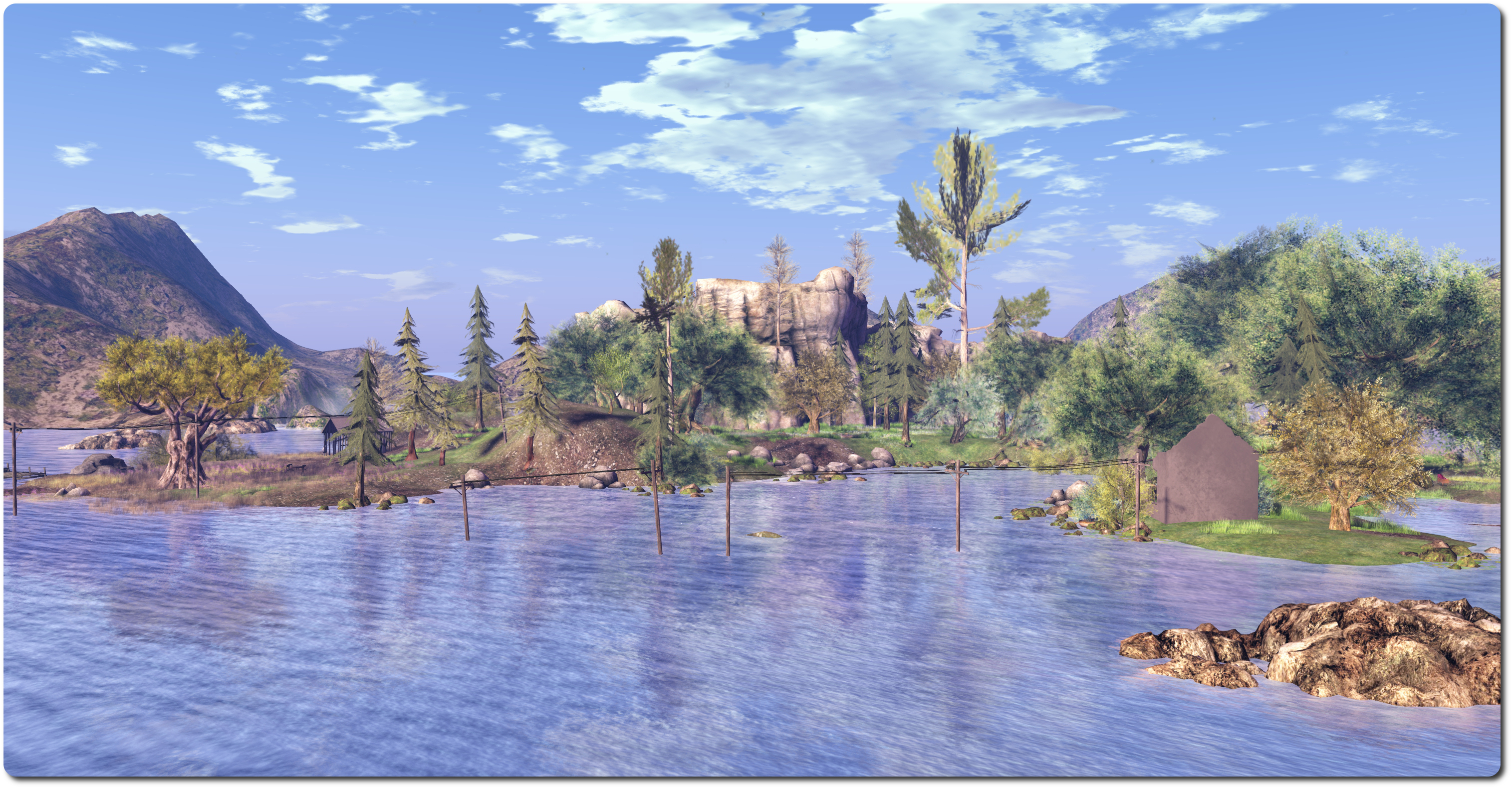
The first is Pigeon Island, which is also the arrival point for visitors. This is a slightly rugged island of temperate disposition, sitting in a bay (or perhaps a fjord?) which, given the lush green of the grass, may see more than its share of rain at times.

A farm looks to have once been here, although little now remains, other than the ruins of a small house or cottage (the actual landing point for the region) and an old shed which faces it across the curve of a rocky little bay. Old telegraph poles march out into the waters of the bay in two lines, still carrying their wires and looking like they may have once met, but their comrades have at some point either fallen into the blue waters or have been taken away. Did the lines running between them carry messages, or did they once bring electrical power to this little place?

Pigeon Island, Neverending; Inara Pey, June 2014, on FlickrPigeon Island, Neverending (Flickr)

Not that the island is deserted; far from it. Sheep wander the low-lying parts of the island, grazing on the grass, and the little shed shows signs of habitation: there are chairs and couple of wood-burning stoves (one with a kettle atop it), while a bed sits in the corner; all signs that someone finds their way to the island, perhaps to make sure the sheep are fairing well, or perhaps to escape some noisier place across the water. There are other signs of life to be found as well: a hammock here, swings there, a table and chairs under the open sky, blankets out on a wooden pier, a telescope … all await your discovery.

The western side of the island is given over to a huge upthrust of rock. Flat-topped and with stair and path cut into its flank, it overlooks both island and bay, a gravel-like beach of stone and eroded rock separating it from the blue waters of the latter. Follow this rough path around the base of the rock, and you’ll find your way to a secluded beach sheltered between rocky shoulders, and more signs of habitation: a bed made in an old rowing boat and a small tent pitched well back from the water, while an old fishing boat sits at anchor.
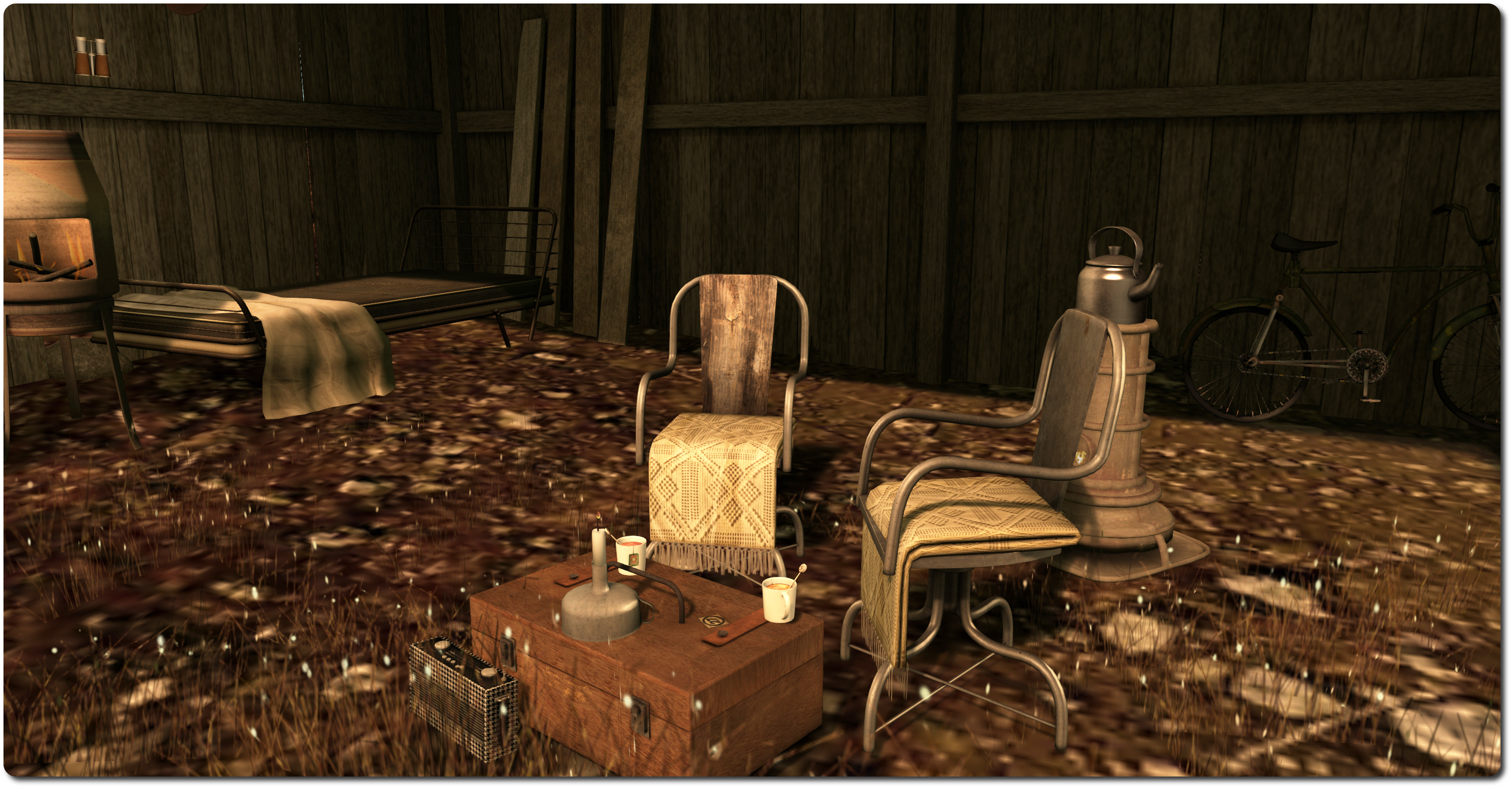
Pigeon Island, Neverending; Inara Pey, June 2014, on FlickrPigeon Island, Neverending (Flickr)

Pigeon island is a wonderful rustic coastal scene, ripe for the SL explorer and photographer. But it’s not all that can be found here. Sitting in the wall of the old farmhouse / cottage is a single wooden door. Open it, and you can be transported high overhead to the streets of Meaningless City.

Here is a place very different to the island’s natural beauty. The streets are deserted, their tarmac cracked and breaking, weeds and grass pushing their way up through the gaps;  concrete walls are cracked and damaged, holes revealing their steel reinforcement. All of the houses stand deserted, grime and dirt turning their empty windows into opaque, sightless eyes as crows circle overhead. In the playground, a lone children’s slide stands rusting and forgotten, barrels with flammable warnings adorning their sides sitting close by…
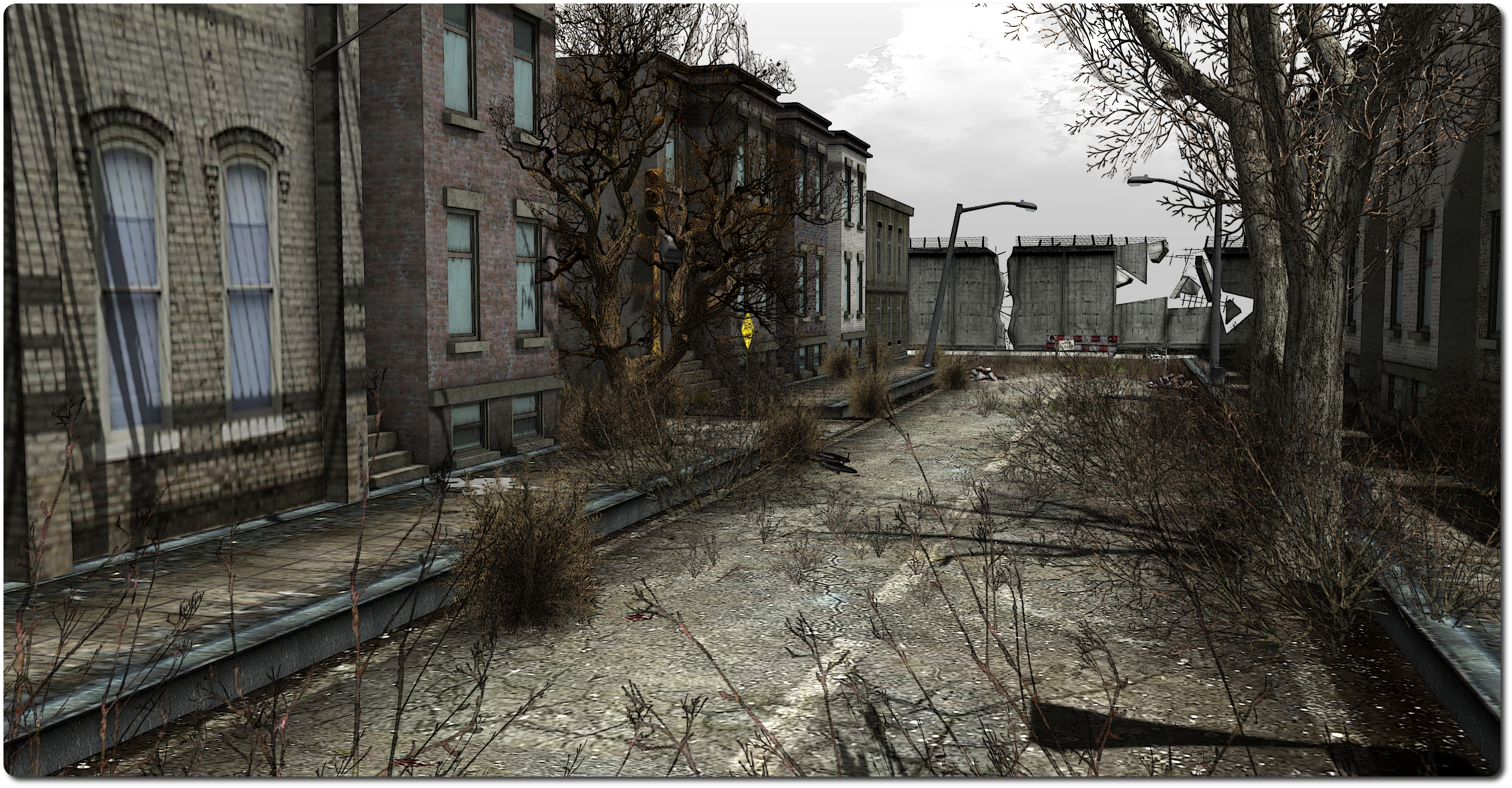
Pigeon Island, Neverending; Inara Pey, June 2014, on FlickrPigeon Island, Neverending (Flickr)

It is clear something has happened to cause the inhabitants to leave this place – but what? Do those barrels with their dire warnings of fire offer a hint, or is it something else? Why are the streets all closed-off by the gaunt forms of concrete walls, the barbed wire along their tops ominously turned inward? And what of the tall, silent sentinel of an old siren standing at one end of a street? What part does that play in the stories waiting to be told here?

Pigeon Island and Meaningless City are poles apart, yet such are the strong contrasts between them, coupled with the strands of stories running through them, that they complement one another in many ways.

Why not pay them both a visit and see what tales they whisper to you?

Related Links

A Maze In Grace in Second life

A Maze In Grace, LEA6

Recently opened at LEA6 is Krystali Rabeni’s A Maze in Grace, which offers visitors a two-part maze to explore.

“Labyrinths are arguably mankind’s first creation borne purely of human imagination. Today, labyrinths and mazes cradle millennia of legend and folklore in their twisted articulations,” Krystali says of the piece. “Labyrinth and maze imagery has at different periods of time in various parts of the world been associated with all aspects of human life. It has been used as a symbol of fertility and birth, as well as one of purgatory and death. It has religious and meditative importance in Hindu, Christian, Islamic, Buddhist and Shamanic rituals.”

A Maze In Grace, LEA6

The starting point for this particular maze is a raised stone terrace ranged to the west of the region, and which offers visitors a note card on the installation. Much of the rest of the region has been flooded, squat grassy banks dividing the water up into channels which surround the terrace. Fours sets of steps, one on each side of the terrace, descend into the ankle-deep waters. At the foot of each set of steps is a sign admonishing people to Keep Off The Grass – a reminder that the water forms the paths of the maze, not the grassy banks.

Within these channels lie several paths which will lead the explorer around and through the region, passing through gaps in the grass banks and to the entrance to the second part of the maze. This is a classic Venus labyrinth, the labyrinth of love and creation, and itself represented by the water element, and one of the nine celestial labyrinths.

A Maze In Grace, LEA6

There are also a couple of secrets to be found as you journey along the watery paths, passing swans and sculptures alike. The first of these is A Maze in Grace; the second, a solitary koi carp. The koi is also reflective of the overall theme of the installation, having a strong life symbolism of it own, as described in the introductory note card.

Krystali tells visitors that as with life, there is no map to help people through this maze. The paths to the centre are many and varied; some people may opt for the short, quick routes to the Venus labyrinth, others may try for the longer paths. There is no right or wrong; but also, as Krystali says, there is no rush nor race. This is a place where you can wander with your thoughts for as long or as short a time as you like.

After all, as many in the past have noted, it is not the destination that counts, but rather the journey taken.

A Maze In Grace, LEA6

A Maze In Grace is a part of the LEA’s Full Sim Art series, and will be open through until the end of June 2014.

 Related links

LEA open round seven of AIR land grants – and more!

LEA_square_logo_60On June 1st, 2014, the Linden Endowment for the Arts Committee announced the opening of the seventh round of land grants for the Artists in Residence (AIR) programme.

Twenty regions (LEA10 through LEA29), donated by Linden Lab and managed by the LEA, are generally offered under the AIR programme, and successful applicants will be given the use of one full region for a period of five months. The region may then be used on an individual or group basis for such diverse activities as:

  • Full sim exhibitions and / or immersive installations
  • Curated projects, especially those which have a connection to physical exhibitions and events (mixed reality).
The Timewalkers, LEA AIR entry, LEA15, May 2014
The Timewalkers, by Solkide Auers, and LEA AIR entry, LEA15, May 2014

Artists are asked to take no more than 3 months to execute their build, so that their installation is open to the public for at least the last 2 months of their grant. However, artists may also open their installation ahead of the three-month build deadline, and many artists in the past have used their land to have multiple exhibits.

The timeline for application as it currently stands is:

  • Application deadline: June 30th, 2014
  • Notification by: July 15th, 2014
  • Sim handover and public announcement: July 31st, 2014
  • End of round: December 31st, 2014.

Artists and performers wishing to apply should read the round announcement and complete the application form at the bottom of that page.

Other LEA Opportunities

A Cathedral Dreamer by Gem Preiz, a Full sim Art series entrant, January 2014

A blog post by LEA Committee member Honour McMillan, outlines other available LEA grant options, and how to apply for them. In brief, these are:

  • LEA6 hosts the Full Sim Arts series, curated by JayJay Zifanwe. The region is made available on a one month basis to artists, with slots now open from July 2014 onwards. Applications for the use of the region should be made directly to JayJay in-world
  • Five additional core regions (LEA1, LEA2, LEA4, LEA8 and LEA9) are available. These offer the most flexible use of LEA regions, and can be used for periods of approximately 3 months duration, the time and amount of land provided dependent upon the use defined in the application form, with applications accepted on an ongoing basis
A part of the LEA Gateway at LEA3

The remaining three regions of the LEA are all “special purpose” regions. these are:

So whatever you needs arts  and / or performance-wise, the Linden Endowment for the Arts may well have you covered, land-wise. So why not drop them an application today?

Drax Files 20: Flokers – a portrait in colour and words

The latest edition of The Drax Files: World Makers focuses on the life and art of Second Life resident Flokers, a young woman from Sicily, now based in the UK, who has a remarkable story to tell. So remarkable, in fact, that the show forgoes the usual teaser  / titles and end piece featuring Drax talking to his guest, and instead lets Flokers tell her story, straight from her lips to our ears.

That the story is presented in this way makes it all the more powerful to the viewer; in just under five minutes, Flokers beautifully encapsulates the breadth and depth of Second Life in so many ways, and reveals just how relevant it can be to people’s real lives and interactions. She also provides a touching insight into synesthesia – and even offers-up an opinion on the value of the humble keyboard at a time when some caught in the renewed enthusiasm for VR are calling for it to “get out of the way”.

As an artist, Flokers presents a unique view of the avatars inhabiting Second Life. Rather than photographing them, she digitally draws them in real life as they pose in her studio in SL, and then later uploads the finished portrait back to Second Life.

“I am going to paint them as if it were real life,” she explains. “I know that avatar represents the inner persona that’s inside the person who is sitting in that computer. I want to represent them the best I can. Doesn’t matter to know who they are in real life, because I know them in Second Life; that’s what I see with my eyes.”

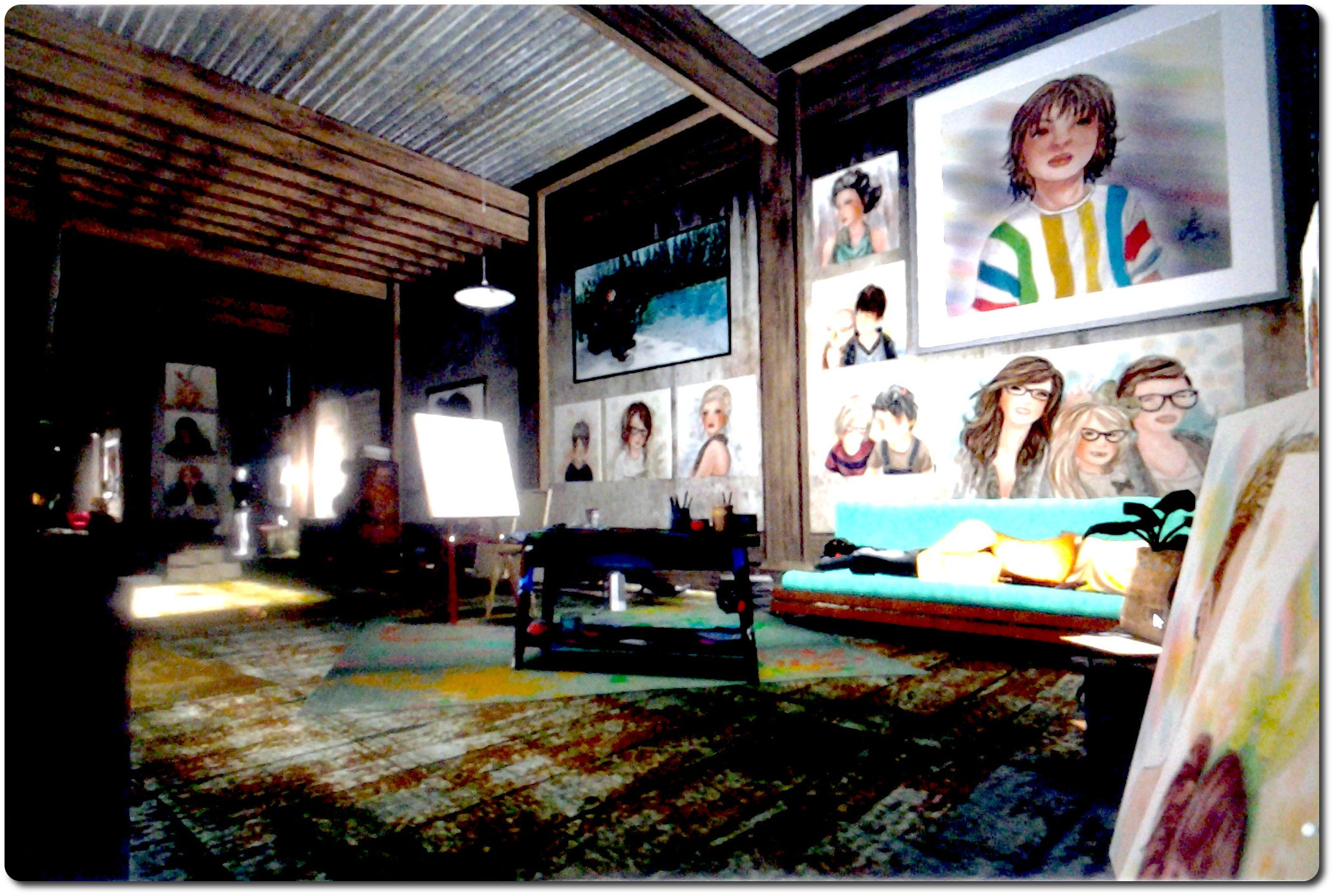
The care Flo takes with her portraits and the success she has in not only capturing the image of the avatar but also something of the personality behind it is clear the minute you enter her studio in Second Life and see the prints of past studies hanging on the walls. Not only that, but to anyone reasonably familiar with Second Life, it is clear she has also captured the essence of the SL avatar itself, making it clear where her subjects reside.

Flokers' studio in Second Life
Flokers’ studio in Second Life

Flo offers those of us who have never experienced synesthesia a first-hand insight to the condition, of which she experiences in both its Grapheme-colour synesthesia and Chromesthesia forms. Not only does she describe the condition verbally, she provides the graphics in the video which allow us to see how she visualises letters, numbers, moods, sounds and even people. Her approach is to present the condition openly and in a matter-of-fact manner which speaks volumes about her own inner strength of character.

“I’ve never seen a city that had not a single child,” she says of her choice in keeping her avatar childlike. As with her description of synesthesia, she tackles the use of child avatars in Second Life head-on; offering a simple and clear message to all those who see anyone opting to use a child avatar as someone leaning towards more negative social behaviour such as edge play or age play: having a child avatar is fun. nothing more, nothing less; it’s a visual recapturing of the carefree fun and moods we experienced as kids and really shouldn’t be taken to mean anything else.

Carefree fun

Much noise has entered the airwaves of late about how the keyboard and mouse represent “the” barrier to the wider adoption of virtual worlds among the general public. Much of this noise has centred around the building excitement about new immersive VR systems and has focused on emerging technologies such as gesture devices.

It’s no real secret that I don’t entirely agree with the view of the keyboard as an obstacle. Not only do lean towards the non-adoption of virtual worlds as being much bigger than an issue of technology, I tend to feel that like it or not, the keyboard and mouse aren’t going to go away that easily, and Flokers offers-up a perfect illustration as why this is so:

In Second Life I can communication better, because I can filter the words that I want to use. The typing animation will tell people that you [are] actually formulating a sentence before sending it. I can re-read what I’m saying, and I can try to think if that in any way, shape or form could offend anybody else.

While voice is undoubtedly a wonderful means of communication, it can led to unnecessary misunderstandings or upset if we don’t give due consideration to what we’re saying and how we’re saying it – which is something we don’t always do; “speak in haste, repent at leisure”, one might say. The keyboard is a wonderful medium for allowing us that time to think; for those who may additionally be communicating in a language which is not naturally their own, it gives added time for consideration, none of which can be easily matched by either talking directly into a microphone or using a voice-to-text filtering tool.

flokersFloker’s Second life story is intimately bound to her current real life situation, not because she earns her living through SL – which is perhaps a story we’re all familiar with – but because she obtained her real-life employment as a direct result of her being in Second Life, where she met her current employer.

Now working as a graphics designer, Flokers sees Second Life very much an integral part of life and her work. In this, and in closing-out the video, she offers-up the perfect response to all those who would otherwise dismiss the platform as “fantasy”:

Second Life changed my life, because what people thought was just a game actually became a real life main source of money and fun. I am able to be myself here. It gave me the chance to become the artist I always wanted to be.

Each time a new edition of The Drax Files comes out, it is hard to imagine that the series could reach further or higher in terms of exploring Second Life and bringing genuine stories about it and the people who use it into the public eye. Yet each and every time the next segment appears, it does precisely that – reaches higher and further.

While a large part of this is down to the stories themselves – and possibly the luck of the draw in terms of the order in which subjects are selected and filmed – the production values evident in each edition cannot be overlooked, nor can the sensitivity shown towards the subject matter. Both of these points are wonderfully demonstrated in this segment, and it would be remiss of me not to mention them and underline the unique editorial skills Drax employs in putting these pieces together.

The magic in this piece, for example is that it really is Floker’s story. There is no need for anything else; no talking heads between Drax and his subject, no need even for an opening title sequence. Floker’s careful, precise and utterly honest discussion of her involvement in Second Life and her real life situation simply doesn’t need any embellishment; it reaches directly into the heart without manipulating emotions, and resonates perfectly.

The musical balance in this show is particularly fine in this regard; the soundtrack is mostly understated, acting as a gentle underlining of Floker’s comments, without ever getting in the way of what she’s saying. When it does come to the fore, it does so magnificently during the airship scenes, with a full-blown orchestral excerpt rich in emotional content which draws one into the scene, eliciting feelings of joy, just as those playing the game surely experience.

Once again, another remarkable piece which is a joy to watch and which speaks volumes about both Second Life and the people who use it.

Related Links


A Virtual Lens and a creative eye

Virtual Lens: Selected Images, 2013-2014

Opening at 13:00 SLT on Friday June 6th, is Virtual Lens: Selected Images, 2013-2014, an exhibition of Ziki Questi’s photography captured over the two years in the title, as selected by the artist herself.

Taking place at Vita Theas’ Serena Imagine Arts Center at Wolves Land, Virtual Lens is a personal presentation for Ziki. “The images are simply ones that I particularly enjoyed as I looked back on my work since the beginning of 2013,” she explains. “While there isn’t any particular theme to the photographs as a whole, there is one grouping along the eastern shore that depicts scenes from Roche, a sim by ddsm2 Mathy, where I’ve worked with depth of field and tilt-shift techniques.”

Virtual Lens: Selected Images, 2013-2014

As an admirer of Ziki’s images (she is one of two SL photographers who have had significant indirect influence on my own attempts with the viewer’s snapshot floater), I felt very privileged to have a preview of the exhibition while she was still setting things up.

The display space takes the form of a summer glade surrounded on three sides by water. A path of dry earth winds through the trees and passes a lighthouse at the water’s edge before meandering onwards – be sure to follow it under hill to ensure you see all the pieces on display.

Ziki’s photographs are displayed alongside the path, each one mounted on its own plinth and in her familiar panoramic format. Details of the location featured in each picture, and the date it was captured, can be found on the reverse side of each frame.

Virtual Lens: Selected Images, 2013-2014

Taken as a whole, it’s a striking, natural environment into which, whether by accident or designs, the selected pictures fit perfectly.

Some of my favourite images are on display here; I can’t ger the hang of tilt-shift for love nor money with the snapshot floater. Ziki, however, has it down to a fine art, and the images she has selected from her time at Roche demonstrate this admirably. So much so, that when looking at some of them, it is easy to believe you’re seeing not images captured in a digital world, but rather precisely framed pictures of model miniatures. They really are that life-like.

Virtual Lens: Selected Images, 2013-2014

This is a superb installation, forming something of a retrospective stretching back over the last 18 months by one of Second Life’s premier photographers, and definitely not one to be missed. And if you fancy taking one of the images on display home with you – you can; all of them are offered for sale.

 Related Links


The Drax Files Radio Hour 21: the image of Second Life

radio-hourI missed reviewing The Drax Files Radio Hour #20 as real life has been keeping me rather busy of late. Hopefully, the transcript of the Creating the VR Metaverse panel at SVVR will go some way to making up for things (and even that was late in getting into print, courtesy of RL!).

Episode #21, the last of the “live” podcast for this series, continues in spirit with the last, the two major interviews – with Voidpointer and Catalyst Linden – having been recorded at the SVVR conference. As usual, and as well as being available on the show’s website and on Stitcher, episode #21 is also on YouTube, and it is to that recording (embedded at the end of this article) any timestamps given in the text refer.

The early part of the show re-visits SVVR and Leap Motion, who are in the process of adding on-screen rigged hands which move in accordance to the user’s hand movements / gestures, and have also creating a prototype cradle which allows the Leap unit to be attached to a Rift headset, allowing it to track hand movements, with the rigged hands appearing on the Rift’s screens.

The recent Designing Worlds show on the new user experience and user retention  – on which Jo appeared – is discussed. Time hasn’t allowed me to watch the show as yet, but it is on my “to-do” list. I confess that I’m always leery of suggestions from users on what “needs” to be done or “should” be done with the whole new user experience. Yes, the Lab hasn’t done particularly well over the last 11 years  – to a point – but that doesn’t actually mean that we, as users necessarily have any clearer idea of what needs to be done / should be done, simply because all too often our own views tend to be somewhat biased to some degree, or we simply fail to take into consideration was has actually been tried in the past and trot out ideas which have been shown to make very little difference in the scheme of things.

Which is not to say that ideas shouldn’t be discussed, but rather a broader forum should perhaps be established, where more in the manner of two-way discussions between Lab and users can take place, ideas more fully synthesised and options looked at.

The new mesh avatars also get a mention, and some of the problems of supplying mesh avatars to new users are highlighted. Leaving aside the valid problems mentioned in the show, What surprised me most about these avatars was that they appeared to have been released prematurely or at least without thorough testing. For example, they were promoted as using fitted mesh, yet the base shape was released as No  Modify, thus nullifying the ability to customise them using the sliders without swapping the shape (something new users are hardly likely to know how to do).

To his credit, Ebbe Altberg took it on the chin when I Tweeted him about this, indicating that it and a number of other issues would be fixed. But really, so basic a mistake shouldn’t have occurred in the first place.

ebbe-avatars

This episode features two interviews with Linden staffers. The first is with Voidpointer Linden, who is well-known to attendees of the Server Beta meetings, which he attends from time-to-time. He has worked on a number of SL projects, including pathfinding, and more recently, the Oculus Rift. The interview commences at the 24:10 mark. Catalyst Linden, the senior director of development at the Lab is interviewed at 37:27 into the recording.

Voidpointer Linden in human form (stock)

Both Voidpointer and Catalyst point to themselves as being “gamers”, and both indicate that on first encountering Second Life as gamers, they simply didn’t get it – although they do now.

A major part of them getting it is clearly to do with the fact that they have joined the Lab, and so SL has become their paid job. However, there is also the fact that as former gamers, they are perhaps both well-placed to understand why and how SL’s appeal needs to be broadened in order to attract more users to it.

During his chat, Voidpointer’s comments on the Lab needing to appeal to as broad a span of potential users as possible, even going so far as to acknowledge that the company needs to address those who, like Pamela from segment #8 of The Drax Files Radio Hour, simply do not see virtual worlds or VR as something they need to embrace, because it has no relevance to them.

Attracting a broader audience is also a theme in Catalyst Linden’s comments, and he goes some way further towards demonstrating why the perception that Linden staffers “don’t get” Second Life really is in error. Even as someone who has only been at the Lab for around 12-15 months, it’s clearly evident that Catalyst does get Second Life and its potential appeal as well as any user who has given serious thought on this subject.

Continue reading “The Drax Files Radio Hour 21: the image of Second Life” →