Second Annual OpenSim Community Conference announced

2014 banner

On Saturday May 31st, the Overte Foundation and Avacon have announced the Second Annual OpenSimulator Community Conference, with a press release on the announcement being circulated via e-mail on Tuesday June 3rd.

The conference will take place on the OpenSimulator Conference Centre grid on November 8th and 9th, 2014. It will be a celebration of the platform and the large and varied community using it. As such, it will feature two days of talks and presentations across four tracks, keynote speakers, panels and social events.

Anyone who is interested in the OpenSimulator software and the future of the metaverse is invited to attend, as well as OpenSimulator developers, grid administrators, and members of the community who participate on OpenSimulator grids.

The 2013 conference arena

The four presentation tracks will comprise:

  • Business & Enterprise: sessions will cover a broad range of topics on doing business in and with OpenSimulator. These include grid hosting, third-party development, private entrepreneurs, in-world and enterprise businesses, and also corporations and organizations using the platform for marketing, fundraising, product research, focus groups, etc
  • Content & Community: this track will examine different aspects of content (e.g. large scale immersive art installations, ballet, theatre, performance art, machinima, literary arts, clothing designs, virtual fashions, architecture, music performances and other cultural expressions) and community (e,g, role-playing groups, science fiction communities, virtual towns and interest groups, historical explorations, religious and spiritual communities, book clubs, etc.), within OpenSimulator
  • Developers & Open Source: will encompassing the technical aspects of OpenSimulator, and seeks presentations related to servers, viewers, external components, grid architecture, development, administration, and anything necessary to the installation, operation and use of an OpenSimulator system
  • Research & Education:  seeks presentations regarding the use of OpenSimulator in research applications in computer science, engineering, data visualization, ethnography, psychology, and economics. It will additionally feature sessions that cover a broad range of uses related to teaching and learning in and with OpenSimulator

In addition, the conference will feature  a new Learning Lab area. which will be available for hackerspaces, speed builds, and workshops for hands-on learning experiences guided by experts in the OpenSimulator community.

The Call for Proposals for all four tracks and the Learning Lab is now open, and all proposals should be submitted by July 1st, 2014.

Commenting on the event in the announcement, conference chair and organiser Chris Collins (Feep Tuque in OpenSim) said:

Last year’s conference was a terrific success with over 350 attendees from 45 unique grids and over 1000+ commits to the core code, which made OpenSimulator a much more stable and scalable platform.

This year we hope to build on that success by offering more opportunities for the community to be involved and doing more outreach to attract new users.  With all the hype surrounding the Oculus Rift and other virtual reality technologies, we think this is the perfect time to let the VR community know that OpenSimulator is a great platform for building the open metaverse.

Further information on the conference will be made available in due course – including details of keynote speakers, volunteer registrations, etc. Registrations will open on September 15th, 2014.

Sponsorship and Crowdfunding Campaign

While the conference is being held in virtual space, it does incur some expenses (such as the professionally managed set-up and operation of the conference grid and the streaming and other web services). As such, the organisers are seeking sponsorship from businesses, entrepreneurs,  and community members alike to help support the conference through a range of sponsorship opportunities, which have this year been updated and revised to better meet the needs of sponsors.

In addition, the conference is running a Crowdfunder Campaign to allow those wishing to make smaller donations to do so. Some unique rewards are on offer to those participating in the campaign, the full details of which can be found on the Crowdfunder Campaign page.

About the Organisers

The Overte Foundation is a non-profit organization that manages contribution agreements for the OpenSimulator project.  In the future, it will also act to promote and support both OpenSimulator and the wider open-source 3D virtual environment ecosystem.

AvaCon, Inc. is a 501(c)(3) non-profit organization dedicated to promoting the growth, enhancement, and development of the metaverse, virtual worlds, augmented reality, and 3D immersive and virtual spaces. We hold conventions and meetings to promote educational and scientific inquiry into these spaces, and to support organized fan activities, including performances, lectures, art, music, machinima, and much more. Our primary goal is to connect and support the diverse communities and practitioners involved in co-creating and using virtual worlds, and to educate the public and our constituents about the emerging ecosystem of technologies broadly known as the metaverse.


Gource visualisation posted by nebadon2025 charting the growth of the OpenSimulator project by code commits from core developers up until the time of the 2013 conference
Upcoming SL maintenance: grid to be closed to log-ins for one hour, May 28th

Update, May 28th: The Lab reports this work is now complete.

On Tuesday May 27th, Linden Lab gave warning that there will be a period of scheduled maintenance on Wednesday May 28th which will see log-ins suspended for around one hour, from approximately 06:00 SLT.

The notice, posted to the Second Life Grid Status Page reads in full:

The Second Life Service will be closed for logins for approximately one hour on Wednesday, May 28 beginning at 6am PDT.

Residents in world will not be logged out, but may experience loss of supporting services such as search and inventory. New logins will not be accepted, and Residents in world should not attempt to transfer or manipulate L$ or valuable (no-copy) assets until the ALL CLEAR is given.

As always, if the scope or the schedule of the work changes, we will update this post.

 Please check with the Grid Status page for updates nearer the time of the maintenance.

The maintenance work is most likely the work planned for Thursday May 22nd, which had to be postponed as a result of significant issues in Second Life services encountered on Tuesday May 20th. Among other things, those issues resulted in the server-side deployments for that day being curtailed, which directly impacted planned activities for the rest of the week.

Assuming the work is the same as that originally planned for May 22nd, it would appear to be  focusing on database hardware, with the result that sims should have slightly faster access time after the work has been completed, although the emphasis has been that if this is the case, it will not be major or noticeable.

Following the problems encountered in week 21, Landon Linden issued a blog post explaining some of the causes of recent problems within the platform, which is recommended reading for those who haven’t yet done so.

Related Links

Loki: using the Xbox Controller with the Oculus Rift

Earlier in May I reported on Dave Rowe’s work integrating the Xbox 360 controller with his CtrlAltStudio viewer, allowing it to be used with the Oculus Rift or Stereoscopic 3D viewing options in that viewer, as well as with the normal display mode.

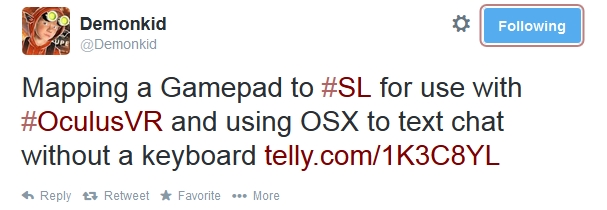
On Saturday May 24th, Loki Eliot tweeted that he’d been working on a similar approach, using the Xbox 360 controller and a dictation feature of OSX Mavericks to provide greater control over his avatar when using the Oculus Rift.

loki-tweet

Since tweeting, Loki has produced a blog post on his work, including links to the software he’s used and tutorials to help get things sorted out. his original video was posted to Telly, which WordPress.com doesn’t like, embedding-wise. However, Draxtor has, with Loki’s permission, reposted it to You tube, and so it’s that version I’ve embedded here.

Loki is the first to admit this approach doesn’t solve all of the Oculus related issues when using Second Life – he has a few wry observations as to where things will “suck” (his expression – not mine!). He also gives some musings on how technology might further assist things in the future.

Loki's work on integrating the Xbox 360 controller for use with SL and the Oculus Rift (image via Loki Eliot)
Loki’s work on integrating the Xbox 360 controller for use with SL and the Oculus Rift (image via Loki Eliot)

The use of HMDs brings with it a lot of challenges – some of which, the Lab freely admits in releasing its Oculus Rift project viewer, it has yet to really tackle. Seeing experiments like this is therefore interesting, as they demonstrate potential alternative (and not necessarily hyper-expensive) means of providing control over basic aspects of using SL with a headset which are not reliant on the keyboard and mouse and, in this case at least, also not dependent upon in-world voice (which many people don’t like to use for a wide variety of reasons). I wonder if approaches like this and Dave Rowe’s work with CtrlAltStudio might raise an eyebrow or two of interest at the Lab …?

Related Links

Why things went wrong recently with Second Life, by Landon Linden

secondlifeWe’re all aware of the recent unpleasantness which hit Second Life over the past few weeks and which culminated in the chaos of Tuesday, May 20th, when the disruption not only caused issues with log-ins, but also caused both a curtailment in server-side deployments on Tuesday and a rescheduling of both deployments for the rest of the week and the postponing of a period of planned maintenance.

As noted in my week 20/2 SL projects update, Simon and Maestro Linden gave an explanation of Tuesday’s issues at the Serve Beta meeting on Thursday May 22nd. However, in a Tools and Technology blog post, Landon Linden has given a comprehensive explanation of the broader issues that have hit second Life in recent weeks.

Landon begins the post:

When I came to Linden Lab over five years ago, Second Life had gone through a period of the coveted hockey-stick growth, and we had just not kept up with the technical demands such growth creates. One or more major outages a week were common.

In my first few months at the Lab, we removed more than a hundred major single points of failure in our service, but several major ones still loomed large, the granddaddy of them all being the core MySQL database server. By late Winter 2009 we were suffering from a core database outage a few times each week.

It is that core MySQL database server that has been partially to blame for the recent problems, having hit two different fatal hardware faults which forced the Lab to stop most SL services on both occasions. As the blog post explains, work is in-hand to remove some of the risk in this database becoming a single point of failure by moving it to new hardware. This will be followed over the coming weeks and months to try to further reduce the impact of database failures.

But the MySQL issue wasn’t the only cause of problems, as Landon further explains:

A few weeks ago there was a massive distributed denial of service attack on one of our upstream service providers that affected most of their customers, including us, and inhibited the ability of some to use our services. We have since mitigated future potential impact from such an attack by adding an additional provider. There have also been hardware failures in the Marketplace search infrastructure that have impacted that site, a problem that we are continuing to work through.

Landon Linden: why things went squiffy with SL
Landon Linden: explaining why SL  has suffered servere issues of late

He also provides further information on the issue which impacted users and services on Tuesday May 20th, expanding on that given by Simon and Maestro at the Server Beta meeting.

At that meeting, Simon briefly outlined Tuesday’s issues as being a case of the log-in server failing to give the viewer the correct token for it to connect to a region, so people actually got through the log-in phase when starting their viewer, but never connected to a region.

Landon expands on this, describing how the mechanism for handing-off of sessions from login to users’ initial regions is a decade old and relies on the generation of a unique identifier (the “token” Simon referred to). Simply put: the mechanism ran out of numbers – but did so quietly and without flagging the fact that it had. As a result, the server team took four hours to track down the problem and come up with a fix.

Referring to this particular issue, Landon goes on:

Having such a hidden fault in a core service  is unacceptable, so we are doing a thorough review of the login process to determine if there are any more problems like this lurking. Our intent at this point also is to remove the identifier assignment service altogether. It not only was the ultimate source of this outage, but is also one more single point of failure that should have been dispatched long ago.

Such open honesty and transparency about technical matters is something that hasn’t really been seen from the Lab since the departure of Frank (FJ Linden) Ambrose, the Lab’s former Senior VP of Global Technology, who departed the company at the end of 2011. As such, it is an excellent demonstration of Ebbe Altberg’s promise to re-open the lines of communication between company and users, and one which is most welcome.

Kudos to Landon for his sincere apology for the disruption in services and  for such a comprehensive explanation of the problems. Having such information will hopefully aid our understanding of the challenges the Lab faces in dealing with a complex set of services which is over a decade old, but which we expect to be ready and waiting for us 24/7. Kudos, again as well to Ebbe Altberg for re-opening the hailing frequencies. Long may it continue.

Related Links

May 22nd Scheduled SL maintenance and log-in freeze postponed

The scheduled maintenance planned for Thursday May 22nd, which would have seen Second life logs-in suspended for about an hour from 07:00 SLT onwards, has been postponed.

The announcement was made as an update to the original Grid Status page maintenance announcement, and reads in full:

[Updated 10:46 AM PDT, 21 May 2014] The maintenance originally scheduled for tomorrow, 22 May at 7am has been postponed.  We’ll post a new scheduled date as soon as possible.

Readers are advised to keep an eye on the Grid Status pages for further updates.

Lab releases Oculus Rift project viewer

secondlifeOn Wednesday May 21st, Linden Lab publicly released the Oculus Rift project viewer. Version 3.7.8.289834 of the viewer offers initial support for Oculus Rift, and is focused on getting started with the Oculus Headset (which has yet to be commercially released, although there are currently some 75,000 SDK 1 models in the world, and shipping will commence soon on the updated SDK 2 version).

For Windows, Oculus Rift requires Windows Vista or later, and with Mac OS X, version 10.7 or later is required.

The blog post announcing the release reads in part:

The early beta testers of our integration have provided some valuable feedback, identifying bugs as well as providing suggestions for additional features and options that would improve the experience of using the Oculus Rift with Second Life. Today we’re pleased to announce that our Oculus Rift integration is now available as a Project Viewer, the first step toward becoming a part of the default Second Life Viewer.

Like our initial beta release, this Project Viewer is more about making it easy to get started using the Oculus Rift to view Second Life than it is about optimizing the UI for headset users. We’ve made some minor adjustments to the regular Second Life UI in order to present it in head-mounted display (HMD) mode, but the UI headset users will experience with this project Viewer is still essentially the same as you’d see without an Oculus Rift.

A new Toolbar button makes toggling the Oculus Rift on / off easy

Features in the viewer include:

  • Full Oculus Rift Hardware Support – includes automatic hardware detection and display calibration for quick and easy setup
  • HMD Mode – activated via Me > Display Select or via CTRL-SHIFT-D / CMD-SHIFT-D or via the HMD Mode toolbar button. This command also allows one to display the stereo rendering output intended for the Oculus Rift on their primary display
  • HMD configuration via Preferences > Move and View > click the HMD calibration button
Display A new Preferences pop-up provides additional display configuration options
  • Full UI Support – users can access the entire Second Life UI and HUDs while in Oculus Rift mode, so there are no limitations on what a user can do in-world while using the headset
  • Avatar Head Motion – Oculus Rift head-tracking data is mapped to the avatar, so users’ avatars look where they do
  • “Align to Look” [Q]  –  allows users to quickly start moving the direction they are looking
  • New First-Person View – allows users to enjoy the immersion previously available with Mouselook mode, but allows the mouse to be used to control the cursor, allowing for interaction with the UI and objects in-world
  • Action Key – [“X”] It is now possible to activate action items (i.e. Opening Doors) from Mouselook mode. Aim the crosshairs at the item you’d like to activate, and press the “X” key. In First-Person mode, the Action Key [“X”] will have the same functionality as clicking the mouse button in Mouselook mode (i.e. it will “trigger” guns or other held items).

To display the viewer with the best results, Linden Lab recommend that the Oculus Rift is configured as an Extended Desktop in Windows (do not Duplicate Displays), and that Mirroring Mode (Settings > Displays) is enabled on Mac OS X.

There are some known issues with the viewer, as noted in the release notes. These include, but are not limited to:

  • Alt+Tabbing out of the viewer confuses the Rift – RIFT-22
  • Build Tool’s Translation plane is opaque – RIFT-4
  • File Browsers cannot function in HMD mode – RIFT-20
  • Snapshots disabled while in HMD mode because:
  • HUD and UI elements always drawn in snapshots –RIFT-30
  • Save to my Computer adds a blank screen between refreshes when trying to take snapshots – RIFT-31
  • Toggling HMD mode sets the focus wrong and you have to click in world before doing anything else, on Macs – RIFT-110

There are also known limitations with the Action Key [“X”] – please refer to the release notes for a list of known issues and to JIRA raised under the RIFT project.

To go with the project viewer launch, the Lab has also created a new Oculus category in the Destination Guide, which is intended to list “places that are particularly compelling with the Oculus Rift.”

The blog post includes an introductory video, embedded below. Please note, this video refers to downloading the release version of the SL viewer – this is incorrect. The Oculus Rift capabilities are only available via the Oculus Rift project viewer, which is correctly linked-to in the blog post.

Related Links