After creating no small furore with their announcement about real IDs being displayed in their forums, Blizzard have performed a 180-degree volte-face with this announcement, from the CEO:
I’d like to take some time to speak with all of you regarding our desire to make the Blizzard forums a better place for players to discuss our games. We’ve been constantly monitoring the feedback you’ve given us, as well as internally discussing your concerns about the use of real names on our forums. As a result of those discussions, we’ve decided at this time that real names will not be required for posting on official Blizzard forums.
Given the speed with which the announcement has come – barely three days after the original was made – one can only come to one of three conclusions:
People still have power….and when many speak in one voice very loudly, corporate ears cannot help but hear…and act.
Blizzard were potentially testing the water to see how people would respond.
Some ideas only look bright at 3:00am in the marketing dept’s meeting room.
Certainly, WoW have a large enough user-base for the former to potentially have impact; and I’d venture to say they are in a tougher marketplace when it comes to the risk of losing players to a rival than Second Life / LL; so if the voices are loud, persistent and demanding enough, it might shake the tree sufficiently to encourage a climb-down. But after three days? Hardly.
No, the clue is in the final sentence, we’ve decided at this time. This strikes me very much as confirming that Blizzard were dipping their toe in the waters of “privacy is no longer the norm”. As has been pointed out, games companies, as well as technologists in general, seem to be falling in love with the idea that privacy is no longer a “good” thing. Whether Blizzard fall into line with this remains to be seen. However, the announcement does make it clear Blizzard appear to consider game play anonymity as and entirely separate issue to that of forum identity, as the announcement also states:
I want to make sure it’s clear that our plans for the forums are completely separate from our plans for the optional in-game Real ID system now live with World of Warcraft and launching soon with StarCraft II. We believe that the powerful communications functionality enabled by Real ID, such as cross-game and cross-realm chat, make Battle.net a great place for players to stay connected to real-life friends and family while playing Blizzard games. And of course, you’ll still be able to keep your relationships at the anonymous, character level if you so choose when you communicate with other players in game.
Note the distinction there: anonymous interaction is defined in terms of “in game” [sic]….
Even so, while it may only be a respite, rather than a complete abandonment of the idea, Blizzard’s reversal on the matter is no doubt more than welcome among the legion of WoW players – and the rest of us should draw at least a small measure of comfort from it.
As is being widely reported, Blizzard, the makers of World of Warcraft have announced an upcoming change to their forum posting policy to the effect that forum users will soon only be able to post “using their Real ID — that is, their real-life first and last name — with the option to also display the name of their primary in-game character alongside it.” With the initial change commencing with the StarCraft II forums on the 27th July, and then being rolled-out to most of the rest of WoW’s forums at some point thereafter.
Blizzard cite the major reason for implementing this change as being an attempt to stamp out flame wars, trolling, etc., – certainly a laudable aim in many respects. However, while the move is being hailed by some users, it appears it is generating considerable ire among others who fear the wider and potentially negative impact of “rl outing”.
I’m not a user of WoW – I’m not a “gamer”, period, and other than OS Grids and an initial foray in Blue Mars, I’ve never ventured very far from Second Life. Certainly, WoW has had absolutely no appeal due to the emphasis (to my untutored eyes) on “war”. But, be that as it may, I don’t need to be a player to understand the concerns that have been voiced by, among others, Before Its News, who provide a neat summary.
What is particularly interesting is that – as BiN states, the Real ID system has, until now been optional – players opt-in (as I understand it from skim-reading a number of articles on the subject) if they want to have their real life name linked to their avatar / character. Under the terms of the announcement, it appears that the linking will shortly be mandatory – if only initially on the majority of WoW forums (Blizzard state a few “classic forums” will not be affected). However, one does wonder where this may end up going, particularly, again as Sean Brooks on BiN points out, Blizzard’s privacy policy reserves the right for the company to, “enhance or merge the personal information collected at a Blizzard site with data from third parties. Blizzard may also provide your personal information to other companies or organizations that offer products or services that may be of interest to you”. Again, while there is currently a opt-out of this dissemination, and there is justifiable concern being expressed that the mandatory use of real life names in the forums could be something of the “thin end of the wedge”.
A wider concern I have with this move (and again, I’m speaking as a non-WoW user), is something Ciaran Laval taps upon – the manner in which our ability to maintain on-line privacy is being eroded by corporations seemingly bent on making Mark Zuckerberg’s belief that “privacy is no longer a social norm” a reality – whether we agree or not. This is a deeply insidious and cynical view for many reasons – not the least of which is that those preaching and/or pushing this mantra tend to exclude themselves from the equation and continue to protect their privacy. In this it is interesting to note that Blizzard are already, it appears, looking to possibly exempt their own forum moderators from having their names displayed on-screen for pretty much the same reasons as those upset by the move has raised as concerns themselves.
Of course, a forum moderator making an unpopular decision might end up a more prominent target for rl “reprisals” than your ordinary Joe Schmo who makes an idiotic or inflammatory remark. However, this doesn’t mean the associated risks in Joe Schmo being “outed” aren’t worthy of equal consideration.
There is absolutely no suggestion that LL are looking in this direction, and it is interesting to note that initial reaction to the news has been fairly mild. Whether it would remain so *were* such a policy to be announced, is a matter of conjecture. If I’m honest, my personal feeling is not even LL would be foolish enough to make any public linking of real life information with Avatars mandatory; certainly, it would fly in the face of all that has come before – and even Mark Kingdon, during the height of the so-called “Facebook pushing” was at pains to point out that any disclosure would remain under the control of the individual residents concerned. But the past is never any guarantee of the future.
It is probable that other providers of on-line games will be watching Blizzard to see if the change brings about the publicly stated goal of reducing the flame wars, trolling, etc., – after all, these are not solely an issue for WoW. The likelihood is probably that it will – if only because the most passionate have opted to vanish into other forums where their anonymity remains secure. Then the concern becomes that of emulation elsewhere (“well if it worked for Blizzard, it can work for us…”). If that were to happen, things might get very messy around the virtual globe…
From time-to-time I’ve paddled around other Grid environments: OpenLifeGrid, New World Grid, InWorldz, etc. I’ve commented on OpenLifeGrid in the past (although I’ve not been back there in about 6 months), and I’ve also poked my nose into Blue Mars. As there has been a lot of commentary on InWorldz of late, and seeing as I’ve been bouncing around the InWorldz grid for some three months now, I’d thought I inflict, er, offer my observations on it.
First off, like any OpenSim Grid, Inworldz (IW) is small. Sims can be measured in the dozens rather than the thousands. The server-side software is also quite a way behind SL in terms of functionality. So don’t expect lots of windlight enhancements and be prepared for frequent server restarts. On the positive side, InWorldz has a working currency and working permissions.
Accessing InWorldz is much like SL…go to the website and register (no charge). The form itself is straightforward, and on completing the registration process, a validation e-mail is sent to you. Follow the instructions in the e-mail, and once validated, you’re ready to log-in.
Viewer-wise, there is a reasonable choice across operating systems, including InWorldz own tailored Viewer, Imprudence and Hippo. My personal preference is to use Imprudence, as I sometimes use this with SL and it has been tuned for OS Grid use; although I’ve played with the InWorldz Viewer and found it acceptable, and I’ve used Hippo with other OS grids. Results with other Viewers tend to be mixed. The infamous Emerald can be used, although I’ve tended to find it exceptionally slow on rezzing, and subject to frequent disconnects / crashes. Meerkat, from which elements of Emerald are drawn, on the other hand runs pretty smoothly on IW, and tends to be my 2nd choice of Viewer, if only because I used it to export the majority of my bits from SL prior to the TPV “lock down” at the end of April, and it is always wise to use the same Viewer to import items as was used to export them.
Whichever Viewer you use (outside of InWorldz’ own) will need to be configured to access the grid – but the instructions on the website for configuring Hippo can be used with other Viewers readily enough.
Logging-in to IW is obviously identical to SL, and will initially drop you at the main public meeting point. This generally has people coming and going and frequently has IW Mentors around. There is also a large freebie store where hair, clothes, shapes, skins, shoes, etc., can be picked up to get you started. The store also has a series of landmark sets, kindly ordered and sorted by category (“Skins and tattoos”, “clothing”, “rentals”, etc), by Pat Nartobi, one of the IW Mentors and good friend. These sets are a must have, as they are a boon to getting around IW and appreciating – despite negativity voiced within the SL official forum and places like SLU – just how IW is growing.
I’m not going to go on about getting around in IW or places to see; the former is easy enough for anyone who has been in SL and the latter is a matter of discovery. Rather, here’s a few bullet points of items of interest:
As one would expect from an OS Grid, IW isn’t subject to many of the limitations one finds in SL:
Full sims support up to 45,000 prims
Prim sizing through the Build tools isn’t constrained to the 10x10x10 limit or torturing mega prims, with the largest permissable prim size being 128x128x128
Land costs are (currently) considerably cheaper than SL: with mainland sims costing $60 a month, with no set-up fee and private islands costing $75 and no set-up fee
Purchasing (renting) land is currently handled through the website. Sims that are available are supposed to show up in the website World Map with a “For Sale” sign in the po-up information display. TBH, this is something I’ve not managed to do with either Firefox or Google Chrome…so I’m likely doing something wrong…
Frame rates within IW are potentially as good as anything in SL, although there is no real windlight processing to be done
There permissions system works as here as for SL (unsurprisingly), although can be a little temperamental at times – if you set the permissions on and object and continue to work on it or modify it, it may get switched to full permissions as a whole if a full perm object is added to it
There are currently no charges associated with uploads / imports, and XML imports are generally very smooth
Like other OS Grids, IW does not support the most use-to-date LSL commands and functions, so some scripts may need to be re-worked to operate on the grid. Some additional capabilities (prim lighting options, for example) are also more restricted than SL
The in-world currency, (I’z or O$, depending on whether you are on the website or in-world) are currently half the value of L$ (500Iz to the US dollar). Currently, the only method of purchasing Iz is via the IW website and Paypal. Goods appear to be priced roughly at their SL equivalents, however (so, for example, an L$800 AO in SL is likely to be O$800 in IW). I should point out you get 50 Iz when you sign-up
Much work has been done to improve the IW Asset database, although in places like public sandboxes, things can be a little unstable – it is not uncommon to get disconnected from the server when saving complex builds
If you are using a Viewer such as Imprudence, many of the “advanced” features may or may not work; the Avatar List, for example, does not work in Imprudence, but has worked (for me) when running Meerkat.
Beyond this, there are the expected bugs and issues – this is OpenSim, so don’t expect everything to run like clockwork, but on the whole, InWorldz offers one of the better (and increasingly more popular) OS Grid implementations. The permissions system, relatively stable currency and sheer friendliness of the team (and mentors) behind it make it one of the more delightful places to visit – and one of the more occupied of OS Grids.
Of course, there are risks associated with any OS Grid involvement. For all its faults, SL is supported by a company that is hardly likely to go *poof* in the night. And with the best will in the world, OS Grids run by enthusiasts, however well-intentioned, don’t have this safeguard. IW suffers to no greater or lesser extent in this than any other OS Grid. However, what it would benefit from is a clearer indication of its foundations (are those behind it purely enthusiasts? is there a registered entity behind it? These questions are not easily answered from a perusal of the website, which is largely anonymous in this regard. While this shouldn’t be a major hindrance to IW’s initial growth, it may well become so if the grid expands and becomes mainstream (although in fairness those behind it probably have this in hand). For the time being, it remains something those with a passion for disliking OS Grids to take pot-shots at IW….
For my part, I enjoy my time there; I’m not sure if I’m going to take the plunge and set-up shop or anything, but it is interesting being back on the ground floor of sorts and re-learning things like very basic scripting (not that I’m an expert). Given the open attitude towards adult matters within IW, it’ll be interesting to see whether or not elements such as RLV support can be made to work on the Grid. Certainly, there is enough there to keep me hopping back and forth.
Certainly, if you are thinking of mooching around other grids, IW is a very good place to start.
Lion’s Gate (my current house) in SL..and in IWThe lounge in Lion’s Gate (SL)…and in IW
I have no idea how many people are active in the Blue Mars beta – aside from the dozen-or-so I’ve met in the Welcome area, I’ve barely seen a soul elsewhere on my travels. Nevertheless, I shall continue my explorations.
Today, skipping away from rl work, I dropped in at the two principal games that are currently in-world. The first, located at the waterfall, is a “flying” game, where you pilot some kind of flying vehicle through a series of rings. along a landscaped course. I didn’t particularly enjoy this for a number of reasons, which can be summarised as:
No clear indication of what you’re supposed to be doing when you arrive – while there are instructions, they are hidden within the “?” icon – usually reserved for generic BM tutorials
The controls are cumbersome – a mixture of using w,a,s,d, CTRL, SPACEand the mouse and the arrow keys which can easily have your fingers tying themselves in knots
It tened to lag (actually the first “lag” I’ve encountered in BM).
I’m sure the game is playable by those with an intuitive feel for games (where I understand w,a,s,d are common control keys), but for me, this was rather a “meh!” moment.
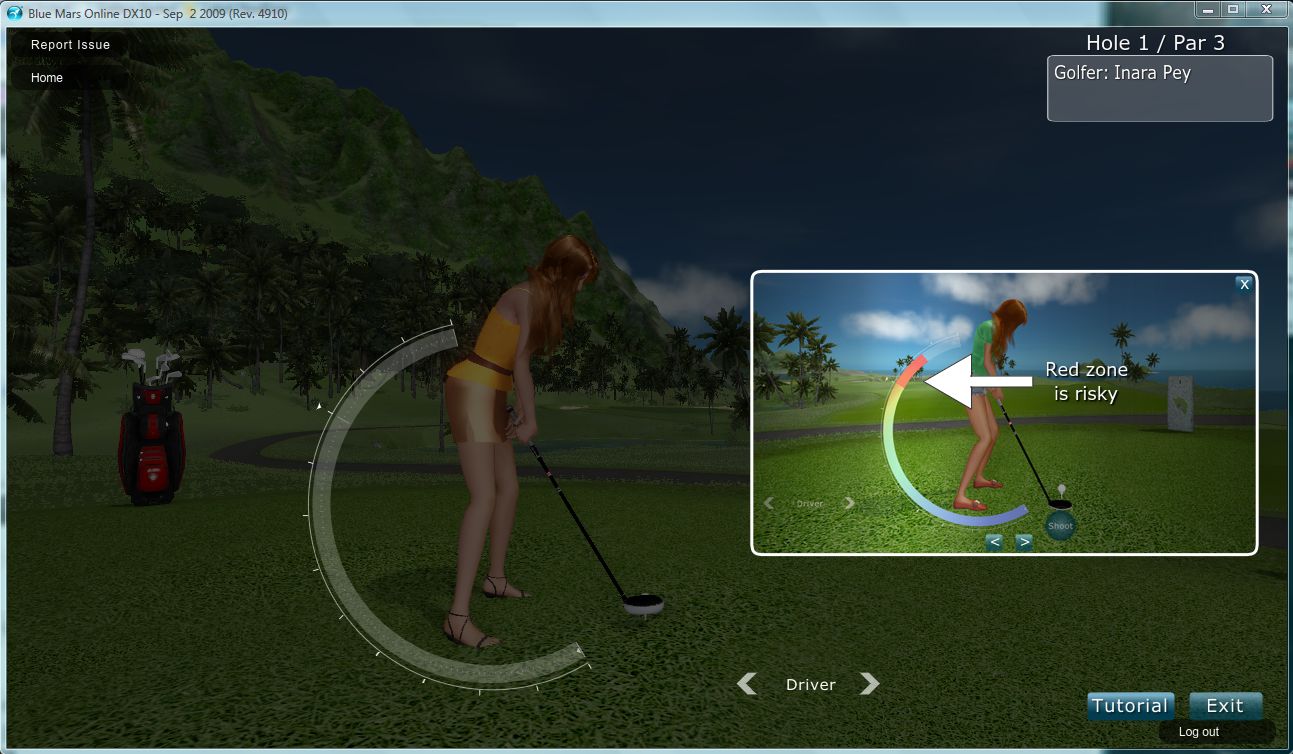
Of far greater fun – is the golf. This is widely used in Blue Mars advertising stills and promo work – and it is actually a lot of fun. It’s also much better thought-out than the flying game, and – in all honesty (and remembering I am in no way a “gamer”) it is like stepping directly from Blue Mars into a quality video game.
Golfing tutorial in action
On teleporting, a splash screen is displayed, offering you the option of playing one hole or three holes. You then get to choose single or multi-player. As I was (again, sadly) on my own, I went for the single player option and found myself on the tee. The screen itself is a lot more friendly – well, it should be; while I may not play golf, I at least know what the idea is, and so a golf course isn’t going to be totally alien – with a comforting button in the bottom right corner labelled TUTORIAL.
This launches a picture-in-picture tutorial guiding you through the on-screen controls, which although is very quick (a pause button would be nice), is also very informative and leaves you in command of the (straightforward) controls and the (few) keyboard options, and ready to play.
Now, I’ve already admitted I know nothing about golf ( share Mark Twain’s opinion of the game: that it is a good walk ruined), so the fact that the game automatically picks your preferred club for you left me with one less thing to get worried about and frustrated over.
This left me with the “simple” acts of aiming and shooting. The former being the (now familiar) right-key-and-drag mouse option to turn my avatar left or right, while the latter is simply achieved by selecting the strength of my swing on the “swingometer”, and then clicking the SHOOT button that pops up.
To be honest, I wasn’t aware of my own strength. For the first two or three goes I kept putting the ball totally out of bounds….causing me to step right back on the swingometer. Once I did get things in bounds, my avatar walked off across the green before arriving at my ball, complete with the preferred club (which I could change, if I wanted).
There are some nice touches in the game – the avatar takes a very natural swing to hit the ball each time, and when putting, if the ball just misses the hole, there is a frustrated stamping of one foot.
Putting
Along the way a little window in the top right records the number of goes you’ve had, while above it sits the number of goes it should take to get the ball in the hole. On my first attempt it took me *cough* eleven goes to get the ball down the hole – but the controls are intuitive enough that on my second go, I had this down to five.
On completing a hole, your avatar gives a little victory salute and if it is the end of the game, you have the option of starting over or exiting and returning to the welcome area.
As a very basic game, the golf is a good indication of possible directions BM can branch, and shows that games, etc., can be integrated into BM. The tutorial in particular demonstrates what can be achieved to assist residents (and in particular newcomers) gain better and easier understanding of where they are and what they can do – so it gets a thumbs-up from me.
Few can be unaware of Blue Mars – it has been the source for speculation for a while now, and the hype machine has been working overtime to promote it on all fronts – Youtube included. For various reasons, I signed up for a Beta account (as well as applying for Content Creation info!) and – to my surprise, and after a very sh***y couple of days (my computer did a “parrot” from the Monty Python sketch of that name – no need to say any more), I found I’d been…..accepted!
Now…the thing to remember is that Blue Mars is still Beta. A lot is still being worked on. And for those familiar with Second Life and the overall ease of use of the UI (despite all the complaints) are going to find BM a little challenging.
Blue Mars UI
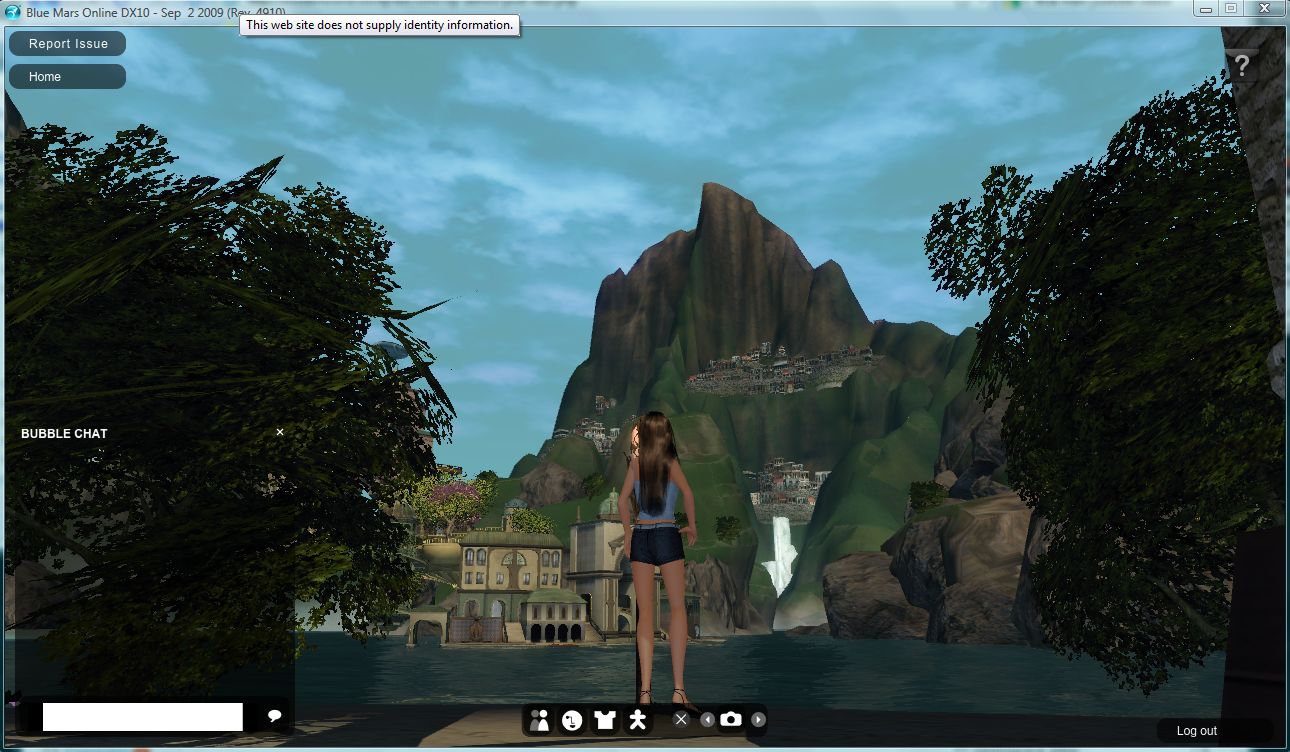
For a start, the UI in BM is …. bare…. There are no visible menu options, no buttons, just a few small icons and a chat box(private instant messaging is not available as yet).
Chat appears in the chat window, which automatically appears above the chat box in the lower left corner of the screen. Scrolling on this did appear a little iffy at times, and I found myself frequently manually scrolling down to keep up with conversations. Chat also appears as a bubble above the avatar’s head…which currently cannot be turned off and is, frankly, a little annoying.
For those used to using SL, the other difference is that avatars don’t have name tags over their heads – this actually makes keeping track of who-is-who a little difficult.
The interface is clearly in a state of flux – some of the tutorial videos refer to elements of the UI that have been removed / replaced, which does make it somewhat harder to get to grips with things, given there is no actual orientation centre. Video tutorials are also potentially going to be available in-world as a picture-in-picture type thing: you click on a question mark icon in the top right of the screen and you get to see video tutorials in a new window. Currently, however, these are restricted to just one, which deals with walking.
However, while the UI is rather bare, it is also somewhat context-sensitive. Click on another avatar, for example, and you can interact with them (kiss, cuddle, shake hands, etc.), add them as a friend, and so on, click on yourself, and you’ll get a menu pertinent to your own avatar.
Movement in BM takes a little getting used to. Rather than using the cursor keys, BM uses two different approaches. In the first you rotate the camera view, a slightly clunky right-click and drag of the mouse (trackballs rule in BM!), then click on the ground were you want to go. Your avatar then moves to that point. Click far enough away, and your avatar will run. Or you can use a combination of letter keys – W(alk) with a,s,d to manoeuvre around. for those used to SL, this is going to take some getting used to as it feels uncomfortable.
Perhaps the biggest critique is that the camera doesn’t track with your avatar when in 3rd person view (or at least, I’ve not found out a way of doing so) – so if you are walking with the camera behind your avatar and make a turn left or right, you’ll end up with the camera looking at your avatar’s right or left side, requiring the camera view to be scrolled around to a more appropriate view. And if you’re used to zooming around to look at things – you’re going to miss that in the current iteration of the BM UI.
Exploring an apartment
Things like sitting are relatively straightforward, simply click on a chair and your avatar will walk to it and gracefully sit down. Again, with animations built into the UI, there is no need for the object itself to be heavily scripted (I assume, at least, as objects aren’t “editable” in the SL sense), and there are no poseballs or silly “sit”, “relax” or other signs hanging over cushions and chairs.
Exactly how doors work, however, is still a mystery to me….
Movement in a wider context in BM is via a familiar teleporting effect, and is initiated either via teleport devices – not all of which are obvious; coming in various forms as garden gazebos, old-style UK red telephone boxes, even objects set into stree lamps or apartment floors – or by clicking on “advertising” images for the various available regions that are displayed in the “welcome” area everyone currently appears to have to log in to. Movement between regions, however, appears to require a return to the welcome area before hopping off again to your required destination – I’ve yet to find a means of going direct from, say, the golf course to New Venice, although teleporting within a region – from a garden to an apartment, say – is possible.
As you can see from the images, the avatar is also somewhat basic – you actually set your avatar’s face from a series of presets prior to entering BM, and once set, you are largely “locked in” to the face for 3 weeks. Whether this is purely for beta purposes or whether it will be the same for the full release remains to be seen. There is a certain degree of “customisation” available, your inventory comes with a few changes of clothing and footwear, and a small range of flex-type hairstyles. Apparently, more will be added as content creators role in – we’ll have to see.
While there is currently little you can do about your avatar’s shape – the bodies all seem to be generic – or do much to alter the shape of your avatar’s head and face once in-world, there is a pallette system rather like those on graphics programs that allows you to add make-up, although I have to admit, I’m no graphics artist, and I find that approach daunting / confusing, so quickly gave up.
Again, one of the things quickly noticeable about Blue Mars is that given bodies are customisable and faces have only limited manipulation, is that the male and female genders (no exotic lifeforms or furries as yet) looks more-or-less identical to one another. Even though racial attributes can be selected at start-up – the fact remains that all the women look to be related to one another, and the guys to one another. With the current limit of clothing, this can give the place a slightly Stepford-esque feel….
Dynamic shadows!
Where Blue Mars immediately impresses is in texturing and detailing. Here it is already easily on a par with SL – and in some areas exceeds it: a very nice touch, dynamic shadows are working. While you cannot tell from the still here, my shadow is moving fluidly in time with my avatar as I stand on this bridge in New Venice.
And “fluid” is the word – BM appears to be largely rendered at the “back end”, unlike SL, where all the rendering talks place on your computer. This means that once connected, everything in BM runs at much higher frame rates than SL, rezzes a lot faster and is on the whole smoother and more life-like when it comes to general movement – although there are occasional glitches and exaggerations in some movements – but for a beta tool, it’s clear effort has gone into making things as smooth and life-like as possible.
The fluidity extends to the avatars – and while they may lack the degree of customisation one is used to seeing in SL, aside from the slightly dorky / gawky default “AO” style animations, I must say that the general animations are astounding. No crimped arms or pretzelled legs; no shoving a hand through one’s own boob to do something and no messy torso folding / twisting. Animations can be loaded by right-clicking your avatar and selecting the required animation from your “personal” menu. And they really are gorgeous (with thanks to Ravenelle for the video link).
Ambeient sounds are far superior to SL as well. You wonn’t find that awful default keening wind blowing in Blue Mars. Enter a garden and you can hear birds singing, perhaps a little music playing, water bubbling in a fountain or brook….wall on a sidewalk and your footfalls echo faintly (and nowhere near as intrusively as scripted footsteps in SL (could someone PLEASE outlaw those bloody scripts?); move onto grass an the footfall alters to something softer, and changes again when you walk on sand, where your feet leave very brief shadow-like marks, almost like indentations in the sand. Walk in water and your steps fall silent, but the water ripples around your legs with each step….and angle your camera under water, and the entire soundscape changes, almosts as if you are underwater in a swimming pool, listening to the world above.
New Venice
I’m not entirely certain how Blue Mars is going to develop, or quite what is going to come out of the Beta. There are huge question marks around content creation, cost, commerce, viability, etc. Exactly how it is going to be operated is interesting as well – major developers will be encouraged to create their own “platforms” (cities) to which users can teleport, each city themed according to the developer’s wishes (and potentially incorporating fees for visiting).
How user content will work is still open to debate, although Jim sink of Avatar Reality, and the VP of business Development for BM is on record as saying:
We wholeheartedly embrace user-generated content. All of our tools are free to use and anyone can become a Blue Mars developer. But user generated content on its own won’t make Blue Mars a success. The real trick is to create a system where the very best user generated content can bubble to the top and to provide a platform where developers who create excellent content can be rewarded for their work and can be confident that piracy will be effectively managed. Managing security issues and improving our promotional features like search, ratings, and recommendations will be an ongoing focus of Avatar Reality.
Exactly how this works out could be interesting.
Right now it is a very quiet place….there are several locations available to visit, but no overall city environment, from what I can see; I’m assuming the developers are waiting for 3rd party developers to come in to develop the “city” hubs around which BM is going to operate. But what is there – after an admittedly shaky start – did impress. I’ll be hading back and looking around some more in the coming days, and may well put more thoughts down here on my findings.




 Inara Pey: Living in a Modemworld