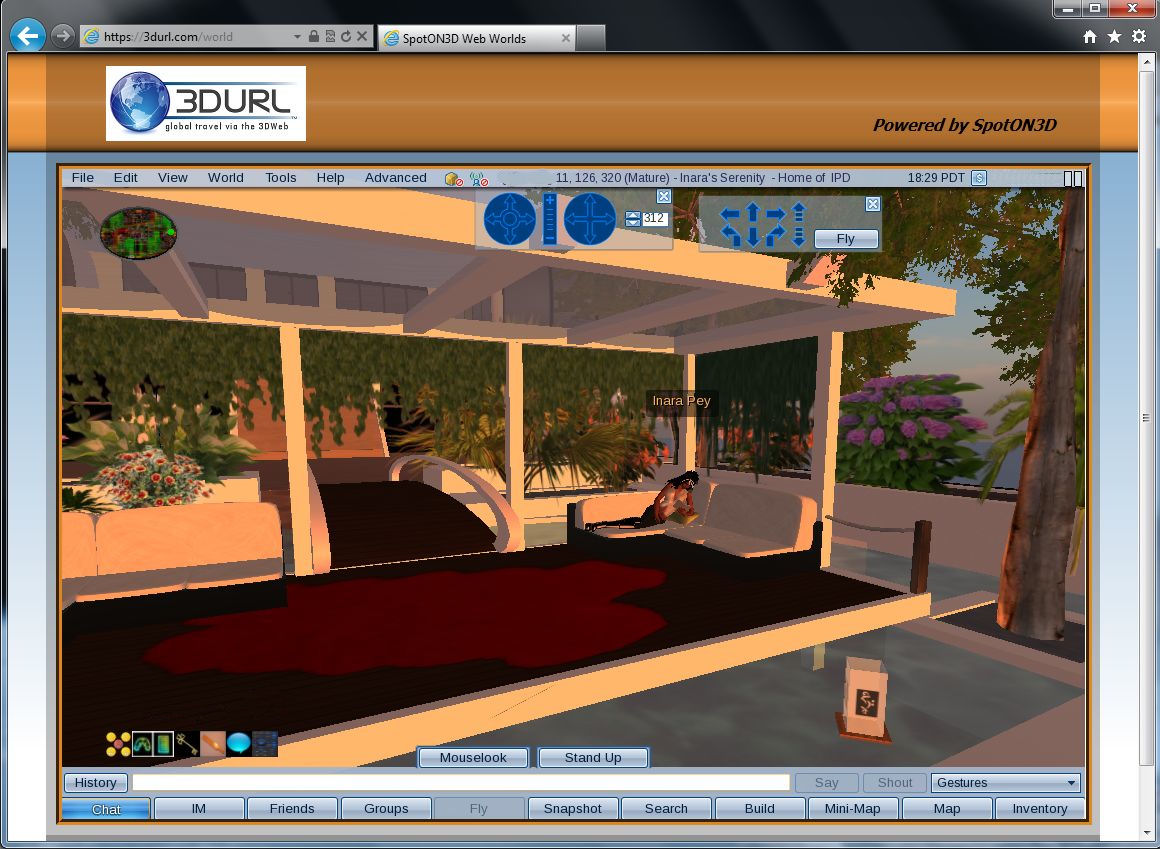
SpotON3D is an OSGrid that has implemented a novel means of accessing a grid: by making the Viewer a browser plug-in that works with IE, Firefox and Chrome – although currently only on the Windows platform (Mac and Linux to follow). For those with a Facebook account, you can also apparently access the Viewer from FB, but as I’m not registered with FB, I canot tell you how!
At home in SL – in a browser
While intended primarily for the SpotON (and VeeSome) grid(s), the Viewer is based on Snowglobe code (with the addition of some of Henri Beachamp’s extras), and so works with SL and other OS Grids.
Setting-up
Go to http://3durl.com/world. You’ll be asked to download and install the SpotON plug-in.
The installation of the plug-in will require you to close your browser.
The installation process will also create a application icon in your Programs list, allowing you to run the browser as a standalone item, as well as via the web.
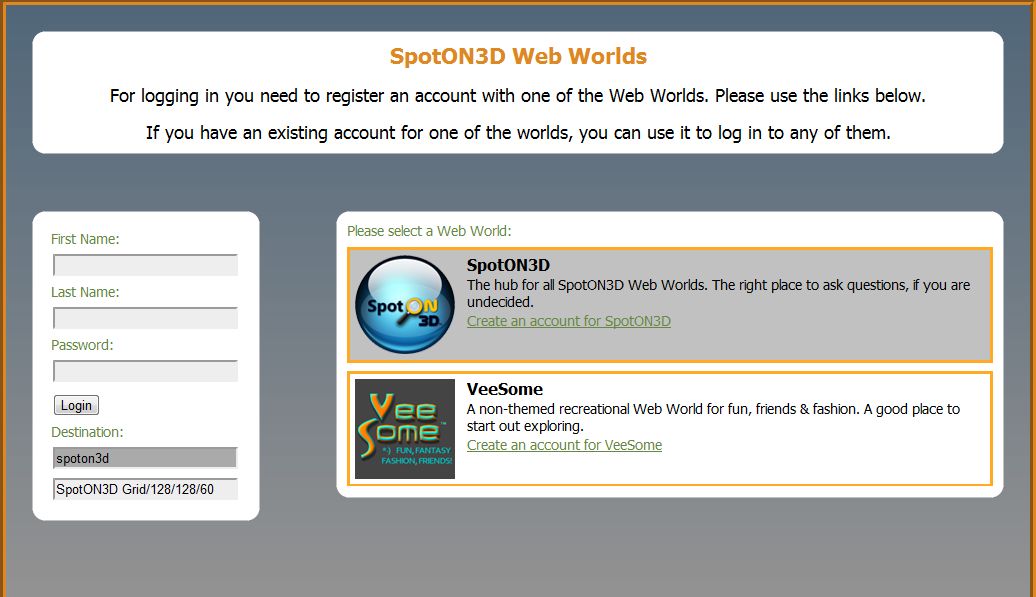
Once installation has completed, return to 3durl.com/world, where you will need to register with one of the offered grids (shown below).
Log-in / Registration page
Registration comprises:
Selecting one of the two grid options
Choosing your default avatar
Providing a name and password for the avatar
Providing an E-mail address for your Master Account (you can register up to five avatars against the Account)
Replying to the Account activation e-mail that will be sent to you.
Once you’ve activated your account, return to the SpotON log-in / Registration page and use the panel on the left to log-in. This will automatically log you into whichever grid you registered with – which you are free to explore, obviously.
Getting to Second Life and Elsewhere
To get to SL or another grid, go to FILE -> LOGOUT. You will be logged out of the current Grid and a splash screen will be displayed, complete with both a GRIDS button and a QUICK GRID SELECT button. You can use the latter to access Second Life as one of the pre-defined Grids in the Viewers, or the former to bring-up the Grid Selection window and add an additional grid.
Grid selection options
Any grids added using the Grid Manager will automatically appear in the Quick Select button as well, making switching between grids very easy; just remember that the Viewer is optimised for SpotON.
In InWroldz In my Browser
Quick Tip
By default, you can only log-in to either the SpotON or the VeeSome grid from the 3durl.com log-in page (depending on which one you chose when signing-up). However, if you want to be able to get to SL or another grid without having to log-in and out with SpotON or VeeSome, you can:
At the 3durl.com log-in page, enter an incorrect user name / password
The plugin will attempt to log you in, but when authentication fails, the Viewer splash screen will be displayed
You can now select your preferred grid from the QUICK SELECT button & supply the required log-in information
Occasionally the splash screen may refresh and default back to either SpotON or VeeSome as the logging-in grid, should this happen, simply click on the GRID button and select your grid from the Grid Manager window and APPLY and OK.
Some things to bear in mind:
SpotON isn’t listed on the SL Third Party Viewer Directory as yet, so there is a risk it is not register for use with SL (not that registered Viewer *have* to be listed in the Directory)
It is based on the SL Viewer 1.23 so no multi-attach options as yet or vertical IM tabs and only minimal skin support (although it does have Mu poses (use “:” for “/me”) OOC auto-complete and RLV/a)
Test Systems and Performance
I tested the Viewer-as-a plugin on three systems, using the same versions of Firefox, IE and Chrome on each. The three test systems comprised:
Acer Eee PC 1201N Netbook: Intel Atom 330 quad core 1.6GHz 2Gb; Windows 7 32-bit + SP1; nVidia Ion2 graphics 256Mb
Sony Vaio UMPC: Intel Core Solo U1500 1.33GHz 1Gb; Windows Vista + Service Packs; Intel 945 graphics chipset, shared memory
Overall, the performance on each was pretty similar to running the Viewer in a standalone mode, other than the fact that visually and fps-wise the Viewer fell somewhat behind the latest offerings from LL and others – but then the code base is significantly older as well, so this is not surprising.
Why Do This?
Given there is little performance-wise to be gained in using the Viewer in this way, coupled with the fact that you are still effectively downloading a Viewer to your PC for grid access, it is tempting to ask why bother? After all, if a computer can run a Viewer in this manner, it is probably going to be able to run a standalone Viewer. So where are the advantages in this approach? I put this question to SpotON3D Manager Victor Hua.
“The biggest advantage is ease of access. Giving people the ability to log in with a minimum amount of effort,” he replied. “Many businesses and educators would like to see the client run as a web based plugin, most likely for those same reasons. Also, having it as a Facebook app opens up the venue for a much larger audience and helps spread and improve adoption.”
The ease-of-access approach is an interesting one (if not entirely new), as it is something grid-based worlds are often critiqued about. However, the real issue with getting to grips with any grid-based world is not so much downloading and installing the Viewer as it is in using it; and here this approach offers no real advantage. But that said, it cannot be denied that many people are more comfortable downloading and using browser plug-ins than perhaps they are downloading and installing dedicated applications. This being the case, presenting the Viewer as a browser plugin, regardless of the fact it is full capable of standalone us, may well persuade people to dip a toe or two into the virtual waters.
It’ll be interesting to see where this idea goes, and whether anyone else will pick-up on it. For my part, I found it a fascinating experience to dabble around in a number of grids from my browser, and actually found this solution somewhat more preferable and convenient to use on the UMPC than using Radegast & its 3D scene rendering capability. That said, until someone comes up with a genuine solution that enables people to access grid-based virtual worlds from within a browser, as Tipodean are attempting to do, and which allows lower-end systems to access the virtual environment, then it is probable this solution will have limited appeal.
Updates
Aug 3rd:The issue of patients on the plugin aspect of this technology, coupled with issues around Viewer and GPL licensing, which are referred to by Kitely CEO Ilan Tochner in the comments below, are covered in-depth today by Maria Korolov at Hypergrid Business.
Aug 20th: As I’ve reported here, SpotON3D has now closed the ability to use the Viewer when presented through the browser with any other grid but their own.
InWorldz LLC, operators of the fast-growing InWorldz grid have today announced a significant joint venture with CariNet Inc. a quality-oriented service provider in the USA, to build a redundant 3D virtual world grid.
The Press Release from InWorldz reads in full:
InWorldz, LLC and CariNet Inc. To Power Virtual World Technology and Hosting Through Joint Venture
Venture to focus on quality of service, scalability, and core software to promote growth and technical innovation
NY and SAN DIEGO, CA , July 30, 2011 – InWorldz, LLC a leading provider of virtual world services and CariNet Inc. a quality-oriented provider of dedicated servers, server clusters, and cloud computing announce plans to form a joint venture to build a redundant 3D virtual world grid capable of high performance and fast growth.
The venture builds around the original vision of the InWorldz founders. Known to their customers mainly by their pseudonyms, Elenia Llewellyn (real name Beth Reischl), Legion Hienrichs (real name John Arnolde), and Tranquillity Dexler (real name David Daeschler) have supported the continuing vision that everyone should be able to experience virtual world technologies and services in a way that enhances their lives and their own vision. Since it’s inception in February of 2009,InWorldz, LLC has listened to customer feedback and demand to provide it’s residents with the software, hardware, and tools they need to create dramatic simulations ranging from vast and mystical oceans, to artistic depictions of real world cities. Building on a strong customer community and a solid technical background, the InWorldz grid has grown to over 800 customer owned regions on word of mouth alone.
CariNet Inc. has been a hosting leader since 1997, offering a wide variety of hosting options including dedicated servers, server clusters, public and private cloud offerings as well as server virtualization hypervisors. CariNet Inc. builds, owns and operates all of their datacenters and are capable of handling customers and demands of any size. CariNet Inc. currently services 7500+ customers around the globe.
CariNet Inc. provides a strong background and expertise in all things hosting. The CariNet team consists of a dedicated group of individuals willing to go the extra mile to make sure they have a quality product their customers can rely on. From power, to network, to hardware and software, CariNet Inc. has created a strong backbone for any business to tether their dreams to and let them run.
Enablement is the shared theme that has brought CariNet Inc. and InWorldz, LLC together. The joint venture will provide InWorldz with access to the latest in hardware and software technology available to support efficiency and scalability. Powered by this venture, InWorldz will have access to systems and expertise that will increase the effectiveness of their business processes, free up development resources, and increase profitability. The joint venture will provide both companies with the opportunity to continue to explore the growing virtual world market and provide the services and support that enable the individual as well as organizations who will use virtual world technologies in the future.
Avination have launched a “try a sim” promotion. you can pick-up a 15K prim simulator for $40USD for the first three months, rising to their standard $60USD a month thereafter.
The offer starts today and runs for an indefinite period. Builds from one discounted sim cannot be transferred to another discounted sim (so no $40-a-month sim hopping!).
Avination is another grid-based virtual world that is making something of a splash. As I’ve taken the time to re-visit InWorldz, I decided it would only be fair if I took a first look at Avination.
My first step was to sign-up via the very plush website (IW and others, take note!). If you want to keep your existing SL avatar identity, this is possible once you’ve signed-up – see below.
The sign-up process is painless: you supply a first name, select a last name from a defined list and follow the prompts as given. If you intend to swap your avatar name for your SL avatar name, make sure you click on the link in the grey area to the right of the first page of the sign-up process & make a note of the Second Life locations where Avination Terminals are located (displayed as a pop-up window).
One interesting step is that you are asked to opt to initially go in-world at either the general Welcome area or the Role-play Welcome area. Unlike other Grids, Avination has been created to fill the niche market area of role-play (of which more anon).
Once you have completed the e-mail verification process, you’re ready to log-into Avination. For this you can use the Aivation Viewer or a suitable SL Viewer 1.x TPV that supports multiple grids (I recommend Imprudence).
To use your existing SL avatar name, log-in to your Avination account at the website and enter your SL name under the Account Details. Once you’ve done this, go in-world in Second Life and locate an Avination terminal where you can link your SL details with your Avination account, and then change your avatar’s name to that of your SL avatar. Once done, you can use your SL name to log into Avination via a Viewer or the web site. As a side note, be aware that you can also use these terminals to transfer L$ from SL to their Avination as well – although not the other way around.
For the record, the system configuration I used for this review comprises: Intel Q6600 quad-core processor, 2.4Ghz / 3Gb RAM; Window 7 with SP-1 installed; Ge9800GT GPU with 1 GB RAM supporting OpenGL 3.3 & the most recent nVidia drivers; Imprudence 1.3.2 and Avination 0.1.0.
Logging In
Avination welcome area
On logging-in I arrived at the welcome area – a large plaza surrounded by shops. The people here were friendly, but there was a certain dearth of information on display. Surprisingly, when compared to elsewhere, I didn’t come across any freebies to help get newcomers started. OK the name of the game is commerce, but there is no harm in giving people the opportunity to improve their basic look before asking them to part with money to get a really good for themselves.
I deliberately hung back on arrival, acting the newcomer and keeping quiet to see what the response would be – in InWorldz, there was a time when it could be overwhelming. Here, while the was a lot of chatting going on, it seemed to be among those who obviously knew one another, with new arrivals overlooked. However, a mentor did eventually take pity on me and passed over a notecard of landmarks. It was then time to sort out Inara Mark 3 and start exploring.
The almost-me
Avination, unlike InWorldz, charges for uploads (C$10 each); this meant I needed funds – and I hit my first problem. While Aviation provide ATMs in SL to transfer funds to their grid, they don’t provide a direct exchange mechanism running the other way – you need to use a 3rd party solution. As the minimum transfer from L$ to C$ is L$1,000, and this was my first visit to Avination with no guarantee I’d be back, I frankly wasn’t willing to part with the funds. Had the exchange system been bi-directional, as with InWorldz, I wouldn’t have had an issue; but c’est la vie.
This left me with the ability to create a new shape (the default shapes selected when joining at not modifiable), and keeping the default skin rather than uploading my own. While the result was reasonably OK, I was very conscious that it wasn’t really *me*, and I think this somewhat divorced me from the experience at times – as if I was looking at things through the eyes of a stranger, so to speak. However, the choice to go this route was mine, and as they say, beggars can’t be choosers; so off I went to explore.
If you hate SL’s Search…
Aside from the list of LMs I was given, the sage advice I received when looking for stuff was to “use search”. Well, yes, if one accepts the fact that search suffers from the same plague as with other grids – and as SL once suffered: keyword gaming. It’s a trifle annoying typing in “hair” and getting dozens or more hits on everything and anything else but hair – but we lived with in it Second Life for years, so even this was a trip down memory lane – albeit with teeth clenched. That said, the search is more amenable than IW’s inasmuch as more tabbed categories work.
Appearances, Shopping and Content
“You may remember me from such grids as….” – familiar names abound in Avination
Avination is perhaps the most “SL-looking” of the developing Grids I’ve visited. Like the others, Windlight is available, textures generally load fast in both Imprudence and the Avination viewer, builds are comprehensive and well-made, and so on. But it is more than that when it comes to the “SL feel”.
For a start it is hard not to go too far before you trip over established names throughout Avination. Many major content creators from all fields are active here, and the range of “known” names seems to be far wider than that found in InWorldz.
There is also the fact that gaming and gambling are a lot more settled in Avination. This is not to say they don’t exist in IW or elsewhere, just that their presence is more obvious here. In this, Avination very much feels like SL circa 2007 – and it’s actually a pretty warm feeling, another trip down memory lane.
Currency and Land
Prices in Avination are comparable to SL in many areas – and may even be cheaper in some. The C$ itself is worth about the same as the L$ in real terms. Hair, for example, can be had for around C$50-C$100 (compared to L$150-L$200 in SL), while boots and shoes seem to fall I the C$150-C$300 and clothes range anything from C$150 through to C$500.
As mentioned above, there is a direct mechanism for getting money from SL to Avination via a series of SL-based ATMs. Once your accounts are linked between the platforms, the transfer is direct: simply pay an ATM for funds to move from L$ in SL to C$ in Avination. The minimum transfer amount is L$1,000 and the ATMs provide a fast pay pop-up for multiples thereof, as well as allowing you to enter any reasonable amount over the L$1,000 mark.
However, getting money from Avination and back to Second Life is not as straightforward. There are no corresponding terminals in Avination. Instead, the recommended route is to use the Virtual World Exchange (VirWoX).
VirWoX is internationally recognised as a currency exchange mechanism (L$ are traded on it) and can offer great flexibility of use. However, VirWoX requires an account registration and credit card, etc., details – and it is conceivable that this will put casual visitors and some potential users off. A direct ATM system would be far more preferable.
In terms of tier, Avination closely matches Inworldz prices: a full sim costing $60USD a month to lease (the same as an InWorldz mainland sim); however, there is no initial set-up fee payable. Full sims have 15,000 prims available, a-la Second Life, and prims can be stretched up to a maximum of 256x256x256m. While the prim count is lower than IW, this shouldn’t necessarily be seen as a point against Avination; we’ve yet to see how a sim with, say, 20-25,000 textured prims such as in an urban environment or on a rental sim and with multiple users (12+ avatars) routinely in the sim impacts Viewer lag.
Aviation also offers a combat role-play ready sim with the CCS system for $75 a month, matching InWorldz private island rate, but again with zero set-up fee. There is also an “XP upgrade” CCS sim available at an extra $50 a month – although what this includes is something I didn’t discover during my couple of days wandering around.
Rental costs on private sims are, as one might expect given the above prices, considerably lower than SL, even taking into account the owner’s own margin. A full sim can be rented, for example, for around C$3800 a week on average (compared to SL’s L$22,000 a week).
As with InWorldz, Avination has adopted the SL maturity rating system (PG. Mature, Adult), allowing a wide range of activities to take place in-world. It is also RLV (or RLV/a) enabled, so offers a further alternative for adult-themed play.
Stability, Physics and Other Bits
Avination is remarkably stable. I encountered precious few problems running either Imprudence or the native Viewer. In terms of frame rates, the Avination Viewer ran at between 28-30fps when I was alone on a sim, dropping to around 14fps on a sim with 10 people (Welcome Area). Imprudence offered up very similar rates. When I did try Phoenix, things weren’t quite as smooth: fps was around 12 when on my own, and fell to 5-6fps if anyone else was on the same sim. Rezzing within Phoenix was also generally slower.
One minor problem I did encounter was that under Imprudence I could not influence the local time of day settings (unless I used Windlight defaults); setting the sun to sunrise, sunset or night had absolutely no impact on my world view. The same problem wasn’t apparent in the Avination Viewer, however, which handled daylight changes perfectly.
A more annoying issue I had when using the Aviation Viewer was that sometimes on clicking vendor boards, etc, (to check / compare prices), and as I didn’t have sufficient funds to cover the cost of items, the “Buy currency” pop-up would be displayed. While this wasn’t in itself much of a surprise, the fact that 50% of the time closing the pop-up resulted in a Viewer crash was.
Avination has a credible physics engine, something vital for role-play and which gives it an edge over other offerings. I’m assuming this is a tweaked offering, rather than the default ODE engine supplied with OpenSim. Lag was generally less noticeable than with InWorldz, and region crossings were very stable; a slight pause on crossing the boundary, nothing more – certainly no rubber banding. Would that SL was as smooth.
Tattoo and Alpha Layers are supported, with the same limitation of only being able to wear a single layer of each that is common to all Viewers based on the SL 1.x code. Voice is also full enabled – something that can be very beneficial in role-play situations.
Website Showcase
An attractive element of Avination is the website – which is largely very well designed and informative, although it could benefit in having Surls in the Showcase section. While descriptions of various groups and businesses good to have, providing links to them would be very useful, even if one needs to copy-and-paste them into the map to make use of them (if live linking to a map a-la SL isn’t possible).
As with Inworldz, Avination has an active and engaging forum section on the website, which is also very well worth a look.
Behind the Scenes
Aviantion is run by Avination Virtual Limited, registered in the UK (Company Registration Number 07476485), and details of the individuals responsible for it are available on the website. There is a policy on content rights and protection which demonstrates that IP and other rights are taken as seriously as possible. Melanie Thielker, Avination’s CEO is well-known in OpenSim circles, adding further credibility to an already strong identity for the organisation.
General Impressions
Avination is very much like InWorldz in many respects, but with more of a “Second Life” feel to it than I found with InWorldz (and this is not meant negatively either way). Like InWorldz, Avination is growing, but is nowhere near comparable to Second Life.
The Builders Mall at Avination
Avination appears to have been somewhat more marketing-oriented than other grids; at the start of 2011 it engaged in an aggressive drive which saw the grid triple in size in terms of both regions and users in the space of a month (mid-January through mid-February); with regions topping out at 925 and user registrations at just a touch under 12K. Today these figures stand at 1042 regions and 30526 registered users, with some 7652 unique user log-ins every 30 days, giving an average daily concurrency of some 255 users. It’ hard to say precisely how this compares to InWorldz – which is not given to publishing monthly usage figures – but the overall user registration counts are roughly comparable at this time, with InWorldz just having the edge.
Like IW, Avination does face an uphill struggle to entice people who have been entrenched in Second Life to make the leap across to the grid and start investing their money in it as consumers. While an aggressive marketing campaign earlier in the year did spark a rapid growth as mentioned above, it would appear this has levelled-off somewhat of late. Getting people who are engrossed in SL both mentality and financially to shift focus – even part-time – is not an easy nut to crack, as I’ve mentioned in my look at InWorldz.
And with due respect to both Avination and InWorldz, the problem is further exacerbated in that while they both strive to be different and apart from SL, to the average user the differences may well appear cosmetic. When it comes to moving around, shopping and buying things, engaging in social activities, playing games, etc., there really isn’t that much of a difference. And this is where things might work against Avination and InWorldz. Not only have people invested a lot of time and money into their SL inventories, the fact that they can buy exactly the same stuff elsewhere isn’t necessarily an enticement for people to voluntarily uproot and leave SL, not even for the promise of lower tier – not unless LL go and do something unbelievably stupid to drive people away.
That said, one thing that might make Aviation a more attractive proposition to SLers who do pop over to give it a try would be a fully in-world bi-directional means of passing funds between L$ and C$ accounts without the need to go through an exchange mechanism like VirWoX. Doing so could well entice them to start spending in Avination – and thus giving them a reason to come back again later.
A lot of work has been put into making Avination a polished, professional package – and if I’m honest here, the likes of IW could learn a lesson or three from Avination in terms of website content and dynamics. This alone may help boost the numbers of people willing to get involved in it: attractive websites tend to, well, attract.
It’s fair to say that Aviation is an attractive proposition for those wishing to engage in the “business” side of grid-based virtual worlds beyond Second Life as well as to the role-play community. Not only is the company offering sims at prices that are somewhat lower than the likes of InWorldz (no set-up fee), they are part of a triumvirate of companies run by the Thielkers – the other two being a virtual environment software company and a hosting service (3D Hosting, operating out of Germany). The latter two companies have been in existence for over two years, and together provide Avination with a strong technical base and potential security against being held to ransom by third-party hosting services, etc.
Overall, I like Avination; it may not have given me the same buzz as InWorldz does, but it is a pleasant enough place and there is a lot going on. I can’t say I’ll be actively involved there – most of the people I know who are looking at other grids are, to be honest, sitting in InWorldz. Nevertheless, if you’re just beginning to venture out into the big wide world of grid-based virtual worlds, Avination, alongside InWorldz, is a good place to start.
As has been pointed out, one element I failed to mention above is the fact that like InWorldz, it is possible to buy currency via the website, using Paypal & ICE (cheques). This was not a deliberate exclusion on my part; rather it was a simple oversight.
There has been much said about InWorldz of late – and the camps seem to be sharply divided as to how “good” it is, so I decided it was high time I popped back (after an absence of some eight months) to take a look at things myself.
When I first reviewed InWorldz, my impressions were generally favourable – the place was just beginning to find its feet, and while it had some rough edges, the potential was there. So, what has happened since that time?
Well, rather a lot, and most of it for the good. User numbers have been growing steadily (Total user count approaching 40K, almost 900 regions online), and a growing number of SL merchants offer their wares in IW as well – of which, more anon – and an active social scene. Those running the grid have now formed a Limited Liability Company in the US – somewhat similar to a Company Limited by Guarantee in the UK – and as such, have revealed their personal details (the LLC itself has a correspondence address in Brooklyn, NY) and address is also given for DCMA issues as well. If nothing else, this should stop those who have in the past, taken pot shots at InWorldz – and OpenSim grids in general – for their “lack of accountability”.
Beyond this, the web site itself remains little changed from the last time I looked, although the range of available Viewers has increased: IW now “officially” recognises Imprudence, and also now has an SSE2-optimised version of their own viewer. Actually, the website is something that needs work; as it stands, it’s pretty unenticing, and doesn’t do IW itself justice in inviting people to come in and have a look around.
For the purposes of this review, I downloaded the latest SSE2-capable version of the IW Viewer and initially used that. For the record, the system configuration I used for this review comprises: Intel Q6600 quad-core processor, 2.4Ghz / 3Gb RAM; Window 7 with SP-1 installed; Ge9800GT GPU with 1 GB RAM supporting OpenGL 3.3 & the most recent nVidia drivers; InWorldz Viewer 1.2.7 (May 15th) or Imprudence 1.3.2; Phoenix .1102 (where specified).
Logging-in
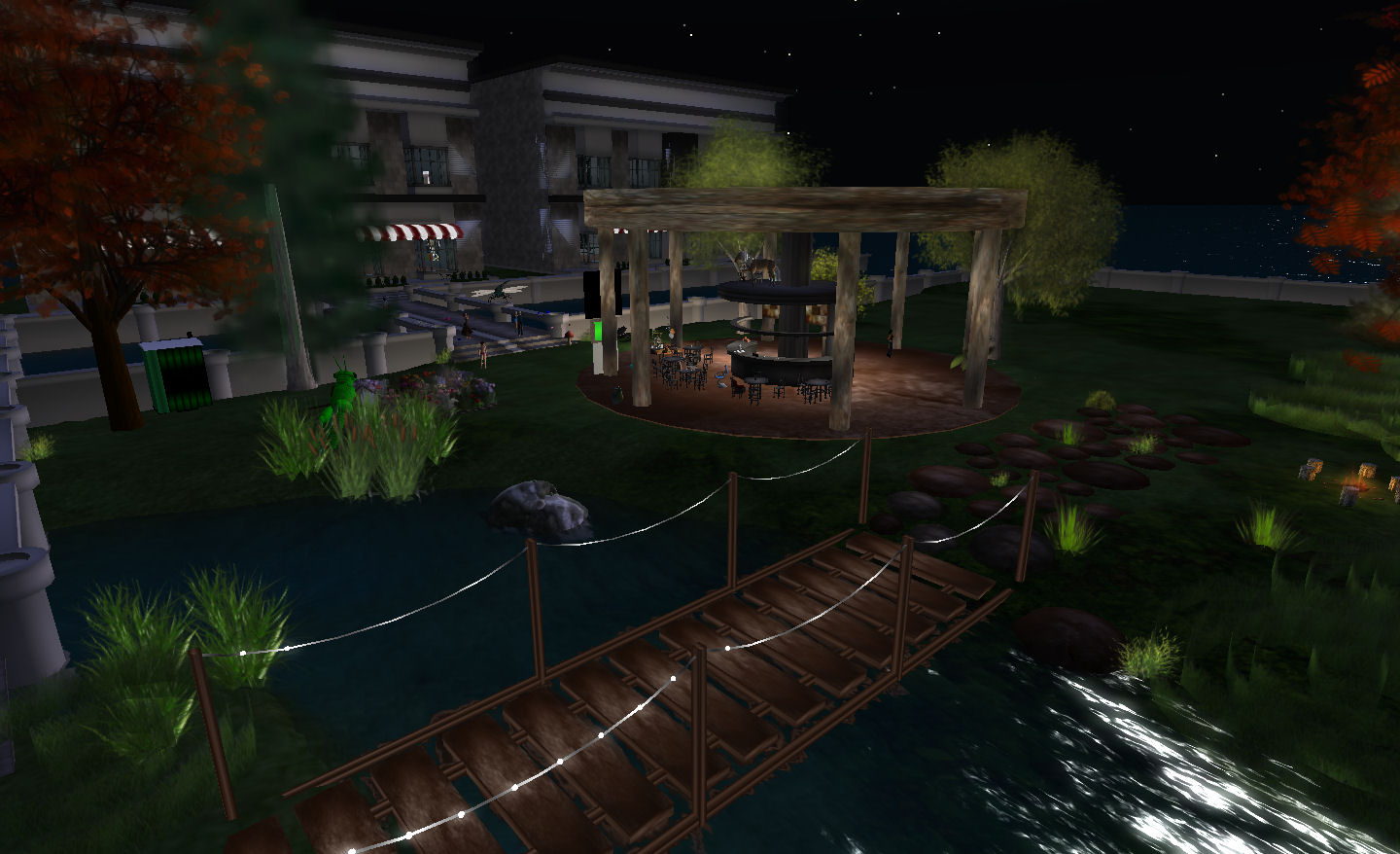
The Coffee Station
Logging-in brought me to the familiar InWorldz Coffee Station, which is the default log-in for those new to IW or who haven’t set a home position, etc. Last year, this was subject to “heavy” (for IW at the time!) traffic, and had both masses of lag and people falling over themselves to provide assistance.
This time, the sim rezzed smoothly and at a speed comparable to SL and lag was non-existent; however, even with only five people present on the sim, I exhibited a familiar movement problem: rather than animating while walking, my avatar would simply “glide”, pose unchanged – something I frequently encountered back last year, when I was using a lower specification graphics card. This was to mark my movement wherever I went.
The first thing I did on getting logged-in was update my appearance to match my SL looks as closely as possible. As I was, until recently, using my own custom skin and am still using my own shape, this was relatively simple – just upload the skin textures (free of charge in IW), apply them via the appearance Editor & then tweak my shape and change hair colour. The results were pleasing, although I need a decent eyebrow shaper in IW to tweak the look a little more.
Yay me! (Left: IW circa Aug 2010; Centre: IW today; Right: SL today)
Search was very much lacking in IW the last time I was there – not so any more. It’s now available, if buggy, and those who remember the “old” (pre-google-ising) SL Search will feel right at home (right down to the keyword gaming that was such an issue in SL!). Indeed, so much of the InWorldz Viewer harkens back to what was in SL several years ago, that using it is something of a pleasant trip down memory lane. That said, I’d avoid the Web Search option in Imprudence.
Phox-y Scripting
Like OSG before it, IW has forked somewhat from the “full” OS Grid standard; I understand the inventory system is being overhauled and they’ve recently introduced their own scripting language – Phox. Now, this gave me cause for concern as last year, I spent a fair amount of time working on various builds as I tried out IW, and most of these ended up scripted using LSL – so I was concerned that I’d have to go re-learn everything in order to re-do everything. However, a quick hop to a sandbox showed my fears were – so far at least! – unjustified. My rezzers worked and all the doors, lighting and other elements worked just fine. The only minor irritant I found was the repeated appearance of a line of object chat “play sound script: 45.000000”, which I couldn’t trace down.
I’ve yet to try out Phox in anger, so cannot give an honest comparison – expect that at some point in the future, perhaps.
Appearances, Shopping and Content
The general “look” of IW has come a long way as well; Windlight is enabled, allowing for eater reflections, etc., to be seen, sculpties are now very prevalent, sim extenders are commonly in use (although rather surprisingly, none of the ones I noted were set to phantom, as with SL, but they didn’t appear to create any issues with sim performance. Could this be due to the lack of any physics engine within IW at present?). Indeed, land in any developed sim in IW and allow it ro rez, and you’d be hard-pressed to tell it apart from anything similar in SL.
“Is this the real IW, or is this just SL?” (It’s IW, honest!)
The choice of shopping in IW has – due to the aforementioned influx of SL creators – dramatically increased in terms of quality and quantity. Prices in IW appear somewhat equitable to those found in SL; I visited a number of clothing stores and found prices ranging from Iz250 through to Iz600; however, given you get around twice the number of I’z that you do L$, then IW is considerably lower-cost than SL. In may respects, this is to be expected: land prices within IW remain markedly lower than SL.
Money brings me to my first gripe: currently, IW uses PayPal as the “official” mechanism for buying currency. This hurts on two counts: the additional transaction fees thrown in by PayPal themselves, plus the fact that I only have one credit card, and that is assigned to a PayPal account I *cannot* use for making personal purchases. While there is an alternative means of obtaining currency – via in-world ATMs linked to their counterparts in SL, so you can transfer L$ and Iz in either direction, it would be beneficial if a further mechanism could be provided by which those unable to use PayPal and who may not be involved in SL could obtain currency.
Content-wise, IW has the familiar PG, Mature and Adult ratings assigned to it – but in a much more logical and user-friendly way (Rodvik, please take note!). Mainland is restricted to PG content only, with private sims available for rating as PG, Mature or Adult, according to the owner’s preference. While this does mean those wanting to run Adult-related activities are restricted to purchasing private island sims, this is not as hard as it may appear, again due to the cost of land.
Land Costs
Sims come in a variety of formats; Mainland sims are limited to 30,000 prims (twice that of SL sims), with pricing set at $60 USD a month tier, and an initial set-up fee of $60 USD. Private island sims come with prim options from 35,000-45,000, with tier set at $75 USD a month and an initial $75 USD set-up fee.
It should be noted that these prices are somewhat “introductory”, and will increase (tier at least), when IW officially goes “live”. However, those taking sims now will have their tier grandfathered at these rates for 12 months following IW going “live”.
There are other much-touted advantages to IW and grids like it beyond the prim count that sims are given: prims can be edited to a size of (on average) 128x128x128, and can be shrunk down to the size of nanoprims without the need for editing tricks as well as supporting a hollowed-out rate of 99%. While there are undoubtedly good, there are still limitations on linking prim sets (though not as restrictive as SL), and assuming LL take linksets into account when mesh is rolled out, it is probable that in terms of resizing prims, SL will be able to match IW and elsewhere for the majority of building tasks.
Show Me the Seccs!
SL has – unfairly in many respects – a “seedy” reputation. While “adult” activities do go on (just like in real life), they are hardly “in your face” as many a tabloid journo would have us believe. Truth is, if you want to find them, you have to make something of an effort and go find them.
Truth further be told, I actually see nothing wrong with much that does pertain to “adult” activities in SL; a lot of them can be downright fun. This being the case, it’s good to see the IW founders being as open-minded towards things “adult” as Linden Lab once was. As mentioned above, there is a sensible rating system (although admittedly no age verification process at this time). Given IW is a place for the over-18s, it should allow for the widest mix of activities.
However, I was genuinely surprised to find RLV in operation on the grid; I was totally oblivious to the fact it had been ported, only that there were rumours of people attempting to port it to “other grids”. It’s only available through those Viewers with RLV/a implemented (such as Imprudence). Suitably themed sims are already popping up, and I noted a couple of (in)famous fetish/BDSM Groups from SL are apparently active over on IW as well.
As an RLV user, I’m pleased to see it in use elsewhere, although I’m curious as to how it will be maintained over time; presumably someone is keeping an eye on Marine’s Kelley’s development of the code – and has had the courtesy of letting her know they’re porting it elsewhere (or if it is RLV/a, letting Kitty know, if she’s not responsible herself).
Stability, Physics and Other Matters
There has been much written on IW stability and general usability, with many reporting they have issues – particularly in the areas of rezzing and crashing.
Gurl-6 is one of the well-known SL brand names with a major IW presence
While these things are highly subjective, I can only report that I leapt around over a dozen sims in my visit; I rezzed and de-rezzed items, I slid through stores, Tp’d hither and thither – and encountered few rezzing issues. Those I *did* encounter all occurred when on Mainland and when flying across sim boundaries; on several occasions things in the sim I was entering would not rez until after I’d Tp’d somewhere in-sim. This was a little disconcerting, as I’d find myself seeing furniture and plants hanging in the air just before I’d hit a wall that wasn’t there…
Viewers-wise the IW and Imprudence Viewers operated admirably well: Imprudence shoving out an average frame-rate of 30fps on sims with others around, and up to 40 on sims where I was alone. The IW Viewer banged things out for me at just *very* slightly lower rates: around 36fps when on my own, and around 25fps on sims with others. Phoenix did not fair quite as well; the frame rates were appreciably lower (22pfs when on my own, 16fps when on a sim with 1-4 others). I also routinely found I needed to force a rebake after Tps in Phoenix in order to properly rez to myself. Logging-out from Phoenix was less than elegant, as it tended to think I was connected to SL, and have been forced to log out, generating the message about viewing chat / IMs or quitting.
One slight issue I did have when working with the various Viewers is that my inventory views didn’t always sync. I first noticed this when creating an Alpha Layer (of which, more below). I used Imprudence to create the layer, but when I re-logged to the IW Viewer, the Alpha didn’t initially show-up – I had to relog. The same issue occurred when creating a Tattoo layer in Phoenix – when I first logged back to the IW Viewer, the tattoo icon was a no-show in my inventory.
And yes, IW does support both Alpha and Tattoo layers. What it doesn’t currently support, however, is multi-attach or multi-layer clothing wear or the new SL Avatar Physics. Doubtless these will come in time, but this is still a Beta grid, so no complaints on these being absent, please!
It is true that IW lacks a physics engine (ODE doesn’t appear to be implemented, and while nVidia PhysX has been promised, it has yet to be delivered), and this is currently limiting – no cars or other modes of transport, including elevators. While not an absolute killer, there are many who do like their vehicles and things, and until physics arrives at IW, it will put people off. That said, I did encounter some odd physics-like behaviour around the grid that was similar to SL pushing. A few times when flying between locations, I’d land at a store and immediately get pushed back to the parcel boundary; if I walked across the boundary, I’d be OK, but flying would see me pushed gently back to the boundary upon landing (this was not any form of rubber-banding).
The Search bugs are a nuisance: items listed in the left-side “results list” don’t always yield information in the right-side “details” pane; annoying when trying to find something like land or go shopping, when all you get is “Land Type: (unknown)” and a blank field for the location.
But these were for me, all niggles. I don’t drive, I rarely fly with anything needing wings in-world, and while I’d like to get my elevator scripts working, that all can wait. Other upsets in IW I can deal with; over the course of a day-and-a-half I found them to be no better or worse than the tribulations I routinely face in SL.
General Impressions
IW is maturing steadily. When I was last there, crashes were frequent to the point of being able to tell the time by them every 1/4-hour or so. Today, nary a crash for me. Teleports all worked fine (although around 1/4 of the LMs I’d collected last year were now invalid, suggesting that either people have moved around, or there has been something of a mild attrition rate within IW.
There is still clearly a lot of work to be put in on it before it is ready for prime time, to be sure – but the creators and their team are aware of this. The population also may be on the low side (in terms of concurrency at any given time) – but a) it is one the rise; and b) those involved in IW are some of the friendliest people on Twitter, where there is always plenty of chatter about events and the like going on in-world at IW.
It is hard to say how well IW will do compared to other grid-based VWs. Certainly, at this point it does not represent real competition to SL; rather, Avination and other OS Grids are more properly its competitors. As such, perhaps the biggest problem it faces (as does Avination and others) is how to reach out to enough users to achieve some form of critical mass; SL itself is a relatively small pond for them all to fish from, and not an easy one to gain a decent catch from at that.
Right now, the bias of use type in IW seems tipped towards content creators rather than consumers. While land costs are very favourable, there is a need to balance this out; low tier won’t matter a hoot if the traffic flow of customers doesn’t offset the cost in being in IW.
And to be sure, persuading people away from SL is no sinecure. When all is said and done, SL is established, both in terms of the platform and it warts and, more importantly, the amount of investment users have made in it over the years – not just content creators, but those consumers who have thousands of items representing hundreds of dollars of expenditure sitting in their inventory. Anyone trying to encourage these people to split their time between two ostensibly similar worlds is going to have their work cut out, plain and simple.
This is not to say IW and grids like it cannot survive. Many are attracted to them because they represent something that has been lost from SL: the frontier spirit, so to speak, and the feeling of community and being in something together. And while enticing people away from SL may not be easy, it is not inconceivable that Linden Lab themselves might spark – unintentionally or otherwise – a mass exodus from SL that could massively help the likes of IW. Let’s be honest; when it comes to user engagement the Lab does show a remarkable ability to aim a loaded handgun and aim it at their own pedal extremities before divesting themselves of a toe or two on squeezing the trigger.
Right now, IW is, alongside of Avination and (perhaps) OSG, the place to watch when it comes to OpenSim-based grids. They seem to have the leap on others, and are exhibiting a stability to make them very viable propositions. Certainly, the care being exhibited in the development speaks volumes; it would have been easy to rush to market with a “final” product (as others have tried). Taking a step-by-step approach and not being harried by dates on a calendar (which LL seemed to be half the time), the creators of InWorldz are demonstrating they are building something then intend to see last.
I know that now I’ve been back for the first time in eight months or so, what I’ve seen has whetted my appetite once more, so hopefully, I’ll be popping back there more regularly in future.
Some Recommendations
Before entering InWorldz (or returning to have a look if you’ve not been there in a while), some personal recommendations (not necessarily endorsed by the folks at IW):
If you have an older version of the IW viewer, de-install it / remove it from your computer and install the latest version
If you are using Imprudence or other Viewer to access IW, don’t overload your Viewer’s bandwidth settings – it can actually be a mistake to set your bandwidth too high; both LL and the likes of Phoenix provide information on why bigger bandwidth settings are not necessarily better; if you experience issues with IW, try dropping your bandwidth down to around the stated 1.5Mbps
If you are using Phoenix, consider swapping to either Imprudence or the IW Viewer – Phoenix looks like it might be a little more unpredictable.
Avatar Reality are causing something of a kerfuffle over their announcement to move into – and essentially exclusively- the world of mobile devices.
It’s an interesting – daring? – move to say the least, given the current size of the mobile device market (16 million worldwide). Even given the projected growth to some 50-60 million units of various descriptions by the end of the year, together with projections for faster, more capable devices such as tablets and slates – Motorola is about to launch the dual-core Xoom, already regarded by some as an “iPad” killer, and rumours circulating as to a dual-core iPad not too far down the road, while even Microsoft are moving more towards the SOC environment as well – it’s hard to see the benefits of going “purely” hand-held, as Jim Sink, the outgoing CEO of Avatar Reality states is the case.
Granted the desktop client is a hefty thing to run – those complaining about SL’s viewer performance on older machines should try to give Blue Mars a go – but it was still usable, and provided the necessary access. Even with the graphics rendered elsewhere than the client, there is still a huge amount of data to be downloaded at times, and with service provisioning and net neutrality now being revised, one has to one as to what compromises will have to be made in the future in order for a fast, efficient and accessible service to be delivered to mobile devices that isn’t going to end up costing an arm or leg – or both.
Given the overall state of flux, this is a decision that may yet come back to bite Avatar Reality, and bite them hard.
So where does this leave Second Life? Certainly, Linden Lab would be foolish to ignore the emerging market, assuming it does grow as rapidly as anticipated, both in numbers and technology. But by the same measure, abandoning the desktop altogether is something that LL should do at their peril.
If LL are going to enter the market effectively and efficiently, they’re going to have to come up with an application that works to the strengths of mobile devices and the wireless medium – and this is potentially a tall order for the company, given its inability to actually identify and understand its core market (i.e. thee and me). In doing so, they are also going to have to resist the temptation to start blindly chasing yet another perceived audience for their wares, something which seems to have been a hallmark of their meanderings over the past few years (first it was Big Business, then it was the New Users, currently it seems to be the Teenage Gamers). Of course, the danger here is what happens if Avatar Reality appear to have a modicum of success? Will LL blindly chase after them, forsaken rhyme and reason?
One would hope not. Rather, given the arrival of a new CEO and the recognition that mobile devices could be an additional string to the Second Life fiddle, one would hope that saner minds will prevail in LL and see dedicated tablet / slate / mobile device access as complementing the current Viewer access through the desktop / laptop / netbook, and not as something to outright replace these.
Such an approach would benefit all – providing LL have the wherewithal to manage it – and open Second Life to widest of all potential technology markets, rather than pushing it into what is – at least for the immediate future – something of a “niche” market – even if it is one that is emerging into something sustainable for the future.



 Avination is another grid-based virtual world that is making something of a splash. As I’ve taken the time to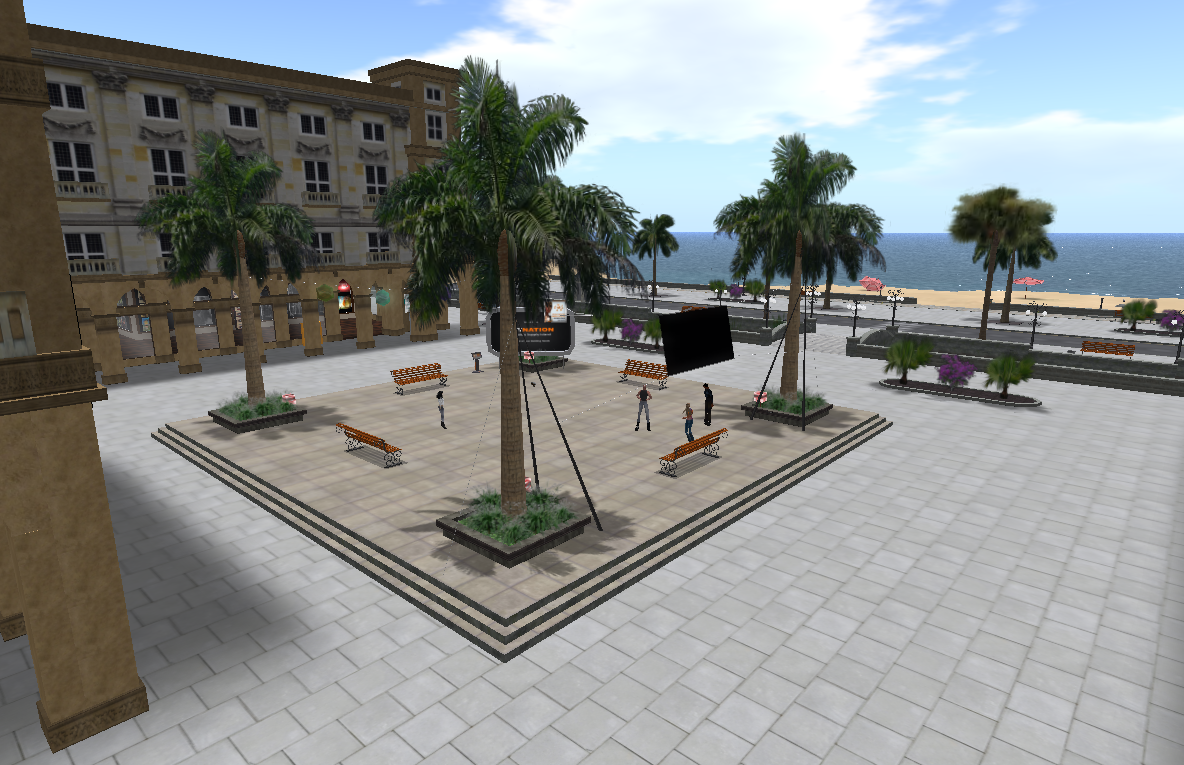





 Inara Pey: Living in a Modemworld