Quartz offers a gem on Sansar, VR and Second Life

“come with me!” – in , Could the Oculus Rift help give Second Life a second life? Alice Truoung examines the promise of avatar-based virtual spaces

There has been another recent spate of articles on Linden Lab, Project Sansar, Second Life and the potential for avatar-based virtual spaces with the upcoming advent of VR. Even Moviepilot, whom I took to task in 2014, has been busy looking at what’s going on, while Gamasutra rushed out what is essentially a nutshell version of Eric Johnson’s excellent Re/code article examining the question of the metaverse, which I looked at here.

However, the pick of the latest crop has to be Alice Truong’s article published in Quartz: Could the Oculus Rift help give Second Life a second life?  While the title might sound Second-Life centric and suggestive of a piece looking at how it will faire under the Rift (“not very well”), it is anything but.

What is actually presented is a well-rounded piece on the future of avatar-based virtual spaces which uses Second Life as the measure of their mark and launchpad for their future. Within it, Second Life is examined from a number of angles and Sansar is explored, together with a nodding look towards High Fidelity.

Alic Troung: thought on virtual spaces and avatars in Quartz (image credit: Quartz.com)
Alice Truong: thought on virtual spaces and avatars in Quartz (image credit: Quartz.com)

As with most of the pieces which had appeared over the last month or so, little real news on Sansar (or SL’s development for that matter) is given out. This is hardly surprising, as the Lab does like to hold its cards close to its chest – the relative newness (and thus the difficulty in highlighting specific tablets-of-stone facts) of Sansar notwithstanding.

What makes this article a joy, is that it provides a solid framing for the subject of the Lab and virtual worlds, reaching back to 1999 and the original efforts with The Rig. This is nicely packaged and offers a solid foundation from which Ms. Truong expertly weave her piece. Some of the path she takes will be familiar, particularly where SL and Sansar is concerned. We get to hear about SL’s growth, revenue, the US $60 million collectively cashed-out of the platform by many of its users, etc.

We also get fair mention of the decline in the number of active users on the platform, but again, this is properly framed. At its peak, SL had around 1.1 million active users; eight-ish years later, that number stands at around 900,000. A decline, yes. but as Ebbe Altberg points out hardly any kind of “mass exodus”; and certainly nowhere near the dire haemorrhaging of users we tend to hear proclaimed to be happening every time the Lab makes what is perceived as an irksome decision.

For Sansar, similarly familiar ground is covered – the revenue model (and the comparison with SL’s model and its weakness), the promise of VR, the opportunity to grow a platform for “tens, if not hundreds” of millions of users, the aspect of much broader “discoverabiilty” / ease of access for Sansar in order to help generate more appeal, and so on.

Mention is made of the Lab planning to “commercially release” Sansar by the end of 2016. Given what has been said by the Lab to date concerning time frames for future work, and allowing for Ebbe’s comments of perhaps having something worthy of a “version 1.0” label by the close of 2016, I’m taking the comment to be more of a misunderstanding on Ms. Truong’s part than any revelation as to Sansar’s roadmap.

Hunter Walk (l), the Lab's former
Hunter Walk (l), the Lab’s former “Director of Everything Non-Engineering” as well as a founder of the company, and now a VC in his own right, and Bernard Drax, aka Draxtor Despres (r) offer thoughts on Sansar

Another enjoyable element of this article is that Ms. Truong casts her net wide for input; thus she captures both Hunter Walk and Draxtor Despres. Their comments serve to both offer the means by which ideas can be further explored in the piece, and serve to offer a measure of counterpoint to the assumed mass appeal spaces like Sansar and High Fidelity will have.

Hunter Walk, for example, underlines the most critical problem in growing users Second Life has faced throughout its lifetime – that of accessibility and use. As he states, “ultimately, the work you had to put in was, for most people, more than the fun you got out.”  Not only does this underline the essential truth about SL’s longest-running issue (it’s as true today for many as 2003/4), it lays the foundation for an exploration of some of Sansar’s fundamental differences to SL later in the article.

Hunter also passes comment on the idea of these spaces finding many millions of users, pointing out that “tens of millions” was always an unrealised dream at the Lab for Second Life; perhaps a cautionary warning about focusing on user numbers. He also seems to offer something of a warning on investment returns in such ventures as well, again referencing Second Life, although if intended as a warning, it is more relevant to High Fidelity (which has received around US $16.5 million in investment to date).

Draxtor similarly questions whether user numbers should necessarily be the focus / rationale for building these kind of virtual spaces. Like him, I’m far from convinced Sansar will have the kind of broad-ranging reach to draw in “hundreds of millions” (or, if I’m honest, even more than  the low tens of millions). I’ve explained some of the reason why I think in my review of Eric Johnson’s piece linked to towards the top of this article, so I won’t repeat them here.

Could the promise of 2mixed reality
Could the promise of 2mixed reality” technologies which combine VR, AR and physical world activities yet serve to keep avatar-based virtual spaces a niche endeavour? (image: Magic Leap, via the New York Times)

If I’m honest, my only regret is that while Ms Truong’s tone is (rightly) sceptical in places, there is no outright challenge to the idea that people will embrace avatar-based interactions on a massive scale just because VR is on our doorstep.

Right now, there is a lot going on in the world of technology: VR, AR, the potential to fuse the two; faster communications capabilities, much better mobile connectivity, and so on. All of these could serve to dramatically marginalise any need to persistently engage in avatar-based interactions outside of very defined areas. As such, the inescapable whiff of “will we build it, they will use it” (to utterly mangle an already oft-misquoted line from a certain film) which seems to pervade the talk of high Fidelity and Sansar does perhaps deserve a degree of challenge.

Perhaps I should drop a line to Peter Gray suggesting an interview on those lines…

In the meantime – go read Alice Truong.

Related Links

Examining the reality of the metaverse

Th obligatory Sansar promo image :) (please can we have some new ones?) - Linden Lab
Th obligatory Sansar promo image 🙂 (please can we have some new ones?) – Linden Lab

Eric Johnson has a thought-provoking article over on re/code. In Welcome to the Metaverse, he ponders the lot of avatar-based virtual spaces, past and future, and how a number of companies – the Lab included – are betting that the “new era” of VR is going to be the means by which such spaces will become mainstream.

It’s an interesting piece, offering plenty of food for thought, starting with an opening statement by the Lab’s CEO, Ebbe Altberg, on defining human life:

What humans do is create spaces. Some spaces are mobile, like a bus. San Francisco is a space that was created by its users. Whether you go into a pub, a bar, a classroom, a bowling alley, an office, a library … We create spaces and we have people come together in those spaces, and then we communicate and socialize within those spaces.

This is actually the first thing about the article that leaves me with a familiar feeling of feeling at odds with the prevailing view of all things metaverse, albeit for a slightly different reason. With due respect to Mr. Altberg, people didn’t come together as a result of building spaces. They built spaces as a result of coming together. However, as an opening gambit for a study of this thing we call the “metaverse”, it’ll do as an opener.

Eric Johnson, Associate editor, Gaming at Re/code (via LinkedIn)

From here, Mr. Johnson give us the pocket introduction to “the metaverse” via the obligatory (and rightful) nod to Neal Stephenson while simultaneously dispensing quickly with a look at the “past promise” of virtual spaces that didn’t in the end measure-up to the expectations.

This leads the way to a clever little nod to the book which has become this decade’s “Snowcrash”  in the form of  Ernest Cline’s Ready Player One (which is actually a very good read) – as a means to introduce the main three companies he sees as currently vying for space in “the metaverse” – the Lab,  High Fidelity and AltspaceVR.

Chances are the Sansar and High Fidelity are already well-known to people reading these pages, which AltspaceVR may have passed some unnoticed. As the article points out, they’ve been developing avatar-based VR for the last couple of years, focusing on shared spaces (watching a film with a friend who is halfway across the world for example), and scheduled events, including gaming weekends, etc.

AltspaceVR also has some ideas for business applications with their environments, which they are planning to offer on a pay-to-use basis. And while their avatars main have been viewed with disdain by some, there are a couple of points to bear in mind where the company is concerned.

The first is that as a result of watching some of AltspaceVR’s virtual interactions, Mark Zuckerberg caught the social VR bug, and Facebook went after Oculus VR, with the subsequent $2 billion acquisition (which was actually quite a modest punt when compared to the $19 billion the company had earlier spent on a proven technology in WhatsApp).

The second is that the company, which has been around about as long at Philip Rosedale’s High Fidelity, has almost raised a comparable amount in funding – around $15.7 million to date (SEC filings indicate High Fidelity has raised around $16.5 million), and both are working at solving many of the same technical issues – head and motion tracking, eye tracking, etc.,

Beyond this, others interested in making a pitch into the metaverse space, as Mr. Johnson mentions are IMVU, which has around 15% of it’s 130+ staff now working on trying to integrate VR into its existing spaces (a-la the Lab’s early effects with SL and the Rift), and a small New York based start-up, focusing on VR social games with around $300,000 in seeding money. called Surreal, the 4-person company is billing itself as “the first fully immersive virtual world”, which is focused entirely on using VR HMDs (Oculus, Gear VR and Cardboard).

Johnson attempts to split his examination of the metaverse into two views: the short-term and the long-term. In doing so, he inevitably points to the elephant in the room: Facebook. In this, he quotes Palmer Luckey, who gives a fair warning as to whether or not “the metaverse” is around the corner, and which stands as a cautionary warning, in more ways than one:

I think at this point the term ‘metaverse’ is a bit undefined. For any one company to say, ‘We are building the metaverse’ is pretty hyperbolic. Building all the pieces is going to be hard, and the way you imagine things in sci-fi doesn’t always translate over to the way things will be in the real world.

Palmer Luckey: precient words on
Palmer Luckey: prescient words on “the metaverse”?

He has a very valid point; and with today’s rapidly evolving pace of technology, it’s one worth keeping in mind; the technical issues people see today as only being surmountable through the use of avatars may not actually be technical issues a few years hence.

Interestingly, Johnson places this in the “short-term” view – although both Oculus VR and Facebook have always talked in terms of “the metaverse” still being around a decade away. For the longer term, Johnson looks in particular at High Fidelity’s work and also the Second Life revenue generation success (and, despite the naysayers out there SL is a commercial success, both for the Lab and its users, the latter of whom benefited with collective revenues of $60 million from the platform in 2014), before taking another look at AltspaceVR.

There is a lot to be digested in the piece, and it makes for a good read. However, for me, Palmer Luckey’s warning that how things don’t always match the real world tends to stand out a lot when a lot of the approach being then with avatar-based virtual spaces tend to smack of the “if you build it, they will use it” approach.

I don’t doubt for a minute that spaces will have a lot of applications among various vertical markets. It is no coincidence that the likes of Philip Rosedale and Ebbe Altberg talk much of the same language concerning them: education, training, healthcare, business; there is potential for avatar-based VR spaces in all of them. But I’m still not convinced that longer-term, such spaces are going to claim a much large market among causal consumers than is currently the case, for a couple of reasons.

The first is that the vast majority of people really haven’t seen the need to “climb in” to an avatar for their social interactions – and getting a shiny new headset (which Johnson quotes some rather interesting demographics about) isn’t actually going to change that. The second is connected to the headsets themselves.

High Fidelity and Linden Lab see the education sector as a major focus for their efforts – and neither is wrong. But are avatar-based virtual spaces really going to go consumer mass market?

Simply put, it would seem likely that this brave new world of VR could end-up delivering so many fantastic experiences and opportunities to the casual user, that the majority still won’t see the need to invest time and effort in creating a virtual alter-ego of the kind we desire (and we, as SL / OpenSim users are a niche), because so much else is being delivered to them pre-packaged and ready-to-go. Thus, as Palmer Luckey indicates, the chances are “the metaverse” could well arrive in our lives in a manner very different to that being envisaged by High Fidelity and Linden Lab, thus leaving their approach still very much niche-oriented.

Not that there is anything wrong with that either. As both Rosedale and the Lab can demonstrate, it’s done them rather nicely over the years. And it is fair to say that “niche” this time around a liable to be somewhat larger, simply because of the vertical market opportunities they’re looking at.

Even so, and as mentioned, there is this optimistic we “build / they come” aspect to the whole idea of avatar-based vertical spaces that it would be nice to see an article probing the pros and cons a little more. Perhaps that might be something for a follow-up from Mr. Johnson? In the meantime, Welcome to the Metaverse is a thought-provoking read, and for reasons I’ve not even scratched at here (such as the question of on-line abuse), as such, it’s not one to miss.

Related Links

With thanks to Indigo Mertel for the Google+ pointer at the weekend.

Jeremy Bailenson talks potential and pitfalls in VR

A Tweet by Loki Eliot drew my attention to a Q&A article in the San Jose Mercury News with Professor Jeremy Bailenson, in which he discusses Virtual Reality and raises some interesting points to consider on the future of the technology as a mass-market product.

Professor Bailenson is well qualified to comment on VR. He’s the founding director of Stanford University’s Virtual Human Interaction Lab, and his main area of interest is the phenomenon of digital human representation, especially in the context of immersive virtual reality. His work has been consistently funded by the National Science Foundation for fifteen years, and his findings have been published in over 100 academic papers in the fields of communication, computer science, education, environmental science, law, medicine, political science, and psychology.

Professor Jeremy Bailenson (image: Stanford University)

While he is immersed (no pun intended) in the technology and believes in its potential, as he tells Mercury News reporter Troy Wolverton, he is no VR evangelist. In fact he harbours mixed views about some of the uses being touted for VR in the future, and is convinced the current emphasis on VR within the gaming environment isn’t the best use for the technology.

“When Commissioner Adam Silver of the NBA came to my lab, he thought that I was going to try to convince him that one should watch an NBA game from VR. And I can’t imagine what would be worse than that,” he tells Wolverton early in the interview.

He continues, “I’ve never worn an HMD (head-mounted device) for more than a half an hour in my life, and nowadays, I rarely wear one for more than five or 10 minutes. And a two-hour NBA game would be pretty brutal on the perceptual system. I believe VR’s really good for these very intense experiences, but it’s not a 12-hour-day thing.

In terms of VR and games, he says, “I don’t believe that video games are an appropriate market for this. Especially when you get into the highly violent games — do you really want to feel that blood splatter on you? I don’t think it’s the right use case.”

His belief is that VR is best suited to specific uses, rather than a catch-all new wonder technology. But even then, he sees limits on how much VR will be used. Not because of any technological limitations, but simply because of the physical impact they have on our vision, and what flows out from that.

“Think about how much time you spend on your device a day. It’s more than six to eight hours, and that’s a long time to be wearing a pair of goggles,” he says. “But even if that wasn’t the case, the real problem is that the visual experience with an HMD necessarily produces some eye strain, and that gets fatiguing over time.”

It’s hard to argue with him on this; computer vision syndrome is a recognised condition affecting around 90% of those who use a computer for more than 3 hours a day. The effects are temporary, but can include headaches, blurred or double vision, neck pain, dry or irritated eyes, dizziness and polyopia. With HMDs placing screens mere centimetres from the eyes to the exclusion of all else, there is a risk the symptoms could be more particularly felt, thus limiting the degree to which we remain physically and mentally comfortable when using them.

Computer vision syndrome (CVS) already affects around 90% of people who use a computer screen for more than 3 hours a day. The affects are temporary, and more irritating than harmful - but could they nevertheless impact the degree with which we use VR HMDs?
Computer vision syndrome (CVS) already affects around 90% of people who use a computer screen for more than 3 hours a day. The symptoms are temporary, and more irritating than harmful – but could they nevertheless impact the degree with which we use VR HMDs?

So where does he see VR having particular application?

Part of his work involves him in building VR systems which allow physically remote people to meet and interact. He uses these to study how such systems change the nature of verbal and non-verbal interaction (hence why High Fidelity ask him to become an advisor), as well as exploring how VR might change the way we think about education, environmental behaviour, empathy, and health. It’s perhaps not surprising that he sees these as the primary uses for VR.

“VR experience changes the way you think of yourself and others and changes your behaviour,” he notes. “And when VR’s done well, it’s a proxy for a natural experience, and we know experiences physically change us.”

Even so, he does remain concerned of the potential negative influence of VR on people.

“Am I terrified of the world where anyone can create really horrible experiences?” He asks rhetorically. “Yes, it does worry me. I worry what happens when a violent video game feels like murder. And when pornography feels like sex. How does that change the way humans interact, function as a society?

“The technology is powerful. It’s like uranium. It can heat homes and destroy nations.”

All told, the interview is an interesting read which serves to get the grey matter boggling a little more on the subject of VR, how it might be used and the impacts it might have.

Related Links

Oculus VR acquires Surreal Vision, and Connect 2 announced

My colleague Ben Lang, over at Road to VR, brought news my way of the latest acquisition by Oculus Rift, following the company’s formal announcement on May 26th.

Surreal vision is a UK-based company which grew out of Imperial College London, and is at the bleeding edge of computer vision technology. One of the founders is Renato Salas-Moreno, who developed SLAM++ (simultaneous localization and mapping) technology. As Ben explains in the Road to VR blog post:

Using input from a single depth camera, SLAM++ tracks its own position while mapping the environment, and does so while recognizing discrete objects like chairs and tables as being separate from themselves and other geometry like the floor and walls.

SLAM therefore offers the potential to take a physical environment, scanning it, and literally dropping into in a virtual environment and have people interact with the virtual instances of the objects within it.

The other two founders of Surreal Vision are equally notable. Richard Newcombe is the inventor of KinectFusion, DynamicFusion and DTAM (Dense Tracking and Mapping) and worked with Salas-Moreno on SLAM++, while  Steven Lovegrove, co-invented DTAM with Newcombe and authored SplineFusion. All three will apparently be relocating to the Oculus Research facilities in Redmond, Washington.

The acquisition is particularly notable in that it follows-on from Oculus VR acquiring 13th Lab at the end of 2014, another company also working with SLAM capabilities. They were acquired alongside of Nimble VR, a company developing a hand tracking system. However, at the time of those acquisitions, it was unclear what aspects of the work carried out by both companies would be carried forward under the Oculus banner.

Richard Newcombe, Renato Salas-Moreno, and Steven Lovegrove of Surreal Vision (image courtesy of Oculus VR)

Surreal Visions, seem to have been given greater freedom, with the Oculus VR announcement of the acquisition including a statement from the team and their hopes for the future, which  reads in part:

At Surreal Vision, we are overhauling state-of-the-art 3D scene reconstruction algorithms to provide a rich, up-to-date model of everything in the environment including people and their interactions with each other. We’re developing breakthrough techniques to capture, interpret, manage, analyse, and finally reproject in real-time a model of reality back to the user in a way that feels real, creating a new, mixed reality that brings together the virtual and real worlds.

Ultimately, these technologies will lead to VR and AR systems that can be used in any condition, day or night, indoors or outdoors. They will open the door to true telepresence, where people can visit anyone, anywhere.

Connect 2, the Oculus VR conference, is promising to provide
Connect 2, the Oculus VR conference, is promising to provide “everything developers need to know to launch on the Rift and Gear VR”

On May 21st, Oculus VR also confirmed that their 2nd annual Oculus Connect conference – Connect 2 – will take place between September 23rd and September 25th at the Loews Hollywood Hotel in Hollywood, CA.

The conference will feature keynote addresses from Oculus VR’s CEO Brendan Iribe, their Chief Scientist, Michael Abrash, and also from John Carmack, the company’s CTO. It promises to deliver “everything developers need to know to launch on the Rift and Gear VR”. As noted in the media and this blog, the launch of the former is now set for the first quarter of 2016, while it is anticipated that the formal launch of the Oculus-powered Gear VR system from Samsung could occur around October / November 2015.

System specifications for the consumer version of the Oculus Rift were announced on May 15th, and caused some upset / disappointment with the company indicating that the initial release of the headset would be for the Windows environment only – there would not be support for Linux or Mac OS X.

At the time the system specifications were release, Atman Binstock, Chief Architect at Oculus and technical director of the Rift, issued a blog post on the system requirement they day they were announced, in which he explained the Linux / OS X decision thus:

Our development for OS X and Linux has been paused in order to focus on delivering a high quality consumer-level VR experience at launch across hardware, software, and content on Windows. We want to get back to development for OS X and Linux but we don’t have a timeline.

The Windows specifications were summarised as: NVIDIA GTX 970 / AMD 290 equivalent or greater; Intel i5-4590 equivalent or greater; 8GB+ RAM; compatible HDMI 1.3 video output; 2x USB 3.0 ports; Windows 7 SP1 or later. All of which, Binstock said, to allow the headset to deliver, “to deliver comfortable, sustained presence – a “conversion on contact” experience that can instantly transform the way people think about virtual reality.”

Oculus VR confirm: consumer headset to ship Q1 2016

On Wednesday, May 6th, Oculus VR confirmed the consumer version of their headset will commencing shipping in the first quarter of 2016, with pre-ordering due to start later in 2015.

  The news broke via a press release from Oculus VR, and Tweets from Oculus VR, Palmer Luckey, and the company’s Vice President of Product  Nate Mitchell (shown on the right).

The announcement ends months of speculation on when the consumer version of the headset might be available, with many originally predicting it would be ready for Christmas 2014 and then Christmas 2015. Despite such speculation, Oculus VR has always carefully avoided mentioning any approximate idea release dates. As I reported in these pages, even as recently as November 2014, Oculus VR Brendan Iribe was playing down any idea of any (then) near-term release of the headset:

We want to get it right. We really do. We’ve gone out there and we’ve set this bar and said, “we are going to get it right, and we’re not going to ship until we get it right” … We’re getting very close … We want it to be a beautiful product; there’s no reason it can’t be a beautiful product … so we still have a way to go, and we’re still working on a number of things, but we’re getting much closer. We like to say it’s months, not necessarily years, away [but] it’s many months, not a few months.

Click for full size

That something might be afoot by way of announcements was initially hinted at in a May 5th Tweet in which Palmer Luckey commented I love it when a plan comes together!

This brought an inevitable run of replies, many seeing it as a hint about the Oculus CV1 (as the consumer version of the headset has sometimes been referred to), including the humorous response seen on the right regarding the headset’s form factor.

Details of the headset are rather scant in the announcement and the images a little on the dark side (I’ve lightened the contrast on them below), with the release merely stating:

The Oculus Rift builds on the presence, immersion, and comfort of the Crescent Bay prototype with an improved tracking system that supports both seated and standing experiences, as well as a highly refined industrial design, and updated ergonomics for a more natural fit.

No details on pricing or quite when in 2015 people will be able to start pre-ordering the headset, and there are certainly no details on the technical aspects of the headset. However, one potentially interesting aspect of the announcement has already sparked some speculation, as it refers to the upcoming release as, “a fully-integrated hardware/software tech stack designed specifically for virtual reality”. This has prompted Techcrunch to comment:

There’s no mention of a third-party computer necessary to power the Rift, which previous Oculus developer kits required. That means the Rift might ship with a game console-esque device to handle computing for the headset. An all-in-one box could make virtual reality much more accessible to consumers, especially those who don’t own a high-grade gaming PC.

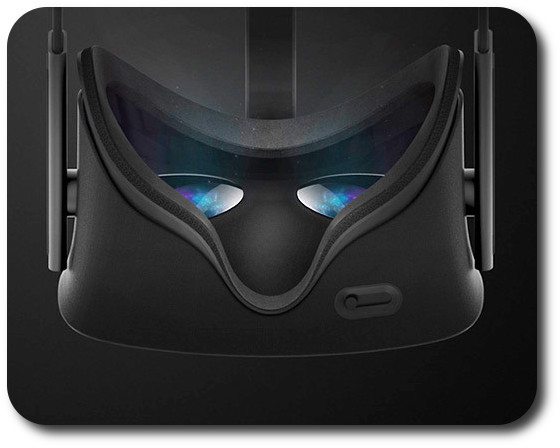
A front view of the Oculus consumer version (courtesy of Oculus VR)

In terms of specification, the announcement was equally enigmatic, stating, “we’ll be revealing the details around hardware, software, input, and many of our unannounced made-for-VR games and experiences coming to the Rift”, with the last part of this statement leading Techcrunch to also speculate whether Oculus VR might also announce a line of in-house developed games to go with the launch.

Given the backgrounds of many of those involved in the company, such an idea might not be wild speculation. As it is, it is already known that Oculus VR is helping to develop immersive movie experiences. Furthermore, in February 2015 it was confirmed that Facebook is developing VR apps, with Chief Product Officer Chris Cox saying that experiences as varied as flying a fighter jet to sitting in a Mongolian yurt would serve as inspiration, and describing the technology as “sending a fuller picture … You’ll do it, Beyoncé will do it”. Ergo, Oculus VR-branded games are not beyond the realm of possibly.

What the announcement does more-or-less mean is that unless something unexpected happens, the Oculus Rift will definitely be available after HTC / Valve have started shipping their own Vive headset, which looks set to hit the market around the same time as Samsung’s  (Oculus-enabled) Gear VR2, towards the end of 2015.

A view from under the Oculus consumer version (courtesy of Oculus VR)

While there has been a lot of hype about the possible demand for what is effectively a first generation headset from Oculus VR, there have also been some notes of caution sounded in some quarters. As gamesindustry.biz notes, Ben Schachter, a Macquarie Research analyst wrote to Facebook investors, stating:

While there is not yet any info on pricing or available units, we expect relatively small number of units and think that the initial device will be supply constrained. We think that the early versions of the device will be more about showing what is possible from gaming and other entertainment genres, and build demand for later versions of the device.

Mr. Schachter isn’t alone. While price may no longer be a limiting factor in obtaining a headset, Jacki Morie, herself a VR pioneer (and whose work has been featured in this blog a number of times) recently warned that care should be taken in how the potential for VR is promoted, in particular pointing to things like an Oculus VR sponsored art contest as a means to send out completely the wrong message about VR to a wider mass market audience and potentially damaging the technology’s credibility as a useful tool.

I actually doubt the wheels will seriously come off the cart with VR this time around, bad marketing campaigns and the like notwithstanding, although Jacki clearly has a point about getting the right message out there in the first place. However, I do tend to think that Mr. Schachter’s comment about the build-up of demand is well put. VR will profoundly alter many ways of doing things for all of us in time; but the the speculation and hype that will not follow Oculus VR’s announcement aside, it’s still going to be a few years or so before we see VR as being as ubiquitous a piece of technology in our daily lives as we do the mobile ‘phone today.

VR update: Google launches Works with Cardboard and acquires; Freefly arrives

Cardboard, Google’s open-sourced approach to VR, has really taken off in the 10 moths since it launched. As well as the original headset made from, err, cardboard, there have been offerings from the likes of South Korean giant LG, while at the  end of 2014, Virgin Holidays adopted Cardboard as a means of offering customers a “try-before-you-buy” VR experience on certain holidays. It has even spurred an update to the 75-year-old Viewmaster.

Such is the popularity of Cardboard as a development platform that it is actually becoming hard to identify what might work with what; the open-source nature of the platform means when it comes to hardware, people can tweak things to their heart’s content – optics, focal length, dimensions, etc., with the result that not all headsets play nicely with apps created using the Cardboard SDK.

In an attempt to counter issues of poor experience, Google announced the Works with Cardboard initiative on Thursday, April 16th. The idea is to ensure that any Cardboard viewer / headset will work with any Cardboard app. It does this quite cleverly: manufacturers define their viewer’s key parameters to Google, and in return receive a QR code. People buying the viewer can then scan the QR code using the Cardboard app, and all Cardboard VR experiences they run on their ‘phone will be automatically optimised to run on the viewer / headset until such time as another QR code is scanned.

WWCIn addition, manufacturers can apply to Google for a programme certification badge (shown on the right) to place on their product, indicating it is suitable for running Google Cardboard VR experiences.

Alongside the new Works with Cardboard initiative, Google have also announced a new set of development guidelines are being put together on the web. These are a little light on specifics right now, but will grow as a resource.  The company has also revamped Google Play’s coverage of VR so that experiences can now be categorised by the following types: Music and Video, Games, and Experiences.

Perhaps most interestingly in terms of Google’s VR news, and as revealed by Road to VR, the company has acquired two VR start-ups.

The first is software studio Skillman & Hackett, who had been developing the award-winning Tilt Brush software, which allowed users to draw in VR using three dimensions, with paint, light, and textures, and then play their creations back. The software can be used  with Oculus Rift and HTC Vive headsets to create scenes and paintings and play them back, while Cardboard users could use the Tilt Brush app to view art created using the software on other platforms. With Google acquiring Skillman & Hackett, it’s not clear if development of Tilt Brush will now continue.

The other company gobbled by Google is Dublin-based Thrive Audio, specialising in positional audio for realistic surround sound for VR experiences. With two patents filed for the technology they’ve been developing, it looks like Thrive will be added to Google’s growing team of VR specialist working on enhancing the Cardboard SDK.

Freefly

The Freefly headset is designed to work with a range of Smartphones
The Freefly headset is designed to work with a range of Smartphones, both iOS and Android

April 2015 also saw the launch of Freefly VR, from UK-based Proteus Labs. With an introductory (“10% off”) price of £59.00 (US $99.00 / 79.00 Euros), the headset is designed to work with any smartphone with a screen size of between 4.7 in and 6.1 in diagonally, both iOS and Android. Freefly utilises the open-source ALP VR SDK, and the headset is not fully compatible with Cardboard apps with use a ‘phone’s magnetometer for input purposes, as this is used for positional head tracking.  To find out more on the system, read the overview over on Road to VR.