Missing Melody, July 2022 – click any image for full size
Bambi (NorahBrent) has been busy with her region designs, with both Longing Melody and Soft Melody gaining a lot of attention – including in this blog – since the start of the year (see: Visiting Longing Melody in Second Life and A Soft Melody in Second Life). Given this, a return to her Missing Melody was on my game card for 2022, but a poke from Shawn Shakespeare encouraged me to make a summer visit to this always-engaging homestead region.
What is a Missing Melody? It’s that song in your head that you can’t get out but not sure how it really goes. It’s that temptation you want to have in your life so you can fight to resist. It’s that place in your heart that is always waiting to be filled.
– Bambi (NorahBrent)
Missing Melody, July 2022
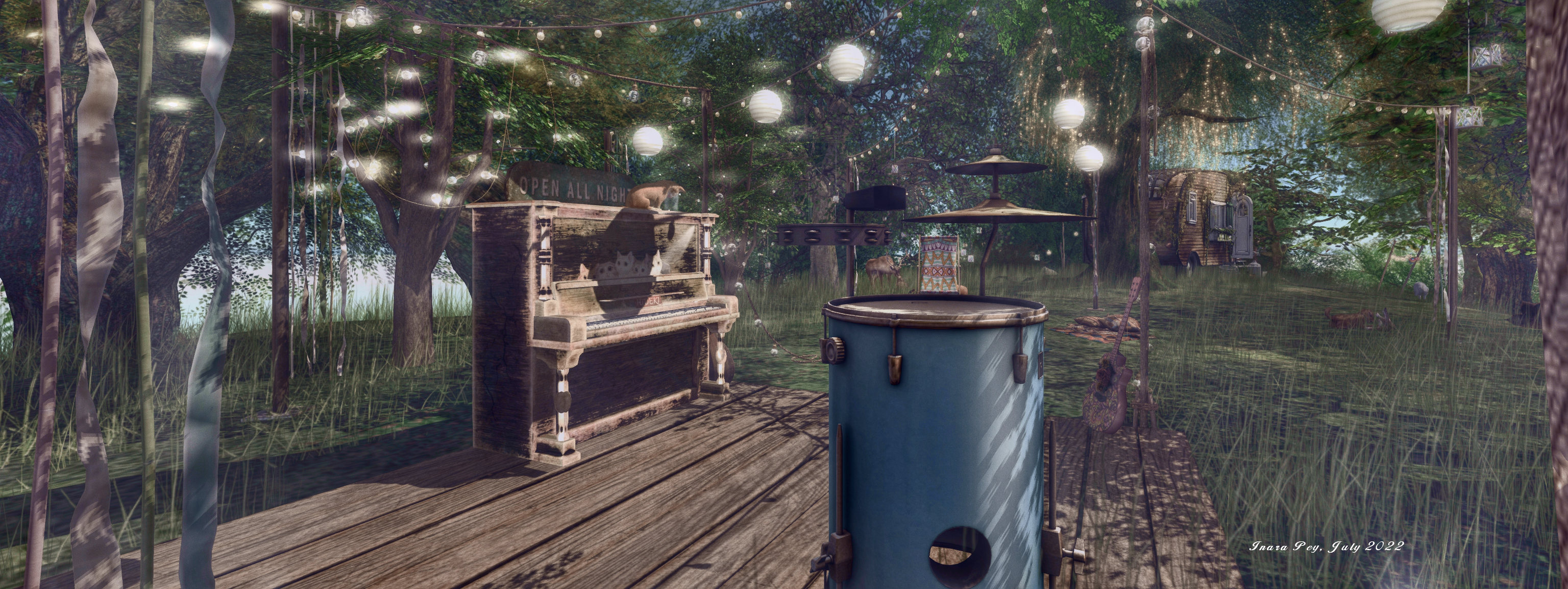
For this iteration, Bambi offers a region setting that is beautiful in its simplicity: a pair of small islands separated by a deceptively deep channel spanned by a long boardwalk floating serenely above the waters. Both islands occupy the northern half of the region, sitting under a bright summer sky (I recommend using the region’s shared environment settings).
To the north-east, the small island rises a rich green hump of land, its slopes carpeted by flowering wild grass, and its crowned by green trees and a copse of lavender wisteria.
The latter form a canopy over the landing point, sitting as it does at the end of a fence-bordered track that points the way westwards before dropping down the gentlest of the island’s slopes, and along which an unexpected family is taking a constitutional walk.
Across the channel, the larger of the two islands holds multiple attractions awaiting discovery. These include the winding climb of steps which lead up to where a caravan and cabin lie on a tree-shaded shoulder of the island’s hills, through a second set of steps that descend to the island’s arc of beach to the north-west, through to the rocky path the climbs up the west side of the island, connecting the beach with a high promontory where a lighthouse watches over the southern waters.
Missing Melody, July 2022
The beach offers the most tropical feel to the setting – and the most places for visitors to relax and spend time, both on the sand and over the water. However, both the cabin and the caravan up on the hill top are furnished as well, making for quiet retreats, whilst between them there sits a little stage and outdoor seating for impromptu musical jams.
Picturesque, (obviously) photogenic, and finished with a gentle soundscape, Missing Melody really doesn’t require a lot of exposition on my part; it genuinely speaks for itself, as I hope the images here show. So why not pay a visit yourself?
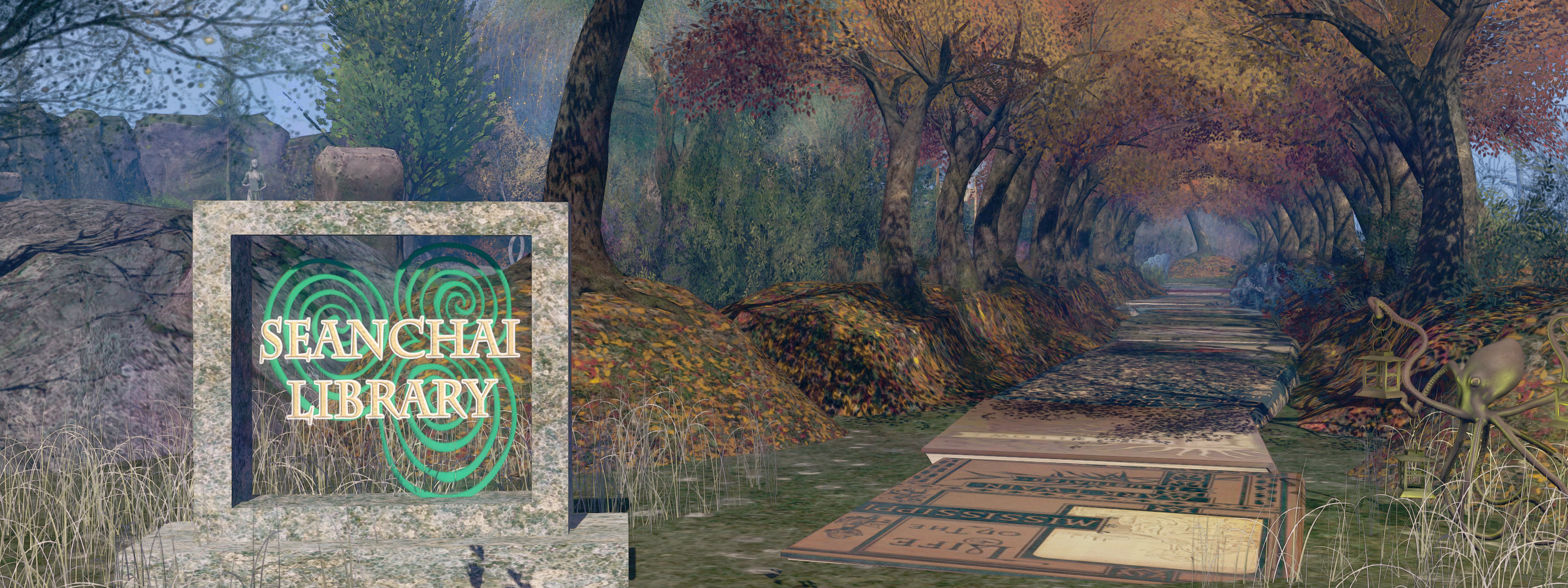
It’s time to highlight another week of storytelling in Voice by the staff and volunteers at the Seanchai Library. As always, all times SLT, and events are held at the Library’s home in Nowhereville, unless otherwise indicated. Note that the schedule below may be subject to change during the week, please refer to the Seanchai Library website for the latest information through the week.
Monday, July 11th, 19:00 Dandelion Wine
The inventor who almost took the pleasure out of life by building a Happiness Machine; the young reporter who fell in love with an alluring lady of ninety; the old gentleman whose last act was listening to the clang of a green trolley car going round a corner, two thousand miles away.
These are just a few of strange and vivid people who entered the secret world of a twelve-year-old boy during one enchanted summer when he discovered the fact that he really was alive…
“The summer of ’28 was a vintage season for a growing boy. A summer of green apple trees, mowed lawns, and new sneakers. Of half-burnt firecrackers, of gathering dandelions, of Grandma’s belly-busting dinner. It was a summer of sorrows and marvels and gold-fuzzed bees. A magical, timeless summer in the life of a twelve-year-old boy named Douglas Spaulding—remembered forever by the incomparable Ray Bradbury.”
Intrepid canine Bob sets out on a dangerous journey in search of his long-lost sister with the help of his two best friends, Ivan and Ruby. As a hurricane approaches and time is running out, Bob finds courage he never knew he had and learns the true meaning of friendship and family.
In the tradition of timeless stories like Charlotte’s Web and Stuart Little, Katherine Applegate blends humour and poignancy to create an unforgettable story of friendship, family, and hope in this sequel to her 2013 Newbery Medal winner The One and Only Ivan.
Read by Caledonia Skytower.
Wednesday, July 13th, 19:00: Seanchai Flicks
A special for Star Wars month as the Seanchai cinema space plays host to videos and throw popcorn around!
Thursday, July 14th, 19:00: The Mandalorian
Shandon Loring reads the novelisation of the popular Disney+ original series.
Logos representative only and should not be seen as an endorsement / preference / recommendation
Updates from the week ending Sunday, July 10th, 2022
This summary is generally published every Monday, and is a list of SL viewer / client releases (official and TPV) made during the previous week. When reading it, please note:
It is based on my Current Viewer Releases Page, a list of all Second Life viewers and clients that are in popular use (and of which I am aware), and which are recognised as adhering to the TPV Policy. This page includes comprehensive links to download pages, blog notes, release notes, etc., as well as links to any / all reviews of specific viewers / clients made within this blog.
By its nature, this summary presented here will always be in arrears, please refer to the Current Viewer Release Page for more up-to-date information.
Note that for purposes of length, TPV test viewers, preview / beta viewers / nightly builds are generally not recorded in these summaries.
Official LL Viewers
Release viewer: version 6.6.1.572458 – formerly the Maintenance M(akgeolli) RC viewer, promoted June 29 – no change.
Release channel cohorts::
Maintenance Optimisations RC version 6.6.2.573065 issued on Thursday, July 7th.
The “Pillars of Destruction” (aka Region R44) within the Carina Nebula, 7,600 light-years from Earth, as seen by the MUSE instrument on ESO’s Very Large Telescope. Towering fields of dust, the pillars are slowly being destroyed by the the stars they helped form; while the nebula is one of the focal-points for initial science imaging by the James Webb Space Telescope. Credit: ESO
Our first glimpse through the eyes of the James Webb Space Telescope (JWST) will be unveiled through a live broadcast on Tuesday, July 12th at 14:30 UTC. However, on Friday, July 8th, NASA announced details on what will be featured in the broadcast and the images that will be published during the presentation, promising that the latter will reveal an unprecedented look into some of the deepest views yet of the cosmos.
The targets were selected by an international committee of scientists from NASA, the European Space Agency (ESA), the Canadian Space Agency (CSA) and the Space Telescope Science Institute in Maryland, which manages the observatory. They include:
The Carina Nebula (NGC 3372): lying some 7,600 light-years away, and visible in southern hemisphere skies, where it appears to lie within the constellation Carina, this nebula is the home of the famous “Pillars of Destruction”, long finger-like structures of cosmic gas and dust.
Southern Ring Nebula (NGC 3132): appearing to lay within the constellation of Vela (also visible in the southern hemisphere sky) this distinctive nebula of gas and material surrounds dying star is some 2,000 light-years from Earth.
Stephan’s Quintet: a visual grouping of five galaxies, four of which (called the Hickson Compact Group92) are a genuine grouping of galaxies that are gradually being drawn together by gravity, and will all eventually merge. The fifth member of the quintet is the result of line-of-sight alignment, rather than an actual part of the group.
WASP-96 b: a “hot Saturn” exoplanet orbiting the star WASP-96, some 1,120 light-years away, within the southern constellation of Phoenix. With a mass roughly half that of Jupiter, the planet orbits its parent every 3.4 terrestrial days and is the first known planet with an entirely cloudless atmosphere, which has a profoundly strong sodium signature.
SMACS J0723.3-7327: an experiment in using gravitational lensing, using the gravity of relatively “nearby” galaxies to “bend” the light from much more distance galaxies to obtain a deep-field view of their stars.
The initial science images from JWST will be part of a science briefing scheduled for 4:30 UTC. on July 12th. Credit: NASA
The presentation and images will mark the first time “operational” data and images relating to scientific targets for the observatory have been made public since the completion of all tests relating to the calibration and commissioning of its four science instruments, all of which allow JWST to operate in a total of 17 different science modes.
It is believed that even though only initial studies of their targets, the images captured by the telescope have stunned science teams and already led to increased understanding of exoplanets, galaxies and the universe itself.
Could Stars be used as Communications Relays?
In June I covered a proposal suggesting the Sun’s gravity could be used to help image exoplanets orbiting other stars using gravitational lensing (see: Space Sunday: exoplanets, starship and the Sun as a lens). Now a paper accepted for publication in The Astronomical Journal lays out the idea that the lensing effect of the Sun’s gravity, and that of other stars, could be used as some kind of interstellar communications network.
The study discusses the idea that gravitational lensing, involving the bending of light as it passes by massive objects like stars and black holes, could be used to focus communications between one point and another, amplifying the signal like an interstellar cell phone tower.
For the purposes of the paper, a team of students at Penn State University working under Jason Wright, professor of astronomy and astrophysics and the director of the Penn State Extra-terrestrial Intelligence Centre, used the Sun as a model, calculating that the gravitational focus on the solar lensing effect lies some 550 AU out from the Sun – or a distance equitable to roughly half-way between the orbits of Jupiter and Saturn.
Communications across interstellar distances could take advantage of a star’s ability to focus and directing communication signals through an effect called gravitational lensing. A signal from—or passing through—a relay probe would bend due to gravity as it passes by the star. The warped space around the star acts somewhat like a lens or transmitter, focusing the beam towards an itended target. Credit: Dani Zemba / Penn State
This is the point where a communications satellite could be placed such that it could use the Einstein Ring effect of gravitational lensing by the Sun to focus its signals on a distant target – and also receive incoming communications from that target as the Sun’s gravity focuses them down onto the satellite.
The most obvious use of such a system would be to enable communications with deep-space probes we might eventually send to nearby stars (assuming they could be accelerated to reach said stars in a reasonably time-frame). However, the students also noted that if the Sun were to be a part of so alien communications network, then we now have a sphere around it where we might detect any relay, which we might try to eavesdrop on.
Whilst a pretty far-fetched idea in terms of an “alien relay station” sitting in our own back yard, the study does offer some food for thought in how signals from ET (if they exist) might leverage stellar objects, and thus offers a potential new avenue to be explored within SETI and CETI (as in Communications) research.
Exploring Mars by Air: the Case for the Sailplane
The success of the Mars Ingenuity helicopter has been encouraging engineers to consider and reconsider all options for remote aerial observations of the Red Planet over the course of the past year. Additional methods for birds-eye views of Mars would not only provide higher resolution data on the landscapes where rovers can’t go — such as canyons and volcanoes — but also could include studying atmospheric and climate processes that current orbiters and rovers aren’t outfitted to observe.
Once such option that had been considered years ago and is now coming back into focus is that of a sailplane. In particular, students at the University of Arizona have been investigating the possible use of small, relatively lightweight (just 5 kg) unpowered sailplanes that could be carried to Mars as secondary payloads alongside larger missions.
Aerospace engineering doctoral student Adrien Bouskela (left) and aerospace and mechanical engineering professor Sergey Shkarayev hold an experimental Mars sailplane. They hope to one day send a custom version of a similar plane to Mars. Credit: Emily Dieckman/College of Engineering.
Protected through their entry into the Martian atmosphere, these sailplanes would fall free from their aeroshells to unfold their 3-metre wingspan to use the so-call boundary layer of atmosphere known to exist around Mars and which is of considerable interest to scientists.
You have this really important, critical piece in this planetary boundary layer, like in the first few kilometres above the ground. This is where all the exchanges between the surface and atmosphere happen. This is where the dust is picked up and sent into the atmosphere, where trace gases are mixed, where the modulation of large-scale winds by mountain-valley flows happen. And we just don’t have very much data about it.
– Alexandre Kling, NASA’s Mars Climate Modelling Centre
Potentially also using fully or partially inflatable fuselage, such sailplanes could ride the wind and air pressure, gathering data whilst exploiting atmospheric wind gradients for dynamic soaring to extend their gradual descent to the ground.
Despite their relatively light weight, the students believe the sailplanes would be capable of carrying an array of navigation sensors, a camera system to images the terrain below it, and temperature and gas sensors to gather information about the Martian atmosphere. As a part of their studies, the students have experimented with radio-controlled sailplanes adjusted to fly themselves and which have been lifted to altitude under weather balloons before being released to see how they manage the dynamics of a descent through Earth’s atmosphere.
he Mars sailplanes will contain a custom-designed array of navigation sensors, as well as a camera and temperature and gas sensors to gather information about the Martian atmosphere and landscape. Credit: Emily Dieckman/College of Engineering
In addition, the students have used computer modelling to research general vehicle handling within the far more tenuous Martian atmosphere. A particular technique used in sailplaning is to use updrafts and thermals in which a pilot can circle and gain lift to increase altitude. Mars is known to have similar phenomena, and the modelling shows that they could be used in a manner akin to sailplaning on Earth – with the added advantage that the higher effective wind speeds often recorded with such updrafts on Mars have the potential to help carry the sailplanes over much greater distances.
If such vehicles were released over terrain features such as Gale Crater (home of the Mars Science Laboratory rover Curiosity or Jezero Crater, home to the Perseverance Mars 2020 rover, they could be used for detailed high-altitude surveys of the craters, using updrafts as the crater walls to regain momentum whilst mapping the crater floors for surface exploration. However, they could also be used in the first highly-details studies of the nature of Vallis Marineris, the 5,000-km long “Grand Canyon” of Mars.
According to the modelling completed by the students, a sailplane could use the rugged, deep base of the canyon, rich in mesas and plateaus to regularly recover 6-11% lift energy on a cyclic basis, which together with the higher atmospheric pressure within the canyon system could allow each sailplane to fly for “days”, offering unparalleled opportunities to study this unique environment.
A further attraction with sailplanes is that of cost: development of a suitable glider vehicle could be measured in years rather than decades, utilising common off-the-shelf parts, particularly where instruments are concerned, with most of the effort going into the delivery / deployment system, gaining a better understanding of the Martian atmosphere and its thermal qualities in order to better determine vehicle flight characteristics, and in how to develop the means to recharge the sailplane’s batteries to power its instruments and controls without relying on a potentially cumbersome solar array system.
Currently, the work by the students has been a project largely internal to the university; however, Kling has worked with the team, and he and professor Sergey Shkarayev from the university who has overseen the work, hope that a formal proposal to extend the research might yield NASA funding.
Kondor Arts Centre; Chuck Clip – America The Crumbling
Art is a powerful tool, offering as it dos the ability for many things from extraordinary creativity, self-expression through to hard-hitting social and political commentary. In this latter regard, art has the ability to prick our conscience and force us, often quite unexpectedly, to confront thoughts and reactions we might otherwise want to try to avoid -and it can also of a means to express pent-up feelings and work through concern and fears. It can thus be both challenging for the audience and cathartic for the artist.
Such is the case with America The Crumbling, an exhibition of visually stunning and socially expressive paintings by Chuck Clip, which opened on July 7th, 2022 at the Kondor Arts Centre, operated and curated by Hermes Kondor. Chuck has, in recent years, perhaps been best known for hosting and promoting art in Second Life through his Sinful Retreat regions or for providing music and entertainment as DJ Matrix. However, he is also a 2D and 3D artist, and with America The Crumbling he returns to theme exhibitions of his own work in-world for the first time in eight years.
Kondor Arts Centre; Chuck Clip – America The Crumbling
Described as being intended to “shine a light on society in America” that is “colourful, disturbing, maybe even offensive”, America The Crumbling tackles head-on the rising threats to democracy and personal freedoms that are being witnessed both in America and around the world, in paintings that are intensely evocative and a veritable tour de force of an artist’s ability to convey thoughts and feelings through the curation of a specific approach to his paintings and the use of a thematic palette (notably the use of red, white and blue both as colours and tones) to convey his sentiments.
From the militarization of the police (which is actually the root concern of the Defund the Police movement, rather than an outright attempt to strip police forces of their abilities to perform their core functions, as some pundits would like people to believe), through the wholesale assault on democracy (most visibly the attempted January 6th, 2020, insurrection in the United States and also the war in the Ukraine), to the more “subtle” attacks on rights and freedoms such as the persistent assault on social care in the US and the erosion of the traditional barrier between church and state that has allowed a radical religious right to embark on what could well become a wholesale assault on the individual rights of those they deem as undeserving of such rights.
Kondor Arts Centre; Chuck Clip – America The Crumbling
As the introductory notes point out, some of these paintings could well outrage some – but I would suspect those who do react so might not full appreciate the existential tripartite threat the American Experiment currently faces politically, religiously and even through its own judicial system.
For my part, I can only admire Chuck’s ability to challenge and evoke through images that are first and foremost expressions of art, and which do not, for the most part, belabour their point, but work far more subtly: Liberty on her sick bed; the splash of yellow in an otherwise monochrome piece that points to the source of the referenced “Evil”, and so on. Which is not to say Chuck has tried to wrap his comments in a “softness” of presentation: his pieces on the state of US policing pull no punches, whilst And the Magats’ Red Glare… carries an emotional power that can result in the sting of tears being felt behind the eyes.
Kondor Arts Centre; Chuck Clip – America The Crumbling
Richly presented and layered, America The Crumbling is a genuinely startling and evocative presentation and not one to be missed.
The following notes were taken from the video recording by Pantera (embedded at the end of this piece, my thanks to her as always for recording the meetings) of the Third-Party Viewer Developer (TPVD) meeting on Friday, July 8th, 2022 at 13:00 SLT.
Please note that this is a summary of the key topics discussed during the meeting and is not intended to be a full transcript of either. However, the video does provide a complete recording of the TPVD meeting, and timestamps to the relevant points within it are included in the notes below.
Since 2015, assets have been delivered to the viewer via HTTP using CDN capabilities.
However, the RequestImage UDP messaging capability for delivering textures has remained in place on the simulator, and it has been noted that some viewers continue to use it directly or as a fallback, requiring the simulator to carry out checks with the CDN service when textures cannot be found.
LL would like to completely remove all reliance on the simulator for texture fetching / checking, and have everything via HTTP and the viewer / asset system / CDN.
To this end the RequestImage message will be deprecated and removed “very soon”.
Viewer that us (or actually rely on) it are therefore asked to ensure they only use the HTTP route.
[Video: 6:55-7:24] Going forward, the simulator code will track deprecated messaging that TPVs may or may not be using, allowing LL to them TPV where such message paths are still being used and which have been earmarked for removal from the simulator.
In Brief
[Video 5:42-6:25] A bug introduced into one of the upload paths this week resulted in the CDN service delivering PNG data in place of JPEG2000 (primarily for profile pictures), which resulted in some viewers experiencing clogging of their texture processing pipes. This issue has now been fixed.
As a part of general discussions, Alexa Linden indicated she’d like to start reducing the time it takes for code contributions from TPVs and third-party developers to be integrated into the core SL viewer code. This includes receiving reminders about old code contributions that may have fallen by the wayside.
There are not currently project, by Mojo Linden continues to seek feedback on them.
He reiterated the idea mentioned at the week #27 CCUG meeting of using low-poly bakes to help “increase” visibility across Mainland regions to try an instil a greater sense of scale of the continents.
Mojo noted this could perhaps leverage the Map service in some manner (a problem being that the Map service currently doesn’t know about mesh geometry).
In raising the Map service, he also noted LL is also aware of the issues within that service that need to be addressed, and that this is really down to determining the optimum time to doe so, rather than having technical reasons why it cannot be improved.
He floated the idea of introducing some means of hidden surface removal, particularly for avatars to remove the need for alpha layers, etc., to hide body parts, the idea being to reduce the complexity of avatar rendering.
There are edge cases with this – such as an item of clothing with both an “outside” and “inside” texture (such as a lining on a jacket) – what happens to the “inside” texture, does it get culled?
He also floated the idea of fully baking the avatar’s appearance such that avatar and clothing are baked as one as a final step of changing appearance, reducing the overall render cost and complexity.
It is not clear if this would allow avatar appearance to be changed in “real time” or not (e.g. Sansar bakes avatars, but does so using a separate environment in which to modify an avatar’s appearance).
The fact that rigging can be variable between clothing and bodies, etc., might also need to be worked around, as baking would likely require committing to a single set of weights.
It is possible the use of baked avatars would allow for an alternative form of avatar impostor for use within large events with a lot of avatars in a single space, the bakes – whilst lower poly than would be the case in less-crowded environments – offering a better visual result than the current impostor system.
A lot of technical questions were through out by those at the meeting as to how LL see baked avatars, etc., “working”. However, as Mojo notes, he’s putting ideas forward to see if there is interest in pursuing them rather than presenting any actual projects; as such answers would be sought collaboratively if it were deemed something that should be looked at more formally / in-depth.


 The inventor who almost took the pleasure out of life by building a Happiness Machine; the young reporter who fell in love with an alluring lady of ninety; the old gentleman whose last act was listening to the clang of a green trolley car going round a corner, two thousand miles away.
 Intrepid canine Bob sets out on a dangerous journey in search of his long-lost sister with the help of his two best friends, Ivan and Ruby. As a hurricane approaches and time is running out, Bob finds courage he never knew he had and learns the true meaning of friendship and family.


 Inara Pey: Living in a Modemworld